
Gandhi’s Student Boycott: Jail Made Heroes, Walk-Outs Made Losers (230)
भारत / GB
Part 230: Mahatma Gandhi’s Peace Efforts (Residue Enters Constitution) | Series Index
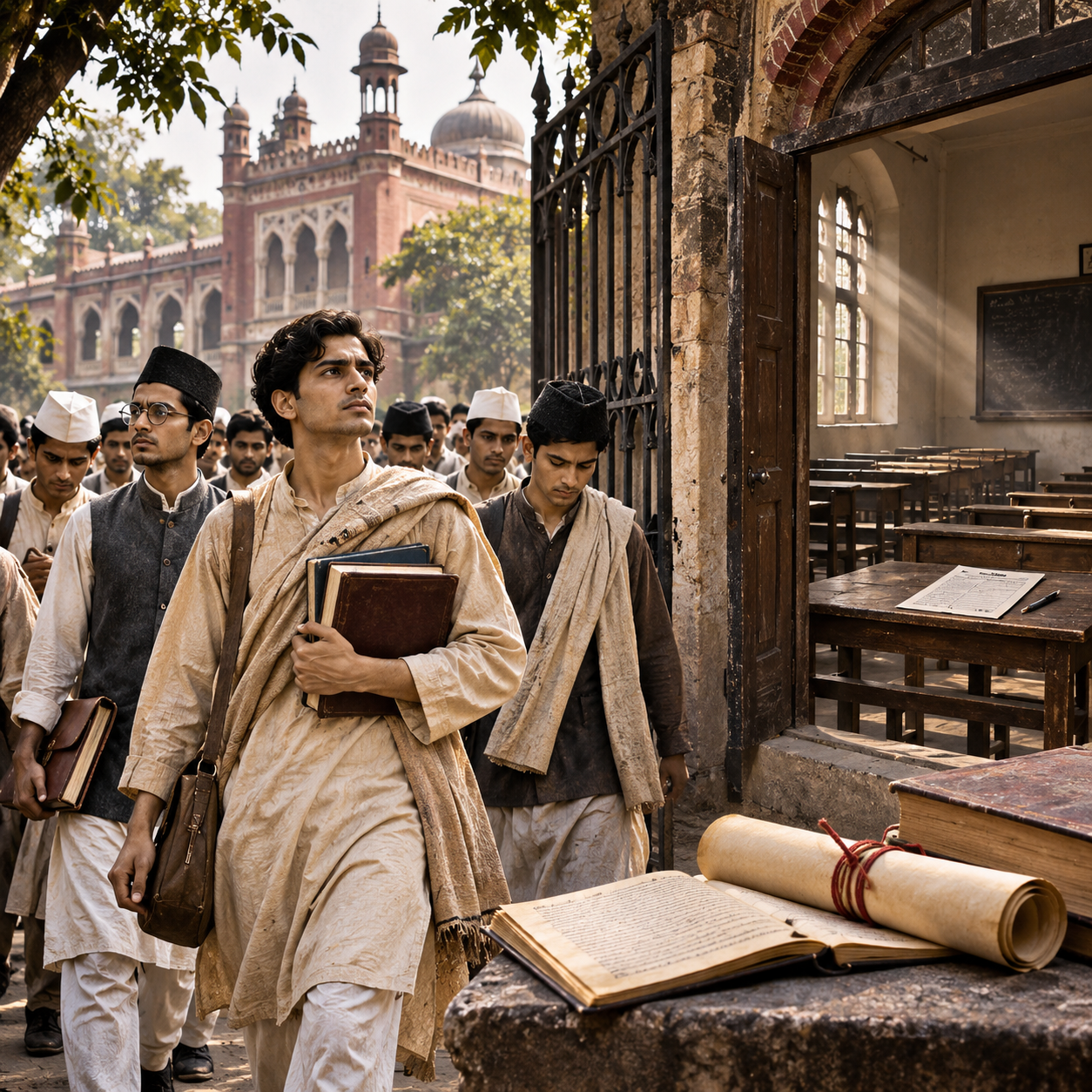
Blog 229 followed Maulana Mohamed Ali from Gandhi’s Khilafat partner and Congress President to the man who ranked Gandhi below “any Musalman” in religion — a ranking Gandhi accepted in print on 10 April 1924, effectively conceding religious precedence over his own Hindu fold to an exclusivist creed. Two years earlier, at his March 1922 sedition trial, Gandhi had pleaded guilty to the movement’s consequences in court while leaving the rank-and-file who obeyed his 1920 boycott call without a plan. In October 1920 that same Mohamed Ali had stood beside Gandhi at Aligarh, calling on students to walk out of their college. This instalment follows the students, not the leaders: Gandhi’s Student Boycott began with the Aligarh walk-out of October 1920, and the young men who answered it — at Aligarh and across India — paid with their education and their careers. The men who went to jail in the same movement were later honoured as freedom fighters. The students who walked out were never counted at all.
Thank you for reading this post, don't forget to subscribe!THE WALK-OUT RECORD: 1920–1980
The Action Taken: In 1920 Gandhi called on students to empty government-controlled schools and colleges and to take no thought of their careers. At Aligarh in October 1920 the college refused to give up its government grant, and teachers and students walked out to found Jamia Millia Islamia on 29 October. Across India thousands followed — roughly nine thousand in the first month alone, entering some eight hundred hastily founded national institutions. In February 1922 Gandhi called the movement off.
Who Paid the Price: The students. They gave up examinations, degrees and the careers those degrees would have opened. When the movement ended, those who could went back to government colleges and lost years; the rest carried certificates from national schools into a world that ran on government degrees. When free India came to honour its freedom fighters, it honoured those who had been jailed, dismissed from Government service, or wounded. It made no provision for a student who had walked out of college on Gandhi’s call.
Why This Matters: The educational boycott asked the most of the youngest. They made the sacrifice Gandhi asked for, in the form he asked for it — and it was the one sacrifice of the movement that no one ever counted, recognised or repaid.
1. The Call: “Take No Thought of Their Careers” — After Two Prior Pull-Outs
The boycott of government-controlled schools and colleges was one of the central items of the 1920 programme, and it was addressed to the young. The editors of Gandhi’s own Collected Works summarise his message plainly: he called upon students to empty those institutions and take no thought of their careers (CWMG, Vol. XIX, introduction).
What makes that call an act of calculated recklessness is what Gandhi had already done twice before—and would do again:
- Two prior plug-pulls on record: In the Ahmedabad Mill Strike (1918) and the Rowlatt Satyagraha (April 1919), Gandhi had already demonstrated his operating rule—mobilizing ordinary people into high-stakes confrontation and abruptly halting or settling the campaign on his own unilateral terms, leaving the rank-and-file to absorb the fallout.
- The Aligarh test (October 1920): Knowing he retained that unilateral veto—and soon entering private talks with Viceroy Lord Reading at Simla in May 1921, where Reading recorded Gandhi’s assurance that he would ensure the movement stayed contained within non-violent bounds—Gandhi, with Mohamed Ali and Shaukat Ali, pressed the Muhammadan Anglo-Oriental College to renounce its government grant.
- The walk-out: The college authorities declined; teachers and students left, founding Jamia Millia Islamia on 29 October 1920 under Deoband theologian Maulana Mahmud Hasan (foundation stone) and Mohamed Ali (first Vice-Chancellor).
Gandhi’s Student Boycott set the pattern for the whole campaign: the leader kept full unilateral authority to pull the plug whenever he chose, while the young were instructed to burn their careers with zero safety net—the exact same model pressed upon lawyers, government clerks, and local officials across India, except that senior barristers could return to their practices after February 1922 while unaccredited students could not.
2. What the Students Gave Up
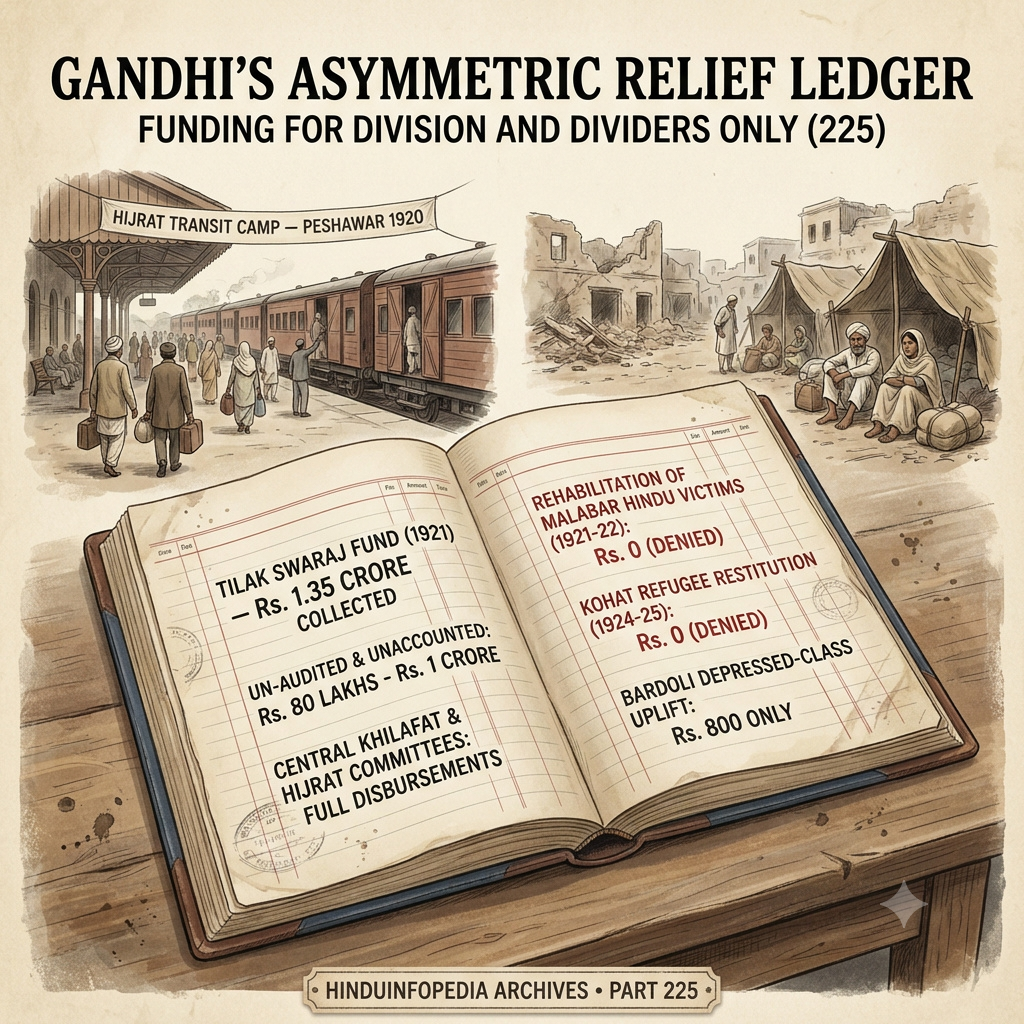
No confirmed educational outlay: Financing national education was a stated promise of the ₹1,30,19,415 collected for the Tilak Swaraj Fund in 1921 (Dr. B.R. Ambedkar, What Congress and Gandhi Have Done to the Untouchables, Ch. II). Yet Congress accounts published no confirmed national figure showing how much of that ₹1.30 crore actually went to schools and colleges when the movement halted in February 1922—leaving the 800+ provincial national institutions without endowments, buildings, or student rescue.
A few documented lives show who could recover and who could not:
- Jayaprakash Narayan (Patna College, 1921): Walked out twenty days before his examinations into Bihar Vidyapith; lacking a recognised Indian degree, he spent seven years in the United States (1922–1929) picking grapes, packing fruit in a cannery, and washing dishes to pay for college.
- Renuka Ray (Diocesan College, Calcutta, 1921): Walked out of her first-year class and donated her bangles to the Tilak Swaraj Fund—but because her father was an ICS officer, her family could send her to the London School of Economics later that year to salvage her degree.
The teachers who answered the call paid in a different coin. A lecturer or headmaster who resigned his post gave up his salary and the service that would have carried him to a retirement pension. Where the Congress could, it paid national-school teachers from its own funds—in Madras, the salaries of teachers who had renounced their posts were met from Congress money—but those funds lasted only as long as the national schools did, and most of the schools did not outlast the movement even as the unspent balance of the Tilak Swaraj Fund vanished from Congress coffers without accounting, as Dr. B.R. Ambedkar recorded. The pension the teachers walked away from was not restored by anyone.
That silence is itself the finding of Gandhi’s Student Boycott. The movement kept counts of its jailed, its funds, and its spinning wheels. No one kept a count of the students whose education it ended.
3. February 1922: The Movement Ends, the Students Are Left
On 12 February 1922, at Bardoli, the movement was suspended under Gandhi’s personal mandate, and about a month later—at his March 1922 sedition trial in Ahmedabad—Gandhi pleaded guilty to the movement’s consequences, effectively tainting every participant who had acted on his call with the same admission of guilt. For the leaders, the next step was ready: within two years many were back in the legislative councils as Swarajists. For the students there was no next step. With only a handful of national institutions able to carry on, many students and teachers drifted back to the government schools and colleges they had left, a year or more behind their classmates. Those who stayed in the national institutions held certificates that the government services, the professions and most universities did not accept.
The students had done exactly what Gandhi asked them to do. The movement that asked it was called off by one man’s decision, and it ended with no plan, no fund and no word for the young people it had pulled out of their colleges.
4. The Recognition Ledger: Who Became a Freedom Fighter
Free India answered the question of who counted. Its Freedom Fighters’ Pension Scheme of 1972, renamed the Swatantrata Sainik Samman Pension Scheme in 1980, set out who would be honoured as a freedom fighter. Its categories are the measure of recognition the state adopted:
| What the person suffered | Recognised as a freedom fighter? |
|---|---|
| Imprisonment of at least six months (three for women and SC/ST freedom fighters) | Yes |
| Underground suffering; internment at home or externment from a district for six months | Yes |
| Confiscation of property; permanent incapacitation in firing or lathi charge | Yes |
| Loss of a Government job, and with it the means of livelihood | Yes |
| Gave up examinations, degree and career by walking out of college on Gandhi’s call | No category |
The table is the verdict. A man who served six months jail term in 1921 entered the record of the freedom struggle and, half a century later, the pension rolls. A Government clerk who was dismissed for joining the movement was recognised for the livelihood he lost. A student who walked out twenty days before his examinations lost a livelihood too — the one his degree would have given him — and the scheme had no line for him. In the official memory of the struggle, jail made freedom fighters. The walk-out made losers.
Two features of the scheme closed the door further:
- Resignation is not dismissal. The “loss of Government job” category had to be proved with orders of dismissal or removal from service. A teacher who resigned his post on Gandhi’s call had no such order — he had obeyed the call, not been punished for it — and so could not use even that line.
- The movement certified itself. Where jail records were missing, a claim could be proved with certificates from co-prisoners already drawing the pension, or from a prominent freedom fighter who had served at least two years. Recognition, in other words, passed through the network of those already recognised. Whether this favoured men close to the Congress circles of the time is an inference from that design, not a finding of any official inquiry; it is stated here as such.
That is the human cost of Gandhi’s Student Boycott: the sacrifice was demanded of the young, and recognised only in the old.
Selective Institutional Protection: Jamia Rescued, Students and Kohat Left Behind
There was one rescue, and it went to an institution. In January 1925, with Jamia Millia Islamia close to shutting down, its founders considered closing it. Gandhi insisted it must go on, declaring that he would go about with a begging bowl if need be; with his support it moved to Karol Bagh in Delhi that year. He also remained Chancellor of the Gujarat Vidyapith he had founded in October 1920.
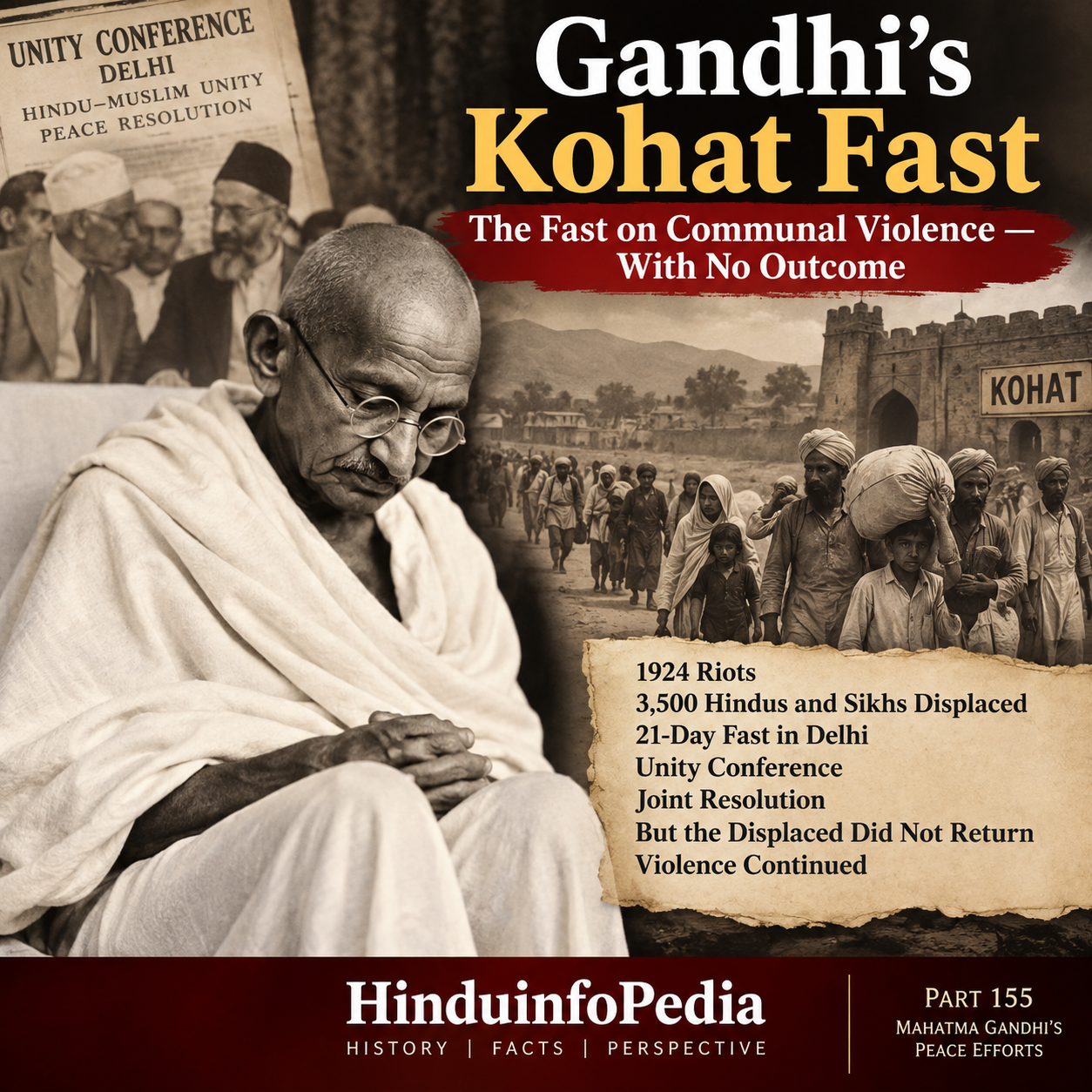
The same season shows where his concern did not reach. In February 1925, weeks after the Jamia decision, Gandhi met the Hindus driven out of Kohat at Rawalpindi and told them not to return until the Muslims of Kohat invited them back with honour (Blog 155). Institutions found a patron. People — the Kohat refugees, the students of 1921 — were left to bear their losses alone.
6. Aligarh Afterwards
The college the students walked out of went on without them—converted into Aligarh Muslim University under the Act of 1920—while the nationalist teachers and students who had walked out never returned. By the early 1940s, the campus stood wide open to Muhammad Ali Jinnah: the All India Muslim Students Federation (founded 1937) was first headed by an Aligarh student, Jinnah addressed Aligarh’s students on 12 March 1941 to enlist them as campaign workers, and at the peak of the 1945–46 elections roughly 250 Aligarh students fanned out across Punjab alone to campaign for Pakistan. Gandhi’s Student Boycott of October 1920 cleared the nationalist cadre out of Aligarh in one stroke—leaving an uncontested campus ready to be mobilized two decades later.
Invitation To Defence
Gandhi’s call to students to leave government-controlled institutions without thought of their careers (CWMG, Vol. XIX), the Aligarh walk-out and the founding of Jamia Millia Islamia on 29 October 1920, the suspension of the movement on 12 February 1922, and the eligibility categories of the Freedom Fighters’ Pension Scheme of 1972 and the Swatantrata Sainik Samman Pension Scheme of 1980 are established exhibits. The defence is invited to produce any provision made by Gandhi or the Congress, between 1922 and 1947, for students who had abandoned their education on the boycott call — a fund, a scheme of re-admission, a recognised degree, or a public acknowledgment of what they had lost.
Gandhi asked the students to empty their colleges and take no thought of their careers. They did. He called the movement off in February 1922 and left them where they stood. When free India drew up its roll of freedom fighters, it counted the jailed, the dismissed and the wounded — and had no line for the student who walked out twenty days before his examinations.
Feature Image: Click here to view the image.
Videos
Glossary of Terms
1. Khilafat Movement: A pan-Islamic political and religious movement that sought to preserve the Ottoman Caliphate and mobilised Indian Muslims during the early twentieth century.
2. Maulana Mohamed Ali: A prominent Khilafat leader who became Congress President at the Cocanada session in December 1923 and later opposed Congress’s constitutional position.
3. Shaukat Ali: Brother of Mohamed Ali and a leading Khilafat activist who worked with him to mobilise support for the movement in India.
4. Non-Cooperation Movement: A political campaign launched under Gandhi’s leadership in 1920, involving the withdrawal of cooperation from British institutions and authorities.
5. Pan-Islamic Network: A political and religious network connecting Muslims across national boundaries through shared religious and political objectives.
6. Creedal Exclusivism: A religious position in which membership of a particular creed is treated as more important than individual character or moral conduct when determining religious standing.
7. Universal Brotherhood: The principle that humanity shares a common moral and social bond irrespective of religious affiliation, reflected in the Dharmic expression Vasudhaiva Kutumbakam.
8. Ummah / Millat: Terms referring to the worldwide Muslim religious community and collective Muslim identity, respectively, as discussed in the blog’s examination of religious solidarity.
9. Vasudhaiva Kutumbakam: A Sanskrit expression meaning “the world is one family”, representing the universalist principle of human brotherhood.
10. Young India: The newspaper published under Gandhi’s editorship, in which he addressed Mohamed Ali’s religious ranking of him on 10 April 1924.
11. Yerawada Jail: The prison in Pune where Gandhi was incarcerated when Mohamed Ali was elected Congress President in December 1923.
12. Nehru Report: The 1928 constitutional proposal prepared under Motilal Nehru’s chairmanship, which became a major point of disagreement over separate electorates and minority safeguards.
13. First Round Table Conference: The constitutional conference held in London from November 1930 to January 1931 to discuss India’s constitutional future, attended by Mohamed Ali but boycotted by Congress.
14. Second Round Table Conference: The 1931 London constitutional conference attended by Gandhi, during which questions of minority representation and separate electorates became central issues.
15. Gandhi’s Khilafat Veteran Failure: The distinctive analytical phrase coined for this blog to describe the failure of Gandhi’s long-standing political partnership with the Khilafat leadership, particularly the contradiction between his acceptance of Mohamed Ali’s religious ranking and his subsequent claim of equal national representation.
#Gandhi #Khilafat #MahatmaGandhi #MohamedAli #IndianHistory #Congress #NonCooperation #YoungIndia #Ambedkar #RoundTableConference #HinduinfoPedia
Scan Through The Entire Series at