
Gandhi’s Baisakhi: 490 People Entered a Garden Never to Come Out (149)
भारत / GB
Part 149: Mahatma Gandhi’s Peace Efforts | Series Index
In the previous blog we analysed the account of Gandhi’s Khilafat Compact. This post carries no prosecution. It places the documented record of April 13 1919 before the reader — the names, the demographics, the documented facts of Jallianwala Bagh. The prosecution will follow in Blog 150. This post places only what is documented before the reader.
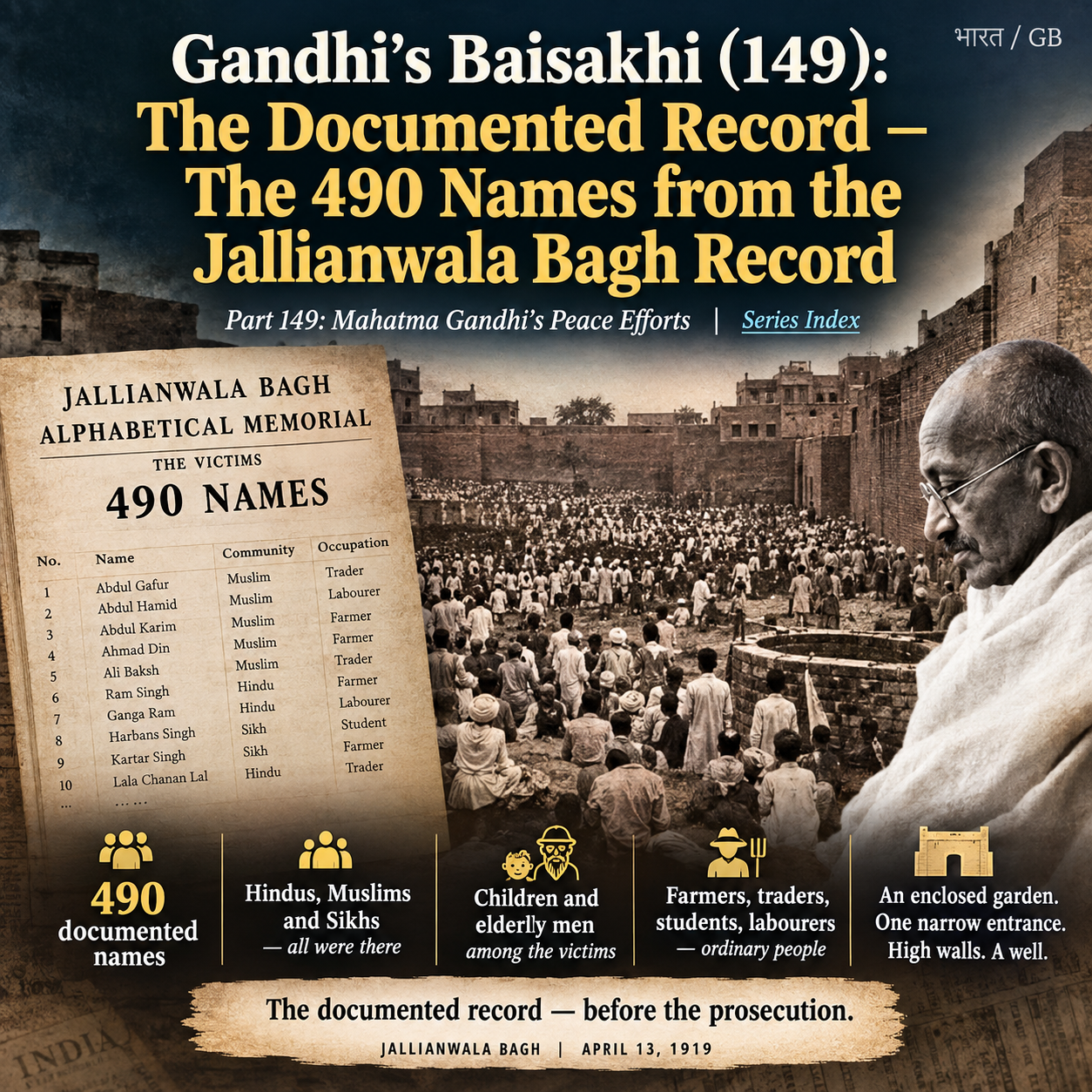
Thank you for reading this post, don't forget to subscribe!The Action Taken: On 13 April 1919 troops fired on the Baisakhi gathering in Jallianwala Bagh; Hunter recorded 379 dead, and this series lists 490 named dead.
Who Paid the Price: The civilians enclosed in the garden who did not come out.
The Alternative Bypassed: A public named accounting of the dead as part of the national record.
Why This Matters: This page is the 13 April 1919 fatality record, not the Tripuri election.
The Date
April 13 1919. Baisakhi — the documented harvest festival of Punjab, one of the most significant documented celebrations in the Sikh and Hindu calendars. Amritsar. The Jallianwala Bagh — a documented public garden enclosed on three sides by buildings, with a documented single narrow entrance.
Gandhi’s Baisakhi places the documented facts of that afternoon before the reader.
The Documented Assembly
The documented gathering at Jallianwala Bagh on April 13 1919 was mixed in its composition and documented purpose. Some had assembled to protest the documented arrest of two documented nationalist leaders — Dr. Saifuddin Kitchlew and Dr. Satya Pal — under the Rowlatt Act. Others were documented Baisakhi pilgrims who had come to Amritsar for the documented harvest festival and had gathered in the Bagh without documented knowledge of the political meeting. Others were documented local residents who had simply gathered in the documented public space.
The documented assembly was unarmed. No documented weapons were found at the scene. The documented gathering was not an armed uprising.
Dyer had issued a documented proclamation that morning forbidding public assemblies. The proclamation was announced by drum and in certain parts of Amritsar. The documented evidence placed before the Hunter Commission established that many in the Bagh — particularly village pilgrims who had arrived for Baisakhi from outside the city — had not heard the proclamation. Punjab was already under documented severe tension: the documented arrests of Dr. Saifuddin Kitchlew and Dr. Satya Pal had triggered documented riots on April 10 1919, in which documented deaths had already occurred. The documented atmosphere of April 13 1919 was one of documented administrative emergency.
Brigadier General Reginald Edward Harry Dyer arrived at approximately 5:30 PM with a documented force of 50 Gurkha and Baluchi riflemen, accompanied by 40 additional Gurkhas armed only with kukris. The documented entrance to the Jallianwala Bagh was narrow — documented accounts place it at approximately 9 feet wide. Dyer’s documented troops blocked the documented exit.
Without documented warning, Dyer ordered his troops to fire. The documented firing lasted approximately 10 minutes. The documented troops fired 1,650 rounds.
Dyer’s documented testimony before the Hunter Commission placed his own stated intent on the written record. He documented that his purpose was not merely to disperse the crowd at Jallianwala Bagh — it was to produce a documented “moral effect” across the whole of Punjab. He further documented that he would have used the two armoured cars with machine guns if they had been able to fit through the narrow entrance. The armoured cars could not fit. The machine guns were not used. This is Dyer’s own documented testimony — not the prosecution’s characterisation.
The Documented Dead
Gandhi’s Baisakhi places the documented figures before the reader precisely — acknowledging that the documented figures vary across sources and that the full documented count was never established with certainty.
The Hunter Commission — the documented official British inquiry appointed October 1919 — recorded 379 dead and approximately 1,200 wounded. The documented Congress inquiry placed the dead at a higher figure. The documented well within the Jallianwala Bagh — into which people jumped to escape the documented firing — contributed to the documented death toll. Its documented depth is on record.
The documented research published on hinduinfopedia.in has compiled 490 documented names — individuals whose documented deaths at Jallianwala Bagh have been placed on the written record from primary sources and documented accounts. The compilation is available at the series index. The prosecution places this documented figure before the reader as the documented record of named individuals — not the total dead, but the documented names.
The 490 Documented Names — Demographics
The documented dead were not a homogeneous group. The 490 documented names carry documented communal diversity — Hindu, Muslim, and Sikh. The documented Baisakhi gathering had brought pilgrims from across Punjab’s documented communities. The documented firing did not select by documented community.
The documented youngest victims: children. The documented records carry the names of boys below the age of ten among the documented dead. The documented oldest victims: elderly men who had come for Baisakhi.
The documented occupations of the dead — where recorded — carry farmers, traders, students, labourers. The documented Baisakhi gathering was not a gathering of documented political activists. It was a documented gathering of ordinary people on a documented festival day.
The Documented Physical Space
Gandhi’s Baisakhi places the documented physical record of Jallianwala Bagh before the reader. The garden was enclosed. The documented single narrow entrance — through which Dyer’s troops had entered — was blocked by the documented troops. The documented walls on three sides were high. The documented well was within the garden.
The documented bullet marks remain in the documented walls of Jallianwala Bagh. They are preserved. The documented depth of the well is documented. The documented narrowness of the entrance is documented.
The prosecution places the documented physical record before the reader without commentary: 490 documented names entered a documented enclosed space on a documented festival day. The documented exit was blocked. The documented firing lasted ten documented minutes.
The Closing Question
Gandhi’s Baisakhi places one documented question before the reader — not about Dyer, not about the British administration, not yet about Gandhi.
490 people entered a garden and did not come out alive.
The documented record of what happened next is established above.
The prosecution will place Gandhi’s documented response to this documented record before the reader in Blog 150 of this series.
The documented institutional response to the events of April 13 1919 carries two documented verdicts within the same Commission. The majority Hunter Commission report concluded Dyer had acted beyond the necessity of the case and had misconstrued his duty. The minority report — signed by the Indian members of the Commission — concluded it was a deliberate terror tactic. Dyer was relieved of his command and barred from further employment in India. He was not prosecuted. The British public and the House of Lords subsequently raised funds in his documented defence. The documented split within the Hunter Commission — between the majority’s “error of judgment” and the Indian minority’s “deliberate terror tactic” — is itself part of the documented record placed before the reader.
This post places only the documented record before the reader — and asks: what does the documented record of April 13 1919 establish as the documented foundation against which every documented response is to be examined?
Invitation To Defence
The floor belongs to the defense. We now invite them to present their exhibits and challenge the narrative established by the prosecution.
April 13 1919. Baisakhi. Amritsar. Jallianwala Bagh — enclosed, one narrow entrance, high walls, a well within. A documented unarmed gathering: protesters, pilgrims, residents. Brigadier General Dyer arrived at 5:30 PM. The exit was blocked. 1,650 rounds. Ten minutes. 490 documented names. The documented record is placed before the reader. Blog 150 will place Gandhi’s documented response alongside it.
Feature Image: Click here to view the image.
Videos
Glossary of Terms
- Baisakhi: A major harvest festival of Punjab, observed as an important festival in the Sikh and Hindu calendars. In this blog, the gathering at Jallianwala Bagh occurred on Baisakhi, April 13, 1919.
- Jallianwala Bagh: A public garden in Amritsar where a large unarmed gathering was fired upon by troops under Brigadier General Dyer on April 13, 1919.
- Hunter Commission: The official British inquiry appointed in October 1919 to investigate the events surrounding the Jallianwala Bagh firing. Its majority report criticised Dyer’s actions, while the Indian members issued a minority view describing the action as a deliberate terror tactic.
- Rowlatt Act: The British Indian legislation under which Dr. Saifuddin Kitchlew and Dr. Satya Pal were arrested, contributing to the political tension in Punjab in April 1919.
- Moral Effect: The purpose stated by Dyer in his Hunter Commission testimony for the firing, extending beyond dispersing the crowd to creating an effect across Punjab.
- Documented Record: A key phrase used throughout this series to distinguish information placed on the basis of recorded evidence, primary sources, inquiries, and documented accounts from later interpretation or argument.
- Documented Names: The 490 individual names compiled in the series research as persons whose deaths at Jallianwala Bagh have been placed on record from primary sources and documented accounts. The figure is presented as a list of named individuals, not as the definitive total number of deaths.
- Demographics: The recorded characteristics of the 490 documented individuals, including their communal background, age, occupation, and place of origin where available.
- Unarmed Gathering: The description of the Jallianwala Bagh assembly as a gathering in which no documented weapons were found and which was not established as an armed uprising.
- Kukri: A curved knife traditionally associated with Gurkha soldiers. The blog records that 40 additional Gurkhas accompanying Dyer were armed only with kukris.
- Armoured Cars: Armoured military vehicles that accompanied Dyer’s force but could not pass through the narrow entrance of Jallianwala Bagh. Dyer stated that he would have used their machine guns if they had been able to enter.
- Minority Report: The separate finding issued by the Indian members of the Hunter Commission, which characterised Dyer’s action as a deliberate terror tactic rather than merely an error of judgment.
- Error of Judgment: The characterisation used in the Hunter Commission’s majority position concerning Dyer’s conduct, contrasted in the blog with the Indian members’ description of the action as a deliberate terror tactic.
- Prosecution: The series’ analytical presentation that places documented evidence before the reader and examines Gandhi’s responses against that record. In this blog, the prosecution is deliberately limited and the principal examination of Gandhi’s response is reserved for Blog 150.
- Defence: The opposing side of the series’ prosecution-and-defence framework, invited to present its exhibits and challenge the narrative established by the prosecution.
#HinduinfoPedia #JallianwalaBagh #JallianwalaBaghMassacre #Gandhi #Baisakhi #Amritsar #Punjab #IndianHistory #History #BritishIndia #HunterCommission #Dyer #MahatmaGandhi
3) Blog Excerpt — Yoast
Gandhi’s Baisakhi places the documented record of Jallianwala Bagh before the reader: an unarmed gathering of protesters, pilgrims and residents, Dyer’s blocked exit, 1,650 rounds fired in ten minutes, and 490 documented names. The blog also examines their demographics, the physical space, the Hunter Commission’s divided findings, and the documented institutional response before Gandhi’s response is examined.
4) Meta Description
Gandhi’s Baisakhi examines Jallianwala Bagh, 490 documented names, Dyer’s firing, and the Hunter Commission record of April 13, 1919.
5) Alternative Titles
Gandhi’s Baisakhi and the 490 Documented Names | Jallianwala Bagh: 490 Names on the Record | April 13, 1919: The 490 Documented Names | Gandhi’s Baisakhi: The Jallianwala Bagh Record | Jallianwala Bagh: The Documented Record of 490 Names | 490 People Entered Jallianwala Bagh and Did Not Return | Jallianwala Bagh 1919: Names, Demographics and the Record | Gandhi and the Documented Record of Baisakhi 1919 | The 490 Names of Jallianwala Bagh | Baisakhi 1919: The Jallianwala Bagh Record
6) Short Meta Tags
HinduinfoPedia, Jallianwala Bagh, Baisakhi, Gandhi, Amritsar, Punjab, Hunter Commission, Dyer, Indian History, British India, Massacre, April 1919, Documented Record, 490 Names, documented, Gandhi, Bagh, people, names, record
Gandhi’s Peace Efforts: The Questions Before the Mahatma (0)
Refer to Various Arks Referred to in the Blog