
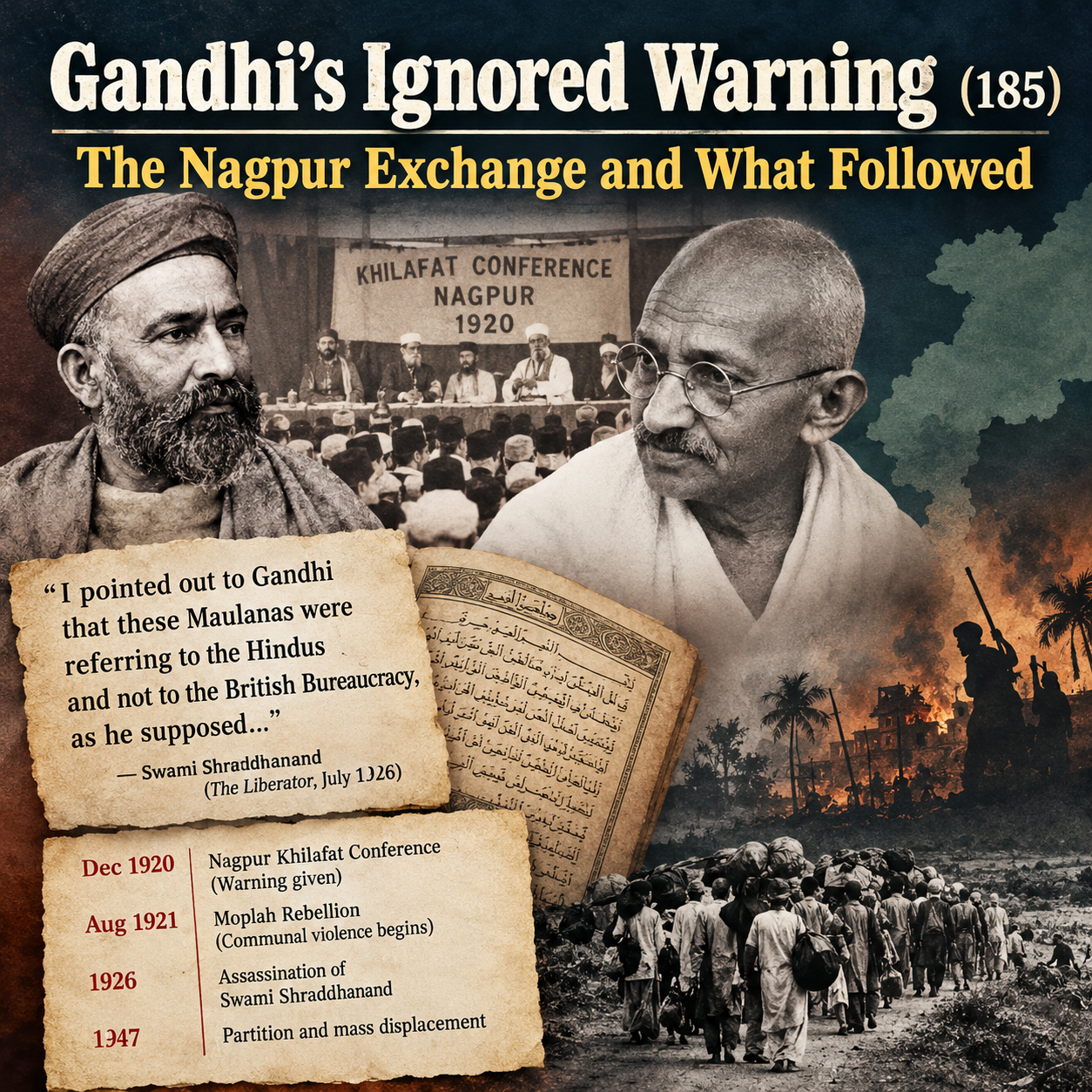
Gandhi’s Ignored Warning: The Nagpur Exchange and What Followed (185)
भारत / GB
Part 185: Mahatma Gandhi’s Peace Efforts | Series Index
The previous blog placed before the reader the baseline — the syncretic Muslim convert communities of Punjab, Agra, and Mewat; the two centuries of clerical doctrine that had failed to reach them; the organisational capacity created by the joint Khilafat–Non-Cooperation movement between 1919 and 1922; and Gandhi’s recorded refusal to examine the theological correctness of the position he was bound to help, which placed the weight of his national moral authority behind the clerical infrastructure he was institutionalising. Gandhi’s ignored warning places before the reader a single recorded exchange from December 1920: a warning given, Gandhi’s response, and what the subsequent record contains.
Thank you for reading this post, don't forget to subscribe!THE HISTORICAL RECORD — GANDHI’S IGNORED WARNING
The Pattern: The standard argument about the Khilafat alliance holds that Gandhi could not have foreseen the communal violence that followed. The primary record contains a specific, documented warning delivered to Gandhi in December 1920 — at the Nagpur Khilafat Conference — by a Hindu leader who was present, witnessed the same speeches Gandhi witnessed, and drew a different conclusion. Eight months later, the Moplah rebellion began. Six years later, the man who gave the warning was murdered. Gandhi’s ignored warning places this sequence before the reader in the order it occurred.
The Lethal Exhibit: Swami Shraddhanand, The Liberator (July 1926): “I pointed out to Gandhi that these Maulanas were referring to the Hindus and not to the British Bureaucracy, as he supposed, for the Maulanas would not refrain from using these verses against the Hindus once the feeling was reversed.” This is Shraddhanand’s account of his exchange with Gandhi at the Nagpur Khilafat Conference, December 1920, as quoted in Dr. B.R. Ambedkar, Pakistan or the Partition of India (1945). It is placed before the reader as second-hand, attributed as such. The verses Shraddhanand identified on the platform: Surah Al-Mumtahanah (60:4) · Surah At-Tawbah (9:5), the Verse of the Sword (Ayat as-Sayf) · Surah At-Tawbah (9:73) and Surah At-Tahrim (66:9) · Surah Al-Baqarah (2:190–193). Gandhi characterised them as alluding to the British Bureaucracy.
Why it matters: The exchange is in the record. The subsequent record is also in the record. The reader will assess whether the warning was material.
The Conference: December 1920
The Setting
Gandhi’s ignored warning emerges from a documented setting. Swami Shraddhanand — Hindu religious leader, Congress figure, and a man Gandhi publicly respected — attended the Khilafat Conference at Nagpur in December 1920 alongside Gandhi. Both men were present for the same speeches. Both heard the same Quranic recitations from the Maulanas on the platform.
The Exchange
Shraddhanand’s account, published in The Liberator (July 1926) and preserved in Dr. B.R. Ambedkar’s Pakistan or the Partition of India (1945, Ch. VII), records that the Maulanas recited Quranic verses containing “frequent references to Jihad and killing of the Kaffirs.” When Shraddhanand raised this with Gandhi, Gandhi’s response was: “They are alluding to the British Bureaucracy.”
Shraddhanand’s reply: “I pointed out to Gandhi that these Maulanas were referring to the Hindus and not to the British Bureaucracy, as he supposed, for the Maulanas would not refrain from using these verses against the Hindus once the feeling was reversed.”
The Attribution
This exchange is placed before the reader as Shraddhanand’s account, as quoted by Ambedkar. It is second-hand. It is attributed as such throughout. Gandhi’s ignored warning does not place it before the reader as Gandhi’s own recorded statement.
Gandhi’s Recorded Position
Gandhi’s recorded position on the theology he was institutionalising at this period is documented independently of Shraddhanand’s account. In his autobiography (Part V, Ch. XXXVI; CWMG Vol. 39, p. 358), Gandhi wrote: “I was not to examine the theological correctness of their position. I felt that if I could be satisfied that they were in earnest, and that their demands were just from their own point of view, and did not involve any moral turpitude, I was bound to help them.”
This is Gandhi’s verbatim statement. It is from the autobiography. It is his own account of his own reasoning. Gandhi’s ignored warning places it alongside Shraddhanand’s account without asserting that one explains the other. Both are in the record. The reader will assess the relationship between them.
Eight Months Later: Malabar, August 1921
The Moplah rebellion began in August 1921 — eight months after the Nagpur exchange.
The colonial administrative record — the Report of the Malabar Special Commission (1921–1922), the District Collector’s reports filed with the Madras Presidency, and the Indian National Congress Enquiry Committee Report (1921) — documents the following: between August and December 1921, Moplah insurgents killed approximately 600 Hindus; forcibly converted an estimated 2,500 Hindus to Islam; drove an estimated 30,000 Hindus from their homes in the Ernad and Valluvanad talukas; and destroyed or desecrated a number of Hindu temples. The Congress Enquiry Committee Report — compiled by Gandhi’s own movement — records these events.
The Report of the Malabar Special Commission records that the insurgents acted in the name of the Khilafat and under the religious authority of local Moplah Maulanas. The political and organisational context — the Khilafat Volunteer Corps structures, the Non-Cooperation alliance, the elevated clerical prestige Gandhi subsequently noted in Young India of 29 May 1924 (CWMG Vol. 24) — is documented in the intelligence files and the Commission’s own analysis.
Gandhi’s ignored warning notes one additional element of the administrative record. The Malabar Special Commission reported that the Moplah insurgency did not emerge spontaneously from economic grievance alone: the intelligence files documented the role of Khilafat Committee infrastructure and the Khilafat Volunteer Corps in the months preceding August 1921. The Commission’s analysis of the Ernad and Valluvanad talukas identifies the local mosque and the Maulana as the organisational units through which the rebellion was coordinated. The same clerical structure whose prestige Gandhi subsequently noted — “the movement has given a prestige to the Maulvis which they did not have before” (CWMG Vol. 24) — is the structure the Commission’s report identifies in the field.
Gandhi’s ignored warning places Malabar before the reader not as a verdict on the Nagpur exchange but as the subsequent record. The reader will assess the relationship between the warning given in December 1920 and the events of August 1921.
Gandhi’s Response to Malabar
Gandhi’s public response to the Moplah violence is documented in Young India. In an article of 8 September 1921 (CWMG Vol. 21), Gandhi attributed the rebellion primarily to economic grievances against the Hindu landlord class and to the record of British repression of the Moplahs. He did not, in this article, attribute it to the clerical mobilisation he had participated in building.
Gandhi’s 29 May 1924 observation — “The movement has given an awakening to the masses… but it has also given a prestige to the Maulvis which they did not have before” (CWMG Vol. 24) — was written after Malabar. Gandhi’s ignored warning places that observation before the reader alongside the timeline: the movement built, the prestige granted, the warning given, the rebellion occurred, and then the observation published.
The sequence is placed before the reader. The reader will assess it.
Six Years Later: December 1926
Swami Shraddhanand was murdered on 23 December 1926. His assassin, Abdul Rashid, entered Shraddhanand’s bedroom while he was ill and bedridden, and killed him. Abdul Rashid was a Muslim whom Shraddhanand had previously employed and trusted.
Shraddhanand had, between 1920 and 1926, led the Arya Samaj’s Shuddhi movement among the Malkana Rajputs of Agra — the syncretic convert community whose customary practices and ancestral identity are documented in the Agra District Gazetteers compiled by H.R. Nevill (1905–1911). This activity had attracted specific hostility from Tabligh and Tanzim figures. Fatwas naming Shraddhanand had been issued. Death threats had been documented and reported.
Gandhi’s ignored warning notes the murder not as a conclusion but as the terminus of a documented sequence: warning given at Nagpur in December 1920, rebellion at Malabar in August 1921, Shuddhi campaigns among syncretic converts from 1923 onward, fatwas and threats, murder in December 1926.
Twenty-seven Years Later: August 1947
Shraddhanand’s apprehension at Nagpur was specific: that the verses would be directed against Hindus once feeling reversed. The subsequent record extends beyond his murder. The Partition violence of August–November 1947 produced, by the estimates of the Indian government’s own relief and rehabilitation records and the Punjab Boundary Force reports, between 200,000 and 500,000 dead in the Punjab alone. Trains arrived at Amritsar, Lahore, and Wagah carrying compartments of corpses — documented in the Punjab Boundary Force operational reports, the accounts of Brigadier T.W. Rees, and the testimony collected by the Women’s Section of the Ministry of Relief and Rehabilitation, Government of India, 1948. Twelve to fifteen million people were displaced. The conversion campaigns Shraddhanand had tried to reverse among the syncretic Malkanas and Meos did not cease with his murder; the Meo population of Mewat, documented as a syncretic community in Powlett’s Gazetteer of 1878, was by 1947 a communal category, and an estimated 100,000 Meos were displaced or killed in the Gurgaon and Alwar violence of 1947 alone.
Did the Khilafat Movement and the Fatwa and the chanting of verses of Quran, including the 9.5 of Surah Towah that calls for elimination of Mushkarin or believers in multiple Gods, in Nagpur in December 1920 create energy that created the events of August 1947? The blog will not answer. The reader is required to judge for himself.
Shraddhanand warned Gandhi at Nagpur in December 1920. The reader will place that warning alongside the full terminus of the sequence it named.
The Record Before the Reader
Gandhi’s ignored warning places the following sequence before the reader:
December 1920 — Shraddhanand warns Gandhi at Nagpur that the verses being recited will be directed against Hindus once feeling reverses. Gandhi’s response: they allude to the British Bureaucracy. Gandhi’s independently documented position: he was not to examine the theological correctness of the position he was institutionalising (CWMG Vol. 39, p. 358).
August 1921 — Moplah rebellion. The Congress Enquiry Committee’s own report documents killings, forced conversions, temple destructions, and mass displacement in Ernad and Valluvanad in the name of the Khilafat.
29 May 1924 — Gandhi’s observation: “The movement has given an awakening to the masses… but it has also given a prestige to the Maulvis which they did not have before” (CWMG Vol. 24).
23 December 1926 — Shraddhanand murdered in his sickbed following fatwas and death threats provoked by his defense of syncretic converts against Tabligh campaigns.
August–November 1947 — Partition violence. The Punjab Boundary Force reports and Ministry of Relief and Rehabilitation records document hundreds of thousands slaughtered, trains arriving with compartments of corpses, fifteen million displaced, and syncretic populations like the Meos reduced to communal targets.
No document in this record contains a statement from Gandhi acknowledging the material accuracy of Shraddhanand’s warning. The primary records show the warning given, Gandhi’s recorded refusal to examine the theological principles behind the cause he was institutionalising, his dismissal of the scriptural threat as an allusion to the British bureaucracy, and the subsequent sequence through its full terminus in 1947. Gandhi’s ignored warning places these elements before the reader in the order they occurred. The reader is left to assess the relationship between them.
Invitation To Defence
The floor belongs to the defence. We now invite them to present their exhibits and challenge the record.
At Nagpur in December 1920, Shraddhanand told Gandhi that the Maulanas reciting jihad verses were referring to Hindus, not to the British Bureaucracy, and that they would not refrain from using those verses against Hindus once feeling reversed. Eight months later, the Moplah rebellion began. The Congress Enquiry Committee’s own report documented what occurred in Ernad and Valluvanad. Three years later, Gandhi observed that the movement had given the Maulvis a prestige they did not have before. Six years after Nagpur, the man who gave the warning was murdered. Gandhi’s ignored warning places this sequence before the reader.
Feature Image: Click here to view the image.
Videos
Glossary of Terms
- Gandhi’s Ignored Warning: The central phrase coined for this blog, referring to Swami Shraddhanand’s reported warning to Mahatma Gandhi at the Nagpur Khilafat Conference in December 1920 about the possible direction of religious rhetoric against Hindus.
- Nagpur Khilafat Conference: A conference held in Nagpur in December 1920, attended by Mahatma Gandhi and Swami Shraddhanand, where Quranic verses were reportedly recited by Maulanas and the exchange described in Shraddhanand’s later account took place.
- Swami Shraddhanand: A Hindu religious leader, Congress figure, and Arya Samaj reformer who advocated the Shuddhi movement and reportedly warned Gandhi about the possible implications of religious rhetoric at the Nagpur Conference.
- Khilafat Movement: A political and religious movement launched by Indian Muslims to defend the Ottoman Caliphate after the First World War. It became associated with Gandhi’s Non-Cooperation Movement between 1919 and 1922.
- Non-Cooperation Movement: A mass political movement led by Mahatma Gandhi between 1920 and 1922, encouraging Indians to withdraw cooperation from British institutions and administration.
- Maulanas: Religious scholars or clerics in the Islamic tradition. The term is used in the blog for the religious speakers who reportedly recited Quranic verses at the Nagpur Conference.
- Jihad: An Arabic-derived Islamic religious term referring to struggle or striving. In the historical account presented in the blog, it refers specifically to the religious rhetoric associated with the verses recited at the Nagpur Conference.
- Kaffirs: A term appearing in the historical quotation attributed to Swami Shraddhanand, referring to people described as unbelievers in certain Islamic theological contexts. Its meaning and usage depend on the religious and historical context.
- Surah At-Tawbah (9:5): A Quranic passage commonly known as the Verse of the Sword, cited in the blog among the verses reportedly recited at the Nagpur Conference and discussed in Shraddhanand’s warning.
- Moplah Rebellion: An uprising that began in August 1921 in the Malabar region of present-day Kerala. The blog discusses the associated killings, forced conversions, destruction of temples, and displacement documented in contemporary administrative and inquiry reports.
- Ernad and Valluvanad: Two historical talukas in the Malabar region that became important locations during the Moplah Rebellion of 1921. They are specifically mentioned in the administrative records discussed in the blog.
- Shuddhi Movement: A religious and social reform initiative associated with the Arya Samaj that sought to bring individuals and communities who had converted away from Hindu traditions back into the Hindu fold. Swami Shraddhanand was a prominent leader of this movement.
- Malkana Rajputs: A community in the Agra region whose members followed a combination of customary practices and religious traditions. They became an important focus of Swami Shraddhanand’s Shuddhi activities during the nineteen twenties.
- Syncretic Communities: Communities in which religious traditions, customs, and cultural practices from different backgrounds coexist or have historically blended. The blog uses this expression for certain communities in Punjab, Agra, and Mewat.
- CWMG (Collected Works of Mahatma Gandhi): The published collection of Mahatma Gandhi’s writings, speeches, letters, and other documented material. The blog uses references to specific volumes and pages to establish Gandhi’s recorded positions.
- SEO Hashtags
#Gandhi #MahatmaGandhi #IndianHistory #SwamiShraddhanand #KhilafatMovement #NonCooperation #MoplahRebellion #Malabar #IndianFreedomStruggle #Partition #History #HinduHistory #HinduinfoPedia
Scan Through The Entire Series at
Refer to Various Arks Referred to in the Blog