

Gandhi’s Khilafat Bomb: The Restraint That Was Lifted (177)
भारत / GB
Part 177: Mahatma Gandhi’s Peace Efforts | Series Index
Blog 176 placed before the reader the method without a ceiling — the structural reproduction of Gandhi’s mobilisation techniques in independent India, where the colonial ceiling that once contained escalation no longer applies. Beginning with this blog we will discuss the Khilafat Bomb Arc: a multi-part forensic sequence examining the the need for it and mechanism Gandhi built, the financing and foreign collaboration, the components he assembled, the detonation he produced, and the structural legacy that followed. This post — the first in that sequence — does not begin with the explosion. It begins with what had been holding the charge in check. Two ceilings existed. The primary ceiling was Gandhi himself: in 1922, at the peak of the Non-Cooperation movement, he suspended the entire agitation unilaterally after Chauri Chaura — pulling back a mobilised nation from the edge at the moment of maximum pressure even against the opposition of all renowned Congress leaders; in 1931 he negotiated the Gandhi-Irwin Pact and called off Civil Disobedience when the movement was at flood; in 1942 he launched Quit India and was immediately arrested, after which the movement collapsed into leaderless suppression. Each suspension was Gandhi’s own hand on the brake. The secondary ceiling was the colonial state — reactive, not structural: Moplah 1921 contained only after foreign press coverage forced acknowledgment; the 1942 crackdown effective only because Gandhi’s arrest removed the organising intelligence — and because Gandhi’s own prior suspensions had already handed the British the lathi licence and the template, as Blog 32, Blog 33 and Blog 41 placed before the reader. In Malabar, neither ceiling operated in time. The Khilafat mobilisation released a charge Gandhi could not call back and the colonial state could not contain before it became a civil war. This post, Gandhi’s Khilafat Bomb, asks what happened when Gandhi’s Khilafat bomb — the restraint lifted — detonated the charge that had been building for 129 years.
Thank you for reading this post, don't forget to subscribe!THE HISTORICAL RECORD — THE RESTRAINT THAT WAS LIFTED
The Pattern: Before the British arrived in Malabar, an agrarian tension between Hindu landholders and Moplah Muslim cultivators was held in check by a governing structure: the Muslim sovereign above both communities imposed a ceiling on extraction and eviction. British codification of land law removed that sovereign and replaced it with colonial courts that enforced Hindu landlord title without appeal. Gandhi’s Khilafat alliance then told the Moplah community that the sovereign restraint was returning — not as a democratic republic, but as the restored authority of the Caliph. The Moplah Khilafat Raj of 1921 was not a spontaneous outbreak. It was the logical local enactment of what the mobilisation had promised. Gandhi’s Khilafat bomb — the restraint lifted — was Gandhi legitimising extra-territorial theocratic authority while providing zero mechanism to govern the forces he unleashed.
The Lethal Exhibit: Ali Musliyar and Variankunnath Kunjahammed Haji did not petition for tenancy reform. They proclaimed an independent Khilafat Raj. They issued passports, appointed revenue collectors, established Sharia courts, and targeted the Jenmis — not merely for rent arrears, but as infidel subjects whose colonial protection had expired. Conversion, expulsion, or execution became the administrative currency of the new state. The William Logan Commission of 1881–82 had already documented the agrarian pressure cooker that British land law had created. Gandhi’s alliance provided the detonator.
Why it matters: The prosecution does not dispute that agrarian grievance existed in Malabar. It disputes the claim that agrarian grievance was the cause of the Khilafat Raj. A community does not issue passports and establish Sharia courts to resolve a tenancy dispute. It does so when it believes sovereign authority has been restored to it. The Khilafat mobilisation supplied that belief. Gandhi’s Khilafat bomb — the restraint lifted — places this sequence before the reader.
The Pre-British Equilibrium
The agrarian structure of 18th-century Malabar was shaped by rigid customary tenures. The Jenmis — primarily Namboodiri Brahmin and Nair Hindu landholders — held ancestral rights (janmam), while the cultivators, including a large proportion of Moplah Muslims, worked the land as Kanamdars and Verumpattakkars (tenants-at-will). The Kanamdars held customary mortgage leases and included wealthier Moplah and Nair families; the Verumpattakkars — simple tenants with no security of tenure — were overwhelmingly poor Moplah and lower-caste Hindu cultivators. Both were subject to the Jenmi’s power to adjust terms, execute evictions, and levy over-leases.
The tension was real. The prosecution does not dispute it.
What disrupted and checked this landlord supremacy in the late 18th century was the military intervention of the Mysore Sultanate. Under Hyder Ali and Tipu Sultan (1766–1792), the sovereign’s authority and sword aligned against the Jenmis. High revenue demands and sovereign confiscations broke the landlord monopoly; Jenmis fled in thousands to the south, while the cultivating peasantry found royal backing against historical extraction. For a generation, the tenantry saw that sovereign power could override the Jenmi.
The prosecution places this disruption before the reader not to romanticise Mysore’s rule — which was drastic, violent, and brief — but to establish what the Moplah cultivator’s living memory held when the British arrived: that a Muslim sovereign’s sword had once broken the landlord’s decree. Gandhi’s Khilafat bomb — the restraint lifted — is a precise claim, not a rhetorical one. To understand what was removed, the reader must first understand what it had once done.

The Colonial Legal Rupture
The Treaty of Seringapatam in March 1792 ended Tipu Sultan’s control over Malabar and transferred the territory to the British East India Company. The sovereign who had suppressed the landlords was displaced by a colonial state that interpreted customary janmam through the lens of absolute English freehold.
The Jenmi’s power to hike customary dues, execute melcharths (ousting existing tenants by leasing over their heads), and enforce summary evictions was codified by Company courts. For the first time, the landlord’s power over the Moplah cultivator was backed by a written legal instrument that colonial courts would enforce without appeal to any higher sovereign authority — and without the sovereign sword that had once broken it.
When the William Logan Commission surveyed the province in 1881–82, it documented that ninety years of this judicial property regime had turned South Malabar into an agrarian pressure cooker. By 1921, that pressure had accumulated for 129 years — British statutory law backing the landlord’s decree, entirely severed from the sovereign intervention that had once overridden it.
The prosecution places the Logan Commission before the reader as primary evidence: the agrarian grievance that preceded the 1921 explosion is in the documented record. The Commission named it in 1882. What the Commission could not have documented, writing ninety years into the dispossession, was what would be done with that grievance four decades later.
The Khilafat Spark: The Promised Restoration
On 18 August 1920, Gandhi and Shaukat Ali arrived in Calicut and addressed a mass rally of 15,000 to 20,000 at Vellayil beach, launching the joint Non-Cooperation and Khilafat movement. The stated objectives were Indian self-rule and the restoration of the Ottoman Caliphate. The political vocabulary Gandhi chose to frame the movement was the vocabulary of Islamic sovereignty under threat and requiring restoration.
The Moplah cultivators of Malabar did not receive this message through the lens of Western constitutional satyagraha. They received it through the lens of their specific, documented history: a community that had lived under a sovereign whose authority aligned with their own, seen that sovereign removed and replaced by a foreign crown whose courts enforced the landlord’s decree against them, and had carried the pressure of that dispossession for 130 years.
The Khilafat message told them the foreign crown’s legitimacy was ending. The sovereign authority of the Caliph — the legitimate Islamic ruler whose departure had left them exposed — was to be restored. Regional ulema across Ernad and Walluvanad declared from their pulpits that the British Empire was finished. As trial records in Case No. 7/1921 documented, rebel leaders proclaimed openly across South Malabar: “The British Raj has ended, and the Khilafat Raj has begun. Pay no more taxes to the Sarkar; the land now belongs to the Khilafat.” In Tirurangadi, following the flight of colonial officials, Ali Musliyar was formally proclaimed leader, Khilafat flags were raised over police stations, and as contemporary court proceedings recorded: “Ernad and Walluvanad are declared Khilafat Kingdoms, and no authority remains save that of the Khilafat and the Sharia.” When the Khilafat committees formed in Malabar, they functioned as shadow administrative councils. When the British apparatus showed signs of hesitation under mass agitation, the community reached the only logical conclusion the mobilisation had prepared them for: the interregnum was over, and the historical sovereign check was back.
For the Moplah cultivator, the cause of Khilafat was not an abstraction about Ottoman succession. It was the promise of Islamic sovereign authority restored — the one governing force that had historically stood between him and the Jenmi’s unchecked power over his land, his tenancy, and his survival. The restoration of that authority was not incidental to the movement’s appeal in Malabar. It was the movement’s entire local meaning.
Gandhi’s Khilafat bomb — the restraint lifted — at the precise moment he provided the Moplah community — reinforced directly from local pulpits by leaders including Ali Musliyar, whose sermons at Tirurangadi declared British authority extinguished and the Caliph’s sovereignty operative over the soil — with the belief that the sovereign’s return was imminent. He provided no parallel mechanism to govern what that belief would produce when it encountered 129 years of suppressed agrarian grievance.
The Khilafat Raj Enacted
The Moplah uprising that began in August 1921 in Malabar was not an agrarian strike. Ali Musliyar and Variankunnath Kunjahammed Haji did not organise a rent boycott or a tenancy reform petition. They proclaimed an independent Khilafat Raj.
The administrative acts of the Khilafat Raj are in the documented record. Passports were issued under its authority. Revenue collectors were appointed. Sharia courts were established to adjudicate disputes. Administrative zones were demarcated.
The Jenmis — the Hindu landholders — were addressed not as landlords against whom tenancy grievances existed, but as infidel subjects whose colonial protection had expired with the British crown’s legitimacy. The classical terms of medieval Islamic conquest were imposed: conversion, submission to dhimmi status, or death.
The prosecution places this administrative record alongside the agrarian grievance. Logan’s 1882 Commission documented tenancy dispossession. The Khilafat Raj of 1921 did not issue a tenancy reform order. It issued passports. The distance between those two responses is the distance between an agrarian grievance and a sovereignty claim. The agrarian grievance was real and documented. The Khilafat mobilisation converted it into a sovereignty claim by telling the community that the sovereign authority they had lost was returning — and that they were its local arm.
Gandhi’s “brave God-fearing men” characterisation of the Moplah perpetrators, and his attribution of the violence to British misrule and colonial agrarian tensions, follows from the same logic that produced the violence itself: the Khilafat alliance was worth more to his programme than the accounting. Gandhi’s Khilafat bomb — the restraint lifted — names what he actually did. The characterisation he offered after the fact names what he chose to say about it.
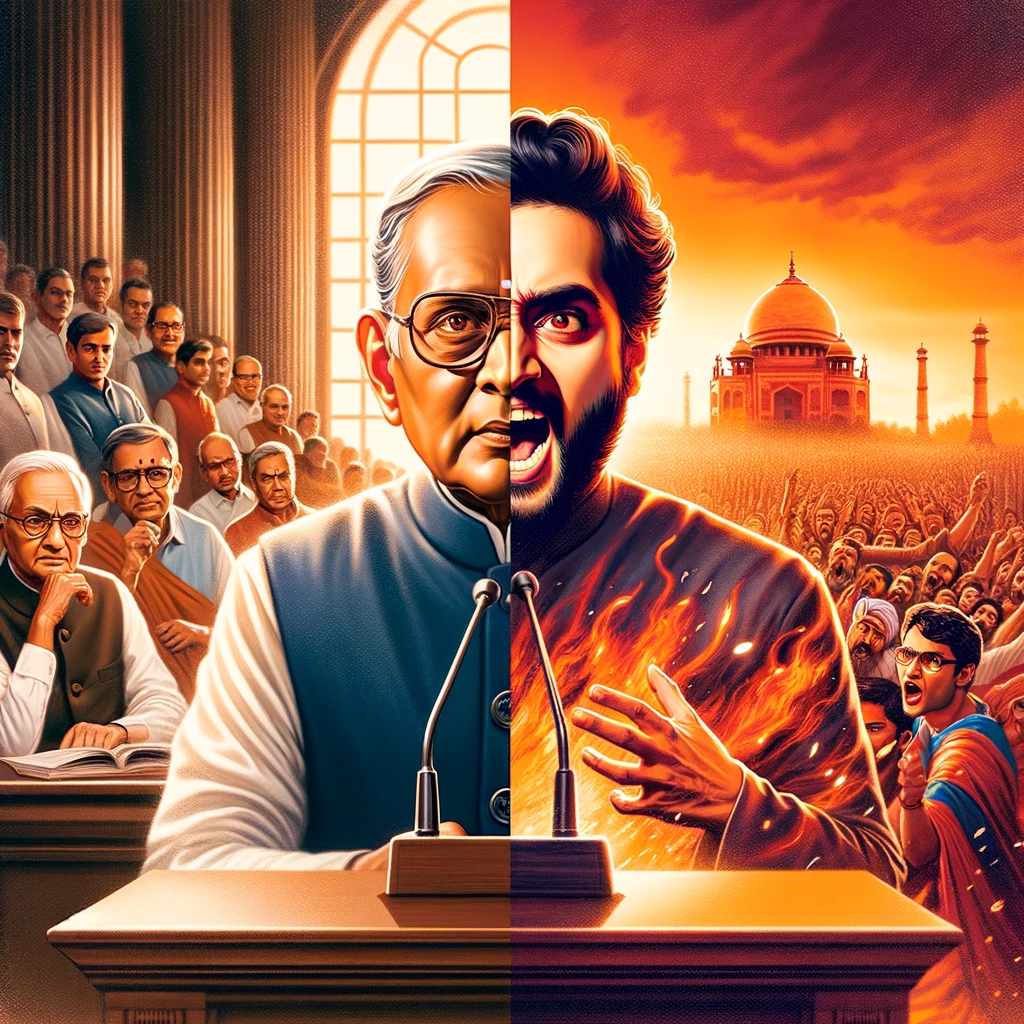
The Prosecution’s Position
Three questions now stand before the reader.
- Does the sequence — Mysore Sultanate sovereign check on Jenmi extraction removed by the Treaty of Seringapatam 1792; British courts codifying Jenmi freehold and enforcing summary eviction without appeal; Logan Commission 1882 documenting 130 years of suppressed agrarian dispossession; Gandhi and Shaukat Ali arriving in Calicut in August 1920 with a mobilisation message that the legitimate sovereign authority was returning — constitute an exhibit the reader places alongside the claim that the Moplah uprising of 1921 was a spontaneous agrarian explosion with no connection to the Khilafat alliance Gandhi had built and led?
- Does the administrative record of the Khilafat Raj — passports issued, Sharia courts established, revenue collectors appointed, infidel subjects identified, classical conquest terms imposed — constitute an exhibit the reader places alongside the claim that the Moplah violence was a tenancy dispute that turned violent, rather than a sovereignty enactment that the Khilafat mobilisation had told the community was both legitimate and imminent?
- Does Gandhi’s response — “brave God-fearing men,” “The British government is mainly responsible for the Moplah outbreak. It has kept the Moplahs in total ignorance,” non-violence preached to the Hindus and freedom fighters, the Khilafat alliance protected from accountability — constitute an exhibit the reader places alongside the three-move template the prosecution has documented running without modification from Malabar 1921 to Murshidabad 2024?
The series does not answer. Gandhi’s Khilafat bomb — the restraint lifted — places the mechanism before the reader: the pre-British equilibrium, the colonial legal rupture, the Khilafat restoration promise, and the Khilafat Raj enacted. The reader will place the founding exhibit alongside the template it established — and complete the sentence.
Invitation To Defence
The floor belongs to the defense. We now invite them to present their exhibits and challenge the narrative established by the prosecution.
The Mysore Sultanate imposed a sovereign ceiling on Jenmi extraction. The Treaty of Seringapatam removed it. British courts codified Jenmi freehold and enforced summary eviction for 130 years. Logan documented the pressure cooker in 1882. Gandhi arrived in Calicut in August 1920 and told the Moplah community the legitimate sovereign authority was returning. Ali Musliyar and Variankunnath Kunjahammed Haji proclaimed a Khilafat Raj — issuing passports, establishing Sharia courts, imposing the terms of conquest on Hindu subjects. Gandhi called them brave God-fearing men and blamed the British. Gandhi’s Khilafat bomb — the restraint lifted — places the mechanism before the reader. The reader will complete the sentence.
Feature Image: Click here to view the image.
Videos
Glossary of Terms
- Khilafat Movement: A political and religious movement launched to defend and restore the Ottoman Caliphate, which Gandhi joined with the Non-Cooperation Movement in nineteen twenty.
- Khilafat Raj: The independent political authority proclaimed by rebel leaders in Malabar during the nineteen twenty-one uprising, described in the blog through administrative acts such as issuing passports and establishing Sharia courts.
- Moplah Rebellion: The uprising that began in Malabar in August nineteen twenty-one, involving Moplah Muslims and marked by agrarian conflict, political mobilisation, and violence.
- Malabar: A historical region on the southwestern coast of India, central to the blog’s account of the agrarian tensions and the Khilafat mobilisation.
- Jenmi: A traditional landholder in Malabar who possessed hereditary land rights and exercised authority over tenants under the customary agrarian system.
- Kanamdar: A cultivator or tenant holding land under a customary mortgage-lease arrangement in Malabar.
- Verumpattakkar: A tenant-at-will who cultivated land without secure tenure and could face eviction under the traditional landholding system.
- Janmam: The hereditary landholding right associated with Jenmi ownership in the traditional agrarian system of Malabar.
- Melcharth: A practice in which a landlord leased land over the head of an existing tenant, potentially resulting in the tenant’s eviction.
- William Logan Commission: The commission associated with William Logan that examined Malabar’s land tenure and agrarian conditions in eighteen eighty-one to eighteen eighty-two.
- Treaty of Seringapatam: The treaty signed in March seventeen ninety-two that ended Tipu Sultan’s control over Malabar and transferred the region to the British East India Company.
- Extra-territorial Theocratic Authority: A form of religious-political authority whose claimed legitimacy extends beyond the territory of a particular state; the blog uses this concept to describe the authority associated with the Ottoman Caliphate.
- The Restraint That Was Lifted: A key phrase in the blog’s title, referring to the removal of restraints that the author argues had previously limited political escalation in Malabar.
- Gandhi’s Khilafat Bomb: A phrase coined in the blog to describe the author’s argument that Gandhi’s Khilafat alliance helped release political forces that culminated in the Malabar uprising.
- Non-Cooperation Movement: The mass political movement launched under Gandhi’s leadership to oppose British rule through non-cooperation, linked in nineteen twenty with the Khilafat campaign.
#Gandhi #Khilafat #Malabar #Moplah #IndianHistory #BritishRule #FreedomStruggle #GandhiHistory #HinduHistory #HinduinfoPedia
Scan Through The Entire Series at
Refer to Various Arks Referred to in the Blog