
Gandhi’s 1942 Proof: What the Uprising Demonstrated — and Who Read It (41)
भारत / GB
Part 41: Mahatma Gandhi’s Peace Efforts | Series Index
Blog 40 placed three pillars and a guilty plea before the reader — the pattern that either represents the most consistent political failure in the history of the independence movement, or something else. This post avoids naming the ‘something else’—it simply documents the record. It documents the event that demonstrated it most precisely — and the conduct of the administration that read the demonstration correctly. Gandhi’s 1942 Proof is not an assertion. It is the documented record of what August 1942 showed, who saw it, and what they did with the information.
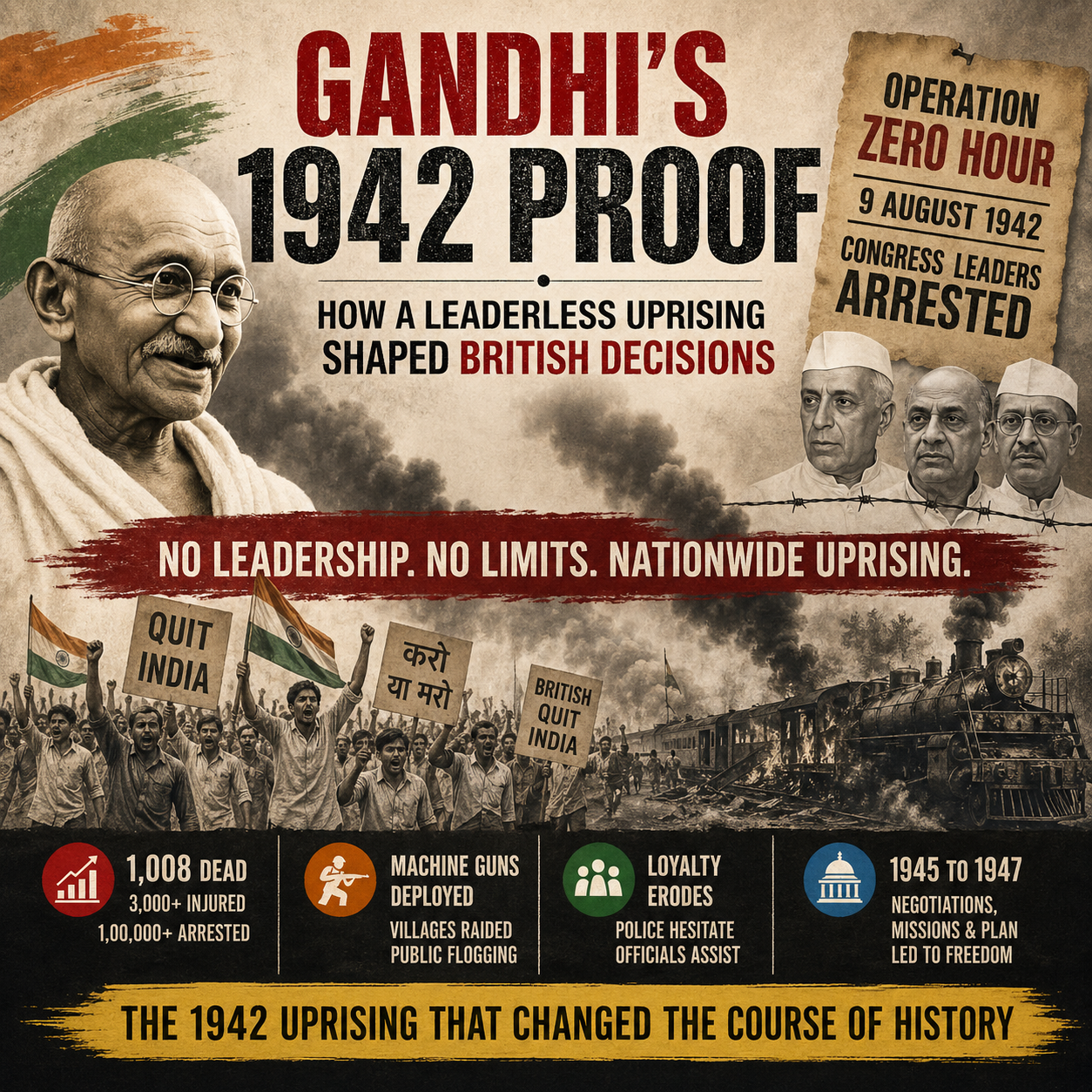
Thank you for reading this post, don't forget to subscribe!The Action Taken: Following the pre-dawn arrest of Gandhi and the CWC on August 9, 1942, an unled, spontaneous mass uprising paralyzed British rail and communication networks across Bihar and UP.
Who Paid the Price: Over 1,008 citizens killed and 3,275 injured under military suppression without coordinated central tactical command.
The Alternative Bypassed: Preparing a pre-arranged decentralized leadership cadre with an explicit contingency action plan.
Why This Matters: Proved that popular resistance possessed spontaneous offensive energy, while colonial authorities recognized that leaderless uprisings could be suppressed with maximum military force.
The Movement Gandhi Did Not Lead
Gandhi’s 1942 Proof begins on August 8, 1942, when Gandhi delivered his Do or Die speech at Gowalia Tank Maidan in Bombay. Before dawn on August 9, Operation Zero Hour arrested him, Nehru, Patel, and the entire Congress Working Committee. By sunrise the independence movement was decapitated.
The British expected the movement to collapse. It did not.
What followed was the most violent mass uprising in India since 1857. Students, workers, peasants, and ordinary Indians who had never participated in a Gandhian campaign took to the streets. They had no leaders. They had no organisation. And they had no ceiling.
The absence of the ceiling is the operative fact. Every Gandhian movement had been bounded — by Gandhi’s moral framework, by his authority to stop it, by the British administration’s knowledge that it would stop before becoming ungovernable. That knowledge had constrained British force across twenty-two years. Without the ceiling, there was nothing to constrain. The uprising could go anywhere. The British did not know where it would stop — because there was no one to stop it.
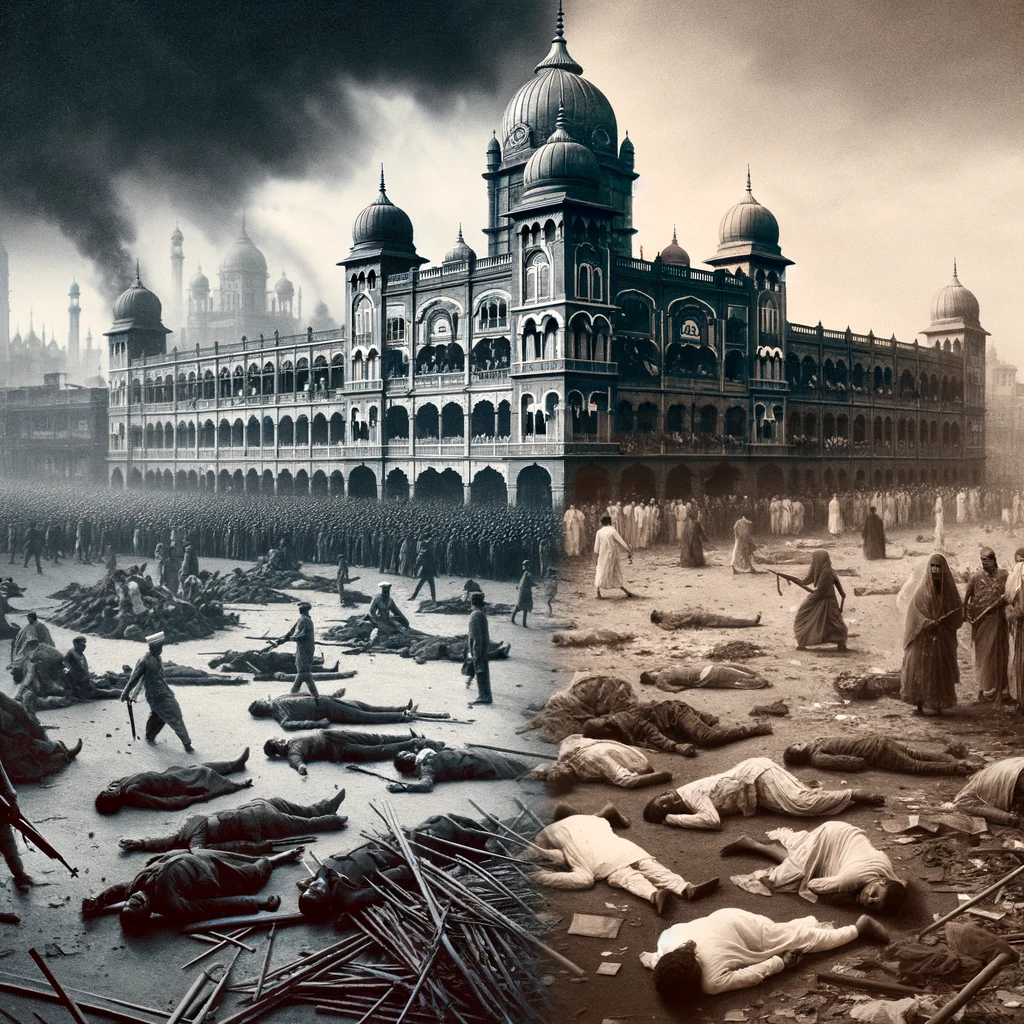
The British suppressed it with documented force. Per the Secretary of State for India’s own figures — the colonial government’s own account — 1,008 people were killed and 3,275 seriously injured between August 9 and November 30, 1942. Over one lakh were arrested. Villages were raided. Public floggings were carried out. The movement was largely crushed within six weeks.
The British suppressed it with documented force, including machine-gun fire from aircraft and ground troops using weapons such as the Bren and Vickers.
The demonstration begins here — not with Gandhi’s leadership of the uprising, but with his absence from it.
What the Uprising Demonstrated
The 1942 uprising demonstrated one thing with more precision than any Gandhian campaign had managed across twenty-two years: what India without Gandhi’s ceiling looked like.
The series has documented across eleven blogs what Gandhi’s ceiling meant for the British administration — the information it provided, the confidence it gave, the licence it issued. The ceiling told the British that Gandhi’s movements would stop before becoming ungovernable. That knowledge had constrained British force, bounded their calculations, and made the independence movement manageable.
The erosion of loyalty among Indian police and civil servants during 1942 — documented in British administrative reports — signaled something the colonial administration had not faced in the Gandhian period: the possibility that the institutional machinery itself might not hold. Local police refused orders. Lower-level administrators provided shelter to activists.
The movement had penetrated the apparatus in a way Gandhi’s ceiling managed campaigns had not, precisely because it had no ceiling the apparatus could plan around.
This was India without Gandhi. Ungovernable. Costly. Unpredictable. The most expensive six weeks of British rule since 1857.
Who Read It — and What They Did
Gandhi’s 1942 Proof was not read only in London. It was read in every British administrative calculation about India from 1943 to 1947.
The Attlee government that took office in July 1945 inherited the 1942 demonstration as part of its briefing on India. The Labour Party had committed to Indian independence in its manifesto. But the form and terms of that independence — who to transfer power to, on what institutional basis, through which political vehicle — were decisions the Attlee government had to make with the 1942 record in front of them.
The 1942 record showed two things simultaneously. First: India without Congress leadership was ungovernable in a way that made continued British rule militarily and economically unviable. The war had already bankrupted Britain. A second 1942 was not affordable. Second: India with Gandhi and Congress managing the independence movement was administrable — costly in political terms, but bounded, predictable, ceiling-enforced.
The Attlee government transferred power to the Congress. Not to the revolutionary movement — which had maintained pressure across two decades and whose leaders had been hanged. Not to the INA — whose soldiers had fought the British Army and whose trial in 1945 had shown the depth of Indian military sentiment. Not to the leaderless crowds of 1942 — who had demonstrated the cost of ungoverned resistance. To the Congress. To the framework Gandhi had built and Gandhi had controlled. To the institution whose ceiling the British administration had read from twenty years of torches.
Gandhi’s 1942 Proof is the documented record of that choice. The British chose the partner whose movements they could manage over the forces they could not. The transfer of power in 1947 was structured to preserve British institutional interests — the Commonwealth relationship, the administrative framework, the economic architecture. Blog 39 documented what that structure preserved. This post documents why the British chose the partner who made that structure possible.
The Conduct That Speaks
The documented conduct does not rest on any private conversation. It does not require a disputed quote or a secondhand attribution. It rests on documented British conduct across five years — 1942 to 1947.
The British administration suppressed the 1942 uprising with maximum force — because it had no ceiling. They released Gandhi from jail in May 1944 on health grounds — before he had served his sentence, before any political concession had been made, before any negotiation had concluded. They negotiated the Simla Conference of 1945 with Gandhi and Congress at the table. They invited Congress to the Cabinet Mission of 1946. They structured the transfer of power through the Mountbatten Plan of 1947 as a Congress-League settlement — the two parties Gandhi’s framework had produced as the legitimate political interlocutors of Indian independence.
At no point in this sequence did the British choose the revolutionary movement, the INA, the 1942 leaderless uprising, or any of the forces that had demonstrated resistance without Gandhi’s ceiling. They chose Gandhi’s framework — consistently, across every decision point from 1943 to 1947.
The series does not assert why. It places the conduct before the reader.
An administration chooses the partner whose movements it can manage. The British chose Gandhi’s Congress. The 1942 uprising had shown them what the alternative looked like. They had suppressed the alternative with 1,008 documented deaths (potentially 4,000–10,000). They released Gandhi before his sentence was complete.
Gandhi’s 1942 Proof is the name for what that sequence demonstrates — documented, dated, on record — about the relationship between the British administration and the man whose ceiling had been their most reliable planning instrument for twenty-two years.
The Series’ Position
Gandhi’s 1942 Proof does not claim Gandhi was a British agent. It claims the documented conduct of the British administration — across 1942, 1944, 1945, 1946, and 1947 — is consistent with the relationship between a colonial administration and the political actor whose consistent choices had made the independence movement manageable.
Blog 40 placed the mask question before the reader — the pattern that is either the most consistent political failure in history or something else. Gandhi’s 1942 Proof is the piece of documented evidence that sits closest to naming the something else — without naming it.
The British suppressed India without Gandhi with maximum force. They still found it ungovernable. They released Gandhi before his sentence was complete. They transferred power through his framework. They called him the greatest citizen of India.
An asset is defined not by its label but by its function. The series places the function before the reader. The reader will apply the definition.
The 1942 uprising showed the British what India without Gandhi’s ceiling cost — 1,008 documented deaths, six weeks of the most serious rebellion since 1857, institutional loyalty eroding at every level. The British response: suppress the uprising, release Gandhi before his sentence ended, transfer power through his framework, call him the greatest citizen of India. The documented sequence is not a verdict. It is the record the reader will complete.
Feature Image: Click here to view the image.
Videos
Glossary of Terms
- Gowalia Tank Maidan: A historic ground in Bombay where Mahatma Gandhi delivered the “Do or Die” speech on August eight, nineteen forty two.
- Operation Zero Hour: The pre-dawn British action on August nine, nineteen forty two, arresting Congress leadership to neutralize the movement.
- Do or Die Call: Gandhi’s directive urging Indians to act decisively for independence during the Quit India Movement.
- Quit India Movement: A mass protest launched in nineteen forty two demanding an immediate end to British rule in India.
- Gandhi’s Ceiling: A term used in this series to describe the implicit limits Gandhi’s leadership placed on movements, keeping them bounded and predictable.
- Leaderless Uprising: The spontaneous nationwide protests after arrests of leaders, lacking central command or coordination.
- Colonial Administration: The governing system established by Britain to control India before independence.
- Administrative Loyalty Erosion: The weakening of support among Indian police and officials toward British authority during the uprising.
- Attlee Government: The British government led by Clement Attlee from nineteen forty five, which oversaw India’s transition to independence.
- Simla Conference: A nineteen forty five political meeting between British authorities and Indian leaders to discuss constitutional arrangements.
- Cabinet Mission: A nineteen forty six British delegation sent to India to plan the transfer of power.
- Mountbatten Plan: The nineteen forty seven framework for partition and transfer of power from British rule to Indian leadership.
- Indian National Army (INA): A military force formed to fight British rule, led by Indian nationalists outside Congress leadership.
- Institutional Framework: The political and administrative structures through which governance and power transfer were organized.
- Gandhi’s 1942 Proof: A coined term in this series referring to the documented sequence showing how the British interpreted and responded to the nineteen forty two uprising.
#HinduinfoPedia #QuitIndia #Gandhi #IndianHistory #FreedomStruggle #1942 #India #History