
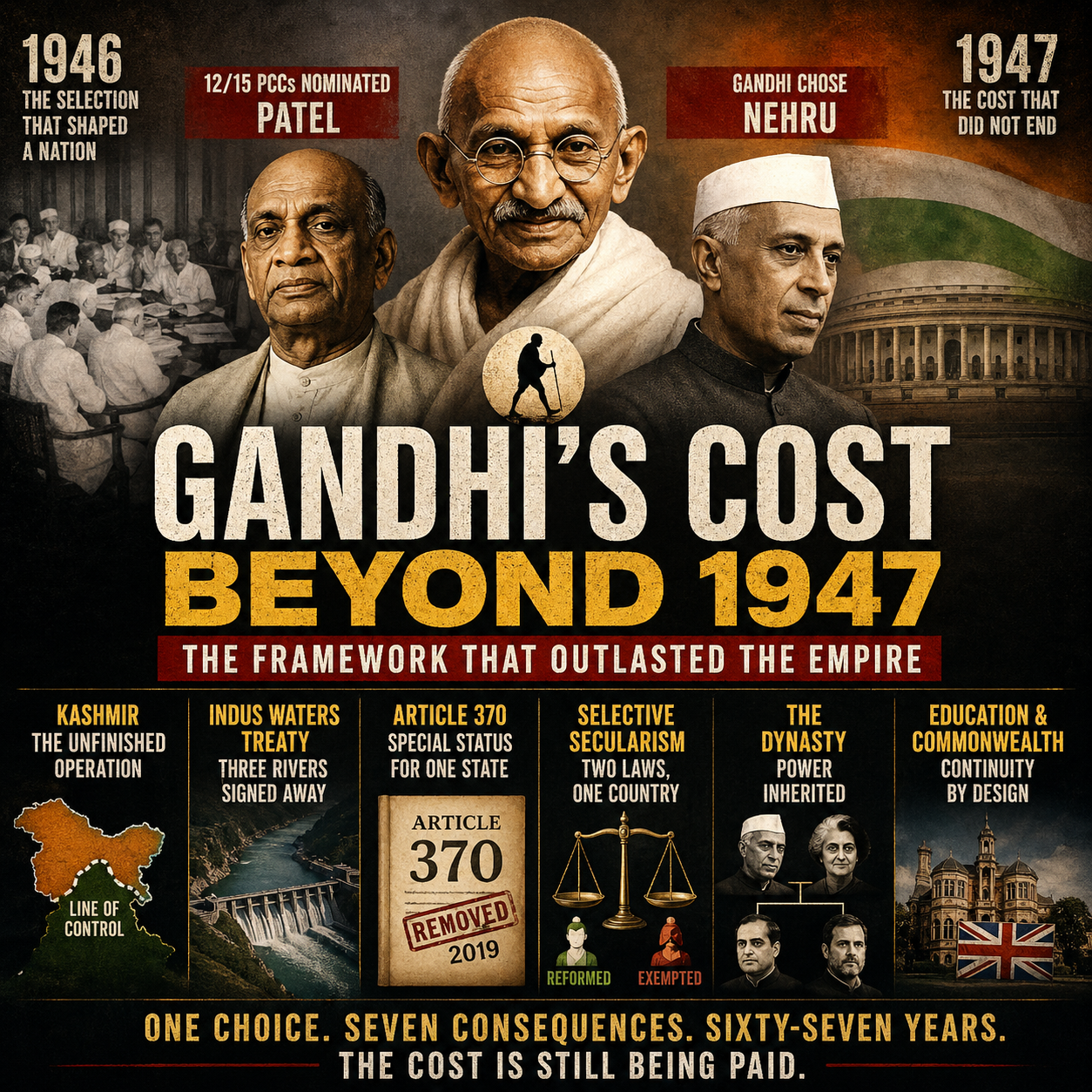
Gandhi’s Cost Beyond 1947: The Framework That Outlasted the Empire (39)
भारत / GB
Part 39: Mahatma Gandhi’s Peace Efforts | Series Index
Blog 38 documented the British paralysis debt — opened February 12, 1922, closed August 15, 1947. Twenty-five years of payments. The British left. The column stopped accruing. But Gandhi’s Cost Beyond 1947 did not stop at that boundary. One final unilateral act — the selection of India’s first Prime Minister — ensured the cost crossed into independent India and ran for sixty-seven more years. This post documents what crossed with it.
Thank you for reading this post, don't forget to subscribe!The Action Taken: The extra-constitutional practice of resolving executive statecraft by personal preference was carried directly into post-independence executive governance.
Who Paid the Price: Cabinet accountability and internal party democracy, as major national policy directions were decided outside open parliamentary debate.
The Alternative Bypassed: Institutional cabinet governance where collective voting majorities determined sovereign state decisions.
Why This Matters: Traces how the mechanism of unelected personal fiat outlasted colonial rule, shaping the executive structure of the newly independent Indian state.
The Final Unilateral Act
Gandhi’s Cost Beyond 1947 begins not in 1947 but in 1946 — with the Congress Presidential election that would determine who became India’s first Prime Minister.
Twelve of fifteen Pradesh Congress Committees nominated Sardar Vallabhbhai Patel. Zero nominated Jawaharlal Nehru. The institutional process — the only democratic mechanism available within the Congress to make this decision — had produced a clear result.
Gandhi intervened. He made clear his preference for Nehru. Patel withdrew. The institutional result was set aside. Nehru became the first Prime Minister of independent India — not through the process that had nominated Patel twelve times, but through the same unilateral authority that had suspended the Non-Cooperation Movement in 1922, signed the Irwin Pact in 1931, and overridden the Congress on every significant decision across three decades.
The suspension of 1922 had demonstrated that Gandhi’s authority operated above the institution’s capacity to refuse. The 1946 selection demonstrated it one final time — and this time the consequence was not a dissolved movement or an abandoned demand. It was the installation of a governing framework for the world’s largest democracy.
Gandhi’s Cost Beyond 1947 is the documented record of what that framework produced.
Kashmir — The Unfinished Operation
October 1947. Pakistani tribal forces, backed by the Pakistani army, invaded Kashmir. The Maharaja signed the Instrument of Accession. The Indian Army moved. By late October the army was advancing and had the operational capacity to recover the entire territory.
Nehru referred the matter to the United Nations Security Council. He declared a ceasefire. The army stopped.
Patel’s opposition is documented in the correspondence of the period. He believed the army should be allowed to complete the operation. The Line of Control froze at the point the ceasefire found it — leaving a third of Kashmir outside Indian administration, creating the dispute that has produced four wars, decades of militancy, and the Pahalgam attack of April 2025.
The series has documented Gandhi’s consistent pattern — maximum pressure dissolved before its objective was reached, settlement accepted before the adversary had been brought to a conclusive position. The Kashmir ceasefire of 1947 carries the same arithmetic in a different domain. The man who made it was selected by Gandhi. The cost is still being paid.
The Indus Waters Treaty — Three Rivers Signed Away
In 1960, Nehru signed the Indus Waters Treaty brokered by the World Bank. Pakistan received rights to the three western rivers — the Indus, the Jhelum, and the Chenab. India retained the three eastern rivers.
The treaty gave Pakistan sixty-five years of guaranteed water security from rivers that flow through Indian territory. It survived four wars between India and Pakistan. It was treated as sacrosanct across every Indian government from 1960 to 2025.
On April 23, 2025 — following the Pahalgam attack in which twenty-six Indian civilians were killed — India suspended the treaty. The suspension came sixty-five years after the treaty was signed and seventy-nine years after Gandhi selected the man who signed it.
The series does not assert that the treaty was signed to serve Pakistani interests. It places the treaty, its terms, its duration, and the event that finally ended it before the reader.
Article 370 — Special Status for One State
Article 370 of the Indian Constitution gave Jammu and Kashmir a special status available to no other Indian state. It was Nehru’s personal insistence — over the objections of Patel and Ambedkar, both of whom opposed it on constitutional grounds. Patel believed it would create a permanent fault line in the Indian federation. Ambedkar refused to draft it and told Nehru he would not do it even if instructed.
Article 370 was written by Nehru’s aide Gopalaswami Ayyangar and inserted into the Constitution. It remained in force for seventy years — governing the terms on which Kashmir related to India, preventing property ownership by non-Kashmiris, maintaining a separate constitution and separate flag.
It was removed in August 2019. The removal required a constitutional reorganisation that took seventy-two years to arrive.
The Selective Secularism — Two Laws, One Country
The Hindu Code Bill of 1955 to 1956 reformed Hindu personal law — marriage, divorce, inheritance, adoption. It was the most significant legal intervention in Hindu social practice since independence. Ambedkar, as Law Minister, drafted it. Nehru pushed it through over significant Hindu conservative opposition.
The Uniform Civil Code — which would have applied equivalent reform to Muslim personal law — was placed in the Directive Principles of the Constitution as an aspiration, not a right. It has not been enacted as national law to this day.
Ambedkar resigned as Law Minister in 1951, citing his frustration with Nehru’s unwillingness to address the full scope of personal law reform. The man Gandhi had coerced into surrendering the separate electorate in 1932 resigned from the government of the man Gandhi had selected in 1946 — over a policy the man Gandhi selected was unwilling to implement.
The asymmetry Nehru installed — reform for one community, protection for another — runs through every subsequent debate on the Uniform Civil Code.
The Dynasty Gandhi Installed
Gandhi did not select an ordinary politician in 1946. He selected the son of Motilal Nehru — Congress President twice, patriarch of the most powerful political dynasty independent India would produce. The Nehru family did not capture Congress the way an outsider captures an institution. They inherited it — first through Motilal, then through Jawaharlal, who served seventeen years as Prime Minister, then through Indira Gandhi, then through Rajiv Gandhi.
Three members of the family have served as Prime Minister of India. A member of the family was in charge of India for forty of the first sixty years of independence. The Congress party — at the verge of collapse today — has not moved one position from the dynasty. Rahul Gandhi leads it. Priyanka Vadra campaigns for it. The institutional capture Gandhi initiated with one unilateral act in 1946 has not been reversed by the institution itself in seventy-nine years.
This blog has documented that Nehru shared with Gandhi one defining characteristic — authority that operated above institutional challenge. Gandhi’s was moral. Nehru’s was political and dynastic. Between them, they ensured that the Congress — which Gandhi had captured as the instrument of the independence movement — became the instrument of one family’s continuous grip on Indian governance.
Gandhi selected Nehru. Nehru installed the dynasty. The dynasty installed the framework. The framework ran until 2014. The institution that was meant to check all of this — the Congress — is still waiting for permission from the same family to do so.
Education Policy Critique and the Commonwealth — Continuity by Design
Nehru kept India in the Commonwealth. The British institutional relationship was preserved at the formal moment of separation — trade frameworks, legal frameworks, and the educational architecture that produced India’s administrative class all carried the British institutional inheritance forward under Indian sovereign cover.
The education policy Nehru chose is the most precise single exhibit of what that inheritance meant in practice. The documented record shows that Nehru’s educational investment was concentrated in higher education — the IITs, IIMs, AIIMS, the national science laboratories, the premier institutions that produced the English-educated professional class. These institutions are internationally respected. They are also the institutions that serve the top fraction of India’s population.
India’s literacy rate in 1947 was approximately 12 percent. The primary school — the institution that would have addressed that 88 percent — received the residual budget. The village schoolhouse that could have produced a literate electorate capable of democratic participation was not Nehru’s priority. The IIT that produced engineers who emigrated to serve Western economies was.
The result: India’s educated elite remained a thin English-speaking layer atop a vast illiterate population for decades after independence. That layer — trained in British institutional frameworks, culturally oriented toward Western professional norms, administratively dependent on English — ran the country. The same families. The same institutions. The same examinations. The ICS renamed IAS, the structures intact, the cultural assumptions preserved.
Patel’s preference for a harder break from British institutional frameworks is documented. The break that occurred was Nehru’s — managed, partial, and preservative of the relationships that mattered to the class Nehru represented and from which Gandhi had selected him.
The primary school could have produced a population capable of holding that class accountable. It was not built at the scale required. The English-educated elite that Nehru’s higher education policy produced governed India for sixty-seven years — unaccountable to the 88 percent whose literacy was deferred while the IITs were built.
The Prosecution’s Position
Gandhi’s Cost Beyond 1947 does not assert that Nehru’s decisions were made to serve British or divisive interests. The series is not in the business of asserting motive. It is in the business of placing the arithmetic before the reader.
The arithmetic: Gandhi’s unilateral authority — built across thirty years, amplified by every suspension and settlement — made its final consequential act in 1946. The man it selected installed a framework that ran for sixty-seven years. Each of the seven decisions documented in this post carried consequences that are still visible today — the Line of Control, the Pahalgam attack, the Indus Waters suspension, the Article 370 removal, the UCC debate, the English-educated administrative elite, the Commonwealth relationship.
The cost that opened on February 12, 1922 did not close on August 15, 1947. Gandhi’s Cost Beyond 1947 is the name for what crossed the boundary — carried not by the British, who had left, but by the framework Gandhi’s final unilateral act installed in their place.
The series does not complete the sentence. The reader has the documented record. The reader will complete it.
Twelve of fifteen Pradesh Congress Committees nominated Patel. Gandhi selected Nehru. The institutional process was set aside by the same unilateral authority that had set aside every institutional process since 1922. What followed — Kashmir, the Indus Waters Treaty, Article 370, selective secularism, English administration, the Commonwealth — ran for sixty-seven years. The British paralysis debt closed in 1947. Gandhi’s Cost Beyond 1947 did not. It was paid by Indians who had no vote in the selection that opened it.
Feature Image: Click here to view the image.
Videos