
Gandhi’s Murder: Was Nehru Involved?
A Clash of Dictatorships: Gandhi vs. Nehru
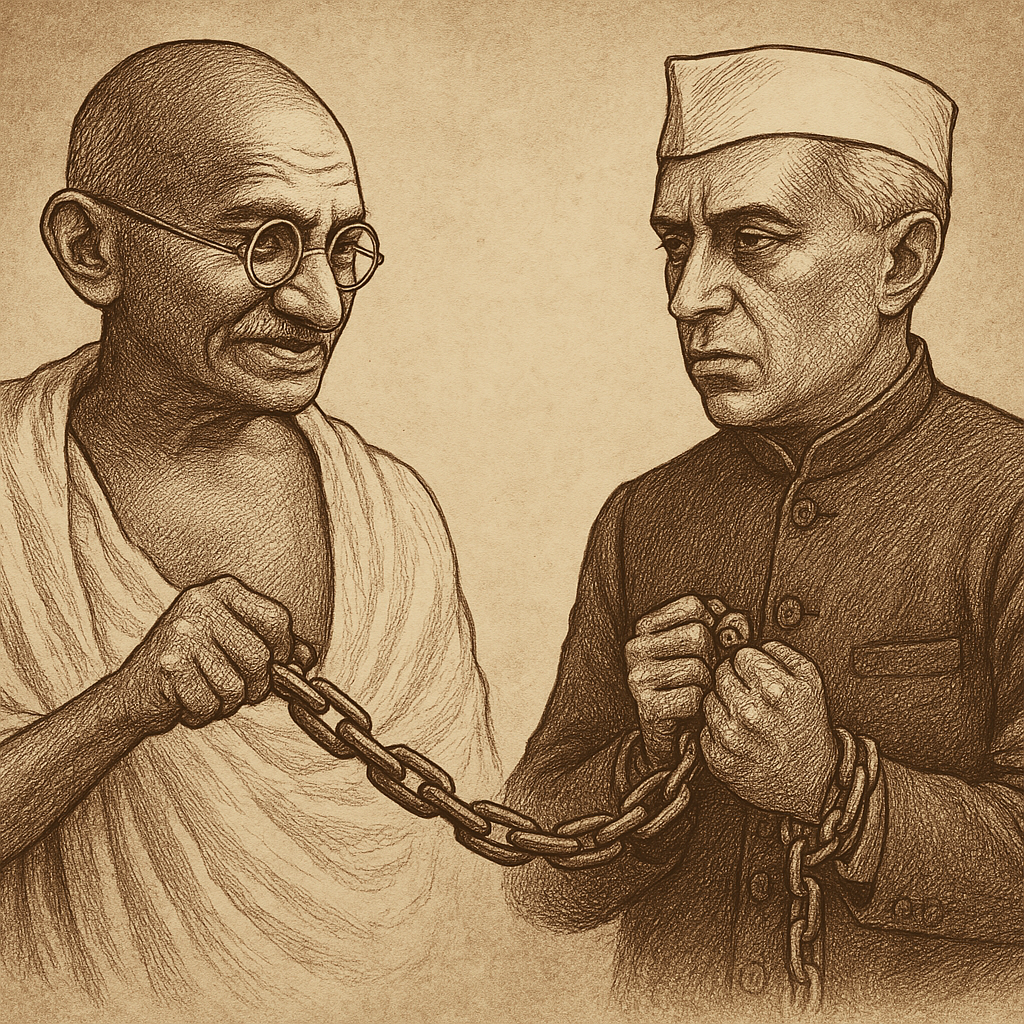
Mahatma Gandhi and Jawaharlal Nehru, icons of India’s freedom struggle, were not merely collaborators but also rivals with profoundly authoritarian tendencies, each dictating the Congress’s course in their own style. Gandhi, with his moral dictatorship, utilized charisma and unwavering resolve to impose his vision of nonviolence and rural simplicity, effectively acting as a ‘super PM’ without official power. His fasts—like the one in January 1948 to secure ₹55 crore for Pakistan—forced even a reluctant government to heel, a testament to his unofficial reign over the nascent nation. Nehru, on the other hand, wielded the formal power of the Prime Minister, enforcing a secular, socialist, and industrial vision that frequently clashed with Gandhi’s more traditionalist and rural-centric ideals. The palpable tension by 1948 suggested that Nehru might have seen Gandhi’s removal as essential to execute his political agenda unimpeded, potentially setting the stage for Gandhi’s murder. This blog explores the deeper layers of their clash, suggesting that the dynamics between these two leaders may have contributed to a darker resolution: Nehru’s possible involvement in the elimination of his mentor to secure his throne.
Thank you for reading this post, don't forget to subscribe!Nehru’s Censorship: A Machine Mightier Than the British
Nehru’s censorship wasn’t just a tool—it was a weapon, dwarfing even the British Empire’s 200-year stranglehold on India’s voice. The colonial rulers, for all their oppression, relied on blunt laws like the Vernacular Press Act (1878) or the Defence of India Act (1915) to silence dissent, yet voices like Tilak’s and Bose’s pierced through, often amplified abroad. Their grip, while iron, was porous under global scrutiny. Nehru, however, built a tighter cage. After Gandhi’s murder on January 30, 1948, he unleashed a censorship apparatus that eclipsed its colonial predecessor in scope and ruthlessness. Nathuram Godse’s 150-paragraph courtroom statement—detailing his grievances against Gandhi and Congress’s Partition failures—was banned from publication until 1968, a 20-year blackout enforced with surgical precision. Not a single work came out from the supposedly open court hearing held in a fortress of Mughal Empire. Books on the assassination, like Gopal Godse’s Why I Assassinated Mahatma Gandhi, were locked away, some still restricted today. The Sunderlal Report, documenting Congress-backed killings in Hyderabad (1948), was buried until 2013—tens of thousands dead, yet silenced under Nehru’s watch.
Censorship or Erasure?
This wasn’t mere suppression; it was erasure. Nehru’s team—cabinet loyalists, police under Home Minister Patel (himself sidelined by Nehru), and a compliant press—formed a censorship machine more pervasive than the British Raj’s scattered efforts. Where the British faced resistance, Nehru exploited post-Partition chaos to gag without challenge. His motive? To hide the truth of Gandhi’s death—whether Godse acted alone, with Nehru’s nudge, or as a pawn in a larger plot. This unparalleled censorship suggests not just control, but a desperate cover-up of who really killed Gandhi.
No Room for Rivals: Nehru’s Intolerance of Gandhi’s Authority
Nehru never tolerated hindrances to his authority—a trait etched in his 17-year rule—and Gandhi, alive, was the one rival he couldn’t subdue. As PM, Nehru held formal power, but Gandhi’s moral dictatorship undermined it at every turn. The ₹55 crore episode was a glaring wound—Gandhi’s fast coerced Nehru’s cabinet into funding Pakistan amid its Kashmir invasion, a humiliation for a leader bent on asserting India’s strength. Nehru’s secularism clashed with Gandhi’s spiritualism; his industrialization defied Gandhi’s village-centric dreams. Had Gandhi lived, his “super PM” sway—meddling in Kashmir, communal policies, or even disbanding the army, as he once suggested—would’ve shackled Nehru’s ambitions. Gandhi’s existence was a chain Nehru lacked the authority to break openly. Murder, then, offered a silent exit—Godse’s bullets, or another’s, could free Nehru to rule unchallenged, his dictatorship finally absolute.
Lapses and Post-Murder Actions: Circumstantial Clues to a Hidden Hand
As we delve deeper into the complexity of Nehru’s position and the challenges he faced from Gandhi’s moral authority, we must now examine the concrete evidence and events surrounding Gandhi’s murder. This closer look at the assassination itself, including the weapons used and the subsequent legal proceedings, may shed further light on the potential links between Nehru’s political imperatives and the mechanics of Gandhi’s untimely death.
The investigation into Gandhi’s murder and the actions that followed drip with anomalies—circumstantial evidence that Nehru’s fingerprints may linger beneath the official tale. The 1948–49 probe, overseen by Nehru’s government, pinned the murder on Godse and his Hindu Mahasabha cohort with startling speed—149 witnesses, a recovered Beretta, and a confession tied it up within a year. Yet, critical lapses scream neglect or design:
No Autopsy: Gandhi’s family opposed a post-mortem, but Nehru’s administration didn’t push—why? Three bullets were confirmed, but a fourth, as Subramanian Swamy posits, could’ve pointed elsewhere. Was this convenience or concealment?
Lost Evidence: The Beretta (serial 606824) vanished post-trial, its chain of custody a mystery. Ballistics linked it to Godse, but a duplicate serial (719791) muddies the waters—did Nehru’s team “lose” it to bury inconsistencies?
Censored Defense: Godse’s statement, rich with critiques of Congress, was suppressed—Nehru’s fear of its contents suggests more than communal risk; did it hint at his complicity?
Rushed Execution: Godse and Narayan Apte were hanged on November 15, 1949, in Ambala Jail—far from Delhi, shrouded in secrecy, their ashes scattered to prevent a shrine. This mirrors Osama bin Laden’s sea burial—a calculated erasure of a potential martyr. Why the haste, unless Nehru dreaded lingering scrutiny?
The Kapur Commission: The Kapur Commission (1966–69), under a Congress still loyal to Nehru’s legacy, revisited the case but sidestepped these gaps—focusing on Godse’s ties to the Hindu Mahasabha and Savarkar, not the PM who gained most from Gandhi’s exit.
The Hyderabad Killings: Post-murder, Congress’s violence—like the 1948 Hyderabad massacre, where Operation Polo killed an estimated 27,000 to 200,000 people, mostly Muslims, under Nehru’s watch—reveals a party willing to use lethal force to consolidate power. If Congress could orchestrate such bloodshed, could they have turned on Gandhi?
Congress’s Ruthless Control: Beyond Hyderabad, Congress’s broader role post-1947 shows a pattern of suppression—sidelining Subhash Chandra Bose, allowing Bhagat Singh’s 1931 execution while Gandhi stood by, and banning books on the assassination well into the modern era. This ruthless grip on power and narrative suggests a party capable of silencing any threat, even one as towering as Gandhi.
These unsettling gaps—from missing evidence to Congress’s bloodied hands—cast a long shadow over Gandhi’s murder. The Hyderabad killings and Congress’s iron control reveal a party unafraid to crush dissent, raising a chilling question: if they could silence thousands to secure power, what stopped them from silencing Gandhi himself? The official story crumbles under this weight, urging us to look beyond Godse’s gun to the hands that might have guided it.
Mainstream Historians on Nathuram Godse:
While celebrated historians such as Judith Brown and Ramachandra Guha have extensively documented the ideological conflicts and collaboration between Nehru and Gandhi, their analyses often overlook the clash of authoritarian traits that defined both leaders’ approaches to governance within the Congress. This significant aspect of their relationship, featuring Nehru’s pronounced authoritarian tendencies alongside his extensive use of censorship, suggests a far more controlling leadership style than typically portrayed. Equally under-discussed is Gandhi’s role as a ‘super PM,’ wielding immense moral authority without formal governmental responsibility, often overshadowing Nehru’s official capacities with his direct interventions in policy matters.
Moreover, the consequences of Gandhi’s murder, particularly events like the Hyderabad killings, where Congress policies played a significant role, remain largely unexplored in mainstream historical narratives. This blog delves into these overlooked aspects, presenting a narrative that not only explores the personal and political dynamics of these two pivotal figures but also the broader implications of their actions on Indian history.
A Circumstantial Verdict: Nehru’s Hidden Hand in Gandhi’s Fall
Here’s my stance, built on these threads: Nehru, a dictator eclipsing Gandhi’s own, orchestrated or abetted Gandhi’s murder to cement his reign. The circumstantial evidence—clashing ambitions, unprecedented censorship, investigative flaws, and Congress’s brutal streak—paints a damning picture. Godse may have pulled the trigger, but Nehru could’ve nudged him, or staged a parallel hit—Swamy’s “fourth bullet” theory gains traction in this light.
The banned records, missing gun, and hushed execution aren’t mere oversights; they’re the debris of a cover-up. History, as Nehru censored it, is a lie—more obscured than under 200 years of British rule. Gandhi’s murder wasn’t just Godse’s act; it was Nehru’s liberation.
This is speculation, not gospel—no archive names Nehru as killer. But the gaps justify doubt: a dictator who bent the Constitution (First Amendment, 1951), bullied the President (Somnath, 1951), and buried massacres (Hyderabad, 1948) had the means, motive, and malice to remove Gandhi. History’s silence isn’t proof of innocence—it’s the echo of Nehru’s brute force. Demand the unsealed truth; only then can we judge who really killed the Mahatma.
Engage and Explore Further
We invite you to delve deeper into this discussion and share your thoughts. Do you think other overlooked aspects of history need reevaluation? What other events or figures in history deserve a second look from a different perspective? Join the conversation in the comments below or on our social media platforms. Let’s challenge the established narratives together and seek the unsealed truths that history might still hide.
Feature Image: Click here to view the image.
Glossary of Terms
- Super PM: A phrase used to describe Gandhi’s informal yet overwhelming moral authority over India’s political decisions, often overriding the authority of the actual Prime Minister without holding an official position.
- ₹55 Crore: Refers to the Rs. 55 crore (550 million) transferred to Pakistan in 1948 as part of the financial commitments under the Partition agreement. Gandhi fasted to pressure the Indian government into releasing the funds despite ongoing conflict over Kashmir.
- Vernacular Press Act (1878): A colonial-era law introduced by the British to curb the freedom of the Indian-language press, which criticized British policies. It’s often referenced as a benchmark for censorship in colonial India.
- Defence of India Act (1915) : A British law enacted during World War I to prevent anti-British activities in India, allowing preventive detention and suppression of dissent.
- Sunderlal Report: An official but long-suppressed report documenting the atrocities committed during the Indian military action in Hyderabad (Operation Polo) in 1948. It estimated large-scale killings, mostly of Muslims.
- Operation Polo: A military operation launched by India in September 1948 to integrate the princely state of Hyderabad into the Indian Union. It led to widespread communal violence and killings.
- Kapur Commission (1966–1969) : A judicial commission of inquiry set up to reinvestigate the conspiracy behind Mahatma Gandhi’s murder. While it highlighted failures in security, it stopped short of implicating higher political authorities.
- Nathuram Godse: The assassin of Mahatma Gandhi. A former RSS worker and member of the Hindu Mahasabha, he was tried and executed in 1949. His courtroom speech was suppressed for two decades.
- Narayan Apte : A co-conspirator in Gandhi’s murder, executed alongside Nathuram Godse in 1949.
- Hindu Mahasabha: A right-wing Hindu nationalist organization involved in the political life of pre-independence India. Godse and several co-accused were associated with it.
- Subramanian Swamy’s “Fourth Bullet” Theory: A claim by Indian politician Subramanian Swamy that a fourth bullet may have been fired during Gandhi’s murder, implying the involvement of more than one assailant or a deeper conspiracy.
- Somnath (1951) : Refers to the controversy over the reconstruction of the Somnath temple. Nehru opposed it being projected as a state-endorsed Hindu revival, clashing with President Rajendra Prasad who supported it.
- First Amendment (1951) : The first constitutional amendment in India, introduced by Nehru’s government, curtailed freedom of speech and allowed the state to impose “reasonable restrictions.” It marked the beginning of Nehru’s formal censorship policies.
- Ambala Jail: The prison in which Nathuram Godse and Narayan Apte were hanged. Their execution was carried out discreetly, and their ashes were scattered secretly.
- Osama bin Laden’s Sea Burial: Referenced as a modern parallel to the secretive disposal of Godse and Apte’s remains. Bin Laden’s body was buried at sea by U.S. forces in 2011 to prevent the creation of a martyr’s shrine.
#GandhiAssassination #NehruControversy #IndianHistory #GodseTrial #HiddenHistory
Related Posts:
Visit the Primary Blog: Nathuram Godse Murderer, Patriot or Fractured
Visit the Link that Inspired the investigation: Debating Nathuram Godse: Murderer or Misguided Patriot
Comments are closed.