
Gandhi’s Weakness Designed Partition: The Weakness That Was Designed (173)
भारत / GB
Part 173: Mahatma Gandhi’s Peace Efforts | Series Index
Blog 172 placed before the reader the Gandhi sovereignty transfer partition — the 834 days between August 15, 1947, the date India was told it was independent, and November 26, 1949, the date India’s own Constituent Assembly passed Article 395, the clause repealing British statutory authority over India; and three territorial decisions of permanent consequence taken inside that window. This post closes the Settlement Arc. It places before the reader the structural question the arc has been building toward: whether the institutional weaknesses of the Dominion period — the British statutory framework, the British Commanders-in-Chief, the referral of Kashmir to the United Nations, the loss of Gilgit — were the product of circumstance, or of design. The Gandhi’s Weakness Designed Partition is the prosecution’s name for the pattern.
Thank you for reading this post, don't forget to subscribe!THE HISTORICAL RECORD — THE WEAKNESS THAT WAS DESIGNED
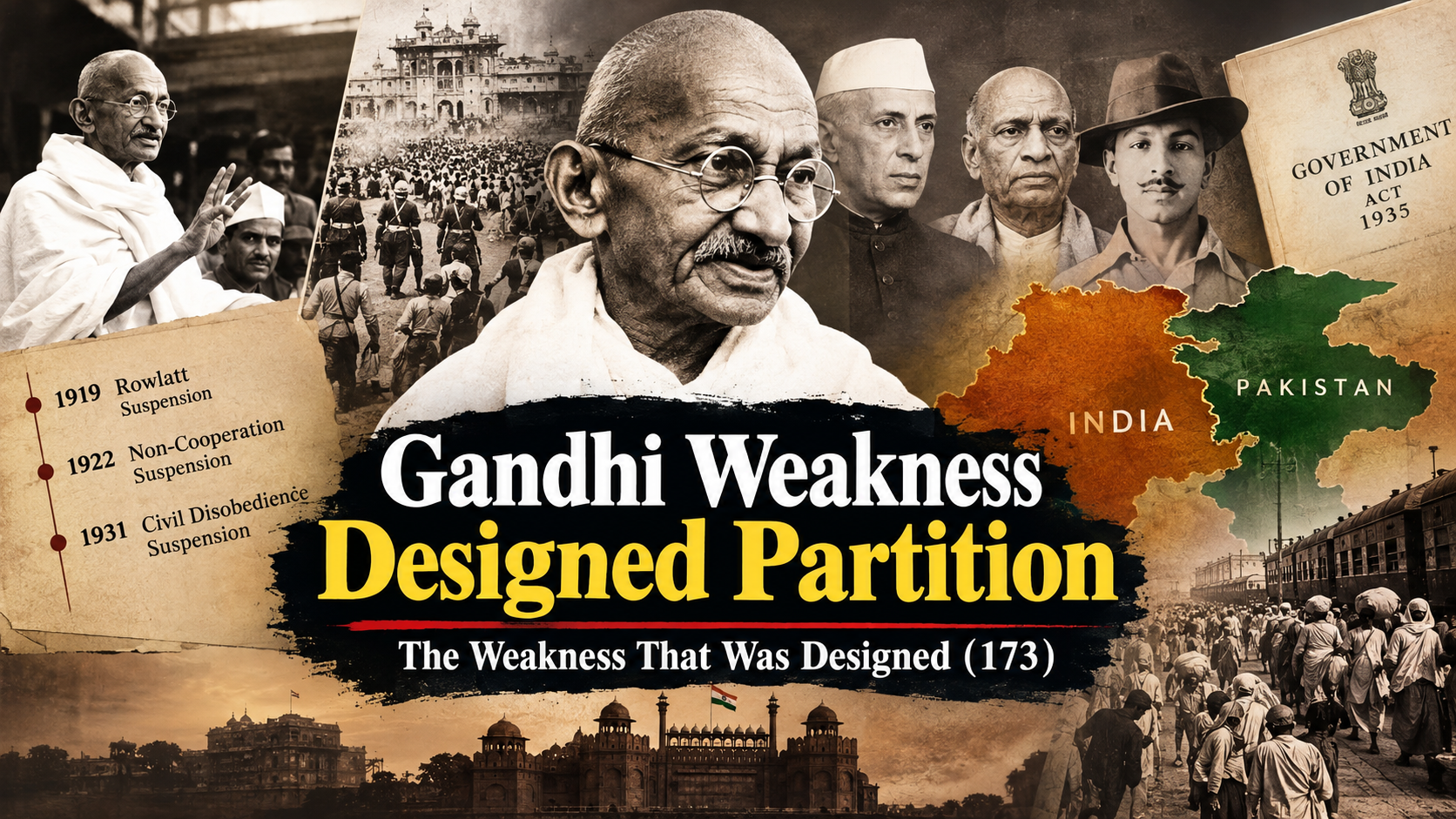
The Pattern: Across thirty years, at each moment of maximum institutional pressure, the Indian National Congress under Gandhi’s leadership chose withdrawal, deferral, or negotiated settlement on terms that fell short of the stated objective. The Rowlatt Satyagraha was suspended after eighteen days. The Non-Cooperation Movement was called off at its peak. The Civil Disobedience Movement was traded for a seat at the Round Table Conference. Dominion status was accepted in June 1947, when the British Cabinet had placed fifteen months of preparation time on the record. Kashmir was referred to the United Nations over Patel’s objection. The Gandhi’s Weakness Designed Partition is not a claim about any single decision. It is a claim about the pattern.
The Lethal Exhibit: At no point in the three decades between 1919 and 1949 did the Indian National Congress, under Gandhi’s guidance, press an advantage to conclusion. Every mass mobilisation was suspended before the colonial administration was forced to a definitive response. Every negotiation produced a settlement that preserved the colonial framework in some form. The sequence is the exhibit. The prosecution does not claim the decisions were identical in circumstance. It places the sequence before the reader.
Why it matters: The Gandhi’s Weakness Designed Partition asks the reader to consider whether the institutional architecture of the Dominion period — the weaknesses that produced the 834-day gap, the loss of Gilgit, the frozen Kashmir line — was the accidental product of haste, or the predictable result of a leadership pattern established across three decades. The reader will place the pattern before the record.
The Three Suspensions
The prosecution has placed the three suspensions before the reader across this arc. They require a consolidated reading.
The first was April 1919. The Rowlatt Satyagraha — the first mass civil disobedience movement Gandhi organised in India — was still active when the Jallianwala Bagh massacre occurred on April 13, 1919. Gandhi suspended the Satyagraha on April 18, 1919 — five days after the massacre. Gandhi called his own judgement a “Himalayan miscalculation.” The movement was suspended. The Rowlatt Act remained in force. The Viceroy’s private correspondence of that period records that the administration had been under acute strain, the railways were affected, and the outcome was uncertain. The Gandhi’s Weakness Designed Partition places the sequence before the reader: the suspension did not prevent the massacre. It followed it. Gandhi’s stated reason for suspension was not British repression of his own people — it was violence by his own supporters.
The second was February 1922. The Non-Cooperation Movement — the most pervasive mass mobilisation since 1857 — was called off after the Chauri Chaura incident, in which a crowd of protesters, fired upon by police, retaliated by burning the police station and killing twenty-two constables. The Viceroy’s correspondence of February 1922 records provincial administrations warning of imminent breakdown. Gandhi initiated the suspension decision personally at Bardoli; the Congress Working Committee formally passed the Bardoli Resolution on February 11–12, 1922. C.R. Das, Motilal Nehru, and Lala Lajpat Rai lodged written protests against the decision. Subhas Chandra Bose called it a national calamity. The stated reason: collective moral unreadiness. The colonial administration was not forced to a definitive response. The Gandhi’s Weakness Designed Partition places this on the record.
The third was March 1931. The Civil Disobedience Movement — which had paralysed salt revenue collection across the country and filled sixty thousand political prisoners into jails — was suspended for the Gandhi-Irwin Pact. The terms: Congress would suspend civil disobedience and attend the Round Table Conference. The British government would release political prisoners not convicted of violence and permit salt manufacture on the coast. There was no commitment on Dominion Status. There was no commutation of Bhagat Singh’s death sentence, which Gandhi had the standing to demand as a condition of the Pact. The movement was suspended. Bhagat Singh was executed on March 23, 1931, eighteen days after the Pact was signed. The Round Table Conference produced nothing. The colonial framework remained.
Three suspensions. Three moments of maximum pressure. Three withdrawals before the colonial administration was forced to a definitive response. The Gandhi’s Weakness Designed Partition is the prosecution’s name for this pattern — not an allegation about intent, but a description of outcome.
The June 1947 Decision
The pattern produced its terminal exhibit in June 1947.
The British Cabinet’s announced transfer date was June 1948. That date carried fifteen months of administrative preparation from February 1947, documented in Hansard. The June 3 Plan — accepted by the Congress on June 3, 1947 — moved the transfer date to August 15, 1947: eleven weeks away. The compression was proposed by Mountbatten. It was accepted by the Congress leadership.
The argument of readiness — deployed three times across thirty years to abort mass action when the colonial state was under pressure — was not deployed in June 1947. It was not deployed when time was formally offered by the British Cabinet and the consequences of haste would fall on the populations of Punjab and Bengal, not on the capacity of the colonial administration to function.
What the Congress accepted in June 1947: eleven weeks for the administrative partition of a subcontinent, the demarcation of boundaries through Punjab and Bengal by a London barrister who had never visited India, the division of the Indian Army, and Dominion status rather than the republic that the Lahore session of 1929 had made the declared objective of the Congress. What the Congress did not accept: the fifteen months of preparation time the British Cabinet had placed on the record, or the time required to constitute the institutional architecture of sovereignty before the transfer date.
The prosecution places a second sequence before the reader. Congress had declined Jinnah’s fourteen-point constitutional proposals at the 1928 Calcutta session — four amendments put to a vote, four rejections on record. It had declined the coalition terms in 1937. It had declined the tribunal offer in March 1940. Each refusal was documented. In June 1947, eleven weeks were accepted for the partition of a subcontinent — without the argument of unreadiness that had been deployed three times across thirty years to suspend mass action when the colonial state was under pressure. The prosecution places the two sequences before the reader: what Congress would not accept from Jinnah across a decade of constitutional negotiation, and what it accepted from Mountbatten in a single meeting.
Some accounts frame the compression as an acceleration — independence arrived sooner than scheduled. The prosecution places the correct comparison before the reader. If the measure of independence is not the administrative transfer of August 15, 1947, but the sovereign act by which India’s own assembly legislated the end of British statutory authority — November 26, 1949, the date Article 395 was passed — then independence did not arrive early. It arrived at least 514 days after the June 1948 deadline Attlee had placed on the record, measured from June 30, 1948, the close of the month he named. The argument of preponment assumes August 15, 1947 was independence. The prosecution does not accept that assumption. On the prosecution’s dating, India was more than 514 days late. The populations of Punjab and Bengal bore the cost of the eleven-week compression. The colonial administration did not.
The Gandhi’s Weakness Designed Partition places this alongside the three suspensions. The argument of unreadiness was deployed when the movement was winning. It was not deployed when the consequences of haste were territorial and demographic. The prosecution does not claim the decisions were made by the same logic. It places the sequence before the reader.

What the 834 Days Produced
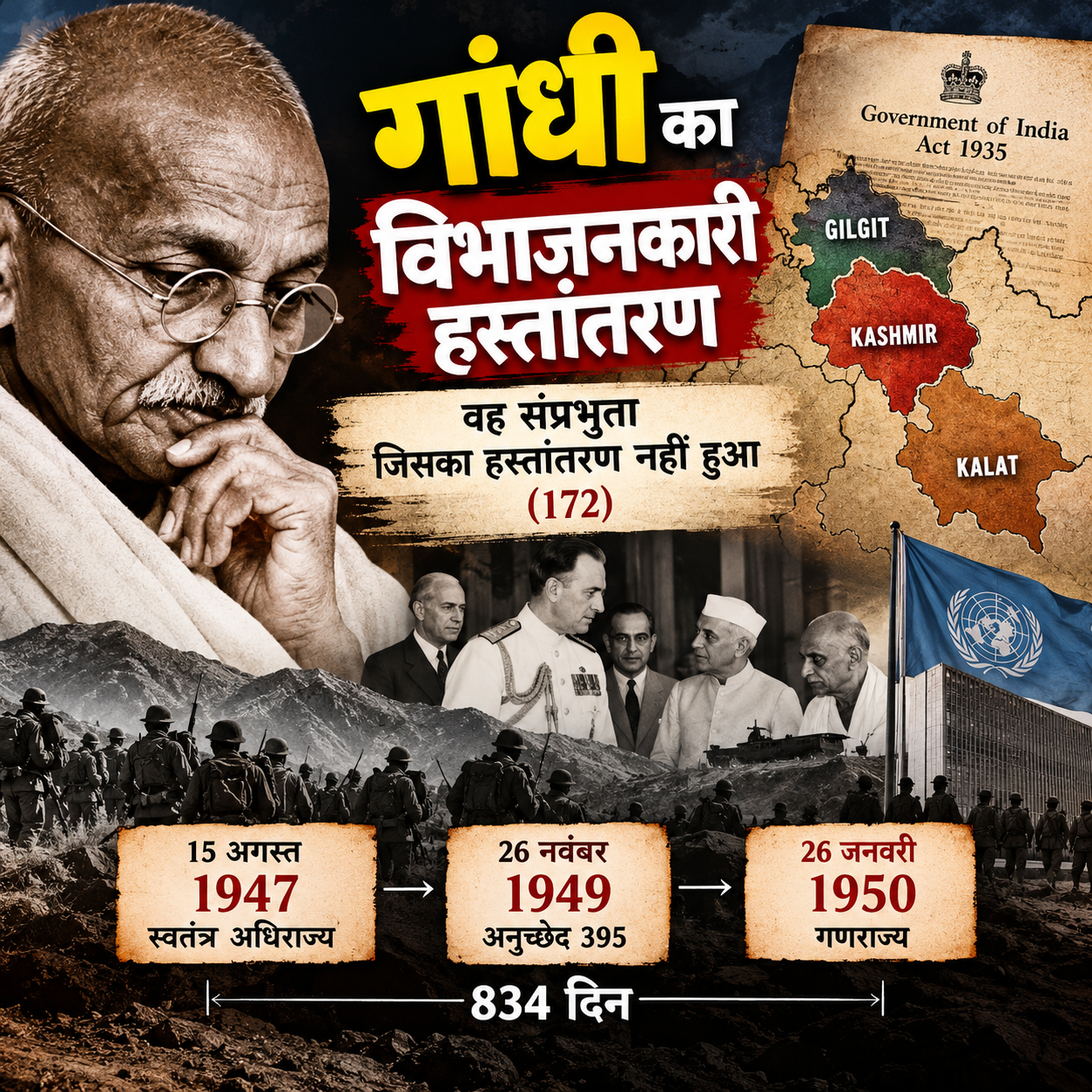
The institutional weaknesses of the 834-day Dominion period — from August 15, 1947 to November 26, 1949, when India’s own assembly passed the sovereign repeal — are on the record.
The Government of India Act 1935, a British Parliamentary statute, remained India’s governing framework for those 834 days. The head of state was King George VI. Lord Mountbatten served as India’s Governor-General for the first ten months. British officers commanded both armies. The Judicial Committee of the Privy Council in London remained India’s apex court until October 10, 1949 — twenty-five months into the Dominion period. Three territorial decisions of permanent consequence were taken inside the window: Gilgit was lost five days after the Instrument of Accession was signed; Kalat’s accession was declined and Pakistan’s annexation followed; Kashmir was referred to the United Nations over Patel’s documented objection on January 1, 1948.
The Gandhi’s Weakness Designed Partition asks whether these outcomes were the accidental product of the eleven-week compression, or the predictable result of accepting Dominion status without the institutional architecture of sovereignty in place. The prosecution does not answer. It places the question before the reader.
Patel’s record is the comparator. Given the institutional framework as it was — the colonial statute, the British Commanders-in-Chief, the Dominion architecture — Patel integrated 565 princely states by direct action. The Hyderabad Police Action required five days. The Junagadh question was resolved in six months. The method Patel applied to the states he controlled produced closure. The method applied to Kashmir — referral to the United Nations, under Nehru’s authority and over Patel’s objection — produced a frozen line that has not moved in seventy-eight years.
The Gandhi’s Weakness Designed Partition places Gandhi’s April 1946 intervention at the Congress Working Committee alongside this outcome: the intervention that placed Nehru rather than Patel at the apex of the transfer negotiations, and therefore at the apex of the decisions taken during those 834 days.
The Design Question
The Settlement Arc has placed six exhibits before the reader across Blogs 168 through 173.
Blog 168: the Gandhi Nehru partition — the April 1946 intervention that determined who governed India at the moment of transfer.
Blog 169: the Gandhi Patel partition — the contrast between Patel’s method and the method applied to Kashmir, and what each produced.
Blog 170: the Gandhi Radcliffe boundary partition — the acceptance of eleven weeks for boundary demarcation through Punjab and Bengal, against fifteen months offered.
Blog 171: the Gandhi dominion republic partition — the 834-day gap between the date India was told it was independent and November 26, 1949, the date India’s own assembly passed the repeal, with January 26, 1950 as the separate date the Republic was proclaimed.
Blog 172: the Gandhi sovereignty transfer partition — the three territorial decisions taken inside that 834-day window, while the colonial statute remained operative and British officers commanded both armies.
This Blog : the Gandhi’s Weakness Designed Partition — the pattern across thirty years of which the Dominion period is the terminal exhibit.
The prosecution does not claim the weaknesses were intentionally designed. It places the pattern before the reader: three suspensions at moments of maximum pressure across thirty years; acceptance of eleven weeks when fifteen months were offered; Dominion status when the declared objective was a republic; Kashmir referred to the United Nations when Patel’s method had closed 565 questions by direct action. The Gandhi’s Weakness Designed Partition is the prosecution’s name for the accumulated exhibit.
The reader will determine whether the pattern constitutes design, circumstance, or something the record does not yet have a name for — and complete the sentence.
The Prosecution’s Position
Gandhi’s Thirty Years closes the Settlement Arc with three questions before the reader. Each question concerns the same proposition: that the institutional weaknesses of the Dominion period were predictable from the pattern that preceded them.
- Does the sequence of three suspensions — Rowlatt 1919, Non-Cooperation 1922, Civil Disobedience 1931 — each at a moment of maximum pressure and each producing a withdrawal before the colonial administration was forced to a definitive response, constitute an exhibit the reader places alongside the claim that the weaknesses of the Dominion period were the accidental product of circumstance?
- Does the June 1947 decision — accepting eleven weeks when fifteen months were offered, and Dominion status when the declared objective was a republic — constitute an exhibit the reader places alongside the claim that the argument of unreadiness was applied consistently, regardless of who bore the consequences?
- Does Gandhi’s April 1946 intervention — placing Nehru rather than Patel at the apex of the transfer, and therefore determining which method was applied to Kashmir during the 834-day window — constitute an exhibit the reader places alongside the territorial record of those 834 days?
The series does not answer. Gandhi’s Thirty Years places the Gandhi’s Weakness Designed Partition before the reader: thirty years of pattern, 834 days of institutional consequence, and three territorial decisions that remain unresolved. The reader will place the pattern, the partition, and the period before the claim that the weakness was circumstantial — and complete the sentence.
Invitation To Defence
The floor belongs to the defence. We now invite them to present their exhibits and challenge the narrative established by the prosecution.
The Rowlatt Satyagraha was suspended in April 1919. The Non-Cooperation Movement was called off in February 1922. The Civil Disobedience Movement was traded for the Gandhi-Irwin Pact in March 1931. In June 1947, fifteen months of preparation were available; eleven weeks were accepted. Dominion status was accepted; the republic came 834 days later, on November 26, 1949, when India’s own assembly passed Article 395. Kashmir was referred to the United Nations over Patel’s documented objection. Gandhi’s April 1946 intervention placed Nehru, not Patel, at the apex of the transfer. The Gandhi’s Weakness Designed Partition places the pattern before the reader — three decades, one Dominion period, three territorial decisions still unresolved. The reader will complete the sentence.
Feature Image: Click here to view the image.
Videos
Glossary of Terms
1. Gandhi’s Weakness Designed Partition: A distinctive phrase coined in the blog to describe the alleged pattern of political withdrawals, negotiated compromises, and institutional weaknesses associated with Gandhi’s leadership, culminating in the consequences of Partition and the Dominion period.
2. Settlement Arc: The concluding sequence of six articles, Blogs 168–173, examining Gandhi’s interventions, Congress decisions, the transfer of power, Partition, and the institutional consequences of the Dominion period.
3. Dominion Period: The period from August 15, 1947, to November 26, 1949, examined in the blog, during which India continued to operate under the Government of India Act, 1935, before the Constituent Assembly passed Article 395.
4. British Statutory Authority: The legal authority exercised through British legislation that continued to govern India during the Dominion period, as discussed in the blog.
5. Article 395: The provision passed by India’s Constituent Assembly on November 26, 1949, repealing the Government of India Act, 1935, and the Indian Independence Act, 1947, along with related enactments.
6. Rowlatt Satyagraha: Gandhi’s mass civil disobedience campaign against the Rowlatt Act in 1919, suspended on April 18, five days after the Jallianwala Bagh massacre.
7. Non-Cooperation Movement: The mass movement led by Gandhi against British rule, withdrawn in February 1922 following the Chauri Chaura incident.
8. Civil Disobedience Movement: Gandhi-led resistance to British rule, including the challenge to the salt tax, suspended in March 1931 under the Gandhi-Irwin Pact.
9. Gandhi-Irwin Pact: The agreement signed in March 1931 between Gandhi and Viceroy Lord Irwin, under which Congress suspended civil disobedience and agreed to participate in the Round Table Conference.
10. Round Table Conference: A series of conferences held in London to discuss constitutional reforms in British India; the blog examines Congress’s participation following the Gandhi-Irwin Pact.
11. Commanders-in-Chief: The senior military officers who commanded the armed forces. The blog highlights the continued presence of British officers in command during the Dominion period.
12. Instrument of Accession: A formal legal document through which a princely state agreed to accede to a dominion. The blog refers to its signing in connection with the loss of Gilgit.
13. Radcliffe Boundary: The boundary drawn by Sir Cyril Radcliffe to divide Punjab and Bengal between India and Pakistan in 1947, amid the accelerated transfer-of-power timetable.
14. Constituent Assembly: The representative body responsible for framing India’s Constitution and passing Article 395, the constitutional milestone used in the blog to distinguish administrative transfer from the termination of British statutory authority.
#Gandhi #Partition #IndianHistory #BritishRule #Congress #Sovereignty #FreedomMovement #HinduinfoPedia
Scan Through The Entire Series at
Gandhi’s Peace Efforts: The Questions Before the Mahatma (0)
Refer to Various Arks Referred to in the Blog