
Gandhi’s Tribunal Offer: Three Days in March 1940 (97)
भारत / GB
Part 97: Mahatma Gandhi’s Peace Efforts | Series Index
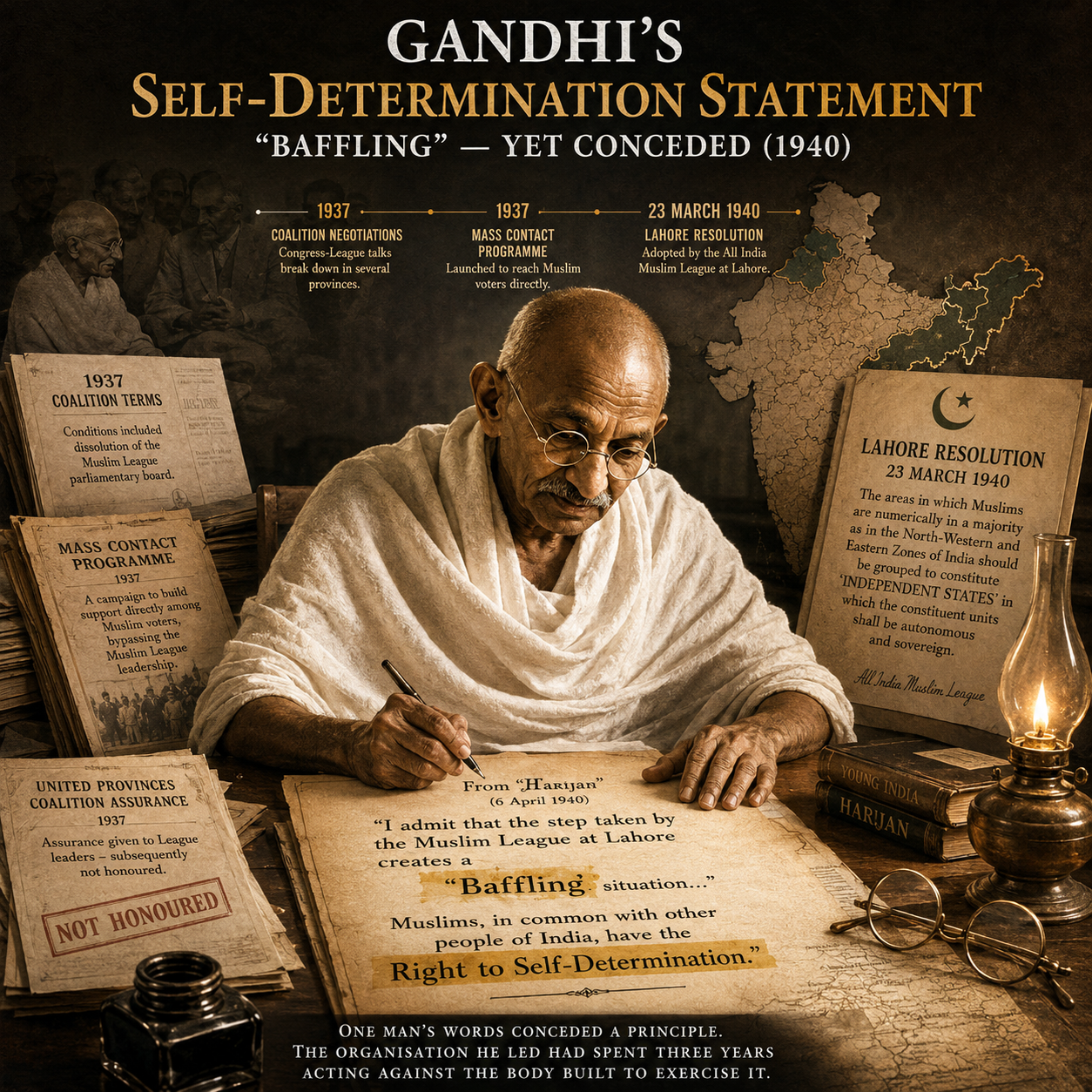
Blog 96 documented Gandhi’s reaction to the Lahore Resolution — “baffling,” yet conceding Muslims’ right to self-determination. This post examines what Gandhi had proposed three days before Muslim League’s Lahore meeting, and what Jinnah said about it in the same address that announced the Two-Nation Theory.
Thank you for reading this post, don't forget to subscribe!The Action Taken: Gandhi rejected the Cripps Mission constitutional proposals—which offered post-war Dominion status with the right to frame a constitution—characterizing the offer as a “post-dated cheque on a crashing bank.”
Who Paid the Price: Nationalist control over defense and governance during the war years, as talks collapsed completely.
The Alternative Bypassed: Accepting interim national executive authority during the war while deferring post-war constitutional disputes to a constituent assembly.
Why This Matters: An unchecked tactical veto: Gandhi’s personal dismissal collapsed negotiations that senior leaders (including Rajagopalachari and Nehru) were inclined to pursue, setting the stage for total confrontation.
Gandhi’s Tribunal Offer — Documented
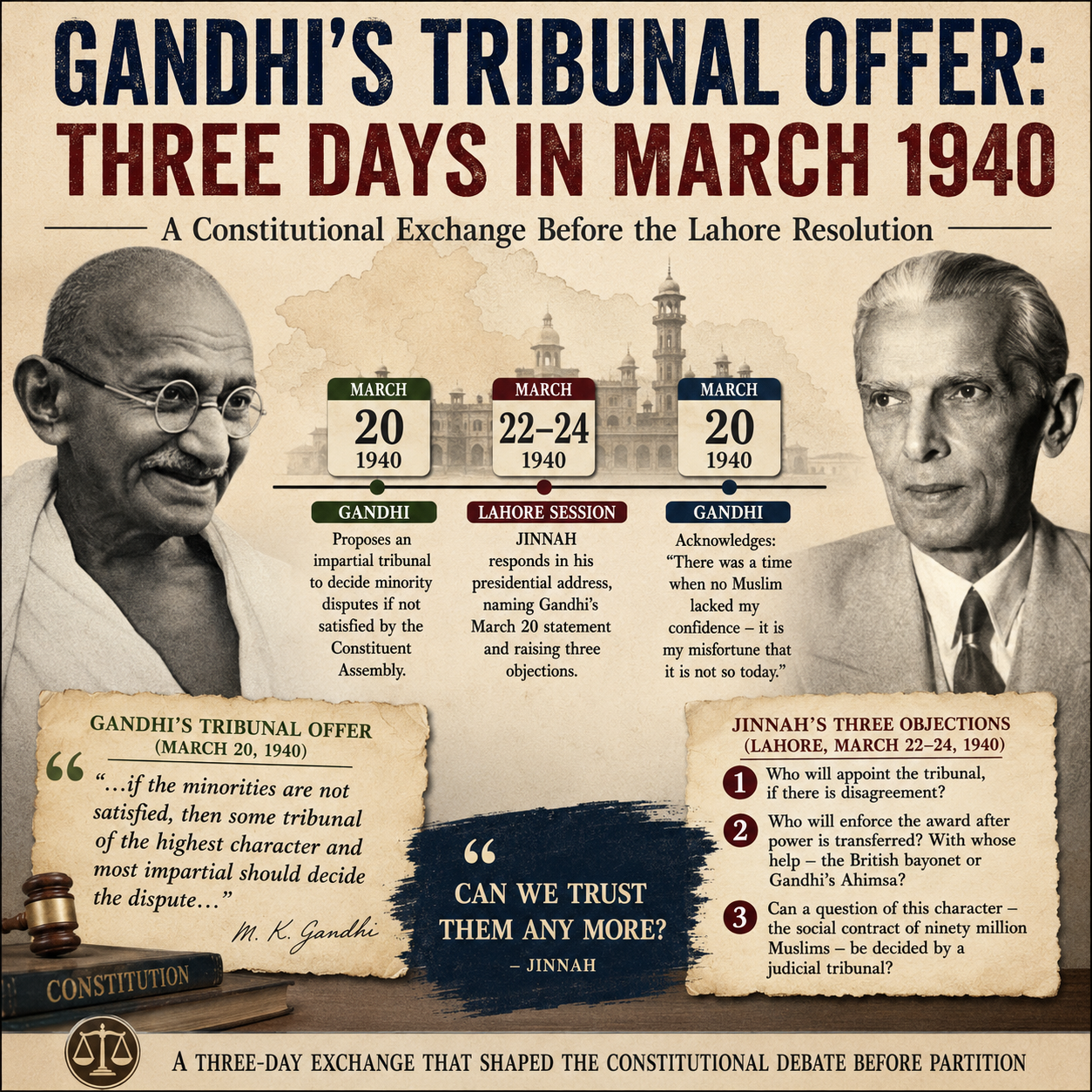
On March 20, 1940 — three days before the Lahore session — Gandhi made a public statement addressing the constitutional question of minority rights. His documented position, as quoted directly in Jinnah’s Lahore presidential address from the primary source at franpritchett.com: if minorities were not satisfied by the decisions of the Constituent Assembly, Gandhi said he was willing that “some tribunal of the highest character and most impartial should decide the dispute.”
Gandhi’s Tribunal Offer places this documented position before the reader precisely. The offer was made in the context of Congress’s wider constitutional proposal: a Constituent Assembly elected on adult franchise, which would frame India’s constitution, with any unresolved minority disputes referred to an independent tribunal. This was Gandhi’s documented framework for addressing the question Jinnah had been raising since 1928 — the same question whose constitutional dimensions had been documented across Blogs 81 through 85, and whose institutional consequences had been documented across Blogs 86 through 93. Gandhi’s Tribunal Offer was the specific mechanism Gandhi had arrived at by March 1940 for resolving what the series has now documented as a twenty-year constitutional dispute with Jinnah — from the 1920 Khilafat objection through the 1928 Calcutta parting of ways to the Lahore session three days away.
Jinnah’s Documented Reply
At Lahore, March 22-24 1940, Jinnah quoted Gandhi’s March 20 statement by date and addressed it directly in his presidential address. The primary source is Jinnah’s full speech, preserved at franpritchett.com.
Jinnah’s documented response raised three specific objections to the tribunal offer. First, who would appoint the tribunal — since in the event of disagreement between the Constituent Assembly majority and the Muslims, the appointing authority itself would be contested. Second, who would enforce the tribunal’s award once the British had transferred power — since, as Jinnah put it, “we come back to the same answer, the Hindu majority would do it; and will it be with the help of the British bayonet or Gandhi’s Ahimsa?” Third, whether a question of this character — the social contract upon which the future constitution of India would be based, affecting ninety million Muslims — could appropriately be decided by a judicial tribunal at all.
Jinnah’s closing documented question on this point, stated directly in the primary source: “Can we trust them any more?” The question was addressed to the audience at Minto Park, Lahore, on March 22-24, 1940 — and it was addressed, by name and by date, to Gandhi’s specific March 20 proposal.
What the Exchange Establishes
Gandhi’s Tribunal Offer places the documented exchange before the reader as a precise, tight, dated record. March 20: Gandhi’s offer. March 22-24: Jinnah’s response, naming the date of Gandhi’s statement and addressing its specific terms.
The prosecution places two observations alongside the exchange. First, Gandhi’s tribunal offer was structurally dependent on the Hindu majority’s good faith for its enforcement — Jinnah’s own documented objection, and one that the documented record of 1937-1939 (Blogs 88, 89, 90) gives specific grounds to assess. Second, the exchange took place within weeks of Gandhi’s own concession (Blog 96) that Muslims possessed the right to self-determination — meaning Gandhi’s framework simultaneously conceded the principle and offered a mechanism that Jinnah documented as inadequate to protect it.
Gandhi Also Said — March 20 1940
Gandhi’s Tribunal Offer places one further documented statement before the reader, also from Gandhi’s March 20 words as quoted by Jinnah at Lahore. Gandhi said: “There was a time when I could say that there was no Muslim whose confidence I did not enjoy. It is my misfortune that it is not so today.”
This documented self-assessment — made three days before Lahore — is placed before the reader alongside the documented record of 1937-1939: the coalition terms, the Mass Contact Programme, the broken assurance, the Day of Deliverance. Gandhi himself placed the loss of Muslim confidence on record. The series does not characterise why that confidence had been lost. The documented record of those three years — Blogs 86 through 93 — is available for the reader to examine alongside Gandhi’s own March 20 acknowledgement that the confidence was gone.
The Prosecution’s Position
Gandhi’s Tribunal Offer places three questions before the reader.
- Did Gandhi’s March 20 1940 proposal offer a mechanism — an impartial tribunal — that was structurally dependent on the good faith of the Hindu majority for appointment and enforcement, as Jinnah’s own documented objection named?
- Did the documented record of 1937-1939 give specific grounds for assessing Jinnah’s documented question — “Can we trust them any more?” — beyond the general claim?
- Did Gandhi’s own March 20 statement acknowledge the loss of Muslim confidence as his “misfortune,” and does the documented record of those years place that acknowledgement in a specific context?
The series does not answer. The primary source is Jinnah’s own Lahore address, quoting Gandhi’s March 20 statement verbatim and responding to it by name. The reader will examine the three-day exchange and complete the sentence.
Invitation To Defence
The floor belongs to the defense. We now invite them to present their exhibits and challenge the narrative established by the prosecution.
March 20, 1940. Gandhi: an impartial tribunal of the highest character shall decide. March 22-24, 1940, Lahore. Jinnah: who will appoint the tribunal, who will enforce its award, can we trust them any more? Gandhi himself: there was a time when no Muslim lacked my confidence — it is my misfortune that it is not so today. The prosecution places the three-day documented exchange before the reader. The reader will complete the sentence.
Feature Image: Click here to view the image.
Videos
Glossary of Terms
- Glossary of Terms
- Tribunal of the Highest Character: Gandhi’s March 20, 1940 proposal that unresolved minority disputes after the framing of India’s constitution should be decided by an impartial and highly respected tribunal.
- Constituent Assembly: A representative body proposed to draft and adopt a constitution for independent India.
- Minority Rights: Constitutional safeguards and protections sought by religious, linguistic, or political minorities within a larger political system.
- Lahore Session (1940): The March 22–24, 1940 annual session of the All-India Muslim League at Lahore, where the Lahore Resolution was adopted.
- Lahore Resolution: The Muslim League resolution adopted in March 1940 that called for autonomous and sovereign Muslim-majority political units in northwestern and eastern India.
- Two-Nation Theory: The political doctrine that Hindus and Muslims constituted two distinct nations with separate political identities and interests.
- Presidential Address: The formal speech delivered by the president of a political organization at its annual session; in this context, Jinnah’s Lahore address of March 1940.
- Self-Determination: The principle that a people or community possesses the right to determine its own political future and constitutional status.
- Adult Franchise: A voting system in which all adult citizens are entitled to vote regardless of property, wealth, or social status.
- Constitutional Dispute: A disagreement concerning political representation, safeguards, powers, or constitutional arrangements within a state.
- Day of Deliverance: The observance called by Jinnah on December 22, 1939 after the resignation of Congress ministries, marking what the Muslim League viewed as relief from Congress rule.
- Mass Contact Programme: Congress’s campaign to establish direct political links with Muslim voters rather than working through the Muslim League leadership.
- Gandhi’s Tribunal Offer: A phrase used in this series to describe Gandhi’s March 20, 1940 proposal for resolving constitutional disputes through an impartial tribunal.
- Three-Day Exchange: A phrase used in this blog series to describe the documented sequence between Gandhi’s March 20, 1940 statement and Jinnah’s March 22–24 response at Lahore.
- Minto Park: The historic Lahore venue where the Muslim League held its 1940 session and adopted the Lahore Resolution.
- Top Searched Short Hashtags
#Gandhi #Jinnah #Pakistan #LahoreResolution #IndianHistory #Congress #MuslimLeague #Partition #Constitution #FreedomMovement #Politics #History #HinduinfoPedia
Gandhi’s Peace Efforts: The Questions Before the Mahatma (0)