
Gandhi’s Broken Assurance: The Coalition Promise That Was Not Honoured (90)
भारत / GB
Part 90: Mahatma Gandhi’s Peace Efforts | Series Index
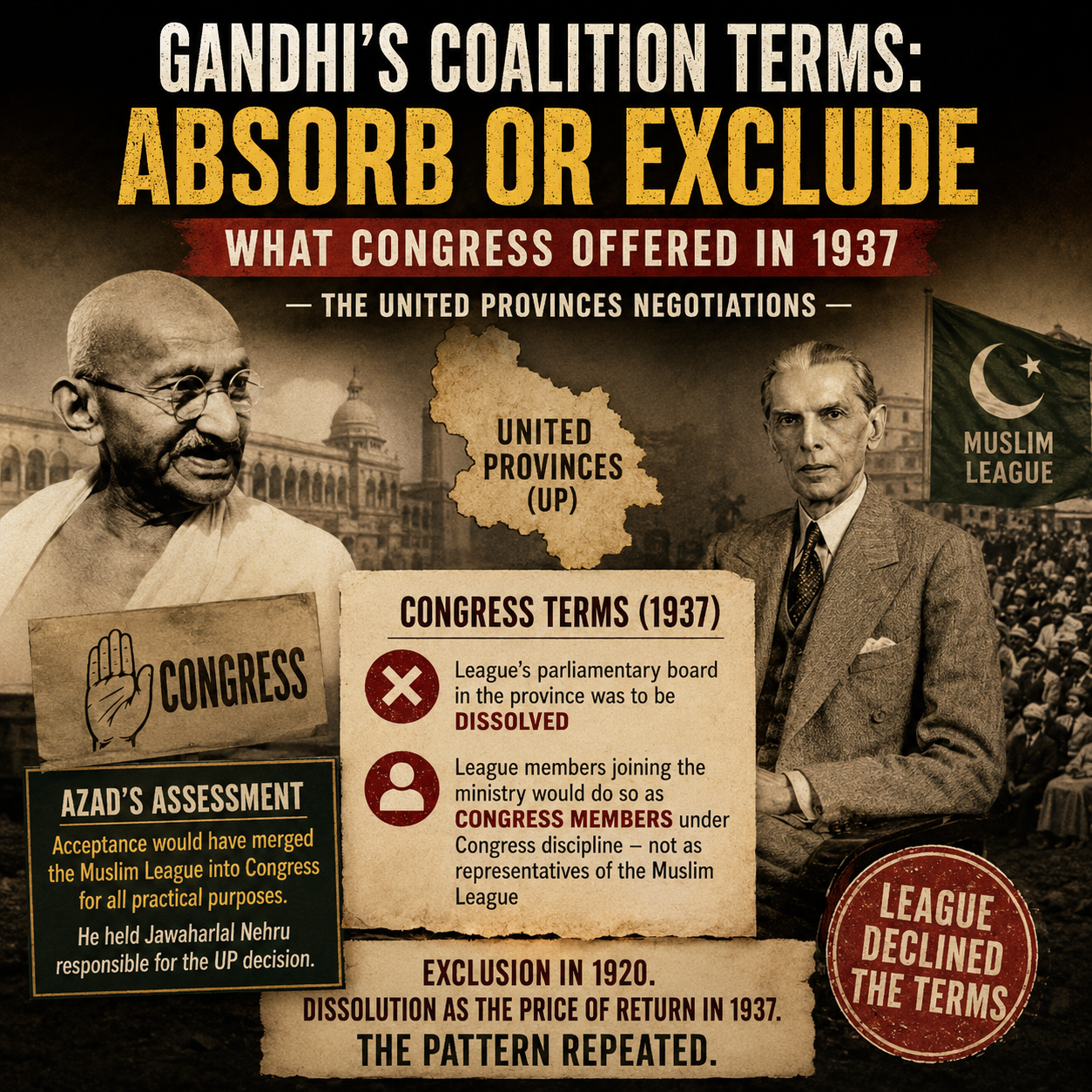
Blog 88 documented the coalition terms Congress required of the Muslim League — dissolution as the price of participation. Blog 89 documented the Mass Contact Programme launched in the same year. This post examines one specific documented fact within that sequence: a named assurance given by Congress’s own President — and not honoured.
Thank you for reading this post, don't forget to subscribe!The Action Taken: Following the sweeping 1937 election victory, the Congress high command rejected a coalition government with the Muslim League in the United Provinces, demanding the League group dissolve and sign the Congress pledge.
Who Paid the Price: Cross-community parliamentary cooperation in northern India, driving the Muslim League into bitter, existential opposition.
The Alternative Bypassed: Forming an inclusive provincial coalition in UP to maintain political fraternity and marginalize separatist elements.
Why This Matters: The decisive catalyst for the Pakistan movement: refusing power-sharing convinced Muslim League leaders that regional majorities would be excluded from governance without separate statehood.
The Documented Assurance — Azad’s Account
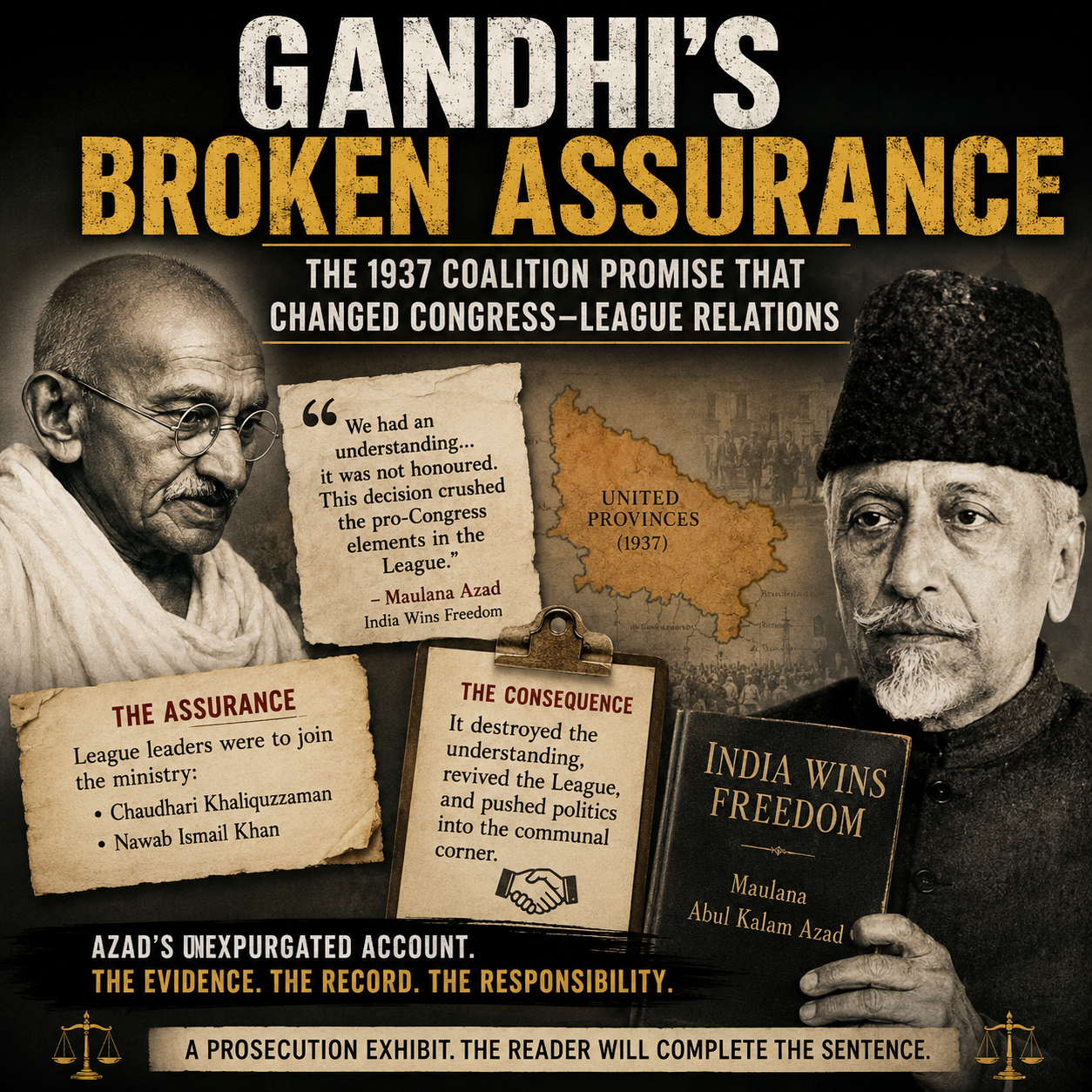
Maulana Abul Kalam Azad’s autobiography, India Wins Freedom, records the following:
Azad had arranged for two senior members of the Muslim League — Chaudhari Khaliquzzaman and Nawab Ismail Khan — to join the United Provinces ministry. Chaudhari Khaliquzzaman was among the most important Muslim League leaders in the United Provinces and one of the figures Azad believed could have helped sustain Congress-League cooperation. He had given assurances to the League on this point. The UP Congress went back on that tacit pre-election understanding for a coalition.
Gandhi’s Broken Assurance places this documented account before the reader with its source clearly identified: Azad was Congress President at the time, an adversary of Jinnah throughout his political life, a lifelong opponent of Partition. This is not a League account of the episode. It is Congress’s own President’s documented account of what Congress did.
Azad’s documented observation that Congress leadership would subordinate their judgments to Gandhi’s stance in the end makes his specific attribution of this decision to Nehru — rather than to Gandhi — a documented fact the reader should weigh carefully.
What the Broken Assurance Produced
Gandhi’s Broken Assurance places the documented consequence before the reader — drawn from the same source, the same autobiography.
The League had cooperated with Congress in some local electoral districts in UP and in return expected coalition participation. The assurance Azad had given created a documented expectation. When that expectation was not honoured, the pro-Congress elements within the League — Khaliquzzaman and Nawab Ismail Khan, the two men Azad had specifically identified — were left without the position they had been promised. The documented consequence: it crushed the pro-Congress elements in the League and forced them into a communal corner. This is Azad’s own documented assessment — not the prosecution’s characterisation.
Azad’s Documented Attribution
Azad’s documented account is precise: he named Nehru, Patel, and Mountbatten. He did not name Gandhi. The series’ standard is placing documented facts before the reader. Rewriting Azad’s documented attribution to assign it to Gandhi would misrepresent the primary source.
Azad documented that Nehru was particularly responsible for creating a gulf of suspicions between Congress and the Muslim League. He identified two specific instances — the 1937 UP decision and Nehru’s 1946 public statement on the Cabinet Mission plan — as the turning points. Azad’s unexpurgated account, published thirty years after his death in 1988, placed responsibility for Partition on Nehru, Patel, and Mountbatten. Gandhi is not in Azad’s documented list.
Gandhi’s Broken Assurance places one documented observation alongside Azad’s attribution: Gandhi held unchallengeable authority over Congress throughout this period — established across Blogs 21-22. The decision that crushed the pro-Congress elements in the League was made under that authority. Azad attributed specific conduct to Nehru. Nehru operated within the organisation Gandhi dominated and whose succession Gandhi controlled — documented in Blog 91.
The Documented Wider Assessment
Azad’s account, in its unexpurgated sections published thirty years after his death in 1988, placed responsibility for Partition on three men: Jawaharlal Nehru, Sardar Vallabhbhai Patel, and Lord Mountbatten. Gandhi is not named in Azad’s list of those responsible for Partition.
Gandhi’s Broken Assurance places this documented fact before the reader without characterisation. Azad — Congress’s own President, who documented the broken assurance and its consequences — did not hold Gandhi personally responsible for Partition in his final documented assessment. The prosecution places this before the reader as part of the complete record. The series documents Gandhi’s specific dated choices. What those choices produced — and who bears responsibility for what followed — is a question the reader will answer having examined the complete record the series places before them. Azad — Congress’s own President, who documented the broken assurance — did not hold Gandhi responsible for Partition in his final documented assessment.
Gandhi’s Broken Assurance places the documented assurance, the documented broken promise, the documented consequence, and Azad’s documented attribution of responsibility before the reader simultaneously — drawn from a single primary source: India Wins Freedom, by Congress’s own President. The series places all of it before the reader — including the documented fact that Azad’s own final assessment did not name Gandhi. The reader will examine the complete documented record and complete the sentence.
One further documented fact: Azad’s account records that most Congress leadership would subordinate their judgments to Gandhi’s stance in the end — yet Azad documented this decision specifically as Nehru’s. The prosecution places both documented facts before the reader: the institutional subordination to Gandhi, and the specific attribution to Nehru. The reader will examine both and complete the sentence.
The Prosecution’s Position
Gandhi’s Broken Assurance places three questions before the reader.
- Did Congress’s own President give a named assurance to two specific Muslim League leaders — Khaliquzzaman and Nawab Ismail Khan — about their inclusion in the UP ministry, and was that assurance not honoured?
- Did the broken assurance produce a documented consequence — the crushing of pro-Congress elements within the League, forcing them into a communal corner — as recorded in Azad’s own account?
- Did Gandhi, whose documented unchallengeable authority over Congress extended over this period, address or reverse the broken assurance — or does the documented record show the consequence running to completion?
The series does not answer. Azad’s documented account is the primary source — written by an adversary of Jinnah who opposed Partition throughout his life and who documented both the broken assurance and its consequences. The reader will examine the broken assurance, the documented consequence, Azad’s attribution of responsibility to Nehru, and Gandhi’s documented unchallengeable authority over the organisation in which these decisions were made — and complete the sentence.
Invitation To Defence
The defence is invited to place its counter-exhibits before the reader, challenging the documented pattern set forth by the prosecution.
1937, United Provinces. Azad arranged for Khaliquzzaman and Nawab Ismail Khan to join the ministry. The UP Congress went back on the tacit understanding. The pro-Congress elements in the League were crushed and forced into a communal corner. Azad’s documented words. Azad’s documented assessment. Congress’s own President. Gandhi held unchallengeable authority over Congress. The prosecution places the documented broken assurance before the reader. The reader will complete the sentence.
Feature Image: Click here to view the image.
Videos
Glossary of Terms
- Maulana Abul Kalam Azad: Senior Congress leader, Congress President, and author of India Wins Freedom, the primary source relied upon in this blog.
- India Wins Freedom: Azad’s political autobiography containing his account of Congress, the Muslim League, Partition, and related political events.
- United Provinces (UP): A British Indian province, later largely becoming the state of Uttar Pradesh, where the 1937 coalition dispute occurred.
- Muslim League: Political organisation led nationally by Jinnah that later became the principal advocate of Pakistan.
- Chaudhari Khaliquzzaman: Prominent Muslim League leader in the United Provinces whom Azad expected to join the coalition ministry.
- Nawab Ismail Khan: Muslim League leader in the United Provinces whom Azad identified as part of the proposed coalition arrangement.
- Coalition Ministry: A government formed by representatives of more than one political party sharing executive power.
- Mass Contact Programme: Congress initiative launched in 1937 to directly reach Muslim voters rather than working through the Muslim League.
- Cabinet Mission Plan: British constitutional proposal of 1946 intended to transfer power while preserving a united India.
- Partition: The 1947 division of British India into India and Pakistan.
- Pro-Congress Elements: Muslim League leaders and supporters whom Azad believed favoured cooperation with Congress.
- Communal Corner: Azad’s description of a political situation in which Muslim League leaders were pushed toward exclusive communal politics.
- Unexpurgated Account: The portions of Azad’s writings published later without earlier restrictions or omissions.
- Broken Assurance: Key phrase used in this blog series to describe Azad’s account of an understanding regarding League participation in the UP ministry that was not honoured.
- Prosecution Exhibit: A recurring series framework in which documentary evidence is presented as part of a structured case for the reader’s evaluation.
#Gandhi #Nehru #Congress #Partition #History #India #Politics #MuslimLeague #UPPolitics #FreedomMovement #Azad #HinduinfoPedia
Gandhi’s Peace Efforts: The Questions Before the Mahatma (0)
Refer to Various Arks Referred to in the Blog