
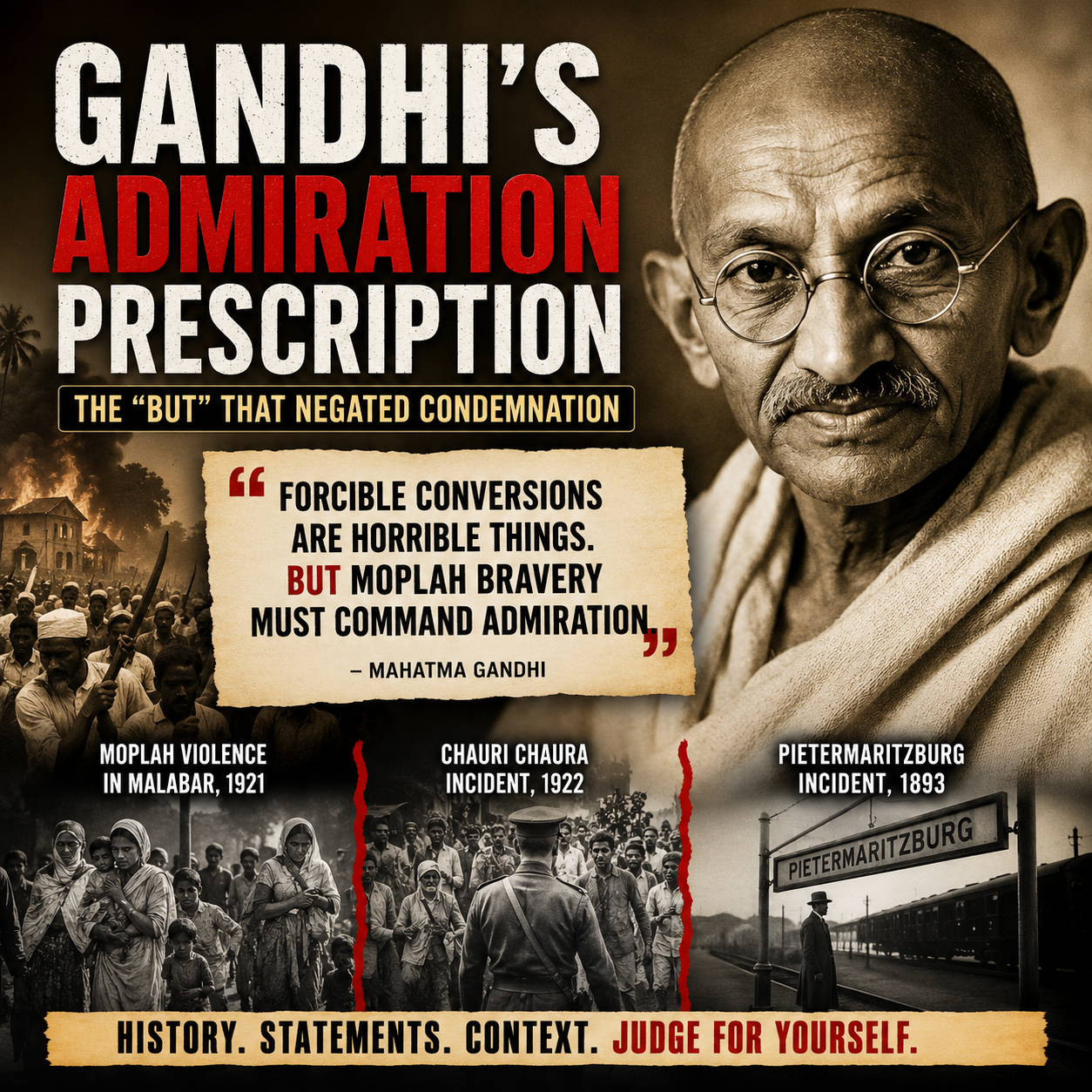
Gandhi’s Admiration Prescription: The “But” That Negated the Condemnation (62)
भारत / GB
Part 62: Mahatma Gandhi’s Peace Efforts | Series Index
Blog 61 placed Gandhi’s own biographical standard before the reader — the force applied to him at Pietermaritzburg he called injustice; the force applied to Hindus in Malabar he called voluntary choice. This post examines the statement that follows immediately — four words of condemnation, one conjunction, an admiration prescription. The prosecution places the statement before the reader word by word. No characterisation is required. Gandhi’s own language is the exhibit.
Thank you for reading this post, don't forget to subscribe!The Action Taken: In official Congress publications, Gandhi paired nominal condemnation of atrocities with an explicit prescription of admiration: “Forcible conversions are horrible things… but how can we help admiring their bravery?”
Who Paid the Price: The victims of the rebellion, whose physical suffering and displacement were politically subordinated to the virtue of anti-colonial religious zeal.
The Alternative Bypassed: An unequivocal moral and political repudiation of communal atrocities committed under the umbrella of Non-Cooperation.
Why This Matters: Documents the syntactical mechanism of appeasement: inserting a qualifying conjunction (“but”) to negate formal condemnation and validate the aggressors’ religious motives.
The Statement — Word by Word
Gandhi’s Admiration Prescription is built on one documented statement — examined word by word, conjunction by conjunction:
“Forcible conversions are horrible things. But Moplah bravery must command admiration.”
The prosecution places each component before the reader:
Forcible conversions are horrible things. — Four words of condemnation. Gandhi acknowledged the act. The word horrible is used. Condemnation appears to be present.
But. — One conjunction. In the English language, “but” introduces a clause that qualifies, limits, or contradicts what precedes it. Gandhi’s condemnation lasted four words. The fifth word negated it.
Moplah bravery must command admiration. — The conclusion. Not an observation — a prescription. Gandhi did not say Moplah bravery *is* admirable. He said it *must command* admiration. The reader is instructed. Admiration is obligatory.
The statement’s architecture: condemnation — negation — admiration prescription. The lasting impression is not the condemnation. It is the admiration. The “but” ensured it.
Additional Statements — The Full Record
The search reveals Gandhi’s Admiration Prescription was not an isolated formulation. Around it, in the same period, Gandhi produced a cluster of documented statements that extended the architecture:
“Their [the Moplahs’] notions of Islam were of a very crude type.” — Gandhi reduced the massacre to a misunderstanding of Islamic theology. The perpetrators were not condemned. They were miseducated.
“Even if one side is firm in doing its dharma, there will be no enmity between the two. He alone may be said to be firm in his dharma who trusts his safety to God and, untroubled by anxiety, follows the path of virtue.” — Gandhi instructed Hindus to trust God while being massacred.
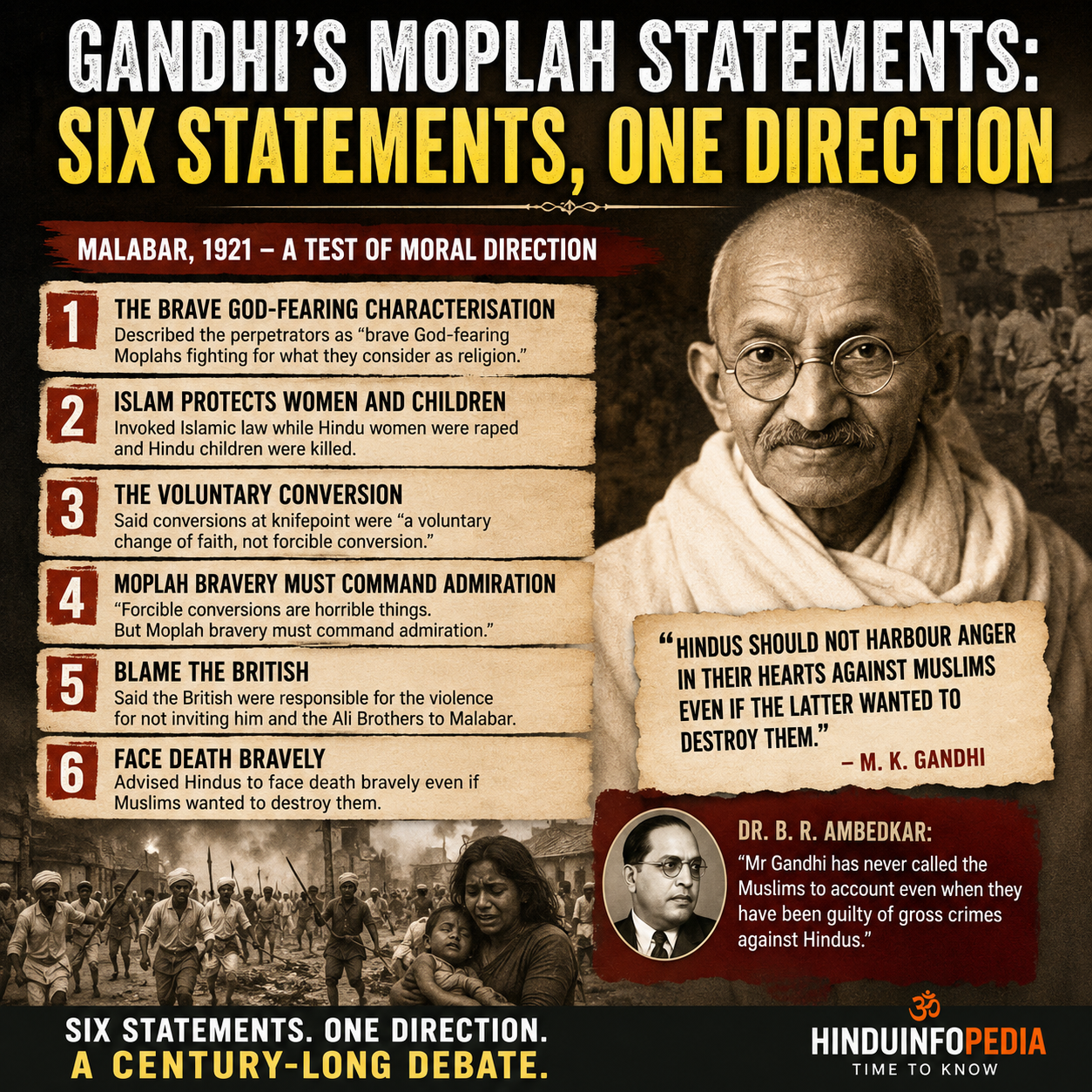
“Hindus must find out the causes of Moplah fanaticism. They will find that they are not without blame.” — Published January 26, 1922. After the massacre had ended. Gandhi told the Hindu victims they were not without blame for the massacre.
“It is no use now becoming angry with the Moplahs or the Muzulmans in general.” — Published January 26, 1922. Hindus were instructed not to be angry.
“Even so is it more necessary for a Hindu to love the Moplah and the Muzulman more when the latter is likely to injure him or has already injured him.” — Published January 26, 1922. Love your attacker more when he attacks you.
“I feel the Moplah revolt has come as a blessing to a system that is crumbling to pieces by the weight of its own enormity.” — Published October 20, 1921. The massacre of 2,500 Hindus came as a blessing.
The prescription Gandhi gave to Hindus — love your attacker more when he attacks you, the massacre came as a blessing, you are not without blame — is placed alongside one documented fact from Gandhi’s own biography. At Pietermaritzburg in 1893, force was applied to Gandhi. He did not call it a blessing. He did not love the white railway official more for throwing him off the train. He did not say he was not without blame for the incident. He called it injustice — and built his entire method from the refusal to accept it. The standard Gandhi applied to himself at Pietermaritzburg was the precise opposite of the standard he prescribed to Hindus in Malabar. The prosecution places both before the reader without characterisation. The reader will note the difference.
The Congress Resolution — Gandhi’s Instrument Confirmed
Gandhi’s Admiration Prescription extended beyond his personal statements. The Congress Working Committee — the organisation the series has documented as subservient to Gandhi’s unilateral authority, incapable of refusing him as Blog 21 documented — passed a resolution on the Moplah massacre that institutionalised Gandhi’s personal position.
The resolution mentioned only three cases of forcible conversion — while the documented evidence showed thousands. It warned the public against believing government and inspired versions of the atrocities. It stated that provocation beyond endurance was given to the Moplahs. Gandhi had already published in Young India that there was only one case of forcible conversion — while his own Muslim contacts informed him he was wrong and forced conversions were numerous in Malabar. Gandhi knew the documented evidence contradicted his published statement. He did not correct it.
The Congress Working Committee did not act independently. It institutionalised what Gandhi had already stated personally. The organisation Gandhi had built to serve his movements served his Moplah position as it had served every other position — without independent judgment, without challenge, without correction. The Congress resolution is not a separate exhibit. It is confirmation that Gandhi’s architecture was not a personal aberration. It was the institutional position of the organisation he controlled.
The Chauri Chaura Contrast
Gandhi’s Admiration Prescription requires the Chauri Chaura contrast — placed precisely, without assertion.
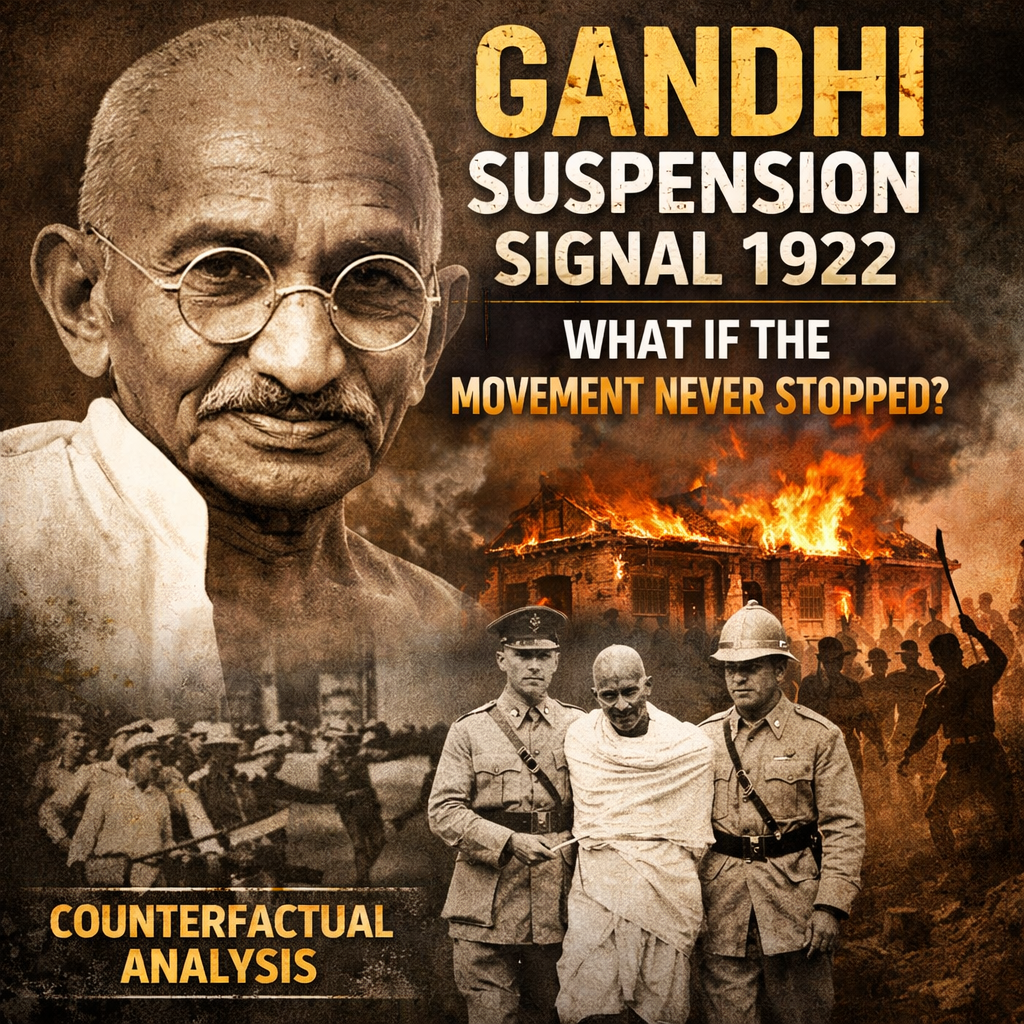
At Chauri Chaura — twenty-two policemen killed, police having fired first — Gandhi used no “but.” He wrote no instruction to Indians to admire the freedom fighters’ bravery. He issued no statement that the killings came as a blessing. He did not say the freedom fighters’ notions of resistance were of a crude type. He did not instruct Indians to love the Chauri Chaura protesters more after the incident.
He dissolved the entire movement in eight days.
The “but” that negated condemnation of Moplah killers was not available for Chauri Chaura. The admiration prescription was not deployed for freedom fighters. The architecture of the statement — condemnation, negation, admiration — operated in one direction only.
The Prosecution’s Position
Gandhi’s Admiration Prescription does not claim Gandhi celebrated the massacre. It places the documented architecture of his statements before the reader — word by word, conjunction by conjunction — and asks the reader to examine what the architecture produced and whose interests it served.
- Does a condemnation negated by “but” constitute a genuine condemnation — or does the “but” negate it?
- Does “must command admiration” prescribe admiration for the men who conducted forcible conversions — or merely observe it?
- Did Gandhi know that forced conversions in Malabar numbered in thousands — and publish that there was only one case?
- Did the Congress Working Committee’s resolution — minimising documented Moplah atrocities to three cases of forced conversion — serve the victims of those atrocities or the alliance that had produced them?
- Did the architecture of Gandhi’s statements — horrible things, but admirable bravery, Hindus are not without blame, love your attacker more, the massacre came as a blessing — serve the preservation of the Khilafat alliance while the massacre was ongoing?
The series does not answer. The statements are documented. The dates are recorded. The Congress Working Committee resolution is on record. The reader will examine the architecture and identify what it was designed to produce.
Forcible conversions are horrible things. But Moplah bravery must command admiration. Hindus are not without blame. Love your attacker more when he attacks you. The massacre came as a blessing. There was only one case of forced conversion — while thousands were documented and Gandhi’s own contacts told him he was wrong. The “but” negated the condemnation. The admiration was prescribed. The correction was never published. The prosecution places the statements before the reader. The reader will identify what the architecture was designed to produce.
Feature Image: Click here to view the image.
Videos
Glossary of Terms
- Pietermaritzburg Incident: The 1893 railway incident in South Africa where Mohandas Gandhi was removed from a train compartment despite holding a valid ticket, later used by him as a foundational example of injustice.
- Moplah Massacre: The 1921 violence in Malabar during the Khilafat period involving killings, forced conversions, displacement, and attacks primarily targeting Hindus.
- Moplahs / Mappilas: A Muslim community of Kerala historically linked to the Malabar region; sections participated in the 1921 rebellion and associated violence.
- Khilafat Movement: A pan-Islamic political campaign launched after World War I to preserve the Ottoman Caliphate, supported in India by Gandhi and Congress leadership.
- Admiration Prescription: A term coined in this series describing Gandhi’s formulation where condemnation was followed by language prescribing admiration for the perpetrators’ bravery.
- Condemnation–Negation–Admiration Architecture: A phrase coined in this series referring to the rhetorical structure identified in Gandhi’s statement: condemnation first, negation through “but,” and admiration afterward.
- Young India: Gandhi’s English-language weekly journal used to publish political opinions, movement guidance, and responses to national events.
- Congress Working Committee (CWC): The principal decision-making body of the Indian National Congress, responsible for resolutions and strategic political direction.
- Chauri Chaura Incident: The 1922 event in Uttar Pradesh where protesters killed twenty-two policemen, after which Gandhi suspended the Non-Cooperation Movement.
- Forcible Conversion: Religious conversion conducted under coercion, threat, violence, or compulsion rather than free consent.
- “But” Negation Principle: A key phrase used in this blog to argue that Gandhi’s conjunction “but” diluted or reversed the force of the initial condemnation.
- Admiration Mandate: A phrase coined in this series referring to Gandhi’s wording that Moplah bravery “must command admiration,” interpreted as prescriptive rather than descriptive.
- Malabar: A historical region in present-day Kerala that became the centre of the 1921 Moplah violence and Khilafat-related unrest.
- Non-Cooperation Movement: Gandhi-led anti-colonial movement launched in 1920 advocating boycott of British institutions, titles, and cooperation.
- Prosecution’s Position: A recurring structural phrase in this series presenting arguments in the style of a legal prosecution, placing documented statements before the reader for judgment.
#Gandhi #Moplah #Khilafat #Malabar #Congress #History #Conversions #Kerala #India #HinduinfoPedia
Scan Through The Entire Series
Gandhi’s Peace Efforts: The Questions Before the Mahatma (0)
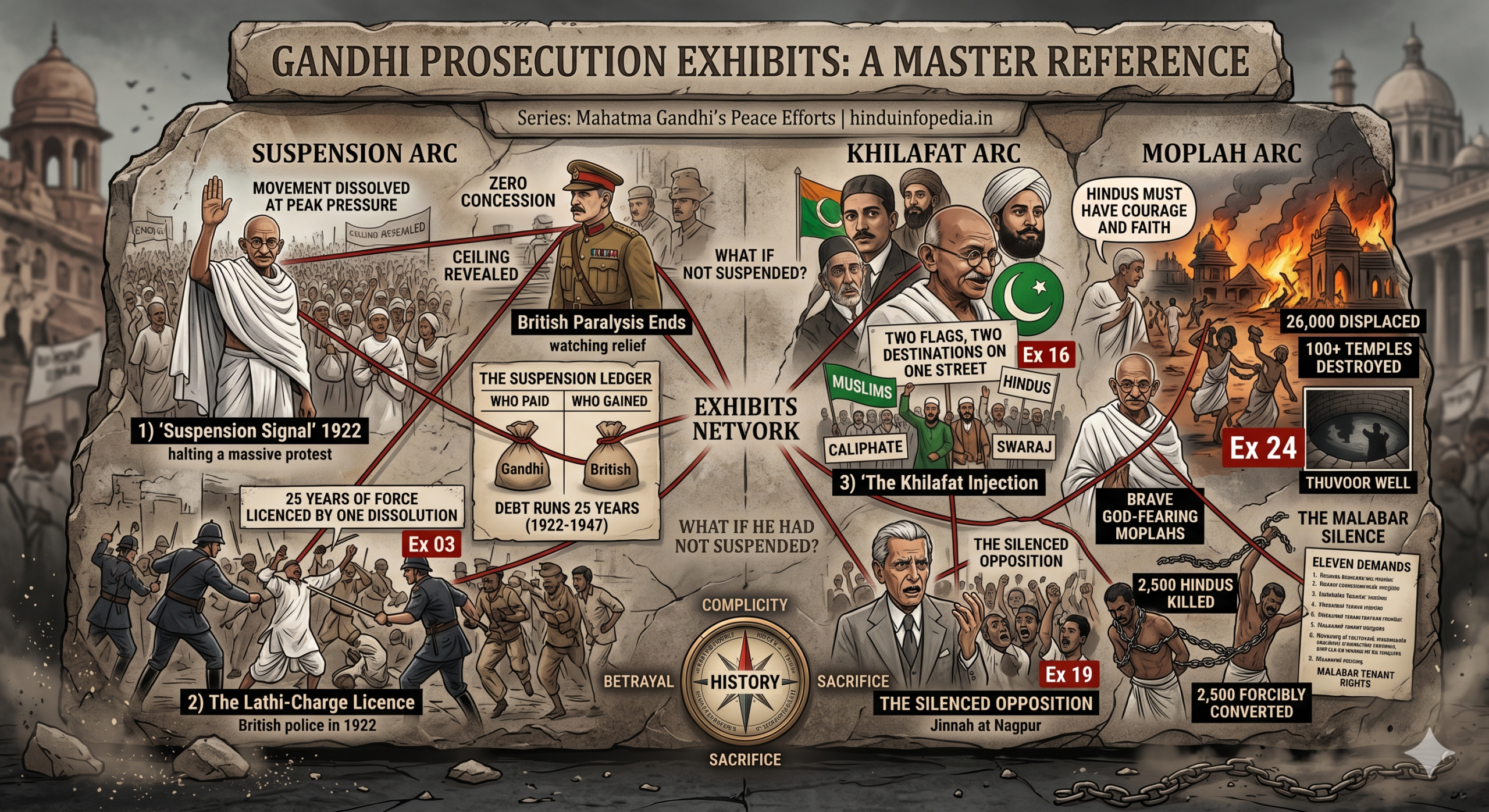
Read The Prosecution Exhibits Through Links
Gandhi’s Admiration Prescription: The “But” That Negated the Condemnation (62)