
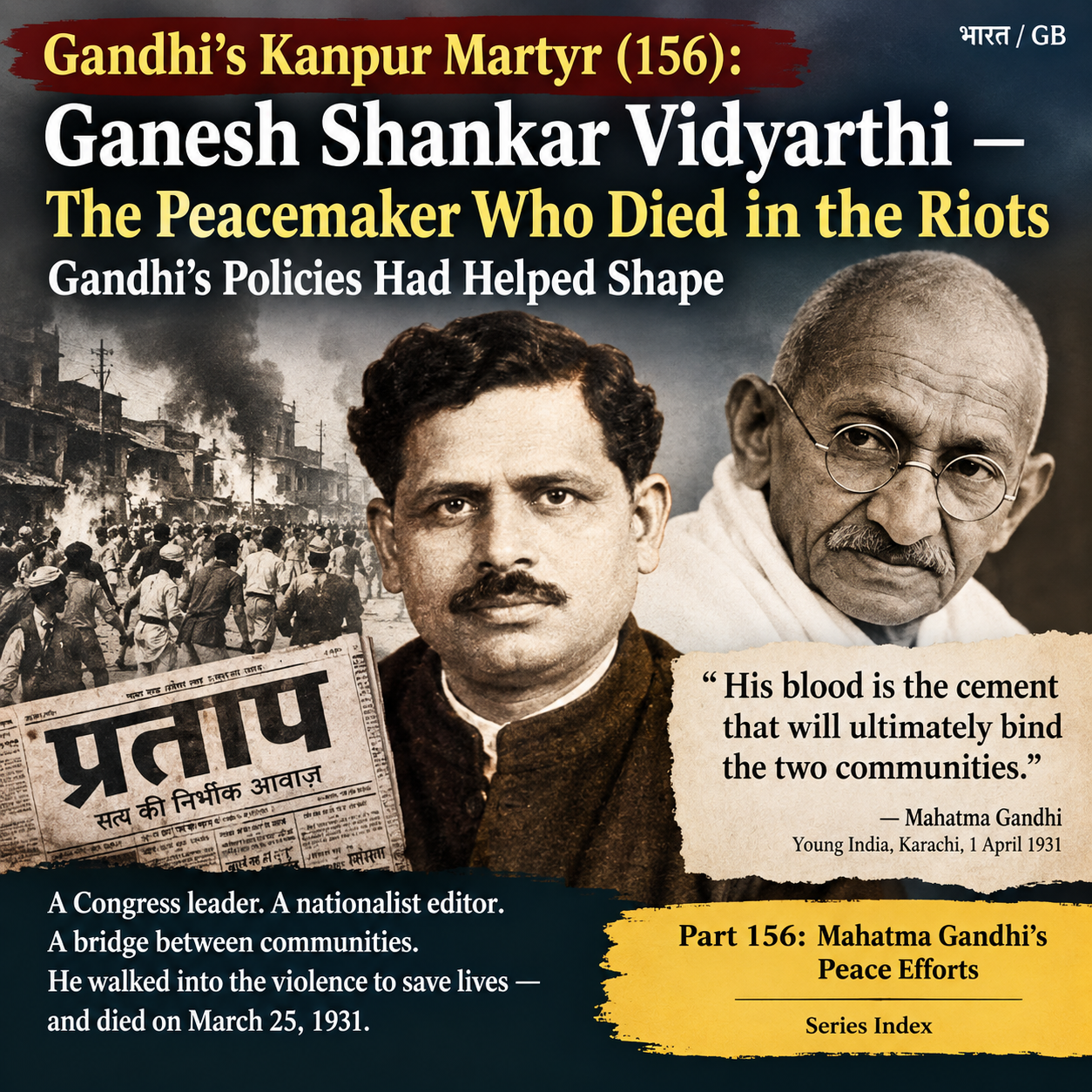
Gandhi’s Kanpur Martyr: Ganesh Vidyarthi And Gandhi’s Policies (156)
भारत / GB
Part 156: Mahatma Gandhi’s Peace Efforts | Series Index
Blog 155 placed Gandhi’s documented Kohat Fast before the reader — the 21-day fast, the Unity Conference, the outcome that left 3,500 Hindus permanently displaced. This post, Gandhi’s Kanpur Martyr, places a individual before the reader: Ganesh Shankar Vidyarthi — the editor who walked into communal violence in Kanpur in March 1931, saving lives from both communities, and did not come out. This blog places what Gandhi’s documented communal framework produced for one individual alongside what Gandhi’s framework prescribed.
Thank you for reading this post, don't forget to subscribe!The Action Taken: The series compiled the complete master register of primary sources, colonial dispatches, and CWMG texts underpinning the first 155 installments, categorizing every exhibit across the seven pillars.
Who Paid the Price: Any assertion that the prosecution rests on ideological polemics, refuted by an exhaustive statutory paper trail.
The Alternative Bypassed: Unstructured narrative storytelling without verifiable archival citations.
Why This Matters: Establishes the retrievable evidence base for the entire series, demonstrating that every charge is rooted in contemporary documentary records.
The Documented Man
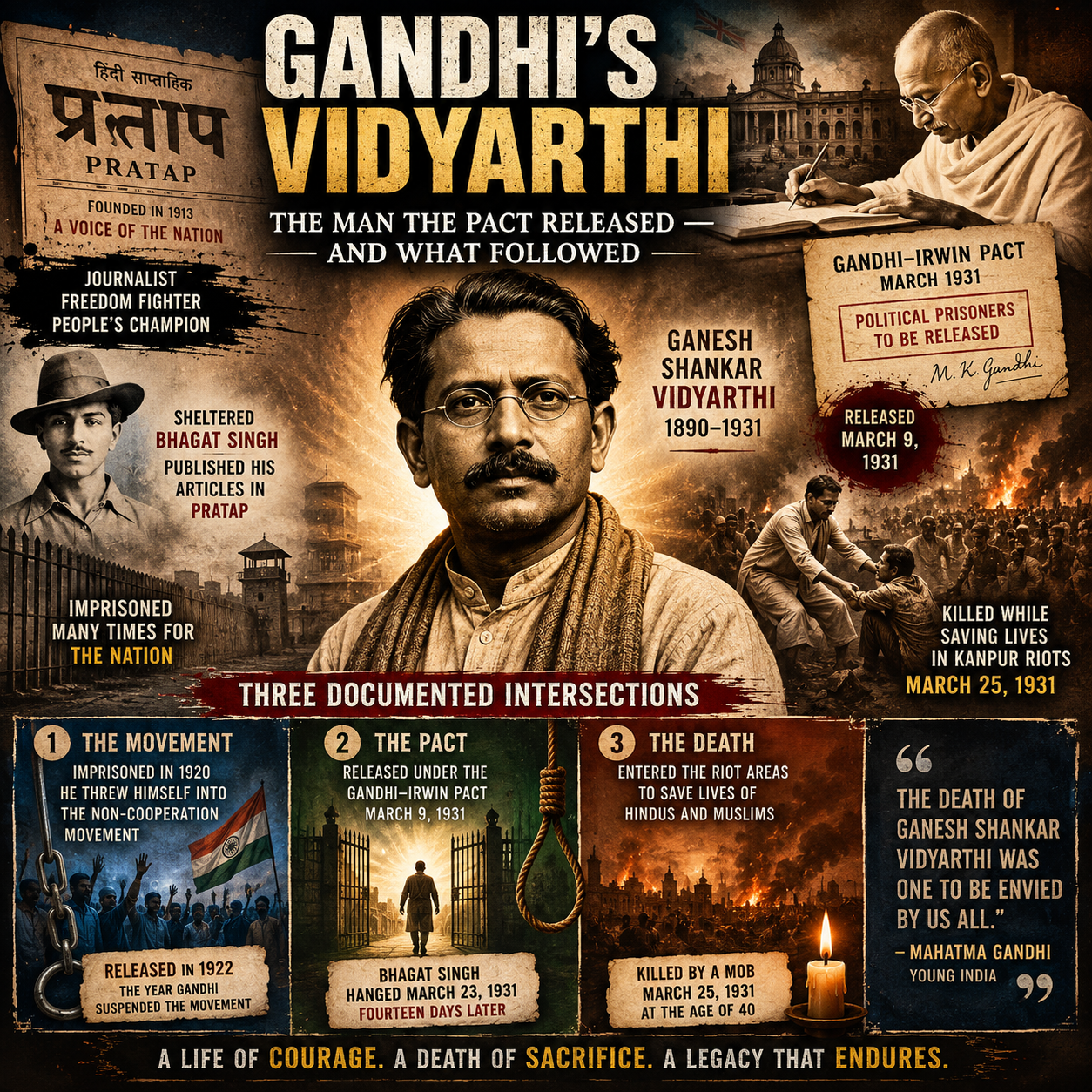
Gandhi’s Kanpur Martyr places Ganesh Shankar Vidyarthi before the reader. Vidyarthi was the editor of Pratap — the Hindi-language newspaper from Kanpur that gave platform to voices Gandhi’s press would not carry. Established in Blog 71 of this series: Vidyarthi gave Bhagat Singh a platform. He published what Gandhi’s Congress press would not. He was an independent voice within the nationalist movement — operating outside Gandhi’s Congress framework.
Vidyarthi was a secular nationalist. His commitment was to Hindu-Muslim unity — not as an abstract principle, but as a daily practice. He had relationships with individuals from both communities across Kanpur.
The Documented Context — March 1931
Gandhi’s Kanpur Martyr places the March 1931 context before the reader. The Kanpur communal riots of March 1931 had an immediate trigger: on March 23 1931, Bhagat Singh, Sukhdev, and Rajguru were hanged. Congress cadres enforced a hartal — a strike to mourn the execution. The enforcement of the hartal produced friction between communities in Kanpur that ignited into communal violence. The riots thus carried a direct connection to the hanging Gandhi had not made a condition of the Gandhi-Irwin Pact signed eighteen days earlier — established in Blog 26 of this series.
The broader communal landscape into which this trigger fell was the product of the decade the series has placed before the reader: the Khilafat compact of 1920, the riot cascade that followed the Khilafat collapse — established in Blog 116 of this series — and the continued communal violence that Gandhi’s Unity Conference and Kohat fast had not halted. The immediate trigger was Bhagat Singh’s hanging. The ground it fell on had been prepared across a decade.
The Documented Death
Gandhi’s Kanpur Martyr places the facts of March 25 1931 before the reader.
Vidyarthi walked into the communal violence. He moved between Hindu and Muslim areas — trying to protect individuals from both communities. Documented accounts, including the testimony of Vimla Vidyarthi compiled by Salil Misra, establish that Vidyarthi rescued Muslim women and families before he was killed trying to rescue Hindu victims. Weapons were distributed targeting him specifically.
Vidyarthi was found disfigured beyond recognition. He was killed on March 25 1931 — in the communal violence that the secular nationalist had walked into trying to prevent.
Gandhi’s Documented Response
Gandhi’s Kanpur Martyr places Gandhi’s documented public response to Vidyarthi’s death before the reader. Gandhi’s Young India response is placed before the reader in full. The truncated version carried in hagiographical accounts reads: “His blood is the cement.” The full statement continues: “The poison has however gone so deep that the blood even of a man so great, so self-sacrificing and so utterly brave as Ganesh Shankar Vidyarthi may today not be enough to wash us of it.”
The full statement establishes two things the truncated version does not. First, Gandhi acknowledged that Vidyarthi’s blood — the death of a man who walked into communal violence to protect lives from both communities — was not enough. The poison was too deep. More would be needed. Second, Gandhi characterised the death as enviable while simultaneously acknowledging it had produced nothing — the poison remained.
The prosecution places the full statement alongside what followed. The series has placed that record before the reader: Great Calcutta Killings 1946, Noakhali 1946, Partition 1947, Kashmir 1989-90. More blood came. The sacrifices continue till date in independent India after about eight decades. The prosecution asks the reader to examine what the full statement — “may not be enough” — established about Gandhi’s framework for what the documented Hindu community was required to sacrifice before the poison would be washed.
The Documented Contrast
Gandhi’s Kanpur Martyr places one contrast before the reader.
Gandhi’s prescription to Hindu victims of communal violence: brave death, soul-force, “die with a smile”. The subject is covered in later blogs in more details.
Vidyarthi’s practice: physical presence in communal violence, rescue of individuals from both communities, death in service to peace.
Gandhi characterised Vidyarthi’s death as enviable. The prosecution places this characterisation alongside the contrast: Gandhi prescribed brave death from distance. Vidyarthi practised brave presence — and died. Gandhi’s characterisation of the death as enviable is placed alongside Gandhi’s absence from Kanpur during the riots.
The Documented Cement
Gandhi said “His blood is the cement.” The prosecution places this characterisation alongside the record that followed — not to assert that Gandhi caused what came after, but to place the metaphor against the structure it was supposed to build.
The full documented statement placed the bar explicitly: the blood of “a man so great, so self-sacrificing and so utterly brave” was not enough. The poison required more. The series has placed the record of what followed before the reader: Great Calcutta Killings 1946, Noakhali 1946, Bihar riots 1946, Partition 1947, Kashmir 1989-90, Muzaffarnagar 2013, Sandeshkhali 2024. The prosecution places the documented “may not be enough” alongside this record — and asks the reader to examine what the documented requirement of more sacrifice, placed against the documented scale of what followed, established about Gandhi’s framework.
The prosecution places Gandhi’s documented word — “cement” — alongside what the cement produced. The reader examines what a cement that built this record establishes about the metaphor. The series does not characterise. It places the word and the record side by side.
The Prosecution’s Position
Gandhi’s Kanpur Martyr places three questions before the reader.
- Does the communal landscape of Kanpur in March 1931 — placed alongside the documented series record of the documented Khilafat compact, the documented riot cascade, the documented communal dispersal, and the documented failed Unity Conference — constitute an exhibit the reader places alongside Gandhi’s role in producing that communal landscape?
- Does Gandhi’s characterisation of Vidyarthi’s death as documented enviable — “His blood is the cement” — placed alongside Gandhi’s documented prescription to Hindu victims of brave death from documented documented distance, constitute an exhibit the reader places alongside what brave presence documented cost Vidyarthi?
- Does the man who walked into communal violence, rescued individuals from both communities, and died doing it — placed alongside the Father of the Nation who characterised his death as enviable from distance — constitute an exhibit the reader places alongside Gandhi’s prescriptions of soul-force and brave death to others?
The series does not answer. Gandhi’s Kanpur Martyr places the man, the death, the documented response, and the contrast before the reader. The reader will examine what the documented gap between Gandhi’s documented prescription and Vidyarthi’s documented practice established — and complete the sentence.
Invitation To Defence
The floor belongs to the defense. We now invite them to present their exhibits and challenge the narrative established by the prosecution.
March 25 1931: Ganesh Shankar Vidyarthi walked into communal violence in Kanpur. Rescued Muslim women. Killed trying to rescue Hindu victims. Disfigured beyond recognition. Gandhi’s documented response: “His blood is the cement.” Gandhi’s documented prescription to documented others: brave death, soul-force, die with a smile. The man who practised what Gandhi prescribed — from documented presence rather than documented distance — died doing it. The prosecution places the contrast before the reader. The reader will complete the sentence.
Feature Image: Click here to view the image.
Videos
Glossary of Terms
- Ganesh Shankar Vidyarthi: Congress leader, nationalist editor of Pratap, and advocate of Hindu-Muslim unity who entered the Kanpur communal violence of March 1931 to rescue people and was killed on March 25, 1931.
- Pratap: The Hindi-language newspaper edited by Ganesh Shankar Vidyarthi, known for giving a platform to nationalist and revolutionary voices, including Bhagat Singh.
- Kanpur Riots: Communal violence that erupted in Kanpur in March 1931, involving killings, arson, attacks and displacement in Hindu and Muslim localities.
- Gandhi-Irwin Pact: The March 1931 agreement between Mahatma Gandhi and Viceroy Lord Irwin that led to the suspension of the Civil Disobedience Movement and the release of specified political prisoners.
- Khilafat Compact: The term used in this series for Gandhi’s political alliance with the Khilafat leadership during the early 1920s and its integration with the Non-Cooperation Movement.
- Riot Cascade: A term used in this series for the documented spread and recurrence of communal riots following the collapse of the Khilafat political alliance.
- Unity Conference: The documented conference associated with Gandhi’s efforts to address Hindu-Muslim communal tensions, including the appeal for communal peace examined in the preceding series entries.
- Kohat Fast: Gandhi’s documented 21-day fast associated with the communal crisis following the Kohat violence and the subsequent efforts at Hindu-Muslim reconciliation.
- Soul-force: Gandhi’s principle of meeting injustice and violence through moral courage, self-suffering and non-retaliation rather than physical violence.
- “Die with a smile”: A key phrase examined in the series describing Gandhi’s prescription that victims of communal violence should accept suffering and even death without retaliation.
- “His blood is the cement”: Gandhi’s description of Vidyarthi’s sacrifice, expressing the belief that his blood would ultimately help bind Hindus and Muslims together.
- Communal Landscape: A key phrase in this series describing the political, social and violent conditions surrounding Hindu-Muslim relations, rather than treating an individual riot as an isolated event.
- Brave Presence: A phrase used in this blog to describe Vidyarthi’s physical intervention in communal violence, including his efforts to rescue people from both communities.
- Prosecution: The series’ method of placing documented words, actions, events and consequences before the reader as exhibits for examination rather than presenting an academic historical narrative.
- Mahatma Gandhi’s Peace Efforts: The series in which this blog appears, examining Gandhi’s documented methods, prescriptions and actions in relation to communal peace and violence.
#Gandhi #Vidyarthi #Kanpur #KanpurRiots #Pratap #BhagatSingh #GandhiHistory #CommunalViolence #HinduMuslim #HinduinfoPedia
Scan Through The Entire Series at
Gandhi’s Peace Efforts: The Questions Before the Mahatma (0)
Refer to Various Arks Referred to in the Blog