
Gandhi’s Succession Design: How the Unchallengeable Chose His Heir (26)
भारत / GB
Part 26: Mahatma Gandhi’s Peace Efforts | Series Index
While analysing Mahatma Gandhi’s philosophies on the freedom struggle—including the initiation of satyagraha and the exit therefrom—his unchecked authority without a formal mandate has been examined in the previous blogs; Blog 25, in particular, dissected his stance on the continuation of the British Raj versus opposition to it. Building on this, the Authority Arc has documented four key elements: the absence of institutional mandate across defining decisions; the four-stage construction of unchallengeable authority; the bureaucratic circular that formalised it; and the three mechanisms through which it operated in practice. This post turns to the final act—the succession—where authority that could not be voted out ultimately chose who would govern independent India, setting aside the democratic verdict of the Congress organisation in favour of one man’s expressed preference.
Thank you for reading this post, don't forget to subscribe!The Action Taken: The Karachi Congress session was convened under tight management to ratify the Delhi Pact as a completed transaction before delegates could mount organized opposition.
Who Paid the Price: Prisoners excluded under the “violence” clause who served full terms, and peasants whose sold lands remained lost.
The Alternative Bypassed: Open floor debate and amendment of the pact terms by elected Congress delegates.
Why This Matters: Demonstrates how leadership authority was deployed to ratify compromise settlements after the fact, leaving followers to absorb unaddressed legal and financial penalties.
The Last Unilateral Decision
Gandhi’s Succession Design was the final exercise of the authority this arc has documented across four posts. It was also the most consequential. Every previous unilateral decision — the launch of Non-Cooperation, the Chauri Chaura suspension, the Irwin Pact negotiations, the Poona Pact fast — had determined the course of the independence movement. None of them determined who would govern India after independence. This one did.
In 1946, the Indian National Congress held elections for its president. The Congress president at this moment was not a ceremonial position. With independence approaching, the Congress president was the figure who would lead the negotiation of the transfer of power and, in all likelihood, become the first prime minister of a free India.
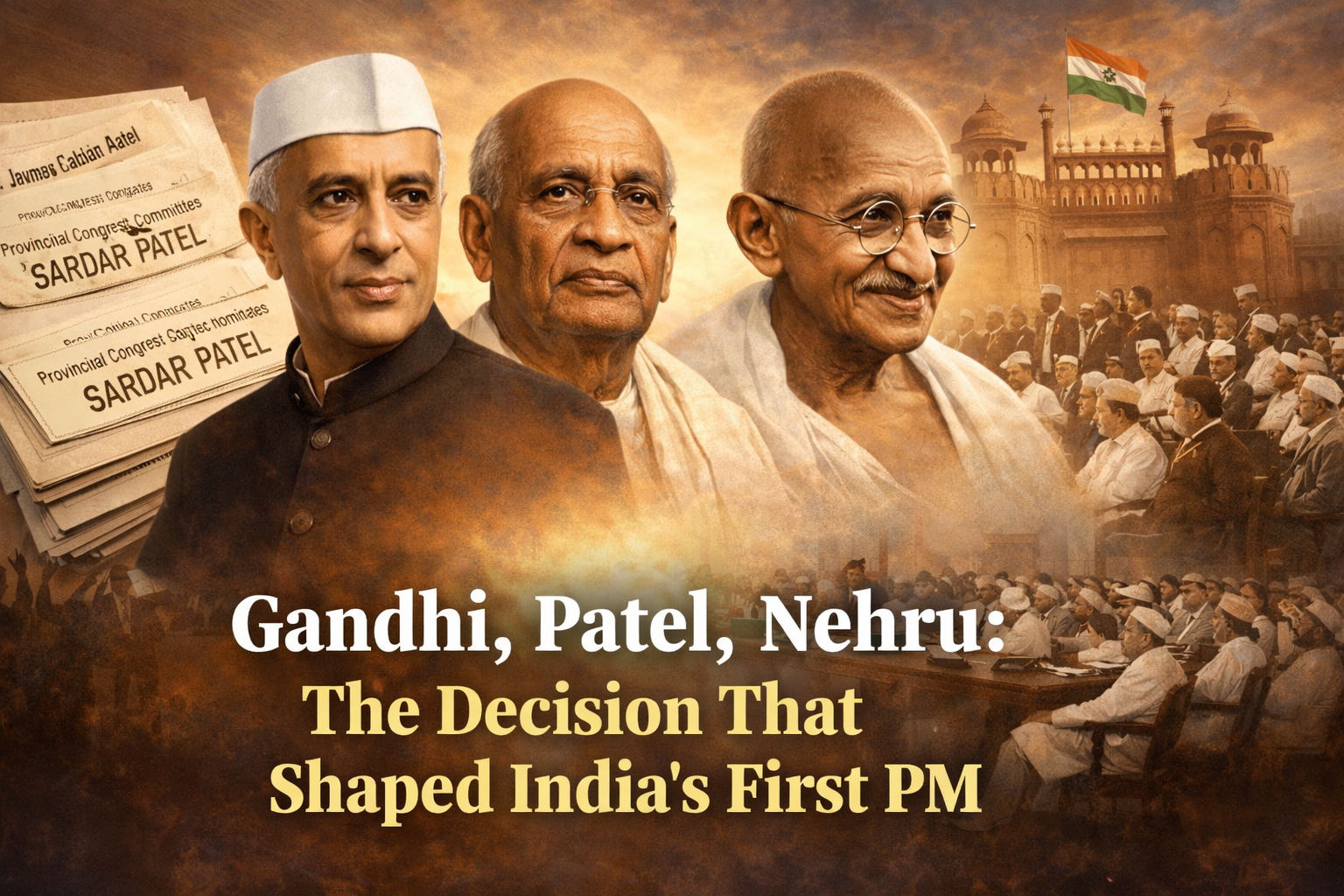
The Congress organisation conducted its vote. Twelve of fifteen Provincial Congress Committees nominated Vallabhbhai Patel. The democratic verdict of the organisation was clear. Patel had earned it through three decades of administrative and organisational work — the integration of the Indian National Congress into a functioning mass organisation, the management of the civil disobedience campaigns at the provincial level, the hardest political labour of the independence movement conducted in the spaces between Gandhi’s headline acts.
Gandhi expressed his preference for Jawaharlal Nehru. Patel withdrew. Nehru became Congress president. Nehru became independent India’s first prime minister.
What Patel Had
Vallabhbhai Patel’s claim to the Congress presidency in 1946 was not sentimental. It was institutional — the most institutionally grounded claim the independence movement’s history had produced for any contested position.
Twelve of fifteen Provincial Congress Committees — the elected bodies of the Congress organisation across India’s provinces — had nominated Patel. This was the Congress organisation exercising the only mechanism it had for expressing a democratic preference: the provincial bodies doing what provincial bodies existed to do, recommending the candidate they judged most fit for the role.
Patel had been the Congress’s organisational backbone for two decades. He had managed the Kheda and Bardoli satyagrahas — the ground-level campaigns that required not inspiration but logistics, not moral authority but administrative precision. He had run the Congress’s provincial operations during the periods when Gandhi was in prison and the organisation had to function without its symbolic leader. He had delivered the provincial election victories of 1937 that gave the Congress its first taste of governmental power.
If the independence movement had an administrator — the person who had built and maintained the machine that Gandhi inspired but did not operate — it was Patel. The twelve Provincial Congress Committees had made a judgement about who should lead the transition from movement to government. That judgement was the only democratic verdict the situation had produced.
What Gandhi Had
Gandhi held no institutional position in 1946 that gave him authority over the Congress presidency.
He had resigned from Congress membership in 1934 — a decision he had framed as allowing the organisation’s internal diversity to express itself without being suppressed by the weight of his presence. He had not rejoined. In 1946, Gandhi was not a Congress member. He was not a Provincial Congress Committee member. He was not a Congress Working Committee member. He held no position that gave him a formal role in the selection of the Congress president.
What Gandhi had was the authority this arc has documented — the moral sanctity that made institutional challenge structurally impossible, the unelected mandate that had operated above the Congress’s formal mechanisms for three decades, the unchallengeable position that had survived every attempt at institutional override from the Swaraj Party in 1922 to Subhas Chandra Bose in 1939.
The operating method was consistent. Gandhi expressed a preference. The institutional verdict was set aside. The expressed preference became the outcome. The mechanism that had overridden Motilal Nehru’s opposition to the Chauri Chaura suspension, overridden Das’s opposition to the Non-Cooperation framework, overridden Bose’s electoral victory in 1939, now overrode twelve Provincial Congress Committees in 1946.
Patel withdrew. He did so without public complaint. He understood, as every serious politician in the Congress had understood for three decades, that the mechanism could not be fought.
Lajpat Rai had named it in 1922: defeat in proportion to the greatness of the leader. In 1946 the proportion was the prime ministership of India.
The Design in the Decision
Gandhi’s Succession Design was not a conspiracy. There is no document in which Gandhi calculated the consequences of the Nehru choice and chose it for strategic reasons. The prosecution does not make that claim and does not need to. What the documentary record shows is something more precise — the consistent application of the authority across every institutional decision, producing the same structural outcome each time, right up to the last act.
Gandhi’s stated reasons for preferring Nehru were consistent with his stated values: Nehru was younger, had an international profile, understood the modern world in ways that the transition to independence would require. These were defensible reasons. They were also reasons that Gandhi expressed as a preference — not as an institutional argument, not as a candidate standing before a vote, but as the wish of the man whose wishes the institution could not override.
The pattern across the four satyagrahas had produced the same structure each time: a stated reason that was defensible, a decision that served the authority’s continuity, an outcome that the institution ratified. Gandhi’s Succession Design followed the identical pattern. The stated reason — Nehru’s suitability — was defensible.
The mechanism — personal expression of preference by the one figure the institution could not refuse — was the same mechanism that had operated across three decades. The outcome — the Congress organisation setting aside its own democratic verdict — was the institution doing what it had always done.
The succession was not designed in the sense of a calculated plan. It was designed in the sense that the authority that produced it had been constructed, consolidated, formalised, and operated for thirty years through mechanisms that made this outcome the only available one.
What Independent India Received
Gandhi’s Succession Design determined the political architecture of independent India at its founding moment. The person who would have been selected by the Congress organisation’s democratic process — the administrator, the builder of institutions, the man who had delivered the organisational infrastructure on which Gandhi’s movements depended — stepped aside.
The person who became prime minister was Gandhi’s preference, installed by the same authority that had operated without institutional mandate across every previous defining decision.
What independent India did with that inheritance is a question outside this series’ scope. The prosecution’s interest ends at the moment of the decision, not its consequences. The series documents the pattern. The pattern is complete.
The Authority Arc — four blogs, one argument — has documented Gandhi’s Succession Design as the final expression of an authority nobody had elected, nobody could remove, and the institution could not override even when twelve of its fifteen provincial bodies had already voted.
The next post leaves the Authority Arc and returns to the consequences of the Irwin Pact — what the prisoners found when they came out of jail, and what remained of the movement that had put them there.

Twelve of fifteen Provincial Congress Committees had voted. The democratic verdict of the organisation Gandhi had never been elected to lead was set aside by one man’s expressed preference. Patel withdrew. The authority that had overridden every institutional challenge across three decades overrode the democratic verdict on its last day of relevance. Gandhi’s Succession Design was not an exception to the pattern. It was the pattern’s final proof.
Feature Image: Click here to view the image.
Videos
Glossary of Terms
- Indian National Congress: The principal political organisation leading India’s freedom movement and central to leadership decisions before independence.
- Provincial Congress Committees (PCCs): Regional units of the Congress that nominated candidates for organisational leadership, reflecting internal institutional preference.
- Congress President (1946): The head of the Congress at a critical time, widely expected to lead negotiations and become independent India’s first prime minister.
- Vallabhbhai Patel: Senior Congress leader known for organisational strength and administrative leadership within the independence movement.
- Jawaharlal Nehru: Prominent Congress leader who became Congress president in 1946 and later India’s first prime minister.
- Mahatma Gandhi: Central figure in India’s freedom struggle whose moral authority influenced major political decisions.
- Satyagraha: A method of non-violent resistance used in India’s freedom movement, led prominently by Gandhi.
- Chauri Chaura Incident: A 1922 घटना where a protest turned violent, leading Gandhi to suspend the Non-Cooperation Movement.
- Poona Pact: A 1932 agreement between leaders on representation for depressed classes within the electoral system.
- Congress Working Committee (CWC): The executive body of the Congress responsible for key organisational decisions.
- Institutional Mandate: Formal authority granted through organisational or electoral processes.
- Authority Arc: The analytical framework used in the series to trace the development and exercise of Gandhi’s influence over time.
- Succession Decision (1946): The process through which Congress leadership transitioned, ultimately determining India’s first prime minister.
#Gandhi #Nehru #Patel #Congress #India #History #Freedom #Politics #Independence #HinduinfoPedia