
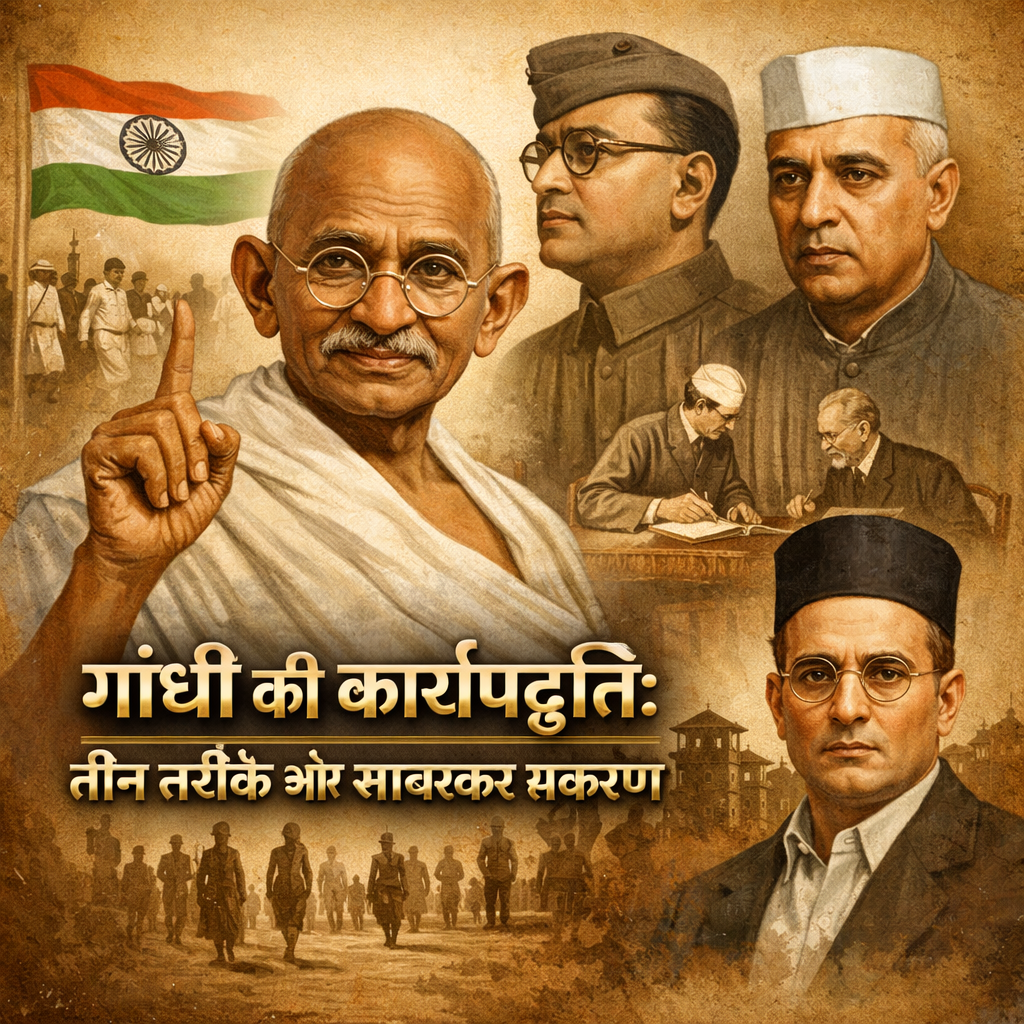
Gandhi’s Operating Method: The Savarkar File and the Pattern (24)
भारत / GB
Part 24: Mahatma Gandhi’s Peace Efforts | Series Index
Blog 22 established that Gandhi’s authority derived from moral sanctity rather than election or appointment. Blog 23 followed the bureaucratic circular of 1938 into the thirteen months that followed it. This post examines how Gandhi’s Operating Method operated in practice — the specific method by which decisions were made, dissent was managed, and the independence movement’s most precisely documented exhibit was produced in a single published article.
Thank you for reading this post, don't forget to subscribe!The Action Taken: Gandhi publicly argued for the release of the Savarkar brothers on the condition that they renounce complete independence from the British Empire.
Who Paid the Price: The revolutionary wing of the movement, whose members were denied unconditional nationalist legal and political support.
The Alternative Bypassed: Broad-based cross-factional solidarity against colonial imprisonment regardless of ideological alignment.
Why This Matters: Documents the application of selective advocacy, reserving unconditional backing for those adhering strictly to his personal doctrine while withholding it from ideological rivals.
The Method, Not the Mandate
Gandhi’s Operating Method is not the story of the authority’s construction — that was Blog 22. It is not the story of the authority’s formalisation — that was Blog 23. It is the story of how the authority, once established, was applied to specific decisions with specific documented outcomes. The method was consistent. It operated across four decades. And it left a paper trail.
Blog 22 noted that every major liberation leader of the twentieth century operated within institutional structures that could in principle challenge them. Lenin reported to the Bolshevik Central Committee. Mao was purged twice before 1966 — proof that the institution had the mechanism to act. Ho Chi Minh worked through collective Viet Minh leadership. Castro through the structures of the Cuban revolutionary government. De Gaulle through a government-in-exile with its own institutional form.
Gandhi had no equivalent institutional check. But the method was not arbitrary. It was precise. It operated through three consistent mechanisms that the documentary record allows us to name.
The Three Mechanisms
Mechanism One — The Unilateral Declaration
Gandhi announced the Non-Cooperation Movement on August 1, 1920 without prior consultation with Congress leaders. He suspended it on February 12, 1922 without consulting the Congress Working Committee. He presented the eleven demands to Lord Irwin on January 31, 1930 without a CWC mandate. He negotiated the Irwin Pact across eight meetings in February 1931 while the CWC was imprisoned and unavailable.
In each case the institution ratified after the fact. The Karachi Congress of March 29–31, 1931 endorsed the pact Gandhi had signed on March 5. The Bardoli CWC resolution of February 1922 accepted the suspension Gandhi had already announced. The method was consistent: act first, receive ratification, call the ratification endorsement.
The unilateral declaration was not recklessness. It was Gandhi’s Operating Method at its most efficient. A mandate requires negotiation. Negotiation produces compromise. Compromise produces an outcome no single person controls. The method produced outcomes one person controlled — and the institution confirmed them because it had no mechanism to do otherwise.
Mechanism Two — The Moral Veto
When institutional challenge did occur, the response was not counter-argument but moral withdrawal. The Swaraj Party, formed by Motilal Nehru and C.R. Das after the Chauri Chaura suspension, entered the legislative councils Gandhi had told the movement to boycott. Gandhi’s response was not to debate the merits. He eventually gave Congressmen the choice to affiliate or not — a studied neutrality that expressed disapproval without direct confrontation, while making clear that his own position had not changed.
The Bose case is the purest example of the moral veto. Bose won the Congress presidency in 1939 against Gandhi’s preferred candidate.
Gandhi declared that Bose’s opponent’s defeat was his own defeat — a statement of personal injury, not institutional argument. Gandhi’s supporters in the Working Committee then resigned en masse, making the presidency unworkable. Bose resigned. Gandhi had vetoed an institutional decision without casting a vote, filing a motion, or invoking any formal procedure. The moral withdrawal was the procedure.
Gandhi’s supporters in the Working Committee then resigned en masse, making the presidency unworkable. Bose resigned. Gandhi had vetoed an institutional decision without casting a vote, filing a motion, or invoking any formal procedure. The moral withdrawal was the procedure.
This veto had physical consequences: stripped of institutional protection, Bose was forced into a life-threatening escape from India. The exclusion—and the state’s pursuit—did not end with the British; the pattern of institutional persecution continued well after independence and even until 2014, when the secret documents were finally released and Netaji was honored with the dignity the method had long denied him.
Mechanism Three — The Accommodation Pattern
A third mechanism ran beneath the first two — a consistent approach to those who might otherwise have become organised opposition. The method was to accommodate the individual while preserving the structural position. Potential opponents were drawn into Gandhi’s framework — given roles, given recognition, given the language of the movement — in ways that simultaneously honoured and contained them.
The pattern across the four satyagrahas shows this mechanism operating at scale: the Gujarati merchant community accommodated in the South Africa settlement, the Congress lawyer class accommodated in the Champaran framework, the moderate Congress leadership accommodated in the Non-Cooperation architecture. Each accommodation simultaneously integrated a potential source of resistance and ensured that integration occurred on Gandhi’s terms, within Gandhi’s moral framework, and with Gandhi’s authority intact.
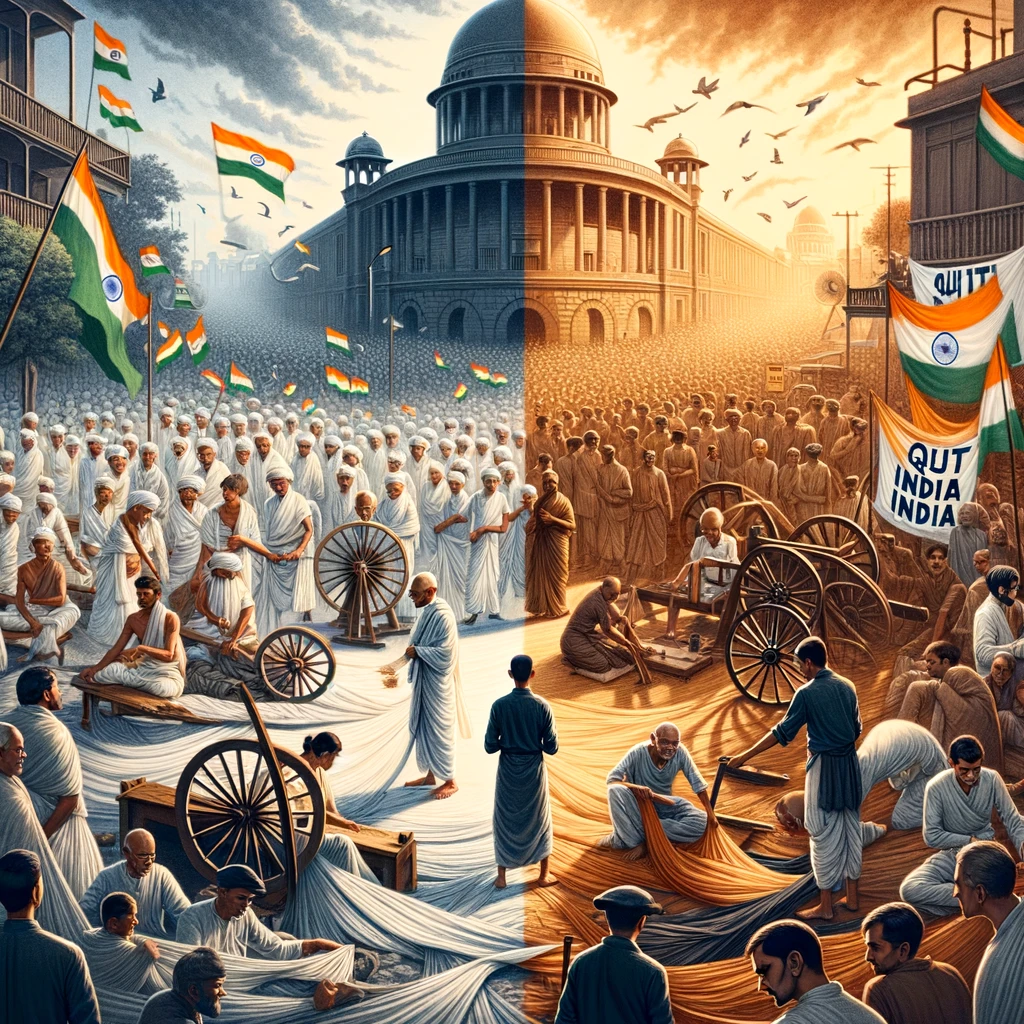
The Savarkar File
Gandhi’s Operating Method produced many documented exhibits. The Savarkar file is the most precise — because it is not an inference from a pattern, not an interpretation of an outcome, not a reading between lines. It is a published article in Gandhi’s own journal, in his own words, on a specific date, making a specific argument that the documentary record does not permit to be reframed.
The background: Vinayak Damodar Savarkar had been transported to the Cellular Jail in the Andaman Islands in 1911, sentenced to fifty years for sedition and conspiracy. He had filed mercy petitions in 1911, 1913, 1914, and 1918 — all rejected. By 1920, his brother Narayan Savarkar was seeking support for a renewed effort at release.
January 25, 1920 — The Advisory
Narayan Savarkar wrote to Gandhi seeking guidance on how to frame the petition. Gandhi replied on January 25, 1920. The advice, documented in the Collected Works of Mahatma Gandhi, Volume 19, was to frame the matter as “purely political” — to remove any framing that could be read as a continued threat to the colonial order.
The advice was practical. It was also the first documented application of the method to the Savarkar question — accommodation within the colonial framework as the instrument of relief, rather than direct confrontation with the authority that had imposed the sentence.
May 26, 1920 — The Article
Four months later, Gandhi published an article in Young India. The date is May 26, 1920. The argument is documented in the Collected Works of Mahatma Gandhi, Volumes 19 and 20.
Gandhi argued publicly for Savarkar’s release. The grounds he cited were that the Savarkar brothers had declared they “do not desire independence from the British connection.”
Read that sentence in its context. The date is May 26, 1920. Gandhi would launch the Non-Cooperation Movement in August 1920 — demanding Swaraj, the end of British rule. He was, at the moment of writing, among the most prominent voices in the Indian independence movement. And his public argument for the release of a prisoner was that the prisoner had renounced independence.
The independence movement’s leader publicly cited renunciation of independence as justification for the release; this reading interprets that choice as significant.
This is a published argument. The interpretation offered here is drawn from the explicit wording of that argument in a published journal on a documented date, available in the Collected Works, and it says precisely what it says.
What the Savarkar File Reveals
The independence movement’s leader published an argument, in his own journal, on a documented date, using renunciation of independence as the justification for a prisoner’s release. The article is in the Collected Works. The argument is in the article. Gandhi’s Operating Method is interpreted here from what is present in print.
The prosecution does not claim that Gandhi’s intervention on Savarkar’s behalf was wrong. A man had been in the Andaman Islands for nearly nine years. Seeking his release was a human act. The prosecution’s interest is in the argument Gandhi chose to make — and what that choice reveals about the method.
The method can be inferred from the choice of argument. Not: release him because the imprisonment is unjust. Not: release him because fifty years for political activity is disproportionate. Not: release him because the trial was compromised. But: release him because he no longer threatens the connection.
This can be read as the accommodation mechanism in its most compressed form. In this interpretation, the accommodation produces the relief, and the relief appears contingent on that accommodation. The person seeking relief provides the ideological concession the colonial authority requires. The method facilitates the transaction and lends it the moral weight of his name and journal.

Anticipated Critiques and Replies
Counter:
The Pattern in the File
The Savarkar file is presented here as part of a broader pattern, not an isolated exhibit. It is the accommodation mechanism documented at the level of a single transaction — a prisoner, a petition, a published argument — which is precisely why it closes the Authority Arc.
The pattern across the four satyagrahas shows accommodation operating at scale: entire communities, entire classes, entire political formations drawn into Gandhi’s framework on terms that delivered partial outcomes while preserving the authority of the man at the centre. The pattern appears consistent across the cases presented, The Savarkar file shows the same mechanism in its minimum unit — one article, one argument, one date, one sentence.
The three mechanisms this blog has named — the unilateral declaration, the moral veto, the accommodation pattern — are not separate instruments. They are three expressions of the same underlying method: the exercise of authority that derives from moral sanctity rather than institutional mandate, applied to specific decisions in ways the institution could not check, producing outcomes the institution then ratified as its own.
The Authority Arc closes with one final question. If no institution granted the authority, and no vote could remove it, and the method produced the outcomes the documentary record shows — who chose the successor? The next post examines the last unilateral decision: Patel had the votes, Gandhi had the word.
The independence movement’s leader published an argument, in his own journal, on a documented date, using renunciation of independence as the justification for a prisoner’s release. The article is in the Collected Works. The argument is in the article. Gandhi’s Operating Method does not need to be inferred. It is there, in print, in Volume 19.
Feature Image: Click here to view the image.
Videos