
Gandhi’s Four Satyagrahas: Four Battles, Four Betrayals (10)
भारत / GB
Part 10: Mahatma Gandhi’s Peace Efforts | Series Index
Nine posts have traced Gandhi from Inner Temple to Dandi — the making of the method, the building of the mass, and the assembling of a chemical bomb that could have dissolved an empire. Before the series moves forward, it pauses to open the ledger. Four battles. Four stated goals. Four outcomes. The numbers do not lie.
The Action Taken: Across four major campaigns, mass civil movements were halted at or near peak pressure without achieving their stated baseline objectives.
Who Paid the Price: Grassroots volunteers who absorbed baton charges, property forfeiture, and prison terms, and had no voice in the decisions to stop.
The Alternative Bypassed: Collective democratic direction through satyagraha committees or the Congress Working Committee.
Why This Matters: Confirmed a structural pattern: mobilization produced immense leverage, which was repeatedly discharged through narrow compromise pacts that preserved leadership standing while leaving underlying administrative structures unaltered.
The Ledger
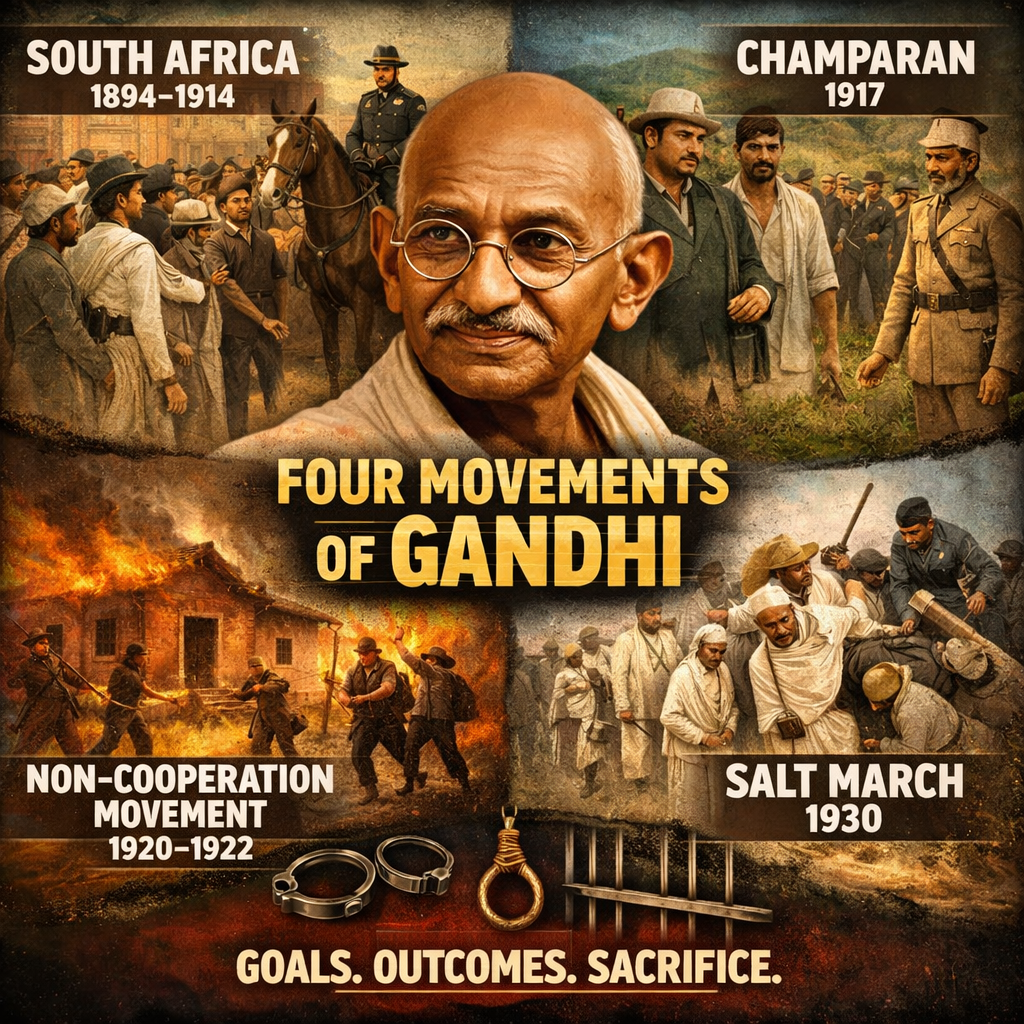
Gandhi’s Four Satyagrahas were the four defining acts of his public career — South Africa, Champaran, Non-Cooperation, and the Salt March. Each was announced with a stated goal. Each produced an outcome. Each enhanced Gandhi’s authority. Each settlement stopped short of the structural change required by its stated goal and, more often than not, imposed additional costs on those who had borne the movement.
Thank you for reading this post, don't forget to subscribe!This post does not argue. It accounts. Gandhi’s Four Satyagrahas — one ledger, four entries.
Act One — South Africa (1894–1914): Method Formation
Stated Goal
Equal rights for Indians in South Africa — the first of Gandhi’s Four Satyagrahas and the crucible in which the method was formed.
The Instrument
The Natal Indian Congress, founded 1894. The ambulance corps in the Boer War and the Zulu Rebellion — blood paid as a price for rights. The Great March of 1913 — Tamil indentured workers finally mobilised alongside the merchant class. Twenty-one years of petitions, campaigns, and satyagraha.
Process
Direct engagement with indentured workers followed by mobilisation into coordinated strike action.
Actual Outcome — 1914 Indian Relief Act
The Indian Relief Act secured: recognition of Indian marriages under Hindu and Muslim law, abolition of the £3 tax imposed on ex-indentured workers. The merchant class received legal property rights and family law recognition.
What the Act did not secure: the indentured system itself remained intact. The Tamil workers who had marched in 1913—and whose suffering had sustained two decades of petitions—remained legally bonded when Gandhi left Durban in July 1914. The system would not fall until 1917 — through campaigns led by others, after Gandhi had departed.
Who Are Other Beneficiaries
The Gujarati trading community secured a more stable and regulated labour environment. Gandhi emerged with public recognition as a practitioner of satyagraha, transitioning from a barrister representing commercial interests to a political figure of wider standing.
Who Paid / Who Was Paid
The Passenger Indian merchant class — who had funded the NIC from 1894 — received the legal infrastructure they had required: marriages recognised, properties secured, £3 tax waived. The indentured Tamil labourer — who had provided the moral currency for every petition — received the waiver and an intact system of bonded labour.
The method forged in South Africa—petition, mobilisation, and negotiated settlement—was now carried into India and applied to a local grievance with sharper administrative focus.
Act Two — Champaran (1917): Method Adapted to India
Stated Goal
Relief for the indigo farmers of Bihar — victims of the tinkathia (three katha compulsory farming of indigo in 20 katha) system that forced them to cultivate indigo on a fixed portion of their land at prices set by European planters. Gandhi asked for a 50% refund of the illegal levies extracted over decades.
The Instrument
The walking investigation. Thousands of affidavits. Refusal to leave when ordered. The Champaran Agrarian Committee formation. The most rigorous ground-level documentation of his public life.
Process
Ground-level investigation through mass affidavits, followed by administrative engagement and negotiated settlement with the planters under official oversight.
Actual Outcome
The planters agreed to a 25% refund — half of what Gandhi had demanded. The tinkathia obligation was abolished. Gandhi accepted the reduced figure, stating that securing the principle mattered more than the amount.
What the settlement did not secure: the underlying tenancy structure that had produced the wrong remained intact. The Indian zamindars — landlords whose system of rack-renting and coercive levy operated independently of the indigo question — were not addressed. The landless agricultural labourer, below even the tenant farmer in Bihar’s rural hierarchy, was not in the settlement at all.
Gandhi’s principal lieutenants in Champaran — Rajendra Prasad and Brajkishore Prasad — were lawyers from landowning families whose own class position sat comfortably above the tenant farmers whose affidavits they were filing.
Other Beneficiaries
The colonial administration secured a controlled resolution to agrarian unrest without wider disruption. Local legal elites associated with the inquiry expanded their political standing through proximity to the process.
Who Paid / Who Was Paid
The tenant farmers received 25 paise for every rupee taken from them. The system that had taken the rupee remained in place. From a contained agrarian intervention, the method expanded to a nationwide scale—no longer addressing a single grievance, but attempting coordinated withdrawal across institutions. In effect, the settlement left the tenancy and zamindari framework intact, leaving its structure undisturbed beyond Champaran.
Act Three — Non-Cooperation (1920–1922): Nationwide Scaling
Stated Goal
Swaraj — self-rule — within one year. Gandhi announced this explicitly at the launch of the movement in December 1920. The mechanism: total withdrawal of Indian cooperation from British institutions — schools, courts, titles, goods, services, elections.
The Instrument
The largest organised civilian uprising in colonial history. Students leaving schools, lawyers leaving courts, 30,000 in jail by end of 1921. The Tilak Swaraj Fund — one crore rupees subscribed within months. The Prince of Wales greeted by empty streets. The British government visibly shaken and confronted with a united Indian front for the first time.
Process
Coordinated withdrawal from colonial institutions—schools, courts, titles, and goods—combined with mass mobilisation and voluntary compliance across regions.
Actual Outcome
Chauri Chaura incident was not an isolated flashpoint, protesters at Chauri Chaura in Gorakhpur attacked a police station and killed 22 policemen. On February 12, Gandhi unilaterally suspended the entire Non-Cooperation Movement. No consultation with Congress leaders. No conditions negotiated with the British. No partial achievement secured before the suspension. The movement, which had nearly brought the government to its knees by November 1921, was called off completely.
Swaraj was not achieved. No constitutional advance was extracted. No timeline was secured. The movement was not paused — it was ended. The next phase retained the mass scale but shifted strategy—replacing diffuse boycott with a single, universally accessible trigger designed to synchronise action across the country.
Other Beneficiaries
The colonial state regained administrative control following the abrupt suspension of the movement. Gandhi consolidated personal authority by demonstrating the capacity to both mobilise and halt mass action.
Who Paid / Who Was Paid
172 people from Chauri Chaura were initially sentenced to death for the police station attack — later reduced to 19 executions and 110 life imprisonments. The millions who had gone to jail, left schools, abandoned practices, and burned their wardrobes received nothing measurable from the British in return for their sacrifice. Gandhi received the moral authority of a man who had demonstrated he could stop a revolution as easily as he could start one — which, to the British, was the most valuable thing he had ever shown them.
The Chauri Chaura incident was not an isolated flashpoint. In Bareilly, police firing during Non-Cooperation protests resulted in casualties among demonstrators. In Nankana Sahib, the 1921 gurdwara massacre—arising within the same cycle of mobilisation—saw scores of unarmed reformers killed. These incidents, less central in the national narrative, reflect the wider spread of violence and repression accompanying the movement.

Act Four — The Salt March (1930): Peak Synchronised Deployment
Stated Goal
Abolition of the salt tax. Purna Swaraj — complete independence.
Instrument
The march from Sabarmati to Dandi, transforming a single act of salt law violation into a nationwide trigger for civil disobedience
Process
A symbolic law breach initiated through a long march, designed to trigger decentralised civil disobedience across regions around a universally accessible commodity.
Actual Outcome
The chemical bomb ran at peak potency through 1930. 60,000 went to jail. The colonial administration lost control of multiple provinces simultaneously. Then the movement was halted — the salt tax was not abolished, Purna Swaraj was not achieved, the Round Table Conference produced nothing. The salt tax remained on the statute books until 1947.
Other Beneficiaries
The British administration re-engaged on negotiated terms through formal dialogue. Gandhi secured international visibility, including recognition as Time magazine’s Man of the Year and a seat at the Round Table Conference in London as an equal of the Empire.
Who Paid / Who Was Paid
60,000 went to jail. The salt tax for which they went to jail remained.
Repression was not confined to arrests alone. At Dharasana Salt Works, unarmed volunteers were systematically beaten during attempts to breach the works, with international observers documenting the brutality. In Peshawar, the Qissa Khwani Bazaar massacre saw troops fire on crowds, with casualties among demonstrators who refused to disperse. These episodes, among others, indicate that the cost of the movement extended well beyond imprisonment.

Gandhi’s Four Satyagrahas: The Pattern
Four battles. Four stated goals. Four outcomes.
In South Africa, the stated goal was Indian rights. The outcome was merchant property rights and a Tamil labourer still bonded.
In Champaran, the stated goal was farmer relief. The outcome was 25% of what was owed, the zamindari system intact and the landless invisible and the landless invisible.
In Non-Cooperation, the stated goal was Swaraj in one year. The outcome was the movement suspended unilaterally at its peak, no gains extracted, 172 Chauri Chaura defendants sentenced to death.
In the Salt March, the stated goal was abolition of the salt tax and Purna Swaraj. The outcome was the the salt tax remaining, repression absorbed, and a seat in London.
Each act mobilised millions. Each settlement delivered a fraction of the stated goal. Each departure left Gandhi’s authority larger than it had been at the start. Each time, the people who had paid the price received the fraction. Gandhi received the authority.
Gandhi’s Four Satyagrahas will surface again across this series as each subsequent exhibit is examined — the pattern they establish is the lens through which every later act becomes legible. The series now examines what that accumulated authority was used for — beginning with the movement that first established the template of communal compromise that would define the next two decades.
Four battles. The goal was always announced. The outcome was always partial. The authority was always enhanced. Who designed the arithmetic?
Feature Image: Click here to view the image.
Videos
Glossary of Terms
- Satyagraha: A method of nonviolent resistance developed by Mahatma Gandhi, based on moral pressure and civil disobedience to achieve political change.
- Natal Indian Congress: An organization founded in South Africa in 1894 to represent and protect the rights of Indians under colonial rule.
- Indian Relief Act (1914): A law in South Africa that recognized Indian marriages and abolished the three-pound tax on ex-indentured workers.
- Indentured Labour System: A labour arrangement in which workers were bound by contract to work for a fixed period with limited freedom to leave employment.
- Tinkathia System: A system in Champaran that compelled farmers to grow indigo on a fixed portion of their land under oppressive terms.
- Champaran Agrarian Committee: A committee formed to investigate the grievances of indigo farmers and recommend solutions under administrative supervision.
- Non-Cooperation Movement: A mass movement from 1920 to 1922 calling for withdrawal of Indian participation from British institutions and services.
- Chauri Chaura Incident: A 1922 event in Gorakhpur where protesters attacked a police station, leading to the suspension of the Non-Cooperation Movement.
- Civil Disobedience: The act of peacefully refusing to obey certain laws or demands of a government as a form of protest.
- Salt March: A 1930 protest led by Mahatma Gandhi from Sabarmati to Dandi against the British salt tax.
- Dharasana Salt Works: A site in Gujarat where nonviolent protesters were beaten during attempts to break the salt laws in 1930.
- Qissa Khwani Bazaar Massacre: A 1930 incident in Peshawar where colonial troops fired on unarmed demonstrators.
- Round Table Conference: A series of meetings held in London to discuss constitutional reforms for India during British rule.
- Zamindari System: A land revenue system where landlords collected rent from farmers, often leading to exploitation.
- Swaraj: The concept of self-rule or self-governance, central to India’s independence movement.
Scan Through The Entire Series at
Gandhi’s Peace Efforts: The Questions Before the Mahatma (0)
Refer to Various Arks Referred to in the Blog
- English YouTube: https://www.youtube.com/@Hinduofficialstation
- Hindi YouTube: https://www.youtube.com/@HinduinfopediaIn
- X: https://x.com/HinduInfopedia
- Instagram: https://www.instagram.com/hinduinfopedia/
- Facebook: https://www.facebook.com/Hinduinfopediaofficial
- Threads: https://www.threads.com/@hinduinfopedia