
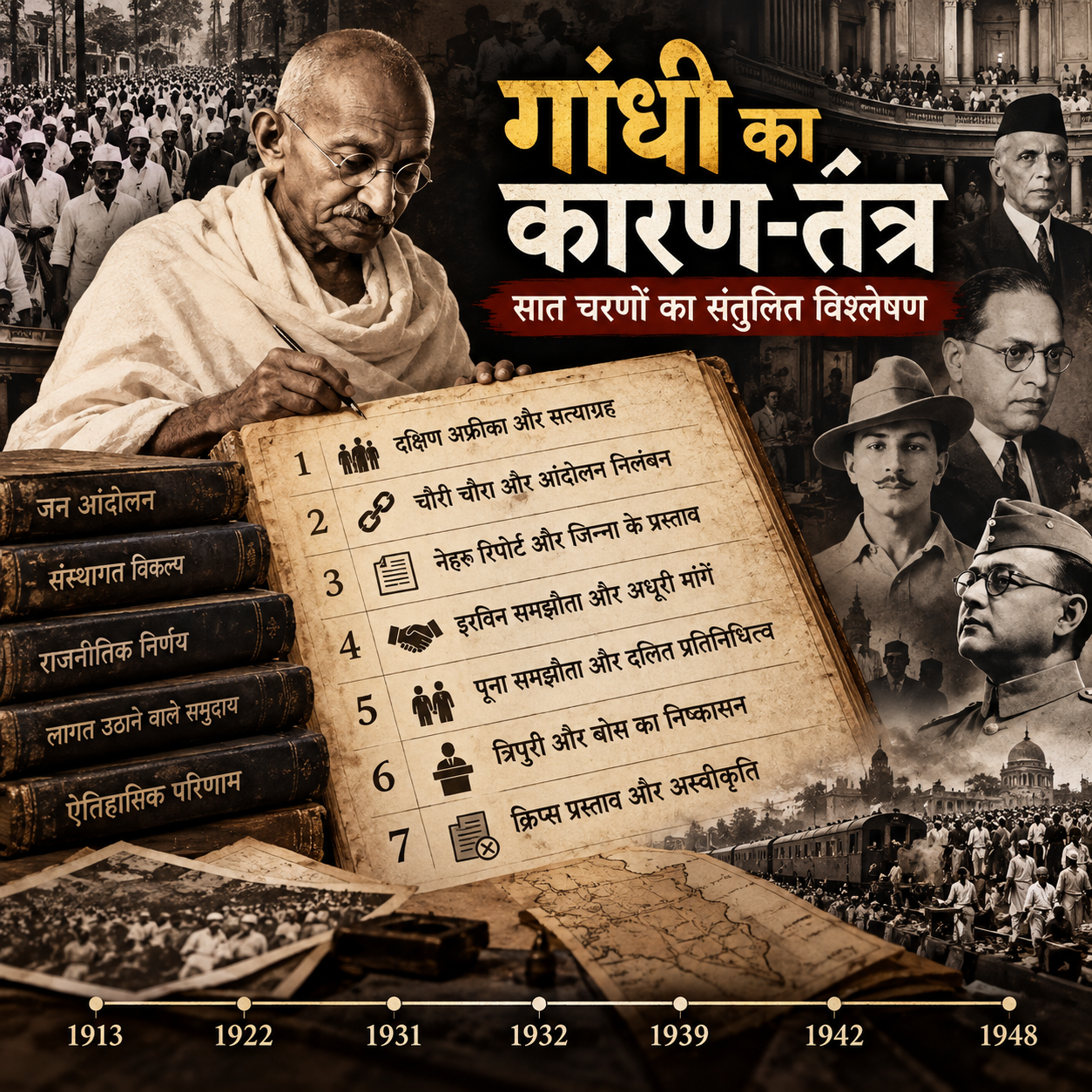
Gandhi’s Causation Engine: The Seven-Arc Balance Sheet Analysis (164)
भारत / GB
Part 164: Mahatma Gandhi’s Peace Efforts | Series Index
Blog 163 placed the imperial calculus before the reader — Savarkar’s consecutive 50-year transportation against Gandhi’s 6-year sentence and 2-year release, one administration, and the documented British reasoning for treating the two men as categorically different threats. Blog 162 placed the economics of Gandhi’s austerity before the reader — who paid for the poverty, what the payment purchased, and the logistics apparatus that maintained the image of renunciation: Bajaj as simultaneous AICC Treasurer and Sevagram funder, Birla’s CWMG Vol. 35 correspondence, Naidu’s formulation, and the king-scale medical household documented by Nayar, Manu, and Pyarelal. This post places the full evidentiary record before the reader: what 163 documented exhibits establish, who absorbed the costs across seven arcs, what the patronage economics and priority inversion pattern add to the structural charge, and what the Final Act will now pursue.
Thank you for reading this post, don't forget to subscribe!THE HISTORICAL RECORD — THE CAUSATION ENGINE (Structural Synthesis)
The Pattern: Across 163 documented exhibits spanning 1888 to 1948, one mechanism repeated without structural revision: mass mobilization deployed at peak administrative vulnerability, suspended unilaterally without enforceable concession, residual costs absorbed by constituencies with no equivalent insulation. Blog 162 added the fourth logistics exhibit — the medical apparatus documented by Nayar, Manu, and Pyarelal — to the patronage record. The Priority Inversion pattern across seven historical instances adds a second structural charge: when the external crisis was largest, the documented operational focus inverted inward. Together, the three structural exhibits — the causation engine, the patronage economics, and the priority inversion — constitute the prosecution’s synthesis frame for the Final Act.
Why This Matters: The pattern is not a personality observation. It is an administrative record. The same command architecture documented in South Africa — Satyagraha as personal moral command without democratic accountability — produced the same suspension outcomes across seven arcs. Blog 162’s patronage record identifies who funded the mechanism. Blog 314’s priority inversion record identifies what the mechanism’s operator prioritised when the external cost was at its highest. The prosecution places all three before the reader.
The Documented Pattern — What 162 Exhibits Establish
Gandhi’s Causation Engine places the operational record before the reader.
Across 162 documented exhibits spanning 1888 to 1948, one pattern repeated without structural revision. Mass mobilization was deployed at peak administrative vulnerability. It was then suspended unilaterally — without committee mandate, without enforceable concession extracted, without the rank-and-file consulted. The residual costs — arrests, deaths, constitutional losses, demographic displacements — were absorbed by constituencies that participated in the movement but received no institutional protection when it was called off.
The pattern was not the product of a single decision. It was the product of a mechanism. The same command architecture that was built and codified in South Africa — Satyagraha as personal moral command without democratic strike ballots (Blog 3) — was the same mechanism that produced the Bardoli suspension of February 12, 1922 (Blog 30), the Irwin Pact of March 5, 1931 (Blog 17), and the unilateral dismissal of the Cripps offer in April 1942. The architecture did not change. The outcomes it produced did not change. The constituencies that absorbed the costs changed. The mechanism remained constant.
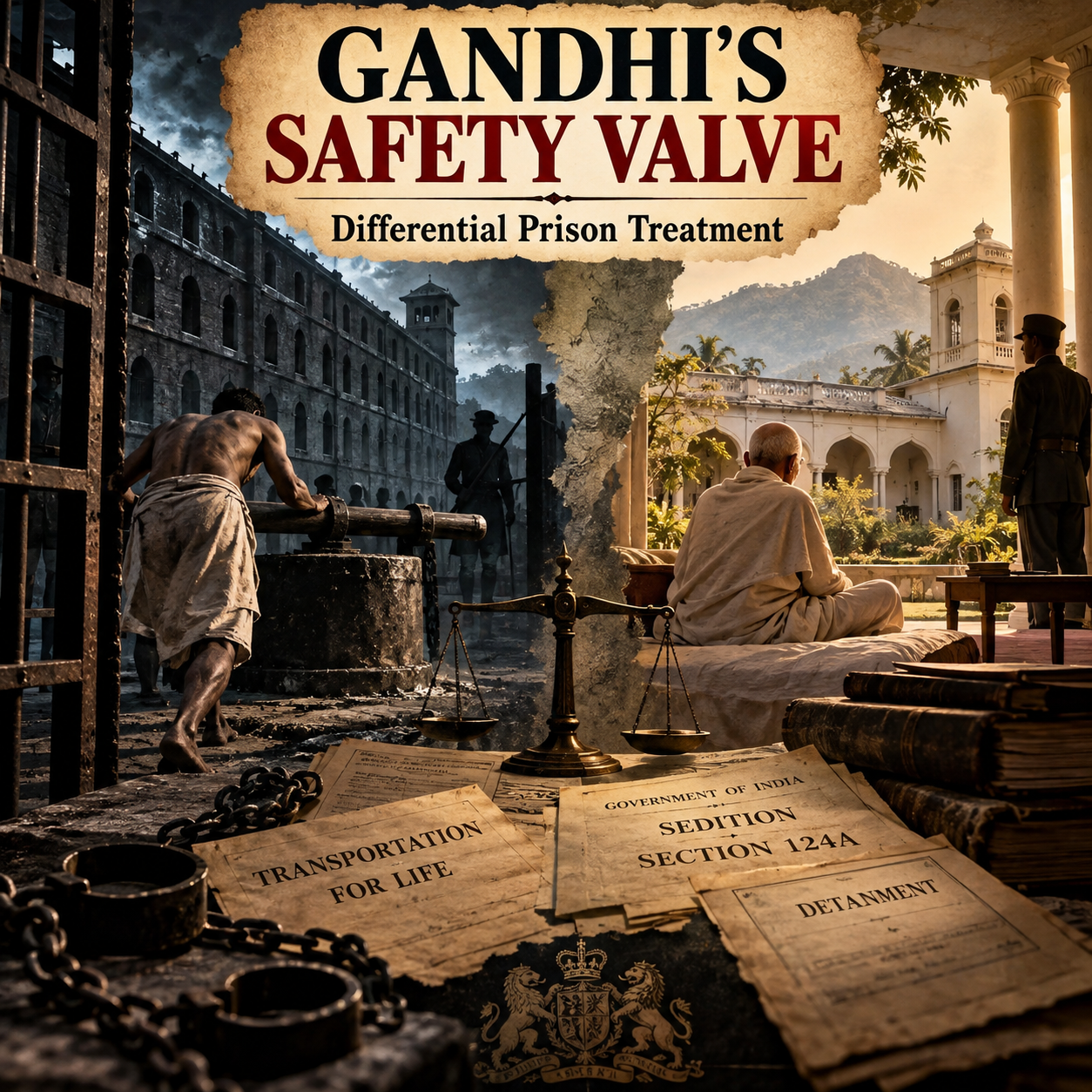
Blog 163 placed before the reader the sharpest single-document exhibit of that calibration: the British administration that sentenced Savarkar to consecutive 50-year transportation under Sections 121 and 302/109 sentenced Gandhi to 6 years under Section 124A and released him in 2 on health grounds — for a campaign that brought the administration to documented fiscal near-collapse. The differential was not statutory accident. It was the administration’s own documented judgment, placed on record by Judge Broomfield at sentencing, about which category of nationalist the system could afford to eliminate and which it could not. (Blog 163).
Gandhi’s Causation Engine places that mechanism before the reader: named, documented, and traceable from first codification to terminal application.
The Patronage Economics — Who Funded the Mechanism
Gandhi’s Causation Engine places the Blog 162 patronage record alongside the seven-arc operational pattern.
The causation engine required funding. Blog 162 documented the structure: Jamnalal Bajaj served simultaneously as AICC Treasurer from 1933 and as Sevagram Ashram’s primary private funder — the official keeper of the party purse and the personal underwriter of the leader’s daily operations were the exact same industrial capitalist. G.D. Birla’s correspondence with Gandhi (CWMG Vol. 35, 1 October 1927) established the direct financial dependency: “My thirst for money is simply unquenchable. I need at least Rs. 2,00,000 for khadi, untouchability and education.” The entire constructive programme — projected as self-reliant and peasant-led — ran on industrial surplus solicited from India’s premier capitalists.
Blog 162 placed a fourth logistics exhibit before the reader that the prosecution adds to the structural synthesis: the medical apparatus. Gandhi’s personal physician Dr. Sushila Nayar documented the daily routine in clinical detail — enemas administered as naturopathic treatment, prepared by attendants who boiled water, mixed sodium bicarbonate solutions, and lubricated rubber cannulas, conducted while Gandhi simultaneously dictated letters. Manu Gandhi’s published diaries (*Bapu — My Mother*; *Ekla Cholo Re*) record the ashram kit maintained on her daily rounds: hot water vessels, thermometers, enema cans, rubber tubes, nozzles, cotton swabs, petroleum jelly — sourced, cleaned, and replaced on a twice-daily schedule. Pyarelal’s biographical series (*The Last Phase*) documents that Gandhi extended this regimen to the entire ashram community, requiring his staff to maintain equipment for all residents. A rotating corps of named physicians, secretaries, and personal attendants maintained a daily medical regimen of documented complexity for a man who had publicly renounced all comfort. The poverty was real in its physical dimensions. Its maintenance infrastructure was not.
The prosecution places the convergence before the reader: patronage flowing consistently from industrial families whose interest in a non-revolutionary independence was the clearest in the record; outcomes consistently compatible with those interests — no revolutionary interruption to industrial capital, no redistribution of property structures, constitutional transfer of power with property intact. Blog 162’s patronage record is the financing exhibit for the causation engine. The same industrial surplus that funded the movement was preserved intact by the movement’s outcomes.
The Priority Inversion — What the Mechanism’s Operator Prioritised
Gandhi’s Causation Engine places the priority inversion pattern before the reader as the third structural exhibit in the synthesis.
Across seven documented historical instances, whenever a major political crisis or humanitarian emergency reached its peak, the operational focus of the movement’s leader inverted systematically — away from the immediate real-world victims, and inward toward personal authority, bodily purity, and domestic subjugation. This was not an isolated aberration. It was a consistent administrative pattern across four decades.
The 1919 sequence is the foundational exhibit. Jallianwala Bagh — 379 killed in a sealed garden on April 13. Gandhi called off the Rowlatt Satyagraha on April 18 — not for justice to the dead, but to preserve movement discipline after crowd violence elsewhere. His *Young India* writings then contextualised the Amritsar massacre within a broader failure of Indian self-discipline. By 1920, the stated priority was not Jallianwala justice or Rowlatt repeal — it was the restoration of the Ottoman Caliphate in Istanbul, a foreign theocratic institution placed explicitly above Swaraj in his own speeches. The external emergency (massacre, colonial repression) was absorbed into a personal authority-rebuilding exercise (Khilafat coalition). The pattern was established at the first opportunity.
The same inversion is documented across six subsequent instances: the unilateral Chauri Chaura cancellation of 1922 (nationwide mobilization subordinated to personal moral brand); the Kasturba penicillin veto of 1944 (wife’s survival subordinated to doctrinal purity, while Gandhi himself had accepted emergency surgery in 1924); the Great Calcutta Killings of August 1946 (Gandhi in Sevagram while thousands died in 72 hours, no fast, no train); the Noakhali bedroom correspondence of 1946–47 (CWMG Vol. 86 letters devoted to nocturnal purity examinations while communal carnage unfolded outside); the Tripuri ouster of 1939 (national anti-colonial unity fractured to preserve personal hegemony over a democratically elected president). At each instance, the macro-crisis provided the stage. The micro-subjugation of individuals — or the preservation of personal authority — was the documented operational priority.
The prosecution places the priority inversion before the reader not as a personality observation but as an administrative exhibit: the CWMG letter ratios, the dated resignation letters of Bose and Parasuram, the Mashruwala and Parikh correspondence, Manu’s diary entries across three months. The inversion is documented, not inferred.
Who Absorbed the Costs — Six Constituencies Across Seven Arcs
Gandhi’s Causation Engine places the cumulative cost ledger before the reader.
The 162 exhibits that are growing in number, identify six recurring cost-bearing constituencies.
Striking workers and peasant agitants left exposed at each suspension point: the coal miners of Newcastle who absorbed baton charges when the 1913 South Africa strike was halted (Blog 3); the 30,000 prisoners of the 1922 Non-Cooperation movement who gained nothing when Bardoli suspended the campaign (Blog 33); the 60,000 satyagrahis of the 1930 Salt March who received zero structural relief under the Irwin Pact (Blog 20); the 172 Chauri Chaura defendants condemned to hang, 151 of whom were saved not by Gandhi but by Malaviya’s courtroom intervention without Gandhi’s support (Blog 37).
Hindu riot victims prescribed non-resistance rather than state protection: the 2,500+ killed and 100,000+ displaced in Malabar (Blog 54), characterized by Gandhi as “brave God-fearing Moplahs fighting for their religion” (Blog 58); the communities of Multan, Saharanpur, Kohat, Delhi, Lucknow, and Allahabad across 91 documented communal riots between 1922 and 1927 (Blog 118), counseled by Gandhi to endure losses without police prosecution and without organized self-defense (Blog 126).
Muslim constitutionalists driven from national politics: Jinnah, shouted down at Nagpur in 1920 when he warned that mobilizing religious mass crowds would produce constitutional chaos (Blog 80); the secular constitutional center of Indian Muslim politics foreclosed between Calcutta 1928 (Blog 83) and the UP coalition refusal of 1937 (Blog 90), leaving the Muslim League as the sole organized Muslim political institution and the Lahore Resolution of March 1940 as its documented institutional consequence (Blog 95).
Dalit communities whose independent political representation was coerced into joint electorates: Ambedkar, summoned to Yerwada in September 1932 and informed that Gandhi would fast unto death unless the Communal Award’s separate electorates for Depressed Classes were surrendered, with the implied threat of nationwide mob retribution if Gandhi died (Blog 159); the Poona Pact signed under that constraint, trading independent political representation for joint electorates, the structural consequences of which remained in place at independence (Blog 159).
Nationalist rivals whose democratic mandates were reversed without counter-election: Bose, elected Congress president in January 1939 by 1,580 votes to 1,375, then rendered ungovernable by the Pant Resolution and Gandhi’s refusal to exercise the approval mechanism it created, forced to resign three months after his democratic election (Blog 160); Patel, backed by 12 of 15 Provincial Congress Committees for the Congress Presidency in 1946 — the position that carried the mandate to head the Interim Government — set aside by Gandhi’s personal word in favor of Nehru (Blog 157).
The rank-and-file of the Quit India movement who bore the physical costs of a movement whose leader was structurally insulated from them: the participants who responded to “Do or Die” on August 9, 1942 faced standard colonial detention and, for revolutionary nationalists from earlier arcs, the documented penal regime of the Cellular Jail, Port Blair — solitary confinement, hard labour, denial of family visits — while Gandhi was administratively interned at Aga Khan Palace with personal attendants, gardens, medical supervision, and companions for 21 months (Blog 161). The differential was not incidental. It was the physical embodiment of the pattern the prosecution has documented across seven arcs.
The broader freedom movement itself: achieving independence on August 15, 1947 within the borders of a geographically bisected subcontinent, with entrenched clerical cadres — empowered by the Khilafat experiment and never dismantled after its collapse — still structurally in place; with no single pact, suspension, or personal veto constituting the formal act of partition, but the cumulative record of those pacts, suspensions, and vetoes constituting the documented causal chain.
The Alternative Bypassed — Seven Structural Junctures
Gandhi’s Causation Engine places the seven documented junctures before the reader.
At each juncture, a documented institutional alternative existed. At each juncture, the alternative that would have diffused authority or shared constitutional power was declined. At each juncture, the option that concentrated the decision in one person without enforceable accountability was taken.
1914: South Africa settlement. Alternative bypassed: full statutory restoration of Indian rights before agreement. Outcome: partial settlement, racial disabilities retained, Gandhi departed with imperial standing intact (Blog 10).
1922: Chauri Chaura suspension. Alternative bypassed: continuing the movement with a disciplined civil disobedience programme while the British faced documented administrative collapse (Blog 29). Outcome: Bardoli suspension, deterrence signal established, 172 defendants condemned (Blog 33).
1928: Calcutta rejection of Jinnah’s four amendments to the Nehru Report. Alternative bypassed: accepting the constitutional amendments that preserved Muslim representation within a united Indian constitutional framework. Outcome: Jinnah’s Fourteen Points, the Muslim League’s institutionalization of separate demands, the documented foreclosure of the secular constitutional centre (Blogs 83–84).
1931: Irwin Pact. Alternative bypassed: refusing to sign until the 11 demands were met to an enforceable extent, leveraging the documented fiscal vulnerability of the British administration (Blog 16). Outcome: zero demands delivered in full, 60,000 satyagrahis unprotected, Bhagat Singh executed 18 days into the pact window when Gandhi held the leverage to make commutation a condition and did not (Blog 158).
1932: Poona coercion of Ambedkar. Alternative bypassed: accepting the Communal Award’s separate electorates for Depressed Classes as a constitutional protection for the most politically vulnerable constituency in India. Outcome: joint electorates under threat of mob retribution, independent Dalit political representation structurally foreclosed (Blog 159).
1939: Tripuri. Alternative bypassed: accepting the democratic verdict of the Congress electorate and working within Bose’s presidency. Outcome: Pant Resolution, CWC resignations, Bose’s forced resignation, Forward Bloc formation, and the removal of the twice-elected Congress president without a counter-election, an impeachment, or a constitutional mechanism (Blog 160).
1942: Cripps offer. Alternative bypassed: extracting the maximum structural concession available at the moment of maximum British vulnerability in World War II — full independence commitment, enforceable and immediate. Outcome: unilateral dismissal of the offer as “a post-dated cheque,” Quit India, Gandhi’s arrest, Aga Khan Palace — where the leader’s conditions of detention documented the differential between the cost he called others to absorb and the cost he absorbed himself (Blogs 97, 147, 161).
Seven junctures. Seven documented alternatives. Seven decisions that concentrated the outcome in one person’s preference without enforceable accountability for the cost borne by those who had no equivalent insulation.
What the Final Act Will Establish
Gandhi’s Causation Engine places before the reader what the second half of the series will now pursue.
The first 163 blogs have built the prosecution’s evidentiary foundation across seven arcs, the patronage economics that funded the mechanism (Blog 162), and the priority inversion pattern that characterised its operator’s documented focus during moments of maximum external cost. The pattern is documented. The constituencies that absorbed the costs are identified. The alternatives bypassed at each juncture are placed on record. The insulation differential — from South Africa to Aga Khan Palace — is documented as a structural exhibit. The patronage convergence — industrial surplus underwriting a movement whose outcomes left that surplus intact — is on the record. The priority inversion — the systematic reversal of operational focus from external emergency to internal control at each critical juncture — is documented across seven instances.
The Final Act will test the causation engine against the terminal phase: the Great Calcutta Killings of August 1946, Direct Action Day, the Noakhali response, the Bihar retaliations, and the January 1948 fast unto death in Delhi. The prosecution will place before the reader whether the documented operational pattern held, broke, or was modified when the cost of partition violence became visible in its immediate human form — and whether the priority inversion that characterised each earlier crisis was sustained through the last one.
The Final Act will complete the structural audit of the patronage and logistics architecture — the full Birla, Bajaj, and Sarabhai financial networks, the ashram trust structures, the industrial tariff alignments — and place before the reader the complete map of whose capital underwrote the movement’s sustained operation across the same period in which the six cost-bearing constituencies absorbed their respective losses.
The Final Act will produce the Causation Engine document: the formal analytical brief that synthesizes the seven-arc record, the patronage economics, and the priority inversion pattern into a structured charge, with exhibits cited, counter-arguments addressed, and the terminal question placed before the reader in its final form.
The reader who has followed the series from Blog 1 already holds the answer.
The Prosecution’s Position
Gandhi’s Causation Engine places four questions before the reader.
- Does the seven-arc record — 163 exhibits documenting the same command architecture deployed from 1913 to 1948, the same suspension pattern repeated at each peak leverage point, the same six cost-bearing constituencies absorbing the residual costs without institutional protection, and the documented insulation differential between the leader’s conditions and those of the rank-and-file at each arc’s terminal point — constitute a pattern the reader places alongside the stated intention of the movement?
- Does the documented patronage record — Bajaj as simultaneous AICC Treasurer and Sevagram funder, Birla’s CWMG Vol. 35 direct financial dependency, the Naidu formulation, the king-scale medical apparatus maintained under the banner of naturopathic simplicity — constitute an exhibit the reader places alongside the convergence between the patronage structure’s interests and the movement’s documented outcomes?
- Does the priority inversion pattern — seven documented historical instances in which the operational focus inverted from external humanitarian emergency to internal personal authority, from Jallianwala 1919 to Noakhali 1946, each instance documented in named primary sources — constitute an exhibit the reader places alongside the documented cost borne by those the macro-crisis was nominally addressed to serve?
- Does the documented record of seven structural junctures at which a constitutional alternative existed, and at which the option that concentrated authority in one person was taken instead, constitute an exhibit the reader places alongside the movement’s claimed democratic character?
The series does not answer. Gandhi’s Causation Engine places the seven-arc balance sheet, the six cost-bearing constituencies, the seven bypassed alternatives, the patronage economics, the priority inversion pattern, the insulation differential, and the mechanism before the reader. The reader will examine what 162 exhibits establish — and complete the sentence.
Invitation To Defence
The floor belongs to the defense. We now invite them to present their exhibits and challenge the narrative established by the prosecution.
162 exhibits. Seven arcs. One mechanism: mass mobilization deployed at peak leverage, suspended unilaterally without enforceable concession, residual costs absorbed by six identified constituencies across 1913–1948. Seven structural junctures. Seven documented alternatives bypassed. The patronage economics: Bajaj, Birla, Naidu’s formulation — the poverty was kept; the keeping was paid for; the payment came from those whose interest in a non-revolutionary independence was the clearest in the record. The priority inversion: seven documented instances across four decades in which the operational focus inverted from external emergency to internal control at the moment of maximum external cost. The insulation differential: the leader who launched absorbed less than those who acted on his call. The prosecution places the causation engine before the reader. The reader will complete the sentence.
Feature Image: Click here to view the image.
Videos
Glossary of Terms
- Causation Engine: The unique analytical term used in this series for the recurring mechanism through which mass mobilization, suspension, personal decision-making, institutional alternatives, and the resulting costs are connected across the historical record.
- Seven-Arc Balance Sheet: The analytical framework used to examine the cumulative record across seven major structural arcs, including the decisions taken, alternatives bypassed, and constituencies that absorbed the resulting costs.
- Structural Juncture: A major decision point at which an institutional or constitutional alternative was available, but a different course was chosen.
- Mass Mobilization: The organized activation of large numbers of people for a political or civil resistance movement, particularly as used in the Gandhi-led movements discussed in the series.
- Satyagraha: Gandhi’s method of civil resistance based on moral pressure and non-violent action, described in this series as operating through personal moral command rather than democratic strike ballots.
- Irwin Pact: The March 1931 agreement between Gandhi and the British Viceroy Lord Irwin, discussed in relation to the suspension of civil resistance and the eleven demands that were not fully secured.
- Communal Award: The constitutional arrangement of 1932 that provided separate electorates for the Depressed Classes, which became the subject of Gandhi’s confrontation with Ambedkar and the subsequent Poona Pact.
- Poona Pact: The 1932 agreement associated with Gandhi and Ambedkar that replaced separate electorates for the Depressed Classes with joint electorates, changing the structure of Dalit political representation.
- Pant Resolution: The resolution associated with Govind Ballabh Pant during the 1939 Tripuri crisis, which contributed to the institutional conflict surrounding Subhas Chandra Bose’s Congress presidency.
- Cripps Offer: The British constitutional proposal presented by Sir Stafford Cripps in 1942 during the Second World War, which Gandhi rejected as a “post-dated cheque” and which preceded the Quit India movement.
- Direct Action Day: The political action called by the Muslim League in August 1946, followed by major communal violence in Calcutta and forming part of the terminal period examined in the series.
- Cost-Bearing Constituencies: The term used in the series for the recurring groups that absorbed arrests, deaths, displacement, political losses, or other consequences arising from the movement’s decisions without equivalent institutional protection.
- Institutional Alternative: A documented constitutional, political, or organizational option available at a particular decision point that could have distributed authority differently or provided another mechanism for addressing the dispute.
- Operational Pattern: The recurring sequence identified across the historical record: mass mobilization at a point of high leverage, unilateral suspension or decision, and residual consequences being absorbed by constituencies that lacked equivalent protection.
- Final Act: The concluding analytical phase of the series, intended to test the identified causation mechanism against the violence of 1946–1948, the final constitutional and political developments, the financial and organizational networks supporting the movement, and the complete evidentiary record.
#Gandhi #IndiaHistory #IndianHistory #Satyagraha #Congress #Partition #FreedomMovement #HinduinfoPedia
Scan Through The Entire Series at
Gandhi’s Peace Efforts: The Questions Before the Mahatma (0)
Refer to Various Arks Referred to in the Blog
Gandhi’s Causation Engine: The Seven-Arc Balance Sheet Analysis (163)