
Gandhi’s Selective Capital: The Duplicity for Violence (181)
भारत / GB
Part 181: Mahatma Gandhi’s Peace Efforts | Series Index
The previous blog placed before the reader the commissioned programme — the documentary proof that Non-Cooperation was not a Gandhian doctrine the Khilafat movement later adopted, but a Khilafat fatwa the Congress subsequently ratified, with Gandhi as translator and the Congress as retail distributor. That blog closed on a question: if the chain of custody runs from the Khilafat Conference to the Congress floor, what governed Gandhi’s decision to place himself at the centre of it? This blog places the answer before the reader in Gandhi’s own words — a dated documentary record of four exhibits, spanning thirteen years, in which his political capital was deployed and withheld not by the principle of ahimsa but by the operational test of utility.
Thank you for reading this post, don't forget to subscribe!THE HISTORICAL RECORD — SELECTIVE CAPITAL
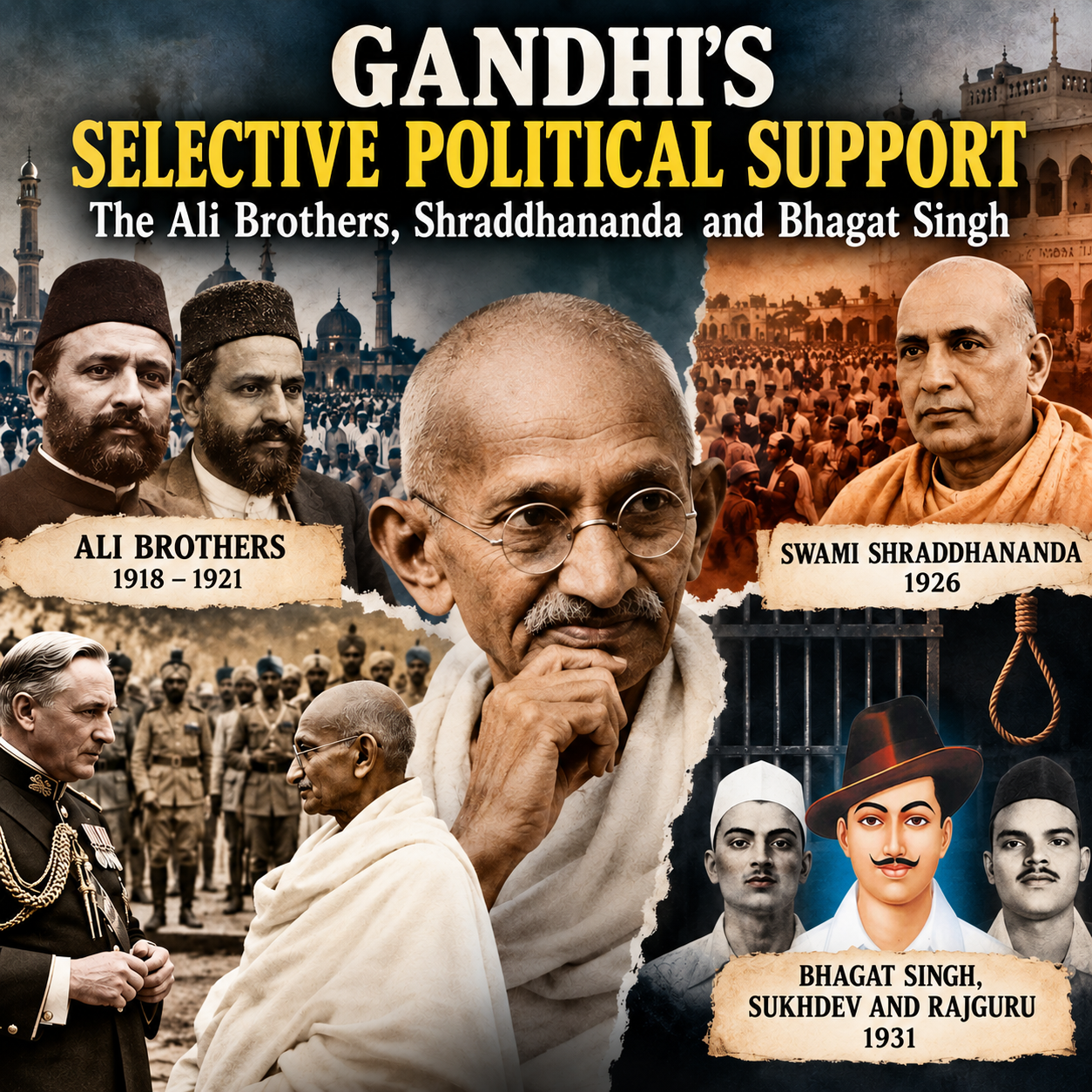
The Pattern: Between 1918 and 1931, Gandhi’s political capital — the finite resource of personal prestige, persistent intervention, and public moral authority — was deployed and withheld in a consistent pattern. Men who preached armed jihad, declared British India the Abode of War, and invited Afghan invasion received repeated ultimatums to Viceroys, personal apologies drafted in their names, and the vocabulary of brotherhood. A man who assassinated a Hindu religious leader in his sickbed received the same vocabulary. A man who captured the imagination of Indian youth without Gandhi’s authority, without the Charkha, and without submission to his moral veto went to the gallows while Gandhi raised the matter casually and did not make commutation a condition of any agreement. Gandhi’s selective capital — the ally protected, the martyr abandoned — places this pattern before the reader as four exhibits across thirteen years.
The Lethal Exhibit: On 18 November 1918, Gandhi wrote to the interned Mohamed Ali and stated the terms of his advocacy in his own hand: “My interest in your release is quite selfish. We have a common goal and I want to utilize your services to the uttermost, in order to reach that goal.” The Collected Works of Mahatma Gandhi document this letter. The prosecution does not assert that this language was cynical. It places the language before the reader alongside the four exhibits that follow and asks whether the pattern the language describes — utility as the criterion, not principle — holds across thirteen years.
Why it matters: The standard defence of Gandhi’s conduct in each of these four episodes rests on the claim of absolute ahimsa: Gandhi could not expend political capital on behalf of men who used violence, and could not withhold it from men who did not.
Exhibit One — The 1918 Transaction: Foes Acquired
The Ali Brothers — Mohammad Ali and Shaukat Ali — were interned under the Defence of India Act from 1916. They were pan-Islamic agitators whose public record included the explicit theological position that armed jihad was a religious obligation, that British India was Dar-ul-Harb — the Abode of War — and that the restoration of Ottoman temporal power was a duty incumbent on every Muslim.
In April 1918, Viceroy Chelmsford convened the Delhi War Conference to rally Indian resources for the British campaign against Germany. Gandhi attended. On 29 April 1918 he wrote to the Viceroy’s Private Secretary J.L. Maffey and to Chelmsford directly:
“The exclusion of leaders like Lokamanya Tilak, Mrs. Besant, and the brothers Ali from the Conference deprives it of any real weight… I still feel that it was a grave blunder not to have invited them… So far as Ali Brothers are concerned, there is no proof of their guilt before the public… Most Mahomedans think what the Brothers think on the situation.”
— CWMG Vol. 14/17 rev., Doc. 258, 29 April 1918
Gandhi’s intervention at the War Conference was not moral advocacy on behalf of interned men. It was a bargaining position. His offer to Chelmsford in the same period was explicit: Gandhi would become the Empire’s recruiter — delivering Indian manpower for the war — in exchange for colonial concessions that included mollifying Muslim sentiment by releasing the Ali Brothers. When Gandhi reviewed their stance on the Khilafat, he did not recoil from their theocratic claims; he recorded in his autobiography that their core demand violated “no ethical principle” and determined that securing their release was the price of becoming a true ally. On 23 May 1919, when he intervened to criticize their draft memorial to the Viceroy, he did not challenge their underlying pan-Islamic objective—he merely pruned away tactical liabilities, such as demanding the restoration of Egypt, to make their petition politically viable.
Six months after the War Conference, on 18 November 1918, Gandhi wrote to Mohamed Ali directly and stated the operational nature of his advocacy without ambiguity:
“My interest in your release is quite selfish. We have a common goal and I want to utilize your services to the uttermost, in order to reach that goal.”
— CWMG, 18 November 1918
The prosecution places this letter before the reader as the first exhibit. Gandhi’s selective capital — the ally protected, the martyr abandoned — does not require inference here. Gandhi stated the transaction in his own hand: utility, not principle. The Ali Brothers in 1918 were an asset Gandhi sought to acquire from the Viceroy in exchange for recruitment services. He named his motive himself.
Exhibit Two — The 1921 Asset Protection: Foes Defended
By 1921 the utility of the Ali Brothers had escalated. They were no longer passive assets to be traded. They were the operational commanders of the Khilafat movement, the public face of the Non-Cooperation programme, and the living proof that Gandhi’s alliance with pan-Islamic networks had produced a mass movement the Congress old guard could not replicate.
Their public record in this period was unambiguous. Mohammad Ali openly treated non-violence not as a religious faith but as a temporary political expedient. Shaukat Ali proclaimed the legitimacy of armed struggle in explicitly theological terms. In Young India, Gandhi conceded the truth on the printed page: “The Ali Brothers will certainly draw the sword, if they could, in defence of their religion and their country… our methods differ, our languages differ.” Both brothers endorsed resolutions that Indian Muslims should assist an Afghan invasion of British India should one occur, and urged Muslim soldiers to desert the Crown forces.
Gandhi’s public characterisation of these men remained steadfast. He called them “brave, God-fearing men.” He defended their agitation on public platforms and positioned them as the authentic leadership of Muslim India and placed their cause before the cause of swaraj.
When Viceroy Reading moved in May 1921 to prosecute the Ali Brothers for speeches inciting military disaffection and violence, Gandhi intervened directly. He held a series of private interviews with Reading, and to abort an arrest that would shatter the Non-Cooperation apparatus, Gandhi drafted and extracted a signed public statement from both brothers expressing regret for the “unnecessary heat” of their speeches and offering assurances against inciting violence while associated with the movement.
The prosecution places this alongside the 18 November 1918 letter. The criterion has not changed between 1918 and 1921. Men who preached armed jihad, declared the Abode of War, and endorsed military mutiny received Gandhi’s drafting services, his public moral endorsement, and his personal diplomatic capital with the Viceroy — because they were the instrument through which his programme ran. Gandhi’s selective capital — the ally protected, the martyr abandoned — places Exhibit Two before the reader: asset protection, not principle.
Exhibit Three — 1926: The Vocabulary Extended to an Assassin
On 23 December 1926, Swami Shraddhananda was assassinated in his sickbed. A man named Abdul Rashid entered his home under the pretence of a visit and shot him while he lay recovering from pneumonia. Shraddhananda was one of the most prominent Hindu religious figures of the era — a leading Arya Samajist, the primary architect of the Shuddhi movement through which converted populations were brought back to Hinduism, and precisely the kind of figure the Khilafat apparatus and its clerical networks regarded as an existential adversary.
Two days later, moving the official condolence resolution at the Gauhati Session of the Indian National Congress on 25 December 1926, Gandhi addressed the national delegates:
“Now you will, perhaps, understand why I have called Abdul Rashid a brother, and I repeat it: I do not even regard him as guilty of Swamiji’s murder. Guilty indeed are all those who excited feelings of hatred against one another.”
— CWMG Vol. 32, Speech on Condolence Resolution, Gauhati, 25 December 1926
Not condemnation. Not neutrality. The vocabulary of brotherhood — the same vocabulary Gandhi had used for the Ali Brothers, the same vocabulary that had characterised his public moral endorsement of men who preached armed jihad — extended now from the national Congress rostrum to the man who had assassinated a Hindu religious reformer in his sickbed.
The prosecution does not assert that Gandhi endorsed the assassination. It places the vocabulary before the reader. The Ali Brothers: “brave, God-fearing men.” Abdul Rashid: “my brother.” The criterion governing the use of that vocabulary is what Gandhi’s selective capital — the ally protected, the martyr abandoned — places before the reader as Exhibit Three.
Exhibit Four — 1931: The Scaffold
Bhagat Singh, Sukhdev, and Rajguru were sentenced to death for the killing of British police officer J.P. Saunders in 1928 and the 1929 Assembly bomb case. They faced execution in March 1931 — at precisely the moment Gandhi was negotiating the Gandhi-Irwin Pact with Viceroy Irwin.
The Hindustan Socialist Republican Association that Bhagat Singh represented was not analogous to the Ali Brothers. It was structurally opposite. The Ali Brothers operated within a clerical network Gandhi had cultivated, managed through personal accommodations, and whose voting mass could be deployed to overwhelm Congress opponents. The HSRA operated entirely outside Gandhi’s spiritual authority. Bhagat Singh had explicitly rejected the supremacy of the Charkha. He had articulated a secular socialist vision of Indian independence in which Gandhi’s moral veto had no place. He had captured the imagination of Indian youth — producing the same revolutionary energy the street had shown for the Non-Cooperation programme — without any submission to Gandhi’s leadership.
Gandhi raised the matter of commutation with Lord Irwin. He did not make it a condition of signing the Pact. Irwin’s own documented minutes confirm that Gandhi’s representations on Bhagat Singh’s behalf were not binding — that Gandhi explicitly did not treat commutation as a breaking condition of the agreement. He did not place the Pact before Congress before the executions, which would have given the Congress the documented opportunity to make commutation a condition of ratification. Bhagat Singh, Sukhdev, and Rajguru were executed on 23 March 1931. The Indian National Congress ratified the Gandhi-Irwin Pact at Karachi days later.
The prosecution places Irwin’s minutes before the reader alongside the 1918 letter, the 1921 apology, and the 1926 vocabulary. Gandhi’s selective capital — the ally protected, the martyr abandoned — is the key phrase the reader carries across all four exhibits: the transaction named by Gandhi himself in 1918, executed in 1921, extended in vocabulary in 1926, and confirmed by its absence in 1931.
The Prosecution’s Position
Four questions stand before the reader.
- Does Gandhi’s own letter of 18 November 1918 — “My interest in your release is quite selfish. We have a common goal and I want to utilize your services to the uttermost” — constitute an exhibit the reader places alongside the claim that Gandhi’s alliance with the Ali Brothers was an act of principled moral solidarity rather than a stated transaction?
- Does the documented sequence — Gandhi drafting a public apology for men who preached armed jihad and endorsed Afghan invasion, while characterising them as “brave, God-fearing men” whose demands violated “no ethical principle” — constitute an exhibit the reader places alongside the claim that Gandhi’s political capital was governed by an absolute commitment to non-violence?
- Does Gandhi’s use of the vocabulary of brotherhood for the assassin of Swami Shraddhananda — the same vocabulary applied to the Ali Brothers — constitute an exhibit the reader places alongside the claim that Gandhi’s moral endorsements reflected consistent ethical principle rather than consistent political grammar?
- Does the documented fact that Gandhi did not make the commutation of Bhagat Singh’s death sentence a condition of the Gandhi-Irwin Pact — confirmed in Irwin’s own minutes — while the men who preached armed jihad had received Gandhi’s repeated ultimatums, drafted apologies, and public moral authority, constitute an exhibit the reader places alongside the key phrase: Gandhi’s selective capital — the ally protected, the martyr abandoned?
The series does not answer. Gandhi’s selective capital — the ally protected, the martyr abandoned — places four exhibits before the reader across thirteen years: the 1918 letter that named the transaction, the 1921 apology that protected the asset, the 1926 vocabulary that extended moral cover to an assassin, and the 1931 scaffold that confirmed the criterion.
Invitation To Defence
The floor belongs to the defence. We now invite them to present their exhibits and challenge the narrative established by the prosecution.
On 18 November 1918 Gandhi wrote to Mohamed Ali: “My interest in your release is quite selfish. We have a common goal and I want to utilize your services to the uttermost.” In 1921 he drafted their public apology to shield them from prosecution — men who preached armed jihad and endorsed Afghan invasion. In 1926 he called the assassin of Swami Shraddhananda “my brother.” In 1931 he did not make Bhagat Singh’s commutation a condition of the Pact. Irwin’s minutes confirm it. The scaffold proceeded. Gandhi’s selective capital — the ally protected, the martyr abandoned — places the criterion before the reader. The reader will name it.
Feature Image: Click here to view the image.
Videos
Glossary of Terms