
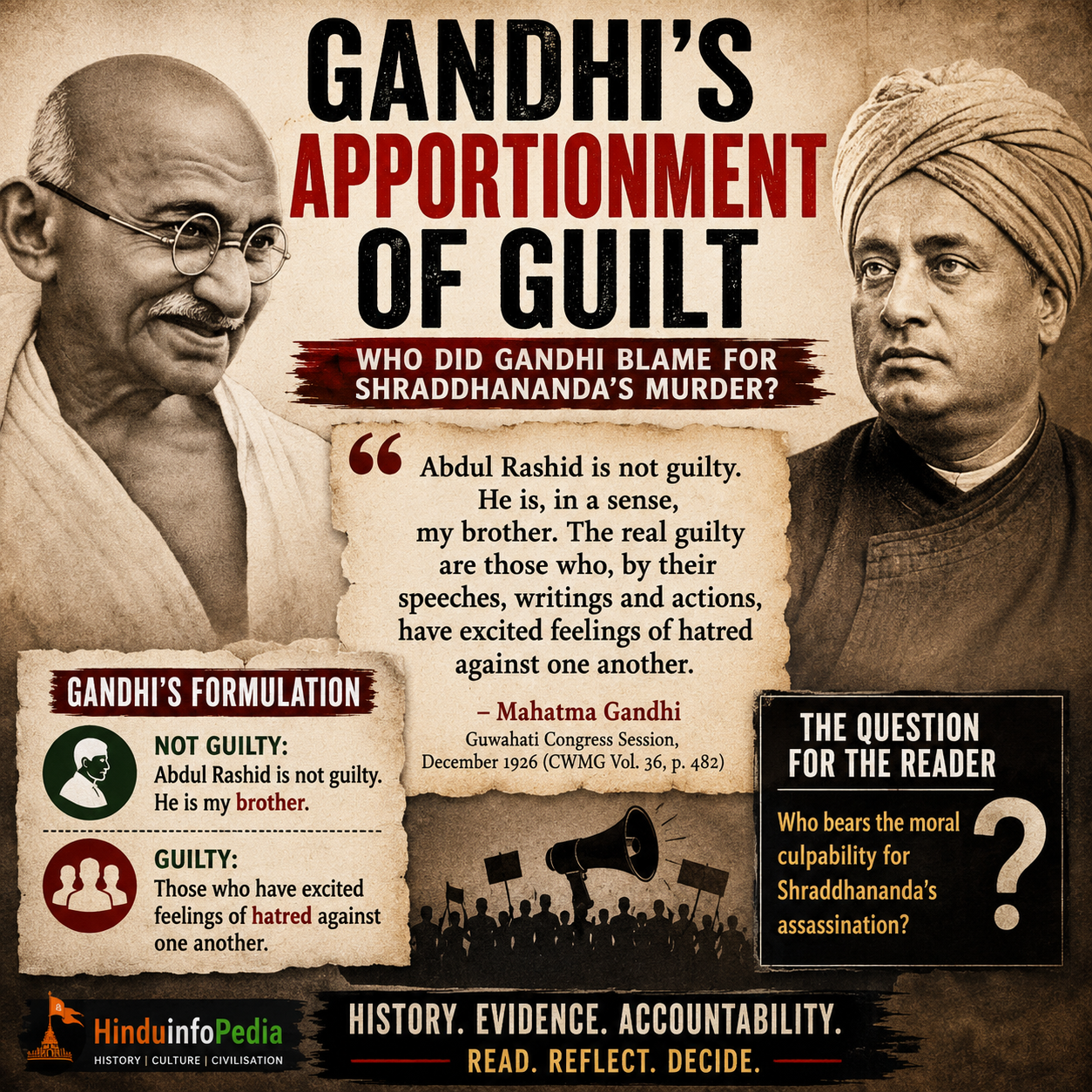
Gandhi’s Apportionment of Guilt: The Guilt He Assigned for Shraddhananda’s Murder (75)
भारत / GB
Part 75: Mahatma Gandhi’s Peace Efforts | Series Index
Blog 74 documented Gandhi’s responses to two documented murders — Shraddhananda and Vidyarthi — placed side by side. This post examines one of those responses in full — the Guwahati Congress address of December 25, 1926 — and places before the reader the precise question it raises: who, according to Gandhi’s own documented formulation, was guilty of Swami Shraddhananda’s murder?
Thank you for reading this post, don't forget to subscribe!The Action Taken: Gandhi pleaded for mercy and understanding for the communal assassin of Swami Shraddhanand, while publicly dissociating the national movement from the revolutionary acts of Bhagat Singh.
Who Paid the Price: Indian revolutionary freedom fighters, who were subjected to strict ethical censure while sectarian assassins received theological understanding.
The Alternative Bypassed: Applying a consistent ethical and legal framework to political violence across all ideological formations.
Why This Matters: Exposes the profound ethical contradiction: armed revolutionaries fighting colonial rule were cast outside the moral pale, while sectarian assassins were extended personal fraternity.
The Documented Murder
On December 23, 1926, Abdul Rashid entered the home of Swami Shraddhananda in Delhi on the pretext of a religious discussion. Shraddhananda was seventy years old and ill with fever. While his attendant stepped out to fetch water, Abdul Rashid shot Shraddhananda twice at point-blank range. He died instantly.
Abdul Rashid stated he murdered Shraddhananda over his comments on Islam and his Shuddhi work. Over 163,000 Malkana Rajputs had been reconverted to Hinduism through Shraddhananda’s movement, bringing him into direct confrontation with Muslim clerics and leaders who had instigated violence against him.
The Primary Source — CWMG Vol. 32
Two days after the murder, Gandhi addressed the Guwahati Congress session on December 25, 1926. The Collected Works of Mahatma Gandhi, Volume 32, pages 461-62, record his words precisely:
“Now you will perhaps understand why I have called Abdul Rashid a brother, and I repeat it. I do not even regard him as guilty of Swamiji’s murder. Guilty, indeed, are all those who excited feelings of hatred against one another.”
Gandhi also objected to the subsequent hanging of Abdul Rashid after he was sentenced to death for the murder.
The Apportionment of Guilt
Gandhi’s Apportionment of Guilt places one analytical observation before the reader — drawn entirely from Gandhi’s own documented words.
Gandhi’s formulation has a precise structure. It consists of three documented moves:
First move: Abdul Rashid is named brother. This is not a figure of speech. Gandhi states it and repeats it in the same sentence.
Second move: Abdul Rashid is not regarded as guilty of the murder. Gandhi removes criminal and moral culpability from the man who fired the bullets.
Third move: Guilt is assigned to those who excited feelings of hatred against one another.
Gandhi’s Apportionment of Guilt places one question before the reader: who were those who excited feelings of hatred?
The documented record establishes the following. Shraddhananda’s Shuddhi movement had reconverted 163,000 Malkana Rajputs to Hinduism. Muslim clerics had publicly incited against him. Abdul Rashid stated he killed Shraddhananda over his comments on Islam and his Shuddhi work.
Gandhi’s Apportionment of Guilt examines this distribution precisely. Gandhi’s formulation — guilty are those who excited feelings of hatred — distributed guilt across both sides of the confrontation. Shraddhananda’s Shuddhi work had excited feelings. The Muslim clerics who incited against him had excited feelings. In Gandhi’s documented formulation both were placed in the guilty column.
The man who pulled the trigger was placed in the brother column.
The prosecution does not assert that Gandhi intended to absolve the killer. It places the documented structure of the formulation before the reader — three moves, documented in CWMG Vol. 32, pages 461-62, in Gandhi’s own words — and asks the reader to identify what the structure accomplishes.
What the Formulation Does Not Contain
Gandhi’s Apportionment of Guilt places one further documented observation before the reader — what the formulation does not contain.
Gandhi’s Guwahati address did not name any Muslim cleric or leader who had publicly incited against Shraddhananda. The documented record shows that Muslim clerics had publicly called for violence against Shraddhananda before his murder. Gandhi’s formulation — guilty are all those who excited feelings of hatred — did not name them.
It named the category. It did not populate the category with documented individuals on the Muslim side.
On the Hindu side, the implication of the formulation was direct — Shraddhananda’s Shuddhi work reconverting 163,000 Malkana Rajputs had excited feelings. Gandhi had placed his position on Shraddhananda’s work on the documented record before the murder. Young India 1922, in an article titled ‘Hindu-Muslim Tensions: Causes and Resistance’: “I know that his speeches are often provocative.” Gandhi also wrote in 1924 — CWMG Vol. 28, p. 56: “The Arya Samaj has, I think, copied the Christians in planning its propaganda. The modern method does not appeal to me.”
Gandhi’s Guwahati formulation placing guilt on those who excited feelings of hatred was therefore consistent with his documented pre-existing position — that Shraddhananda’s Shuddhi work and speeches were provocative. The formulation was not a sudden reaction. The documented record shows it was Gandhi’s consistent characterisation of Shraddhananda’s methods.
The prosecution places this structural observation before the reader. Gandhi’s words are the evidence. No characterisation is added.
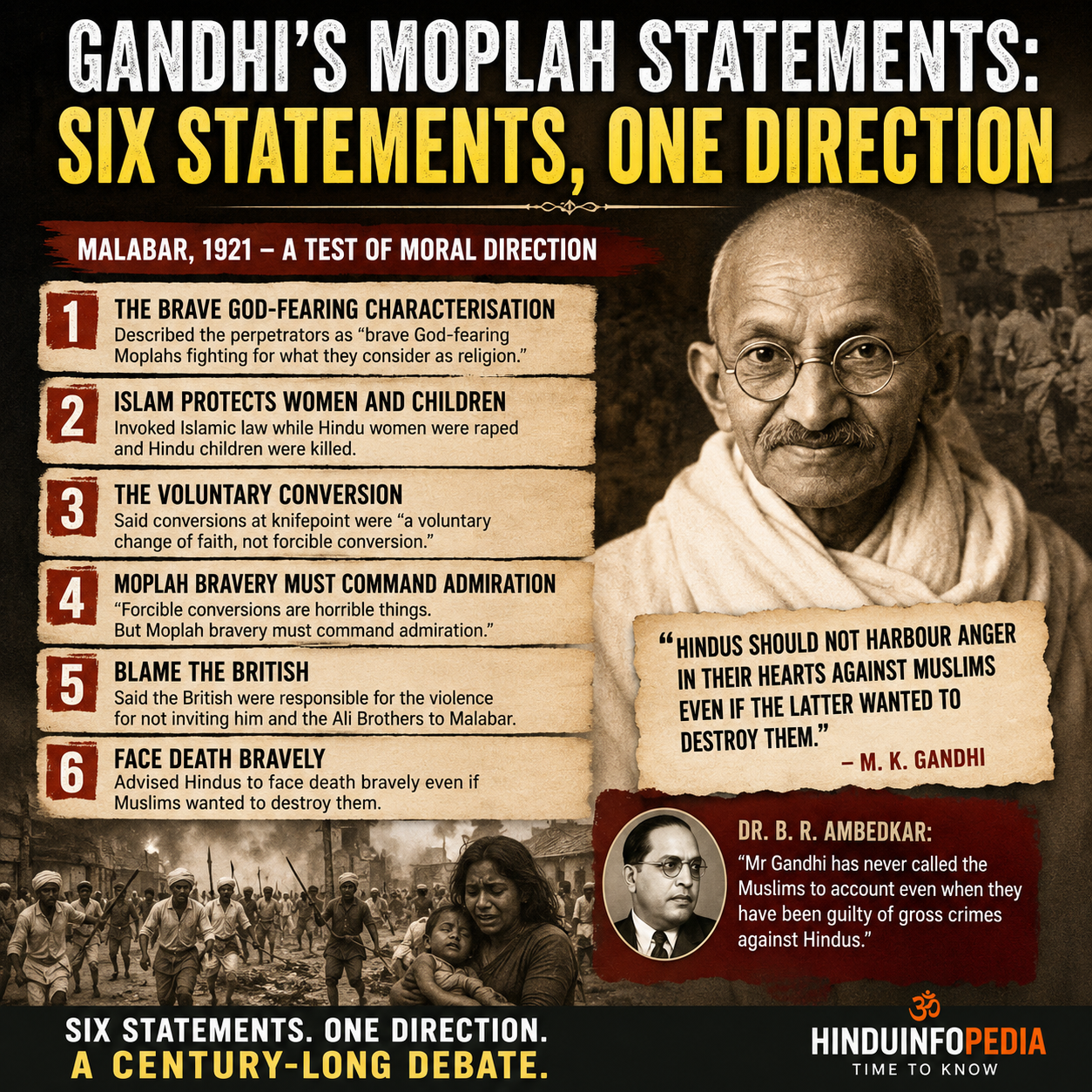
Ambedkar documented the broader pattern in Pakistan or the Partition of India — that Gandhi never called upon Muslim leaders to condemn outrages against Hindus, and kept silent over them. The Guwahati formulation is one documented instance of that pattern — placed on the record in Gandhi’s own words, on December 25, 1926, two days after Shraddhananda was shot in his sickbed.
The Prosecution’s Position
Gandhi’s Apportionment of Guilt does not claim Gandhi approved of Shraddhananda’s murder. It places the documented formulation before the reader and asks the reader to identify what it does.
- Did Gandhi’s formulation remove criminal and moral culpability from the man who shot a seventy-year-old Hindu religious leader in his sickbed?
- Did Gandhi’s formulation assign guilt to those who excited feelings of hatred — a category that included the victim’s own documented religious reform work?
- Did Gandhi name any Muslim cleric who had publicly incited against Shraddhananda in his documented assignment of guilt?
- What does the reader conclude when they complete the sentence: according to Gandhi’s own documented formulation, the guilty parties for Swami Shraddhananda’s murder were…
The series does not answer. The primary source is CWMG Vol. 32, pages 461-62. The words are Gandhi’s own. The reader will examine the formulation and complete the sentence.
Abdul Rashid shot Swami Shraddhananda twice in his sickbed. Gandhi: Abdul Rashid is my brother. I do not regard him as guilty. Guilty are those who excited feelings of hatred against one another. The prosecution places the documented formulation before the reader and asks one question: according to Gandhi’s own words — who were they?
Feature Image: Click here to view the image.
Videos
Glossary of Terms
1) Glossary of Terms
- Swami Shraddhananda: Arya Samaj leader and prominent advocate of the Shuddhi movement who was assassinated in Delhi on 23 December 1926.
- Abdul Rashid: The man convicted of assassinating Swami Shraddhananda, claiming religious motivations connected to Shraddhananda’s views and activities.
- Shuddhi Movement: A movement led by Arya Samaj to reconvert individuals and communities who had previously left Hinduism back to the Hindu fold.
- Malkana Rajputs: A community in northern India that became the focus of large-scale Shuddhi reconversion efforts during the 1920s.
- Arya Samaj: A Hindu reform movement founded by Swami Dayanand Saraswati that emphasized Vedic teachings and social reform.
- Guwahati Congress Session: The Indian National Congress session held in Guwahati in December 1926, where Gandhi commented on Shraddhananda’s murder.
- CWMG (Collected Works of Mahatma Gandhi): The official multi-volume compilation of Mahatma Gandhi’s speeches, writings, letters, and statements.
- Apportionment of Guilt: The key phrase of this blog, referring to Gandhi’s documented allocation of responsibility for Shraddhananda’s murder.
- Brother Column: A phrase coined in this series to describe Gandhi’s characterization of Abdul Rashid as a “brother” despite the murder.
- Guilty Column: A phrase coined in this series to describe those whom Gandhi identified as responsible for creating hatred and communal hostility.
- Communal Hatred: Hostility and antagonism between religious communities, particularly Hindus and Muslims, during the period discussed.
- Young India: Gandhi’s influential journal in which he frequently expressed his views on political, social, and religious issues.
- Religious Reform Work: Efforts to change, revive, or promote religious beliefs and practices, including Shraddhananda’s Shuddhi activities.
- Moral Culpability: Responsibility for wrongdoing in an ethical or moral sense, distinct from legal guilt.
- Pakistan or the Partition of India: Dr. B.R. Ambedkar’s 1945–46 work examining Hindu-Muslim relations, partition, and communal politics.
#Gandhi #Shraddhananda #AryaSamaj #History #Congress #Hindu #India #Ambedkar #Politics #Shuddhi #HinduinfoPedia
Gandhi’s Peace Efforts: The Questions Before the Mahatma (0)
Refer to Various Arks Referred to in the Blog