
Gandhi’s Blood Cement: What Vidyarthi’s Death Meant — and What Gandhi Said It Meant (72)
भारत / GB
Part 72: Mahatma Gandhi’s Peace Efforts | Series Index
Blog 71 documented three intersections in Ganesh Shankar Vidyarthi’s life — the movement, the pact, the death. This post examines what his death actually meant for the national movement and places two documented records side by side: the eyewitness testimony of his daughter Vimla Vidyarthi and Gandhi’s published tribute in Young India.
Thank you for reading this post, don't forget to subscribe!The Action Taken: Gandhi articulated the doctrine of “blood cement,” stating publicly that Hindu-Muslim unity would not be cemented by paper pacts, but by the willing, unresisting blood sacrifice of innocent satyagrahis.
Who Paid the Price: Peaceful citizens in riot areas, whose deaths were elevated into political instruments of unity rather than treated as crimes demanding prosecution.
The Alternative Bypassed: Establishing communal peace on statutory legal accountability, criminal deterrence, and equal enforcement of the penal code.
Why This Matters: Formulated an explicit theological doctrine of political conciliation: substituting the voluntary martyrdom of victims for the legal prosecution of violent aggressors.
What Vidyarthi Did — Documented by Eyewitnesses
The night before his death, Vidyarthi wrote a letter to a friend dissuading him from coming to Kanpur to help. He wrote: “The police stands by watching unconcerned while mosques and temples are burnt, people are beaten and shops are looted.”
On the morning of March 25, 1931, Vidyarthi went out bare-headed and bare-footed into the riot-stricken areas. Eyewitnesses documented in the Cawnpore Riots Inquiry Committee Report that he began visiting various mohallas — the colonies of both Hindu and Muslim communities — rescuing people from both communities, trying to reason with armed mobs.
At Etawah Bazaar he discovered that a Hindu, aged about thirty, had protected the lives of about thirty Muslim men, women and children from rioters. He was then requested by Kanahya Lal to rush to rescue Hindus trapped in certain Muslim quarters.
He went. He was attacked and killed.
What Vimla Vidyarthi Documented
Vimla Vidyarthi — the daughter of Ganesh Shankar Vidyarthi — gave a documented interview to Suresh Salil, who edited and compiled her father’s collected works. Her testimony is on the documentary record.
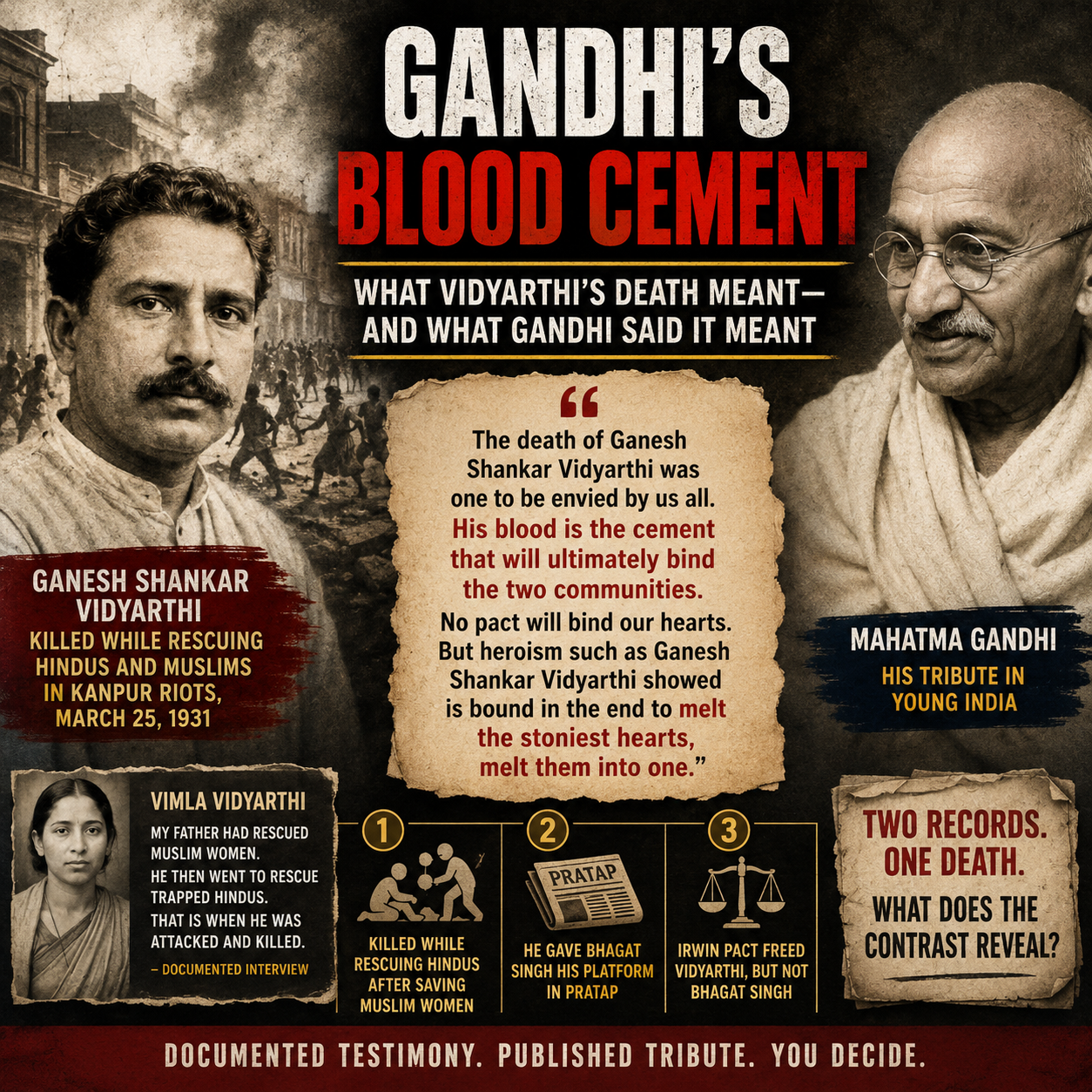
Vimla stated that her father had successfully rescued some Muslim women. He then immediately got involved in rescuing some trapped Hindus. It was at this stage that he was attacked and killed. Gandhi’s Blood Cement places this testimony on the documentary record alongside what Gandhi published in Young India.
She also recalled a well-informed person stating earlier that day that weapons were being distributed in several localities and it was being said that the Lion of Kanpur would be killed that day. Vidyarthi’s body was found days later — multiple stab wounds, his face completely disfigured. His identity was confirmed by his clothes, letters in his pockets, peculiar hairstyle, and a tattoo on his arm.
Vimla’s documented conclusion: the killing of Vidyarthi was part of the same conspiracy which led to the hurried execution of Bhagat Singh, Sukhdev and Rajguru two days earlier. The Irwin Pact that released Vidyarthi on March 9 had not made either Bhagat Singh’s execution or Vidyarthi’s safety a condition of negotiation.
What Gandhi Said — The Full Quote
Gandhi’s documented tribute to Vidyarthi was published in Young India. The prosecution places the full passage before the reader:
“The death of Ganesh Shankar Vidyarthi was one to be envied by us all. His blood is the cement that will ultimately bind the two communities. No pact will bind our hearts. But heroism such as Ganesh Shankar Vidyarthi showed is bound in the end to melt the stoniest hearts, melt them into one.”
Gandhi’s Blood Cement places three documented facts alongside this tribute.
One: Vidyarthi was killed while rescuing Hindus — after having already rescued Muslim women — by a mob his daughter documented as part of a planned conspiracy. Gandhi called the death enviable and his blood the cement that would bind two communities.
Two: Vidyarthi had given Bhagat Singh his platform in Pratap. Gandhi had not made Bhagat Singh’s execution a condition of the Irwin Pact that freed Vidyarthi sixteen days before his death.
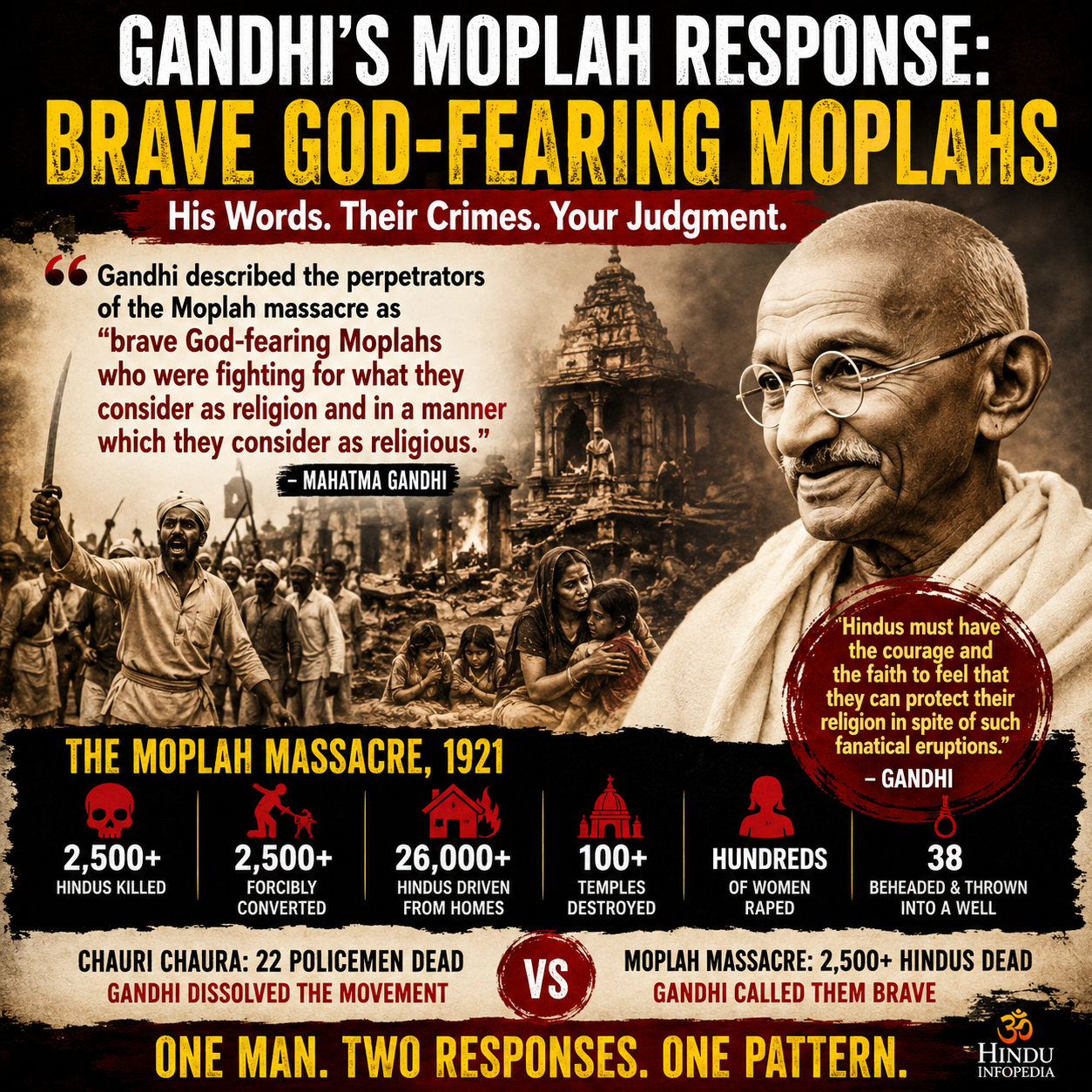
Three: Gandhi’s framing of Vidyarthi’s death — blood as cement, Hindu death binding communities — follows the documented pattern the Moplah arc established across seventeen blogs. At Moplah: 2,500 Hindus dead, Gandhi told the survivors to have courage and faith. At Kanpur: Vidyarthi dead trying to save Hindus, Gandhi called the death enviable cement.
The Prosecution’s Position
Gandhi’s Blood Cement does not claim Gandhi was indifferent to Vidyarthi’s death. It places two documented records before the reader — the daughter’s testimony and the Gandhi tribute — and asks the reader to examine the gap between them. The tribute in Young India documents genuine grief and genuine admiration.
It places the documented framing before the reader — and asks one question.
Vidyarthi’s daughter documented that her father was killed while rescuing Hindus — that weapons had been distributed that morning specifically targeting him — that the killing was part of a conspiracy connected to Bhagat Singh’s execution.
Gandhi’s documented response framed the death as blood that would cement two communities. Gandhi’s Blood Cement places that framing before the reader precisely — the full Young India quote, not the shortened version that has entered common circulation.
- Did Gandhi’s framing of Vidyarthi’s death — as cement binding communities — address what Vimla Vidyarthi documented about how and why her father died?
- Did Gandhi’s framing place any accountability on those who killed Vidyarthi — or did it redirect the death toward a discourse of unity?
- Is the framing of a Hindu man’s death while rescuing Hindus as “cement binding two communities” consistent with the pattern the series has documented across Moplah, Kohat, and Ahmedabad?
The series does not answer. Gandhi’s Blood Cement places Vimla Vidyarthi’s documented testimony before the reader alongside Gandhi’s documented tribute. Gandhi’s documented tribute is placed beside it. The reader will examine both and complete the sentence.
Vidyarthi rescued people from both communities. He was killed while saving trapped Hindus after saving Muslim women. His daughter recorded that he was specifically targeted that day. He was the bridge between Gandhi’s path and the revolutionaries. Sixteen days after the Pact released him, two days after Bhagat Singh was hanged, he was eliminated. Gandhi wrote: his blood is the cement that will bind the two communities. The prosecution places both the daughter’s testimony and Gandhi’s tribute before the reader. The reader will examine what the framing does — and what it does not do.
Feature Image: Click here to view the image.
Videos
Glossary of Terms
- Ganesh Shankar Vidyarthi: Indian freedom fighter, journalist, editor of Pratap, and Congress leader who was killed during the Kanpur riots of March 1931 while rescuing people from communal violence.
- Vimla Vidyarthi: Daughter of Ganesh Shankar Vidyarthi whose recorded testimony provides details about the circumstances surrounding her father’s death.
- Young India: Mahatma Gandhi’s influential English-language journal in which he published political commentary, public statements, and tributes, including his remarks on Vidyarthi’s death.
- Cawnpore Riots Inquiry Committee Report: Official inquiry report documenting events, eyewitness accounts, and circumstances related to the Kanpur communal riots of 1931.
- Kanpur Riots (1931): Communal disturbances that erupted in Kanpur shortly after the execution of Bhagat Singh, Sukhdev, and Rajguru, resulting in significant loss of life and property.
- Irwin Pact: Political agreement signed in March 1931 between Mahatma Gandhi and Lord Irwin that led to the release of many political prisoners and temporarily suspended the Civil Disobedience Movement.
- Bhagat Singh: Revolutionary nationalist whose execution on March 23, 1931, became one of the defining events of India’s freedom struggle.
- Sukhdev: Revolutionary associate of Bhagat Singh who was executed alongside him in 1931 for his role in anti-colonial activities.
- Rajguru: Indian revolutionary and associate of Bhagat Singh who was executed by the British colonial government in 1931.
- Pratap: Hindi newspaper edited by Ganesh Shankar Vidyarthi that became known for nationalist journalism and support for revolutionary causes.
- Lion of Kanpur: Popular honorific used for Ganesh Shankar Vidyarthi in recognition of his courage, leadership, and public service.
- Blood Cement: A distinctive phrase used in this blog to describe Gandhi’s characterization of Vidyarthi’s death as a sacrifice whose “blood” would serve as the “cement” binding Hindu and Muslim communities.
- Communal Harmony: The ideal of peaceful coexistence and mutual trust among different religious communities, a recurring theme in Gandhi’s public writings.
- Prosecution’s Position: A recurring analytical framework in this series that places documentary evidence before readers and examines Gandhi’s actions, statements, and decisions through a critical lens.
- Moplah Arc: The multi-part section of this series examining Gandhi’s responses to the 1921 Moplah uprising and the broader implications of those responses.
#Gandhi #Vidyarthi #BhagatSingh #Kanpur #Congress #History #FreedomStruggle #India #YoungIndia #HinduinfoPedia
Gandhi’s Peace Efforts: The Questions Before the Mahatma (0)