
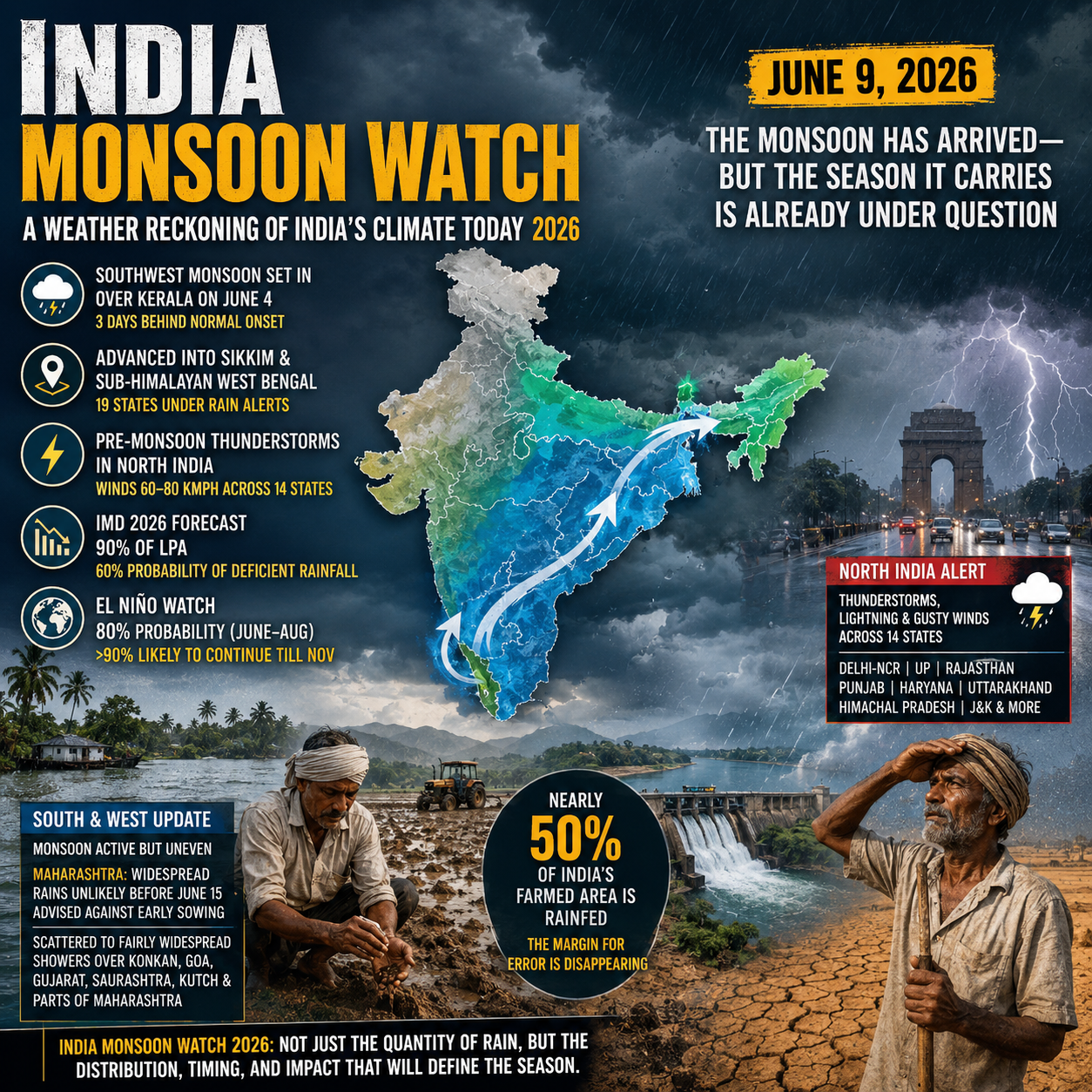
India Monsoon Watch: A Weather Reckoning of India’s Climate Today 2026
India Weather Watch-1
भारत / GB
The Southwest Monsoon Has Arrived — But the Season It Carries Is Already Under Question
India’s weather in June sits at the hinge between two realities: the scorching pre-monsoon heat that breaks records across the plains and the rain-bearing southwest monsoon that every farmer, every city planner, and every water ministry watches with disciplined anxiety. This series tracks that hinge — not just the forecast, but what it means.
Thank you for reading this post, don't forget to subscribe!Introduction: India Monsoon Watch and What June 9 Actually Looks Like
India Monsoon Watch, June 9, 2026: the southwest monsoon has arrived, it is moving, and the country it is entering is already stressed. The India Meteorological Department confirmed the monsoon set in over Kerala on June 4 — three days behind its normal onset date of June 1. As of today it has advanced into Sikkim and parts of Sub-Himalayan West Bengal. Nineteen states are under IMD rain alerts. The north is being hit by pre-monsoon thunderstorms with winds touching 60–80 kmph. The south is watching a monsoon that arrived late and is now being told to expect less than normal rainfall for the entire season.
India Monsoon Watch — What the IMD Is Actually Saying
The IMD’s India Monsoon Watch numbers for 2026 are not reassuring. The department has forecast rainfall at 90% of the Long Period Average — the threshold at which a monsoon season is classified as below-normal. There is a 60% probability of deficient rainfall, defined as less than 90% of the LPA. Behind that number sits a larger atmospheric reality: the World Meteorological Organization puts the probability of El Niño conditions during June–August 2026 at 80%, with continuation near or above 90% likely through November. El Niño typically suppresses Indian monsoon rainfall. The India Monsoon Watch for 2026 is, in other words, a watch for a season already running a deficit before it has fully begun.
North India India Monsoon Watch — The Pre-Monsoon That Is Already Doing Damage
While the southwest monsoon tracks northward from Kerala, northern India is experiencing something different: an active pre-monsoon system that the IMD has placed under thunderstorm alert across 14 states. Delhi-NCR, Uttar Pradesh, Uttarakhand, Punjab, Haryana, Rajasthan, Himachal Pradesh, and Jammu & Kashmir are all under alerts for thunderstorms, lightning, and gusty winds reaching 60–80 kmph. This is not monsoon rain — it is pre-monsoon convective activity, unpredictable in both location and intensity. The India Monsoon Watch distinction matters here: pre-monsoon thunderstorms bring water but also power outages, localised flooding, crop damage from hail, and the particular danger of lightning strikes in open agricultural land. The relief from heat is real; the risks are equally real.
The bridge from pre-monsoon violence to monsoon deficiency runs through the same soil. Farmers in the north making planting decisions this week are watching two contradictory signals simultaneously — thunderstorm warnings overhead and a below-normal seasonal forecast ahead. India Monsoon Watch is as much a cropping calendar question as a meteorological one.
South and West — India Monsoon Watch on the Active Monsoon Front
In the south and west, the India Monsoon Watch picture is of active but uneven monsoon advance. Maharashtra Chief Minister Devendra Fadnavis stated on June 7 that widespread monsoon rainfall across Maharashtra is unlikely before June 15 and advised farmers against early sowing. The southwest monsoon has entered South Konkan, with moderate to heavy rainfall in Sindhudurg and Ratnagiri, but both intensity and pace of advance are expected to slow. Mumbai is seeing cloudy skies and intermittent showers. The IMD has noted that Konkan, Goa, central Maharashtra, Marathwada, Gujarat, Saurashtra, and Kutch will see scattered to fairly widespread showers — but scattered and widespread are not the same thing, and this season the difference will matter to agricultural output across the western belt.
Series Reading
Ugadi Panchanga Precision: The Astronomical New Year
How the calculations of the traditional luni-solar calendar map structural planetary patterns with absolute mathematical precision.
Aamlki Ekadashi: A Day of Amla Fasting and Timeless Insight
Understanding the biological rhythms, seasonal adjustments, and historical background behind ancient systemic fasting methodologies.
India Monsoon Watch — The Agricultural Stakes in One Number
Nearly half of India’s farmed area has no irrigation and depends entirely on monsoon rains. The India Monsoon Watch is not a weather service for umbrella decisions — it is the primary input variable for food prices, reservoir levels, rural employment, and the fiscal position of state governments whose subsidy obligations rise when the rains fail. A season that delivers 90% of LPA is not a catastrophe. It is, however, a season in which the margin for distribution error disappears. If 90% of average rainfall falls unevenly — heavy in some regions, deficient in others — the aggregate number looks acceptable while specific states face crop failure. India Monsoon Watch in 2026 is therefore a watch not just for total rainfall but for where it falls and when.
Next in this series: India Monsoon Watch — El Niño, Reservoir Levels, and the Three States That Cannot Afford a Below-Normal Season.
Feature Image: Click here to view the image.
Videos
Glossary of Terms
- India Monsoon Watch: A recurring analytical series tracking the progress, distribution, risks, and consequences of India’s southwest monsoon beyond daily weather forecasts.
- Southwest Monsoon: India’s principal rainy season, driven by moisture-laden winds from the Indian Ocean, supplying most of the country’s annual rainfall.
- Monsoon Onset: The officially declared arrival of the southwest monsoon over a region, typically beginning with Kerala before advancing northward.
- Long Period Average (LPA): The benchmark average rainfall calculated over a long historical period and used by meteorologists to classify monsoon performance.
- Below-Normal Rainfall: A monsoon category in which seasonal rainfall falls below the normal range, often affecting agriculture, reservoirs, and rural livelihoods.
- Deficient Rainfall: Rainfall amounting to less than 90% of the Long Period Average, indicating a significant seasonal shortfall.
- India Meteorological Department (IMD): India’s national weather agency responsible for forecasts, warnings, monsoon monitoring, and climate assessments.
- El Niño: A Pacific Ocean climate phenomenon that alters global weather patterns and often suppresses monsoon rainfall over India.
- Pre-Monsoon Convective Activity: Thunderstorms, lightning, hail, and gusty winds that occur before the arrival of the southwest monsoon.
- Monsoon Advance: The northward and eastward progression of monsoon rainfall across India after its onset over Kerala.
- Rainfall Distribution Error: A situation where overall seasonal rainfall appears adequate but is unevenly distributed across regions, causing local droughts or crop losses.
- Cropping Calendar: The agricultural schedule that determines sowing, growing, and harvesting periods based largely on expected rainfall patterns.
- Monsoon Deficiency Risk: The possibility that rainfall may remain below normal due to climatic influences such as El Niño, affecting water and food security.
- Reservoir Dependence: The reliance of irrigation systems, drinking water supplies, and hydroelectric generation on monsoon-fed storage reservoirs.
- Weather Reckoning: A phrase coined in this series describing the broader climatic assessment of how weather patterns affect agriculture, water resources, economics, and public policy.
#Monsoon #Rainfall #Weather #Climate #India #ElNino #IMD #Agriculture #Drought #Forecast #Water #Environment #Monsoon2026 #ClimateChange #HinduinfoPedia