
Gandhi’s Responsible Aspirations: What the Nehru Report Satisfied — and What It Did Not (85)
भारत / GB
Part 85: Mahatma Gandhi’s Peace Efforts | Series Index
Blog 84 documented the Calcutta vote — four amendments, four rejections. This post places Gandhi’s documented statement on the Nehru Report before the reader alongside the four rejected amendments and asks a precise question: whose aspirations did the report satisfy — and whose did Gandhi’s formulation place outside the category of responsible?
Thank you for reading this post, don't forget to subscribe!The Action Taken: In December 1928 Gandhi declared that the Nehru Report satisfied all responsible aspirations after Jinnah’s minimum amendments had been voted down at Calcutta.
Who Paid the Price: The last documented opening for a single, negotiated communal constitution.
The Alternative Bypassed: Keeping Jinnah’s rejected clauses on the table instead of closing the report as complete.
Why This Matters: Fixed the 1928 Calcutta vote—not the 1931 London conference—as the recorded break.
The Primary Source
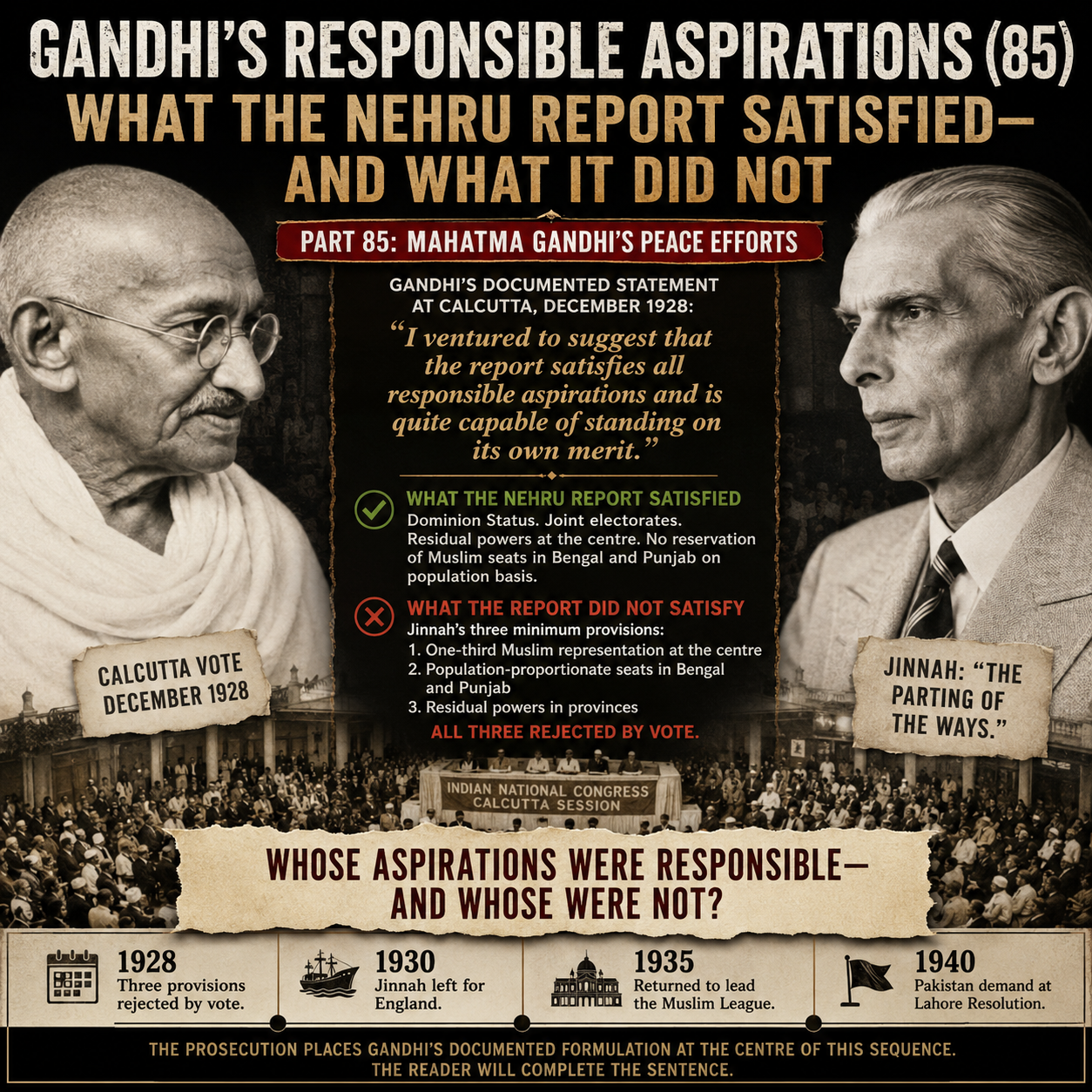
Gandhi’s documented statement on the Nehru Report, December 1928:
“I ventured to suggest that the report satisfies all responsible aspirations and is quite capable of standing on its own merit.”
This statement was made at the Calcutta session — the same session where Jinnah’s three amendments were put to a formal vote and all three were rejected.
Gandhi’s Responsible Aspirations places this documented statement alongside the documented record of what the Nehru Report contained and what it excluded.
What the Report Satisfied
The Nehru Report recommended Dominion Status, joint electorates, residual powers at the centre, and no reservation of Muslim seats in Bengal and Punjab on population basis. It reversed the agreements Congress had made with Jinnah at the Madras session in December 1927.
Gandhi declared this framework as satisfying all responsible aspirations. Gandhi’s Responsible Aspirations places the precise scope of that declaration before the reader — what the framework contained, and what Jinnah had asked for that it did not contain.
What the Report Did Not Satisfy
Jinnah had reduced his demands to three minimum provisions at Calcutta — one-third Muslim representation at the centre, population-proportionate seats in Bengal and Punjab, residual powers in provinces. These were a deliberate reduction from his broader demands, meeting Congress more than halfway.
All three were rejected by vote.
Gandhi’s statement — that the Nehru Report satisfied all responsible aspirations — was made after those three votes. Gandhi’s Responsible Aspirations places one precise observation before the reader: Gandhi’s formulation classified Jinnah’s three minimum provisions as falling outside the category of responsible aspirations.
The prosecution notes that Jinnah was at this moment the most constitutionally accommodating Muslim political leader available to Congress. He had opposed the Simon Commission alongside Congress when Shafi cooperated with the British. He had offered to trade separate electorates — the most contested Muslim demand — for other constitutional concessions. He had reduced his demands to three minimum provisions. Gandhi’s formulation — all responsible aspirations satisfied — applied to a framework that had rejected all three.
Who Jinnah Was at This Moment
Gandhi’s Responsible Aspirations places the documented record of Jinnah’s position in 1928 before the reader — not as characterisation but as documented fact.
Jinnah had opposed the Simon Commission alongside Congress — the only prominent Muslim leader to do so while Shafi’s faction cooperated with the British. He had been willing to trade separate electorates for constitutional concessions — a position more accommodating to Congress than Shafi’s hardline retention of separate electorates. He had reduced his demands to three minimum provisions at Calcutta specifically to find common ground.
At the Calcutta session, a Hindu Mahasabha leader questioned whether Jinnah even represented Muslim opinion. Jinnah responded: “Do you want Muslim India to go along with you? If you do not settle this question today, we shall have to settle it tomorrow.”
Gandhi declared the framework that rejected Jinnah’s three provisions as satisfying all responsible aspirations.
The Documented Consequence
Gandhi’s Responsible Aspirations places the documented sequence following that statement before the reader. Jinnah called Calcutta “the parting of the ways.” He left for England in 1930 to practise at the Privy Council. He did not return to Indian politics until 1935 — when he returned to lead the Muslim League with the consolidated Muslim political mass Gandhi’s Khilafat experiment had built available to him.
The man Gandhi’s Congress had foreclosed at Nagpur in 1920 — documented in Blog 82. The man who had opposed the Simon Commission alongside Gandhi. The man who had offered to trade separate electorates to find common ground. The man whose three minimum constitutional provisions Gandhi had declared outside the category of responsible aspirations in 1928. He returned in 1935 and demanded Pakistan in 1940. The documented sequence from Gandhi’s December 1928 statement to the Pakistan demand of 1940 is twelve years. The documented sequence from Gandhi’s foreclosure of Jinnah’s constitutional path at Nagpur to the Pakistan demand is twenty years. Both sequences pass through the moment Gandhi declared the framework that offered Jinnah nothing as satisfying all responsible aspirations.
The Prosecution’s Position
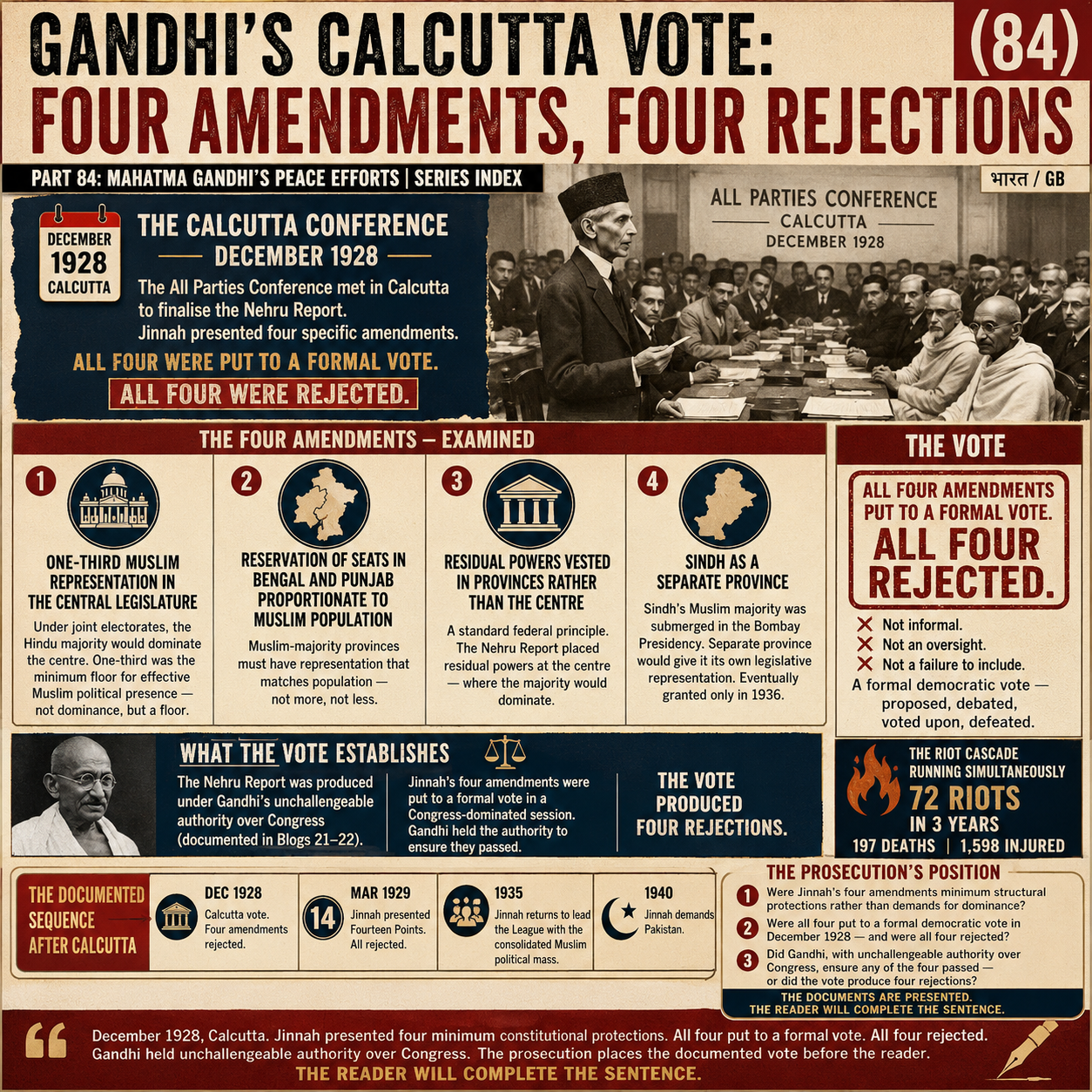
Gandhi’s Responsible Aspirations places three questions before the reader.
- Did Gandhi’s documented statement — that the Nehru Report satisfied all responsible aspirations — place Jinnah’s three minimum provisions outside the category of responsible aspirations?
- Was Jinnah, at the moment Gandhi made this statement, the most accommodating Muslim political leader available to Congress — having opposed the Simon Commission with Congress, having offered to trade separate electorates, having reduced his demands to three minimum provisions?
- Did Gandhi’s formulation, by classifying the rejection of those three provisions as the satisfaction of all responsible aspirations, close the last documented constitutional path that could have kept Jinnah within the framework of a united India?
Gandhi’s Responsible Aspirations does not answer. Gandhi’s documented statement is the primary source. The three rejected provisions are the documented exhibit. The sequence that followed — Jinnah’s departure, his return in 1935, the Pakistan demand in 1940 — is on the documented record. The prosecution places all three before the reader without characterisation. The three rejected provisions are documented. The consequence — Calcutta as parting of the ways, Jinnah’s departure, his return in 1935 with Pakistan as the eventual outcome — is documented. The reader will examine the sequence and complete the sentence.
December 1928, Calcutta. Three minimum provisions rejected by vote. Gandhi: the report satisfies all responsible aspirations. Jinnah: parting of the ways. 1930 — Jinnah left for England. 1935 — returned to lead the League. 1940 — Pakistan demand. The prosecution places Gandhi’s documented formulation at the centre of this sequence. The reader will complete the sentence.
Feature Image: Click here to view the image.
Videos
Glossary of Terms
- Gandhi’s Responsible Aspirations: The key phrase of this blog and a coined series term referring to Gandhi’s December 1928 statement that the Nehru Report satisfied “all responsible aspirations,” examined in the context of the Calcutta vote and Jinnah’s rejected amendments.
- Nehru Report: A constitutional proposal published in 1928 under the chairmanship of Motilal Nehru, outlining a framework for self-government in India, including Dominion Status and joint electorates.
- Calcutta Session (1928): The December 1928 session of the Indian National Congress where the Nehru Report was debated and Jinnah’s three constitutional amendments were rejected.
- Dominion Status: A constitutional arrangement under which a territory enjoys self-government while remaining within the British Commonwealth under the British Crown.
- Joint Electorates: An electoral system in which all voters participate in the same election regardless of religious or community identity.
- Separate Electorates: An electoral arrangement under which members of a religious or social community vote separately for their own representatives.
- Residual Powers: Constitutional powers not specifically assigned to either the central or provincial governments, making their allocation a major issue in constitutional negotiations.
- Population-Proportionate Representation: A system of legislative representation based on the population share of a community or region.
- One-Third Muslim Representation: Jinnah’s proposal that Muslims should hold one-third of the seats in the central legislature as a constitutional safeguard.
- Simon Commission: A British commission established in 1927 to recommend constitutional reforms for India, widely opposed because it contained no Indian members.
- Muhammad Ali Jinnah: A leading constitutional lawyer and politician who initially advocated Hindu-Muslim political cooperation before later leading the Muslim League.
- Muslim League: A political organization founded in 1906 that represented Muslim political interests and later became the principal advocate of Pakistan.
- Parting of the Ways: Jinnah’s description of the outcome of the 1928 Calcutta Session after the rejection of his constitutional proposals.
- Lahore Resolution: The 1940 resolution adopted by the Muslim League that called for independent states in Muslim-majority regions of British India and became associated with the Pakistan movement.
- Constitutional Settlement: A negotiated political agreement establishing the structure, powers, and representation mechanisms of government within a constitutional framework.
#Gandhi #Jinnah #Congress #NehruReport #Calcutta #Pakistan #History #India #Politics #HinduinfoPedia
Gandhi’s Peace Efforts: The Questions Before the Mahatma (0)