
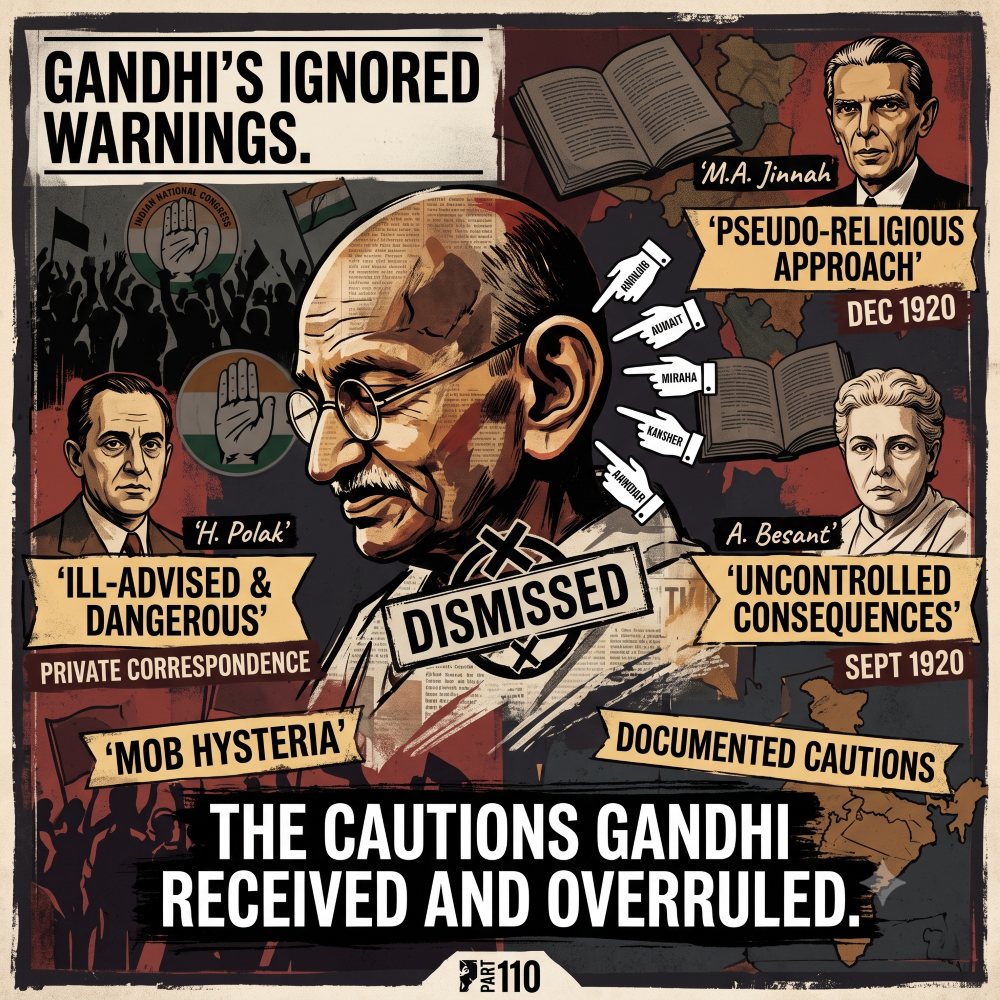
Gandhi’s Ignored Warnings: The Documented Cautions Gandhi Received — and Dismissed (110)
भारत / GB
Part 110: Mahatma Gandhi’s Peace Efforts | Series Index
Blog 109 placed the third evidentiary layer on the cause inversion — what Gandhi’s own contemporaries documented seeing, warning against, and being overruled by. This post, Gandhi’s Ignored Warnings, isolates the specific documented warnings directed at Gandhi personally by named leaders, the documented language of those warnings, and Gandhi’s own documented self-description of what he was doing.
Thank you for reading this post, don't forget to subscribe!The Action Taken: Written cautions from Jinnah, Polak, and Besant against mixing religious mobilisation with mass politics were received and set aside.
Who Paid the Price: The constitutional dissenters whose warnings were treated as obstruction.
The Alternative Bypassed: Answering those cautions in writing before launching the 1920 programme.
Why This Matters: Places the warning file on record; it is not the later cow-protection barter.
Gandhi’s Own Documented Admission — Before the Warnings
The record begins with Gandhi himself. On May 12 1920 — before the September Calcutta session, before the December Nagpur session — Gandhi wrote in Young India:
“I have been experimenting with myself and my friends by introducing religion into politics.”
(Young India, 12 May 1920)
Gandhi’s Ignored Warnings places this documented self-description before the reader first. Gandhi did not stumble into the religious-political merger. He documented it as a deliberate experiment, in his own words, in his own journal, four months before Congress formally adopted it. Gandhi immediately clarified in the same article what he meant by “religion”: not institutional Hinduism but a universal moral framework — “the religion which transcends Hinduism… which binds one indissolubly to the truth within.” The prosecution places this clarification before the reader alongside what the practical application of that experiment produced: the Khilafat Movement’s documented demands were not universal moral truth but the territorial restoration of a defeated foreign empire. What Gandhi called a spiritual experiment, Jinnah called working up mob hysteria. The documented record of what followed is available to the reader across Blogs 102-109. The warnings that followed were directed at a man who had already, by his own documented account, decided to introduce religion into politics as an experiment.
Jinnah’s Documented Warning — Nagpur December 1920
At the Nagpur Congress session of December 1920, Jinnah was the solitary dissenter among some 50,000 delegates. He rose to speak and was shouted down by the crowd Gandhi had mobilised. His documented speech placed two specific objections on the record.
First, on the programme itself: “it is not the right step to take at this moment… you are committing the Indian National Congress to a programme which you will not be able to carry out.” (Documented in A.G. Noorani, The Destruction of Hyderabad, citing session proceedings.)
Second, on what Gandhi had introduced into Indian politics. After the session, Jinnah told journalist Durga Das in a documented exchange recorded in Das’s own book India from Curzon to Nehru and After:
“Well, young man. I will have nothing to do with this pseudo-religious approach to politics. I part company with Congress and Gandhi. I do not believe in working up mob hysteria.”
Gandhi’s Ignored Warnings places these documented Jinnah statements before the reader alongside the documented Jinnah profile already established across Blogs 81-98 ( The Jinnah Arc, Split Between Congress and Muslim League, Closing Arc): the man called Ambassador of Hindu-Muslim Unity, who had spent twenty years working for Hindu-Muslim constitutional cooperation, who had built the Lucknow Pact of 1916, and who left Congress at Nagpur with this documented verdict on what Gandhi had introduced.
The Documented Gandhi’s Ignored Warnings on Religious Zealotry
Jinnah’s documented characterisation of Gandhi’s Khilafat advocacy — recorded across multiple contemporary sources including Wikipedia’s documented citation of his position — was that it constituted an endorsement of religious zealotry and that Gandhi’s satyagraha campaign was political anarchy. He believed self-government should be secured through constitutional means, not through mass religious mobilisation.
Gandhi’s Ignored Warnings places one further documented Jinnah observation before the reader. The Dawn.com source, citing Kanji Dwarka Das’s documented account (India’s Fight for Freedom, Bombay, Popular Prakashan, 1966, pp. 286-287), records that at Nagpur, paradoxically, had there been a Hindu majority, Jinnah would have prevailed. Gandhi prevailed because of a highly organised, pro-Khilafat contingent whose vocal presence in the pandal effectively drowned out Jinnah’s constitutionalist dissent — a mobilised bloc Gandhi’s own Khilafat alliance had brought into the session. The overall Congress delegate composition remained predominantly Hindu; what Dwarkadas documented was a contrived pro-Khilafat mobilisation that overrode the solitary dissenter, not an absolute Muslim demographic majority of the full Congress body.
Henry Polak’s Documented Gandhi’s Ignored Warnings
Gandhi’s close friend and fellow South Africa barrister Henry Polak found the Non-Cooperation/Khilafat merger “ill-advised and dangerous.” Gandhi tried to convert Polak to his views and failed — documented in Gandhi’s own correspondence, CWMG Vol. XCVI pp. 271-273. Polak was not a political opponent. He was the man Gandhi had worked alongside in South Africa for years, a personal friend whose documented assessment of Gandhi’s Khilafat decision was placed on the private record in Gandhi’s own Collected Works.
Besant’s Documented Warning
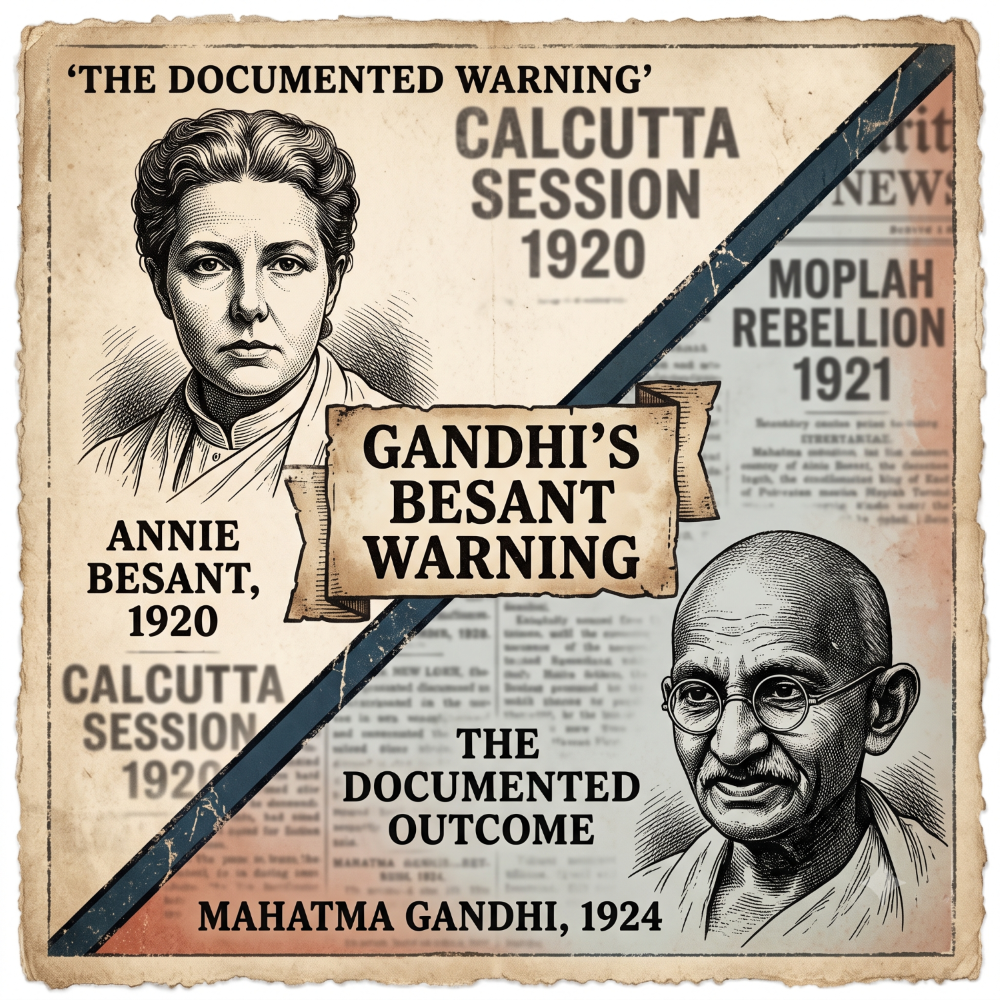
Annie Besant — documented in Blog 106 — warned Gandhi at the September 1920 Calcutta session that mass religious mobilisation would produce consequences he could not control. Her documented The Future of Indian Politics (1922) placed the post-Moplah verdict on primary source record from Madras, adjacent to the Malabar region where the consequences arrived within one year.
What Gandhi Did With the Warnings
Gandhi’s Ignored Warnings places the documented pattern before the reader. Each warning named a specific danger: Jinnah named mob hysteria and pseudo-religious politics. Polak named ill-advised and dangerous conduct. Besant named consequences Gandhi could not control. Gandhi’s own documented May 1920 Young India admission named the experiment itself.
Gandhi proceeded. The September 1920 Calcutta session formally adopted the Khilafat demands alongside Swaraj. The December 1920 Nagpur session overrode Jinnah’s solitary documented dissent with a Muslim-majority crowd. Polak was not converted. Besant’s six dissenters were overruled.
The Prosecution’s Position
Gandhi’s Ignored Warnings places three questions before the reader.
- Did Gandhi document in his own words, on May 12 1920, that he was deliberately introducing religion into politics as an experiment — before the warnings arrived, before Congress adopted the programme, before the consequences followed?
- Did Jinnah — the man who had spent twenty years building Hindu-Muslim constitutional cooperation, who was shouted down by the Muslim majority Gandhi had mobilised — place on documented record that Gandhi was working up mob hysteria through a pseudo-religious approach that would not carry out its programme?
- Did Gandhi proceed after receiving documented warnings from Jinnah, Polak, and Besant — each naming a specific documented danger — and does the documented outcome of that decision belong before the reader alongside each warning that preceded it?
The series does not answer. Gandhi’s Ignored Warnings places Gandhi’s own documented self-description, Jinnah’s documented Nagpur warning, Polak’s documented private assessment, and Besant’s documented caution before the reader in sequence. The reader will examine what Gandhi was warned against — and complete the sentence.
Invitation To Defence
The floor belongs to the defense. We now invite them to present their exhibits and challenge the narrative established by the prosecution.
May 12 1920, Gandhi, Young India: “I have been experimenting with myself and my friends by introducing religion into politics.” December 1920, Nagpur: Jinnah, the last dissenter among 50,000, shouted down by Gandhi’s Muslim majority — “I will have nothing to do with this pseudo-religious approach to politics. I do not believe in working up mob hysteria.” Polak: ill-advised and dangerous. Besant: consequences you cannot control. Gandhi proceeded. The prosecution places the documented warnings and the documented decision before the reader. The reader will complete the sentence.
Feature Image: Click here to view the image.
Videos
Glossary of Terms
- Gandhi’s Ignored Warnings: The key phrase of this blog, referring to documented cautions given to Mahatma Gandhi by prominent contemporaries before and during the Khilafat–Non-Cooperation movement, and his decision to proceed despite them.
- Cause Inversion: A concept developed in this series describing the reversal of responsibility by focusing on consequences while overlooking earlier documented decisions and warnings that preceded them.
- Young India: Mahatma Gandhi’s weekly journal in which he explained his political philosophy and published his statement on introducing religion into politics on 12 May 1920.
- Non-Cooperation Movement: The nationwide movement launched by Gandhi in 1920 encouraging Indians to withdraw cooperation from British institutions.
- Khilafat Movement: A political movement supporting the restoration of the Ottoman Caliphate after the First World War, which Gandhi allied with the Non-Cooperation Movement.
- Pseudo-Religious Politics: Muhammad Ali Jinnah’s documented description of mixing religion with political mobilisation, recorded after the Nagpur Congress session.
- Mob Hysteria: Jinnah’s expression describing emotionally charged mass political mobilisation replacing constitutional political processes.
- Henry Polak: Gandhi’s close associate and fellow lawyer from South Africa who privately described the Khilafat–Non-Cooperation alliance as “ill-advised and dangerous.”
- Annie Besant: Indian nationalist leader and former Congress President who warned Gandhi that mass religious mobilisation could produce consequences beyond control.
- Nagpur Congress Session (1920): The December 1920 Congress session where Gandhi’s Non-Cooperation programme was adopted and Jinnah’s dissent was rejected.
- Calcutta Special Session (1920): The September 1920 Congress session where the Khilafat issue and Non-Cooperation programme were first formally adopted.
- CWMG (Collected Works of Mahatma Gandhi): The official multi-volume compilation of Gandhi’s writings, speeches, correspondence, and documents used as a primary historical source.
- Constitutional Politics: A political approach based on legal procedures, representative institutions, and negotiated constitutional reforms rather than mass agitation.
- Documented Warning: A caution preserved in contemporary speeches, letters, books, or official records, forming part of the evidentiary framework of this series.
- The Prosecution: The analytical framework used throughout this series that presents documented historical evidence for readers to evaluate without claiming judicial authority.
#Gandhi #Jinnah #Khilafat #Congress #History #India #Freedom #Politics #Nationalism #NonCooperation #YoungIndia #HinduinfoPedia
Gandhi’s Peace Efforts: The Questions Before the Mahatma (0)
Refer to Various Arks Referred to in the Blog