
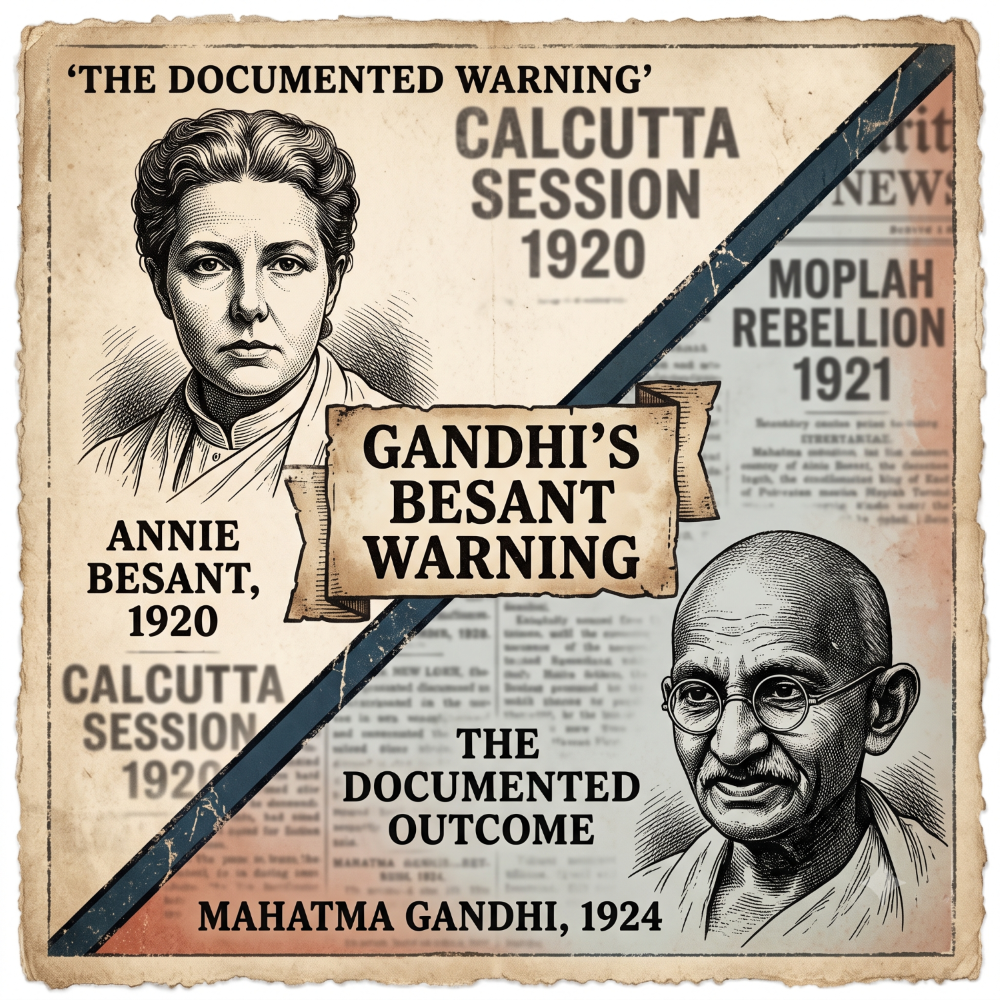
Gandhi’s Besant Warning: The Documented Caution, the Documented Outcome (106)
भारत / GB
Part 106: Mahatma Gandhi’s Peace Efforts | Series Index
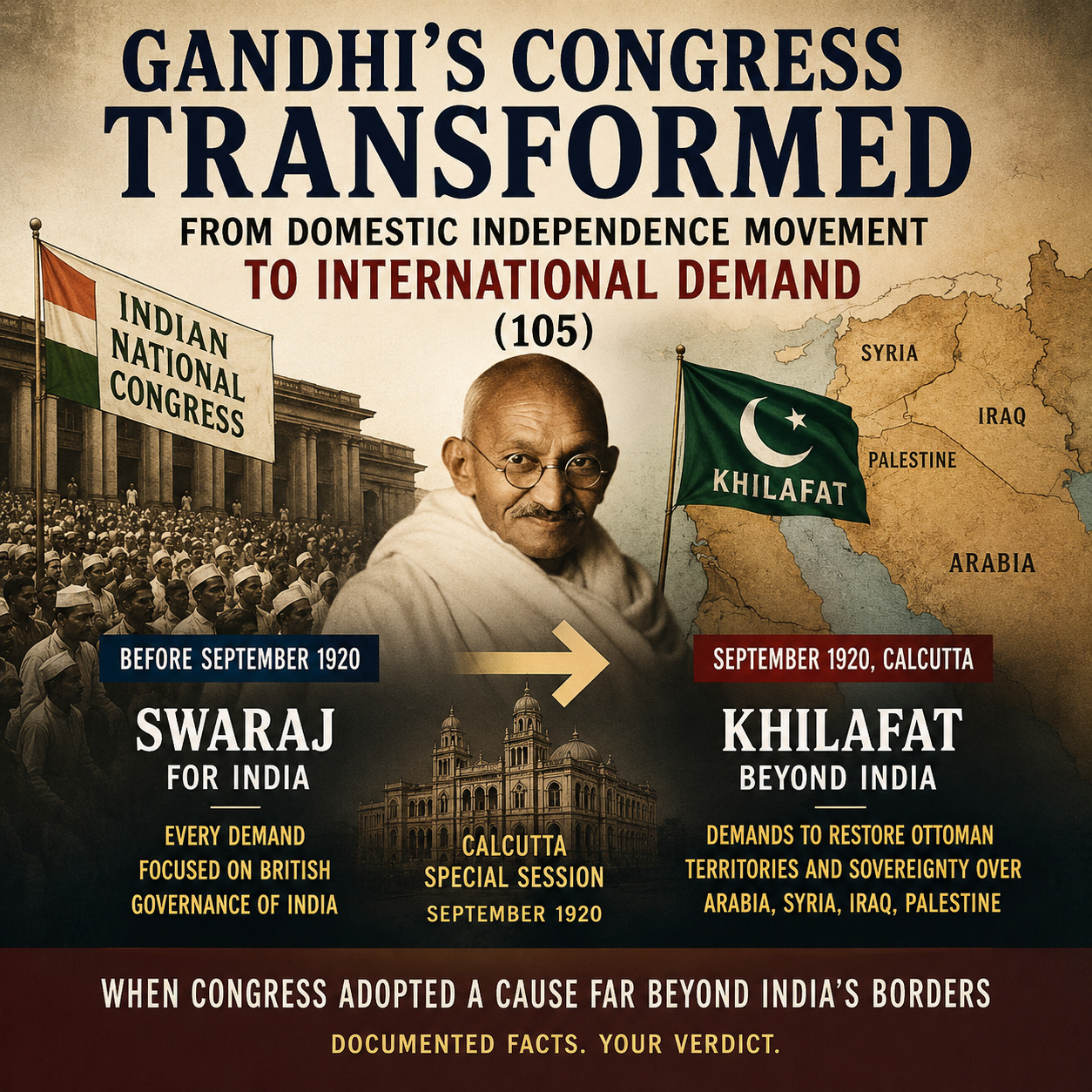
Blog 105 documented what Congress formally became when Gandhi merged its cause with the Khilafat Movement at the September 1920 Calcutta session — a domestic independence organisation that adopted demands extending to Britain’s Middle Eastern territorial settlement. This post places the warning Gandhi overruled to produce that transformation, and the documented outcome the warning named.
Thank you for reading this post, don't forget to subscribe!The Action Taken: The Khilafat conference at Karachi passed a resolution declaring it religiously unlawful for any Muslim to serve in the British Indian Army, a move Gandhi formally endorsed as a religious imperative.
Who Paid the Price: The secular discipline of public political protest, which was reframed around fatwas and sharia obligations rather than civil constitutional rights.
The Alternative Bypassed: Calling for military resignations strictly on grounds of anti-colonial democratic self-determination.
Why This Matters: Subordinated national political boycott to theological duty, reinforcing the authority of clerical bodies to determine which state laws were religiously permissible.
Who Annie Besant Was — Documented
Gandhi’s Besant Warning places the source of the warning before the reader first. Annie Besant was not a peripheral figure offering a casual reservation. She was the first woman elected President of the Indian National Congress — at the Calcutta session of December 1917. She had launched the Home Rule League in 1916 and had been interned by the British for her political activism, her release demanded jointly by Congress and the Muslim League. She was an experienced political operator who had watched Indian religious politics at close quarters for decades. Gandhi himself had written to demand her release.
By 1920, Besant was one of only six dissenters at the September Congress session who stood against Gandhi’s merger of the Khilafat cause with the Indian freedom movement and the Non-Cooperation Movement — facing an overwhelming majority that Gandhi had mobilised behind his position.
The Documented Warning
Gandhi’s Besant Warning places Besant’s documented specific objection before the reader. Her position, recorded across contemporary sources: she believed the common man lacked the ability to meet physical abuse with non-violence — and therefore feared that a movement built on mass religious mobilisation would turn violent. She opposed the merger of Khilafat movement with Non-Cooperation on this specific documented ground: that mixing religion with politics at mass scale would produce consequences Gandhi could not control.
Gandhi’s own documented counter-position at the same session: “I would, in order to achieve success in the Khilafat issue, even postpone the issue of Swaraj.” The independence movement itself — Congress’s documented primary purpose — was subordinated in Gandhi’s own documented words to the Khilafat cause Besant was warning against.
The Documented Outcome — Within One Year
Gandhi’s Besant Warning places the documented timeline before the reader. The September 1920 Calcutta session adopted Gandhi’s position over Besant’s documented objection. Within one year — August 1921 — the Moplah massacre began in the Malabar region of South India, in territory that had been a focal point of Khilafat mobilisation. What had begun as agitation against British authority escalated into documented violence against Hindus: killings, forced conversions, temple desecrations, and the displacement of Hindu communities across Ernad and Valluvanad. The rebellion was led by Khilafat leaders who declared Khilafat Kingdoms in the affected areas. Contemporary British administrative records, Besant’s own documented account, and Ambedkar’s analysis in Pakistan or the Partition of India all document the scale and character of what followed.
Besant’s own documented verdict, written from Madras — directly adjacent to the Malabar region where the rebellion occurred, placing her account in the category of eyewitness-proximate primary source — in The Future of Indian Politics (1922):: “Malabar has taught us what Islamic rule still means, and we do not want to see another specimen of the ‘Khilafat Raj’ in India.” She documented that Gandhi had stated the Moplahs “had acted as they believed that religion taught them to act” — and named Gandhi’s own framing as the problem, not as a justification. She reported over 100,000 Hindus forcibly converted or driven from their homes in Malabar.
Gandhi’s Documented Response to the Outcome
Gandhi’s Besant Warning places Gandhi’s own documented response to the Moplah rebellion alongside Besant’s documented warning. Gandhi’s documented positions, Young India 1921-1922 — examined in detail in the following blog in this series — described the Moplahs as “brave God-fearing” and asked Hindus not to let the events “strain Hindu-Muslim unity.” He defended Maulana Hasrat Mohani, who had publicly justified the Moplah violence as religious action, as “one of our most courageous men.”
Gandhi’s own documented May 1924 assessment in Young India (CWMG Vol. 24, pp. 136-143), three years after the Moplah rebellion and after the Khilafat Movement had collapsed into communal riots across India: Gandhi wrote in the same essay that he had asked Hindus to make common cause with Muslims on the Khilafat question, that this had unified and awakened the Muslim community, and that now that the Khilafat question was over, the awakened Muslims had — in his own documented framing — turned against Hindus. (Young India, May 29 1924, CWMG Vol. 24 pp. 136-143.)
Gandhi’s own documented 1924 words named what Besant’s documented 1920 warning had predicted.
The Prosecution’s Position
Gandhi’s Besant Warning places three questions before the reader.
- Did Besant — the first woman Congress President, an experienced political operator who had watched Indian religious politics at close quarters — warn Gandhi specifically that mass religious mobilisation would produce consequences he could not control, and did Gandhi overrule her as one of only six dissenters against his position?
- Did the documented Moplah rebellion of 1921 — occurring within one year of the Calcutta session — produce the category of consequence Besant’s documented warning had named: violence Gandhi could not control, produced by the religious mobilisation he had insisted upon?
- Did Gandhi’s own documented May 1924 words — “the awakened Mussalmans have proclaimed a kind of Jihad against us Hindus” — place on record what Besant’s 1920 warning had predicted, in Gandhi’s own language?
The series does not answer. Gandhi’s Besant Warning places the documented warning, the documented override, and the documented outcome before the reader in sequence. The reader will examine what Besant named in 1920, what Gandhi documented in 1924, and complete the sentence.
Invitation To Defence
The floor belongs to the defense. We now invite them to present their exhibits and challenge the narrative established by the prosecution.
September 1920, Calcutta. Six dissented. Besant: mass religious mobilisation will produce consequences you cannot control. Gandhi: I would postpone Swaraj itself for the Khilafat cause. August 1921: Malabar. Besant documented it herself: Malabar has taught us what Islamic rule still means. Gandhi, May 1924: the awakened Mussalmans have proclaimed a kind of Jihad against us Hindus. The prosecution places the warning and the outcome before the reader. The reader will complete the sentence.
Feature Image: Click here to view the image.
Videos
Glossary of Terms
- Annie Besant: The first woman President of the Indian National Congress (1917), founder of the Home Rule League, and a leading critic of merging the Khilafat Movement with India’s freedom struggle.
- Khilafat Movement: A political and religious movement launched to support the Ottoman Caliph after the First World War, later endorsed by Gandhi as part of the Non-Cooperation Movement.
- Non-Cooperation Movement: A nationwide movement initiated by Gandhi in 1920 urging Indians to withdraw cooperation from British institutions.
- Calcutta Session (1920): The September 1920 session of the Indian National Congress where Gandhi secured approval to combine the Khilafat cause with the Non-Cooperation Movement.
- Moplah Rebellion (1921): An uprising in the Malabar region that escalated into large-scale violence, forced conversions, displacement, and attacks on Hindu communities.
- Malabar: A region on India’s southwestern coast where the 1921 Moplah Rebellion took place.
- Young India: Gandhi’s weekly journal in which he published his political views, including his reflections on the Khilafat Movement and Moplah events.
- CWMG (Collected Works of Mahatma Gandhi): The official multi-volume compilation of Gandhi’s writings, speeches, and correspondence.
- Home Rule League: An organization founded by Annie Besant in 1916 to campaign for self-government within the British Empire.
- Swaraj: Self-rule or national independence, the principal objective of the Indian National Congress during the freedom movement.
- Hasrat Mohani: A nationalist leader and Islamic scholar who publicly defended the Moplah rebels as acting on religious grounds.
- Khilafat Raj: Annie Besant’s expression describing a political order based on the objectives of the Khilafat Movement, used in her criticism after the Moplah Rebellion.
- Documented Warning: The series’ key phrase referring to Annie Besant’s recorded objections in 1920 against combining religious mobilization with mass politics.
- Documented Outcome: The series’ key phrase referring to the historical developments—especially the Moplah Rebellion and Gandhi’s later writings—that are presented as the consequences of the warning.
- Gandhi to Besant Warning (Key Phrase): The central theme of this blog examining Annie Besant’s documented warning to Gandhi, Gandhi’s rejection of it, and the subsequent historical developments.
#Gandhi #AnnieBesant #Khilafat #Congress #Moplah #History #India #Freedom #Politics #HinduinfoPedia
Gandhi’s Peace Efforts: The Questions Before the Mahatma (0)