
Gandhi’s Khilafat Period Dispensation: The Cause Inversion Asymmetric Language, 1921-1922 (119)
भारत / GB
Part 119: Mahatma Gandhi’s Peace Efforts | Series Index
Blog 118 placed the documented pattern across three instances — Moplah 1921, Shraddhanand 1926, Direct Action Day 1946. This post returns to the Khilafat period and places the documented language pattern in its densest primary source form: four dated CWMG citations, 1921-1922, in which Gandhi’s documented words for Muslim perpetrators and Hindu victims of the same documented events are placed before the reader side by side.
Thank you for reading this post, don't forget to subscribe!The Action Taken: When communal riots erupted in Multan during Muharram (Sep 1922)—resulting in the destruction of temples and killings of Hindus—Gandhi counseled the minority Hindu population not to pursue police cases or seek state protection.
Who Paid the Price: The victimized Hindu population of Multan, who were urged to surrender their statutory legal remedies under the Indian Penal Code.
The Alternative Bypassed: Demanding full, transparent state criminal prosecution and judicial restitution for damaged properties.
Why This Matters: The post-Malabar template in practice: victims of targeted rioting were urged to show spiritual forbearance and drop legal charges, ensuring that communal rioters faced no legal consequences.
The Primary Source Record — October 1921
Gandhi’s Documented Dispensation places the most precise documented exhibit before the reader first. Young India, October 20 1921, CWMG Vol. 21, p. 317. Gandhi’s own documented words — perpetrators and victims placed in the same article, in the same paragraph, in consecutive documented sentences:
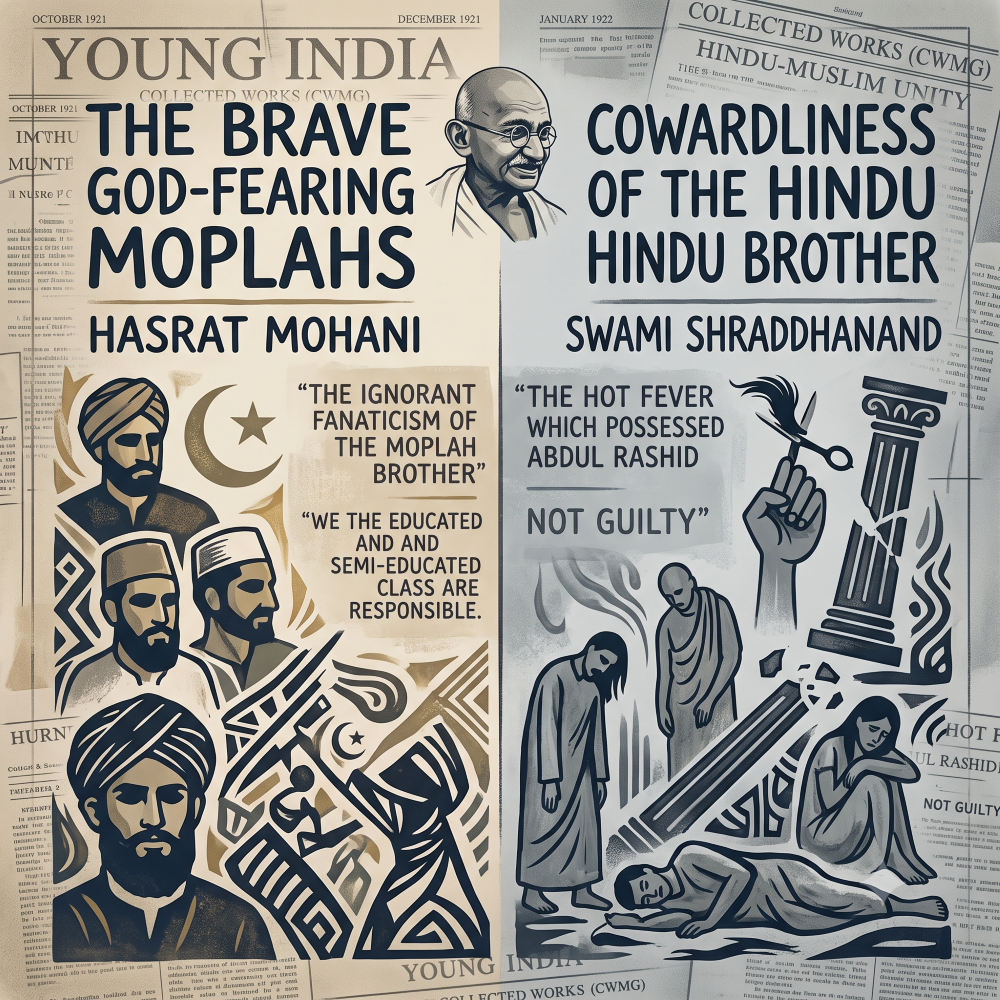
On the Moplah perpetrators: “ignorant fanaticism of the Moplah brother.”
On the Hindu victims: “cowardliness of the Hindu brother who helplessly muttered the Islamic formula or allowed his tuft of hairs to be cut or his vest to be changed.”
Gandhi’s Documented Dispensation places one observation before the reader: the documented language is not separated by time, by article, or by context. It is placed by Gandhi in the same paragraph of the same documented article. Fanaticism — applied to perpetrators of documented killing, forced conversion, and temple desecration — is modified by “ignorant.” Cowardliness — applied to victims of documented killing, forced conversion, and temple desecration — stands without modification. The perpetrator’s conduct is documented as fanaticism. The victim’s conduct under duress is documented as cowardice.
The Primary Source Record — December 1921
Young India, December 8 1921, CWMG Vol. 22. Gandhi’s documented language for the Moplah perpetrators — already established in this series across Blogs 58-68 (Moplah Unrest Moplah Conclusions) — placed before the reader in its most precise form:
“The brave God-fearing Moplahs were fighting for what they consider as religion and in a manner which they consider as religious.”
Gandhi’s Documented Dispensation places the documented vocabulary before the reader: brave. God-fearing. Fighting for religion. The documented Moplah conduct — established in this series from the Malabar District Gazetteer, the Hitchcock Report, Besant’s eyewitness-proximate account — included documented killing, documented forced conversion, documented temple desecration, documented displacement of Hindu families across Malabar. Gandhi’s documented December 1921 vocabulary for the people whose documented conduct produced these documented outcomes: brave, God-fearing, fighting for what they considered religion.
The Primary Source Record — January 1922: Hasrat Mohani
Gandhi’s Documented Dispensation places a third documented exhibit before the reader. Young India, January 26 1922, CWMG Vol. 22. Gandhi’s documented defence of Maulana Hasrat Mohani — who had publicly justified the Moplah violence as a legitimate religious war:
“Maulana Hasrat Mohani is one of our most courageous men… In spite of his amazingly crude views about religion, there is no greater nationalist nor a greater lover of Hindu-Muslim unity than the Maulana. His heart is sound and superior to his intellect.”
Gandhi’s Documented Dispensation places the documented sequence before the reader: Mohani had publicly justified documented killings and forced conversions as a religious war. Gandhi’s documented response: “most courageous,” “no greater nationalist,” “his heart is sound.” Gandhi’s documented qualification of Mohani’s justification of communal violence: “amazingly crude views about religion.” The documented violence Mohani had justified — listed as crude views. The documented man who had justified it — listed as courageous, nationalist, sound of heart.
The Primary Source Record — January 1922: Hindu Responsibility
The fourth documented exhibit from the same period is placed before the reader. Young India, January 26 1922, CWMG Vol. 22:
“Hindus must find out the causes of Moplah fanaticism. They will find that they are not without blame. They have hitherto not cared for the Moplah. They have either treated him as a serf or dreaded him.”
The prosecution places this documented statement alongside the October 1921 statement already before the reader. October 1921: Hindu victims of documented forced conversion were documented as cowardly. January 1922: Hindus were documented as responsible for Moplah fanaticism through their historical treatment of the Moplah community. The documented violence — four months, documented at scale — is placed by Gandhi within a framework that locates its causes in Hindu conduct toward the Moplah community over time.
Ambedkar’s Documented Corroboration
Gandhi’s Documented Dispensation places Ambedkar’s documented verdict alongside the four primary source exhibits. Ambedkar, *Pakistan or the Partition of India*, available at franpritchett.com:
Gandhi “was so much obsessed by the necessity of establishing Hindu-Muslim unity that he was prepared to make light of the doings of the Moplas… He spoke of the Mappilas as the ‘brave God-fearing Moplahs.’ Gandhi blamed Hindus rather than holding Muslims accountable.”
Ambedkar’s documented verdict — from the drafter of India’s Constitution, the series’ most cited independent primary source — placed alongside Gandhi’s own documented language from the same period. The pattern Ambedkar documented is the pattern the four CWMG citations establish: Gandhi’s documented language consistently applied “brave,” “courageous,” and “God-fearing” to the perpetrators, and “cowardly” and “not without blame” to the victims.
The Prosecution’s Position
Gandhi’s Documented Dispensation places three questions before the reader.
- Did Gandhi’s own documented October 20 1921 Young India article (CWMG Vol. 21, p. 317) place in the same paragraph — on the perpetrators of documented killing, forced conversion, and temple desecration: “ignorant fanaticism”; on the victims of those documented acts: “cowardliness of the Hindu brother who helplessly muttered the Islamic formula or allowed his tuft of hairs to be cut”?
- Did Gandhi’s documented December 1921 language — “brave God-fearing Moplahs fighting for what they consider as religion” — and his documented January 1922 defence of Hasrat Mohani as “most courageous” and “no greater nationalist” despite Mohani’s documented public justification of the Moplah violence — constitute a consistent documented vocabulary applied to the Khilafat period’s Muslim actors?
- Did Gandhi’s documented January 1922 placement of Hindu responsibility for Moplah fanaticism — “they have hitherto not cared for the Moplah, they have either treated him as a serf or dreaded him” — extend the documented pattern of locating responsibility in Hindu conduct rather than in the documented violence, as Ambedkar’s documented verdict in Pakistan or the Partition of India established?
The series does not answer. Gandhi’s Documented Dispensation places four dated CWMG primary source citations and Ambedkar’s documented corroboration before the reader in sequence. The reader will examine the documented vocabulary Gandhi applied to perpetrators and the documented vocabulary Gandhi applied to victims in the same documented period — and complete the sentence.
Invitation To Defence
The floor belongs to the defense. We now invite them to present their exhibits and challenge the narrative established by the prosecution.
October 20 1921, Young India, CWMG Vol. 21, p. 317. Same paragraph. Perpetrators: “ignorant fanaticism of the Moplah brother.” Victims: “cowardliness of the Hindu brother who helplessly muttered the Islamic formula.” December 8 1921, CWMG Vol. 22: “brave God-fearing Moplahs fighting for what they consider as religion.” January 26 1922, CWMG Vol. 22: Hasrat Mohani — who publicly justified the Moplah killings as a religious war — “one of our most courageous men… no greater nationalist… his heart is sound.” January 26 1922, CWMG Vol. 22: “Hindus are not without blame. They have hitherto not cared for the Moplah.” Ambedkar: Gandhi “was so much obsessed by the necessity of establishing Hindu-Muslim unity that he was prepared to make light of the doings of the Moplas.” The prosecution places four dated primary sources and Ambedkar’s documented verdict before the reader. The reader will complete the sentence.
Feature Image: Click here to view the image.
Videos
Glossary of Terms
- Gandhi Khilafat Period Dispensation: A key phrase in this blog referring to Gandhi’s documented language and positions during the Khilafat period, presented through primary source records for examination.
- Cause Inversion: A recurring concept in this series describing the attribution of responsibility to victims or their community instead of focusing primarily on the documented perpetrators of violence.
- Asymmetric Language: The use of different descriptive standards or vocabulary for perpetrators and victims involved in the same documented events.
- Khilafat Movement: A pan-Islamic political movement launched after the First World War to support the Ottoman Caliphate, which Gandhi supported as part of the Non-Cooperation Movement.
- Moplah Rebellion: The 1921 Malabar uprising involving widespread violence, killings, forced conversions, temple desecrations, and displacement, examined in this series through documented historical sources.
- CWMG (Collected Works of Mahatma Gandhi): The official multi-volume compilation of Gandhi’s writings, speeches, correspondence, and published articles used as the primary documentary source.
- Young India: Gandhi’s English-language weekly journal in which many of the cited statements from 1921–1922 were originally published.
- Hasrat Mohani: Indian nationalist, Islamic scholar, and political leader whose public justification of the Moplah violence is examined alongside Gandhi’s documented comments.
- Documented Corroboration: Independent documentary evidence used to support or verify conclusions drawn from primary sources.
- B. R. Ambedkar: Principal architect of the Constitution of India whose observations in Pakistan or the Partition of India are presented as an independent corroboration of the documented pattern.
- Primary Source Record: Contemporary original documents created during the events being examined, including Gandhi’s own published writings.
- Documented Vocabulary: The specific words and expressions used in authenticated historical documents, analyzed without reinterpretation.
- Prosecution’s Position: The structured presentation of documentary evidence in this series, inviting readers to evaluate the historical record without asserting a judicial verdict.
- Invitation to Defence: A recurring feature of this series inviting opposing evidence or alternative interpretations supported by documentary sources.
#Gandhi #Khilafat #Moplah #History #Ambedkar #India #Congress #Malabar #Partition #Politics #HinduinfoPedia
Gandhi’s Peace Efforts: The Questions Before the Mahatma (0)
Refer to Various Arks Referred to in the Blog