
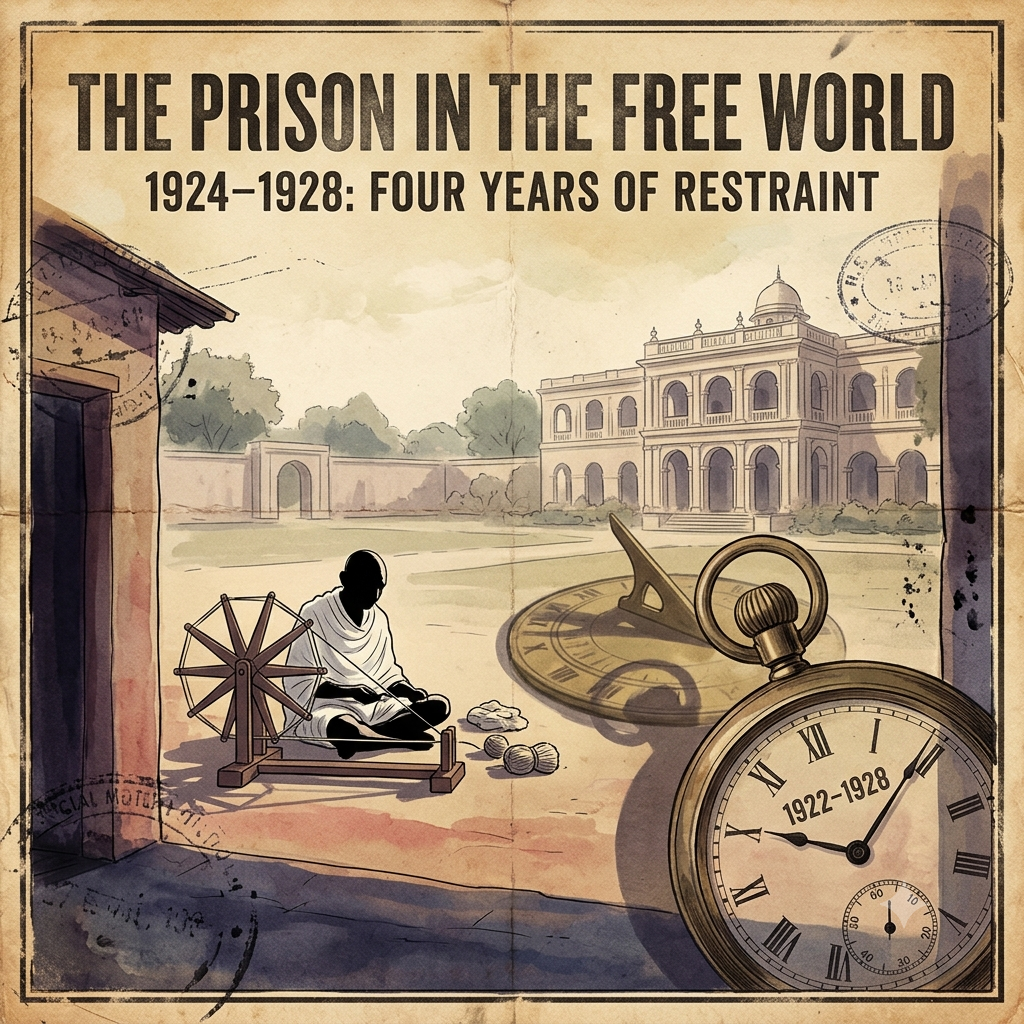
Gandhi’s Constructive Interregnum: The Prison in the Free World (211)
Was It the Prison, or an Attempt to Imprison the Nation’s Struggle?
भारत / GB
Part 211: Mahatma Gandhi’s Peace Efforts | Series Index
Blog 210 documented Gandhi’s Belgaum compromise — the December 1924 settlement through which Gandhi accepted his sole Congress presidency, ceded council-entry politics to the Swarajists, and installed the 2,000-yard monthly charkha franchise as the condition for voting membership. This blog examines the four years that followed from 1925 to 1928: the rapid collapse and repeal of the spinning franchise at Patna in September 1925, the complete absence of mass civil disobedience across the exact unexpired span of Gandhi’s March 1922 sentence, and the functional convergence by which Gandhi’s constructive interregnum lowered India’s political temperature for the British Raj until the Calcutta Congress of December 1928.
Thank you for reading this post, don't forget to subscribe!THE ARITHMETIC OF THE INTERREGNUM
The Action Taken: Following the Belgaum Congress of December 1924, Gandhi withdrew from active anti-British confrontation for four full years (1925–1928). When Congress members rejected his 2,000-yard monthly yarn requirement, the All-India Congress Committee at Patna in September 1925 repealed the mandatory spinning franchise and handed full parliamentary authority to the Swaraj Party, while Gandhi retreated into the All-India Spinners’ Association and village tours. He issued no ultimatum to the British Government until the Calcutta Congress of December 1928 — nine months after his original six-year sentence from March 1922 would have expired.
Who Paid the Price: The nationalist rank and file who sought renewed mass struggle against colonial rule were channelled into apolitical spinning quotas and internal social work. Provincial activists confronting the all-white Simon Commission in 1927–1928 operated without Gandhi leading a nationwide civil disobedience campaign, while the Raj consolidated its administrative grip undisturbed by mass non-cooperation.
Why This Matters: Gandhi’s constructive interregnum demonstrates functional alignment without requiring a secret treaty. Had Gandhi remained in Yerwada Prison for his full six-year sedition term from March 1922 to March 1928, he could not have led mass agitation against the Raj; released on medical grounds in February 1924, he delivered the exact same four-year moratorium voluntarily while retaining supreme moral veto over Congress.
The Unexpired Sentence Clock: March 1922 to March 1928
When Judge C. N. Broomfield sentenced Gandhi to six years’ simple imprisonment on 18 March 1922, the statutory terminus of that sentence was 18 March 1928. Although Viceroy Lord Reading’s Government remitted the unexpired four years on 5 February 1924 under Section 401 of the Code of Criminal Procedure on grounds of convalescence, the political calendar that followed matched the prison sentence almost to the month.
This four-year moratorium defines Gandhi’s constructive interregnum. Between his release in February 1924 and the expiration of his original sentence clock in March 1928, Gandhi initiated zero mass civil disobedience campaigns, led no tax-refusal movements, and issued no constitutional ultimatum to Delhi or London. Whether governed by his self-imposed prisoner’s code of honour, his medical recovery, or his reading of Congress’s internal divisions, his conduct outside Yerwada delivered the exact four years of street-level quiescence that keeping him inside Yerwada was meant to secure.
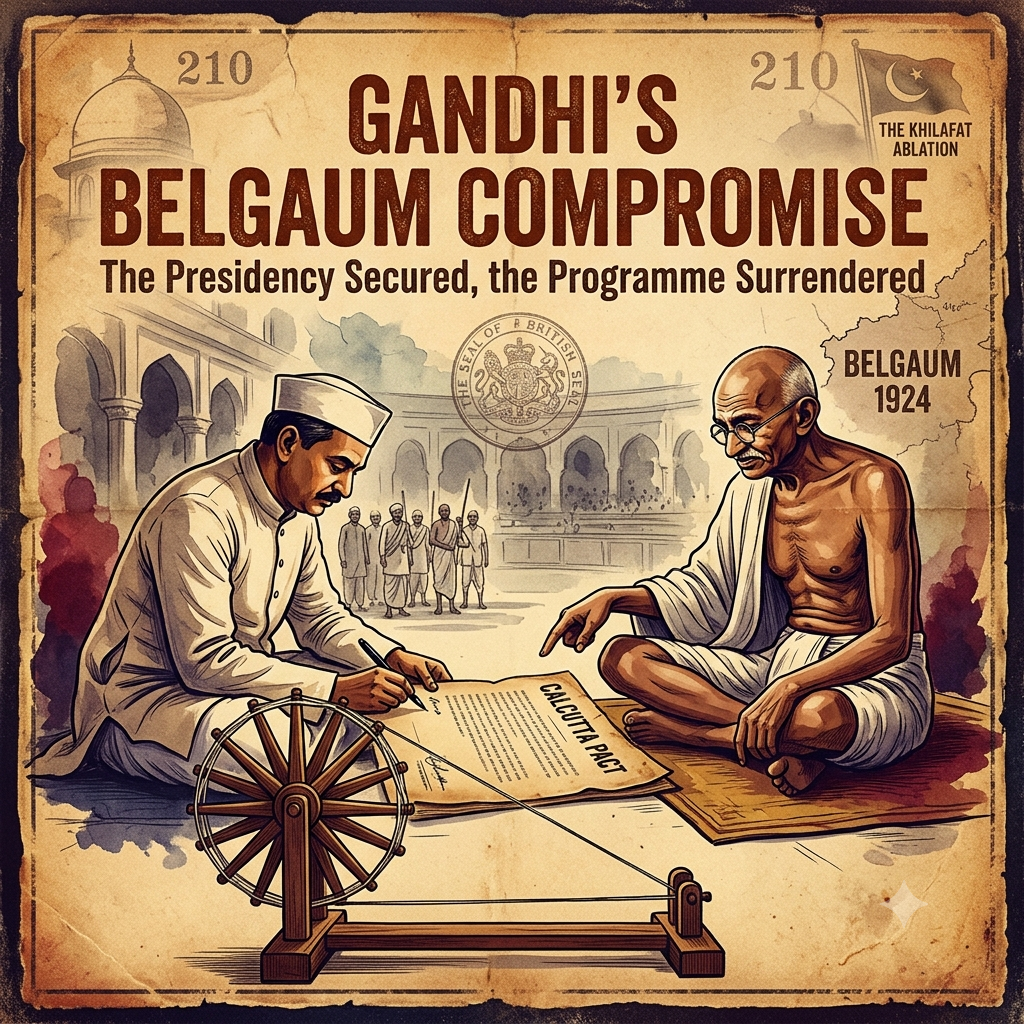
Collapse of the Charkha Franchise: Patna, September 1925
The organizational centerpiece of the Belgaum settlement failed within nine months of its adoption. Across early 1925, Congress committees reported that rank-and-file members refused to spin 2,000 yards of yarn each month, causing paid Congress membership to plummet and threatening to reduce the national organization to a small coterie of dedicated spinners. Rather than reviving mass politics, Gandhi’s constructive interregnum initially shrank the party’s active base — operating as an active filter that weeded out anyone who would not follow his personal instructions.
At the All-India Congress Committee session at Patna in September 1925, once the nine-month filtering had finished weeding out non-compliant members, Gandhi bowed to organisational reality and undid the hurdle of his own Belgaum franchise. The Patna AICC amended the Congress constitution to restore the four-anna cash subscription as the standard membership qualification, making hand-spun yarn optional, and formally recognised the Swaraj Party as the sole political and parliamentary wing of Congress. Gandhi stepped back from day-to-day political direction into the newly formed All-India Spinners’ Association — funded through large private grants he sought from industrialist G. D. Birla rather than mass member quotas — separating constructive khadi work from legislative politics while leaving direct confrontation off the national agenda.
This institutional separation proved sufficient to divert the attention of nationalists from the freedom struggle and Swaraj toward peripheral constructive routines — diluting the independence cause into yarn quotas, village uplift, and internal social work while leaving British administrative power unchallenged.
Functional British Alignment: Asset by Outcome, Not Secret Treaty
Critics and defenders have long debated whether an unwritten understanding accompanied Gandhi’s February 1924 medical release under Ramsay MacDonald’s Labour Government. The documentary record contains no secret signed pact — and none was necessary. In political analysis, an actor functions as an asset to an imperial power whenever his sustained institutional choices systematically neutralise threats to that power’s stability without extracting constitutional concessions in return. This pattern had already been demonstrated during the Rowlatt Act resistance, Jallianwala Bagh and its aftermath, and the May 1921 understanding with Viceroy Lord Reading that culminated in the unilateral termination of the Non-Cooperation Movement.
Across 1925, 1926, and 1927, Gandhi’s constructive interregnum performed precisely that stabilising function for the British Raj — even as multiple independent power centres emerged inside Congress that he neither directed nor controlled. Following C. R. Das’s death on 16 June 1925, parliamentary leadership passed to Motilal Nehru and Central Assembly President Vithalbhai Patel (elected in August 1925), while Responsivists including M. R. Jayakar, N. C. Kelkar, and Lala Lajpat Rai charted independent courses. A younger radical wing led by Subhas Chandra Bose and Jawaharlal Nehru pushed through the Complete Independence resolution at the Madras Congress of December 1927 — Gandhi attended as an observer with no floor strength to block it — and founded the Independence for India League. Vallabhbhai Patel led the February–August 1928 Bardoli Satyagraha to a successful conclusion under his own direct command, without Gandhi leading the march.
By June 1927, Gandhi publicly acknowledged in Young India that his voice no longer carried weight in communal or council politics: “Today I have no influence over either Hindus or Muslims… My word carries no weight with them.” Writing to Jawaharlal Nehru on 17 January 1928 — after the Madras independence resolution he had been unable to prevent — Gandhi stated: “The differences between you and me appear to me to be so vast and so radical that there seems to be no meeting ground between us.” Throughout this three-year erosion of his authority, Gandhi kept nationwide anti-British civil disobedience entirely off the table — returning to active floor management only at Calcutta in December 1928, nine months after his original sentence clock had expired.
The Simon Commission Test and the Calcutta Ultimatum (1927–1928)
The depth of this restraint became unmistakable in November 1927, when the British Government appointed the all-white Indian Statutory Commission under Sir John Simon to review constitutional reform. The exclusion of all Indians provoked immediate nationwide outrage, culminating in the Madras Congress boycott resolution of December 1927, mass street demonstrations upon the Commission’s arrival in February 1928, and the fatal police assault on Lala Lajpat Rai in Lahore on 30 October 1928.
Even during this nationwide upheaval, Gandhi refrained from launching civil disobedience, keeping Gandhi’s constructive interregnum intact until after March 1928 had passed. Only at the Calcutta Congress session in December 1928 — nine months after the six-year clock of his March 1922 sentence had expired — did Gandhi return to direct political arbitration. Even then, when younger leaders led by Jawaharlal Nehru and Subhas Chandra Bose demanded immediate declaration of complete independence, Gandhi intervened to pass a compromise resolution by 1,350 votes to 973 granting the British Government one full year — until 31 December 1929 — to grant Dominion Status before any civil disobedience would be contemplated, pushing actual mass action back to the Salt March of March 1930.
What the Interregnum Closes
Between February 1924 and December 1928, nearly five full years elapsed without a single nationwide satyagraha against British rule — fulfilling the exact political calculation behind Viceroy Lord Reading’s February 1924 medical release. Rather than reigniting struggle, Gandhi cooled the political temperature in Delhi and across British India through three concrete acts of restraint:
- Diverting Nationalist Energy Inward: Re-channelling active Congress cadres from anti-British confrontation into 2,000-yard spinning quotas, the All-India Spinners’ Association (Patna, September 1925), and village uplift tours.
- Containing the 1927–1928 Simon Commission Upheaval: Refusing to convert nationwide street protests against the all-white Simon Commission or the fatal police assault on Lala Lajpat Rai (30 October 1928) into a mass civil disobedience campaign — even while Vallabhbhai Patel proved at Bardoli (February–August 1928) that local tax resistance was viable.
- Buying London a One-Year Grace Period at Calcutta: Returning to active floor management in December 1928 only after his six-year sentence clock (March 1922–March 1928) had expired, and intervening by 1,350 votes to 973 to block Jawaharlal Nehru and Subhas Chandra Bose’s demand for immediate Complete Independence in favour of a one-year Dominion Status deadline (31 December 1929).
By the time Gandhi’s constructive interregnum concluded at Calcutta in December 1928, the charkha franchise installed at Belgaum had been repealed at Patna, the Swarajist council experiment had fragmented after C. R. Das’s death, and thirty thousand volunteers imprisoned during 1921–22 had watched an entire political generation pass without a renewed struggle. Without conceding a single constitutional demand, the British Raj had obtained six years of immunity from Gandhi-led mass civil disobedience following his March 1922 arrest — two years inside Yerwada Prison and four years outside it under the banner of constructive restraint.
Modern Parallel
During the NDA administration (2014–present): Government critics argue that structural economic challenges—such as youth unemployment and agrarian distress—warrant sustained parliamentary pressure, while political commentators across the spectrum observe that opposition campaigns have frequently centered on procedural or symbolic controversies (such as electronic voting machine disputes or constitutional rhetoric) rather than sustained grassroots mobilization around bread-and-butter governance issues.
Invitation To Defence
The September 1925 Patna AICC resolution repealing the mandatory 2,000-yard spinning franchise, Gandhi’s 1925–1927 constructive tour itinerary, and the December 1928 Calcutta Congress one-year Dominion Status compromise are all in the primary record. The defence is invited to identify any nationwide anti-British civil disobedience campaign launched or sanctioned by Gandhi between his 5 February 1924 medical release and the expiration of his original six-year sentence term in March 1928, or to explain how his four-year moratorium differed in practical effect from serving the remainder of his sentence in custody.
Sentenced to six years’ imprisonment in March 1922 and released on medical grounds in February 1924, Gandhi kept mass anti-British civil disobedience completely off the table across the exact four-year remainder of his original term. His 2,000-yard charkha franchise collapsed and was repealed at Patna in September 1925, yet his four-year retreat into constructive work held nationalist agitation in check through the Simon Commission crisis until December 1928. No secret treaty was needed. Gandhi’s constructive interregnum delivered by voluntary restraint every year of stability the Raj had sought by conviction.
Feature Image: Click here to view the image.
Videos
Glossary of Terms
1. Gandhi’s Constructive Interregnum: The period between 1924 and 1928 during which Gandhi withdrew from direct anti-British political confrontation and concentrated on spinning, khadi production, village uplift, and internal social work. The blog uses this term to describe the four-year period of voluntary political restraint following his medical release from prison.
2. Unexpired Sentence Clock: The remaining period of Gandhi’s original six-year prison sentence, running from his medical release on 5 February 1924 until its original expiry date of 18 March 1928.
3. Medical Remission: The remission of the remaining four years of Gandhi’s prison sentence on medical grounds by the Viceroy Lord Reading’s Government on 5 February 1924, under Section 401 of the Code of Criminal Procedure.
4. Charkha Spinning Franchise: Gandhi’s membership qualification introduced at the December 1924 Belgaum Congress, requiring members to spin 2,000 yards of yarn every month to qualify for voting membership in Congress.
5. Belgaum Compromise: The December 1924 political settlement under which Gandhi accepted his sole Congress presidency, transferred council-entry politics to the Swarajists, and introduced compulsory monthly spinning as a condition of voting membership.
6. AICC (All-India Congress Committee): The principal committee of the Indian National Congress responsible for implementing organisational and political decisions. Its September 1925 Patna session repealed the mandatory spinning qualification and restored the four-anna cash membership subscription.
7. All-India Spinners’ Association: An organisation established to promote hand-spinning and khadi production. Gandhi moved into its constructive activities after withdrawing from day-to-day political direction in 1925. The blog notes that it received substantial private financial support from industrialist G. D. Birla.
8. Functional British Alignment: A political analytical expression coined in the blog to describe a situation in which an individual’s institutional decisions produce outcomes favourable to an imperial power without requiring a secret agreement or formal collaboration. It is presented as alignment through consequences rather than documented conspiracy.
9. Swaraj Party: A political organisation formed by Congress leaders advocating participation in legislative councils to challenge British colonial administration from within. Following the September 1925 Patna decision, it received formal recognition as Congress’s political and parliamentary wing.
10. Responsivists: Congress-related political leaders who pursued an independent legislative approach and differed from the Swarajist political strategy. The blog identifies M. R. Jayakar, N. C. Kelkar, and Lala Lajpat Rai among those who charted independent political courses.
11. Simon Commission: The Indian Statutory Commission appointed by the British Government in November 1927 under Sir John Simon to examine constitutional reforms in India. Its exclusion of Indian members provoked nationwide protests and political opposition.
12. Complete Independence Resolution: The resolution demanding complete independence for India, advanced by younger Congress leaders under Subhas Chandra Bose and Jawaharlal Nehru at the Madras Congress session in December 1927.
13. Dominion Status: A constitutional arrangement under which India would obtain self-governing status within the British Commonwealth while retaining a constitutional association with the British Crown. At the December 1928 Calcutta Congress, Gandhi supported granting the British Government one year to concede this status before considering civil disobedience.
14. Satyagraha: A method of political resistance developed by Gandhi, based on non-violent opposition and the pursuit of truth. In this blog, the term refers particularly to organised resistance against British colonial authority.
15. Constructive Restraint: A distinctive expression used in the blog to describe Gandhi’s withdrawal from direct mass political confrontation while concentrating on constructive programmes such as spinning, khadi, and village uplift. The article argues that this restraint produced the practical effect of keeping nationwide nationalist agitation under control.
#Gandhi #MahatmaGandhi #IndianHistory #IndianFreedomStruggle #BritishRaj #IndianNationalCongress #CivilDisobedience #Swaraj #SimonCommission #Satyagraha #Khadi #HinduinfoPedia
Scan Through The Entire Series at