
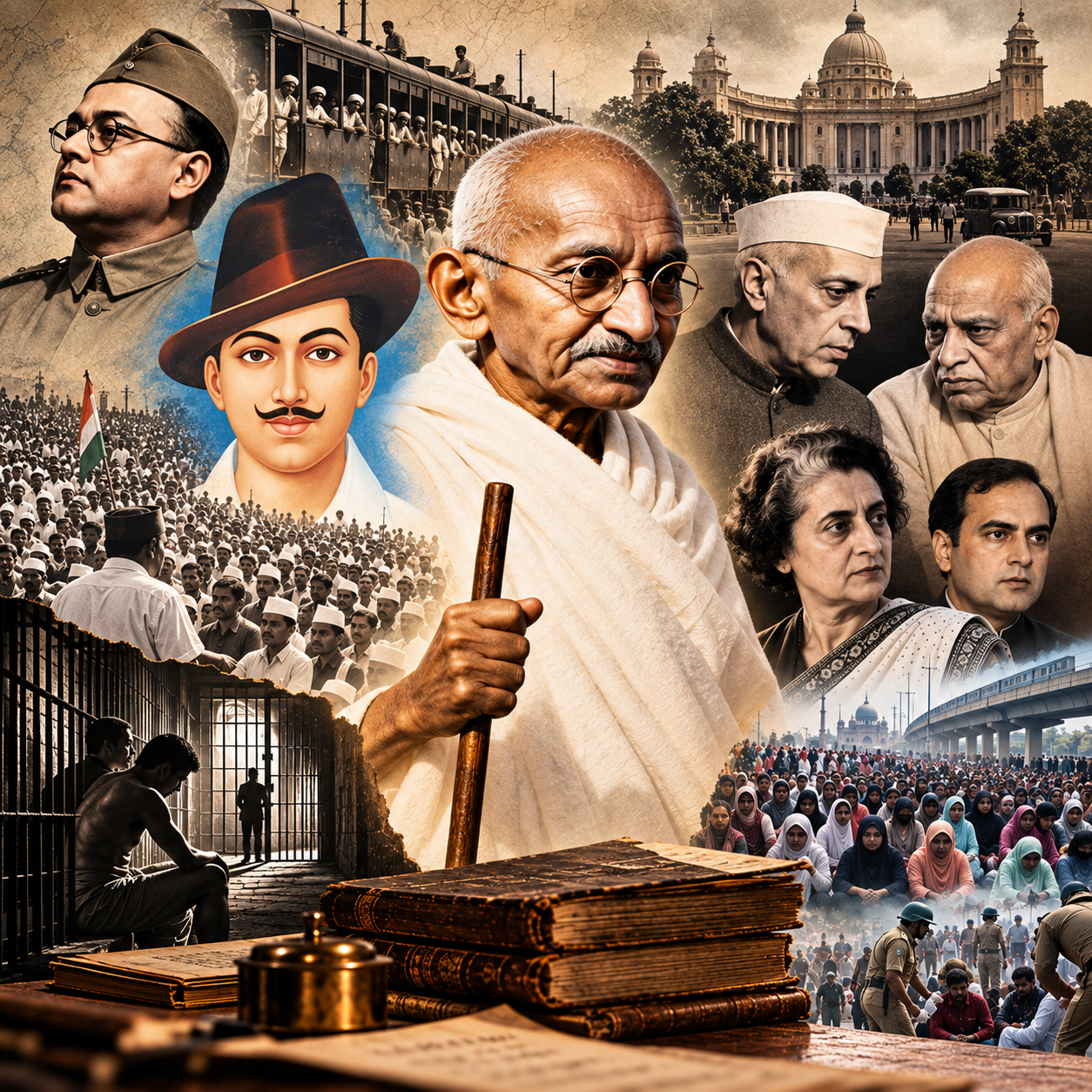
Gandhi’s Still Running India?
भारत / GB
Special Dispatch: Gandhi Jayanti 2026 | Series Index
The prosecution does not ask the reader to mourn the man or celebrate him. It asks the reader to recognise the machinery.
Thank you for reading this post, don't forget to subscribe!1. The High Command and the Dynasty Continue to Rule
Then: At Tripuri in 1939, Subhas Chandra Bose defeated the establishment candidate in a democratic vote; the High Command engineered his ouster. In May 1946, twelve out of fifteen Provincial Congress Committees voted for Sardar Vallabhbhai Patel; Gandhi intervened to bypass the party and install Jawaharlal Nehru. Both events are documented in this series. The foundational rule was established: organic, internal democracy is a structural threat to be crushed by the centre.
Now: That exact mechanism evolved seamlessly into dynastic absolutism. In June 1980, following the death of Sanjay Gandhi — who had wielded extra-constitutional power over cabinet ministers without holding ministerial office — the machinery ignored senior leadership to draft Rajiv Gandhi, an airline pilot with zero political record. In October 1984, following Indira Gandhi’s assassination, constitutional seniority (Pranab Mukherjee) was discarded mid-flight to swear in Rajiv directly before the parliamentary party had even convened. In March 1998, elected President Sitaram Kesari was locked in a room at 24 Akbar Road while a palace coup seated the dynasty. In May 2004, the senior-most parliamentarian was bypassed once more, the prime ministerial chair handed to a nominated proxy while real executive authority remained anchored to 10 Janpath.
The High Command and the Dynasty are not distinct political actors: the High Command is the structural instrument that selects the dynasty, and the dynasty is the permanent CEO of the High Command. Eight decades on, the operating code remains unaltered: the organisation proposes; the bloodline disposes.
2. The Street Veto: Foreign Theocracy Over Sovereign Governance
Then: In 1920, Gandhi tethered the Indian national movement to the restoration of the Ottoman Caliphate — a foreign theocratic institution in Istanbul with no constitutional mandate over Indian citizens or Indian law. The trade of national political capital for extraterritorial religious solidarity ended in the slaughter and forced conversions of the Malabar Rebellion of 1921. Both are documented in this series.
Now: In December 2019, theological street mobilisations blockaded a sovereign public highway for over 100 days at Shaheen Bagh; the state provided police perimeters and political interlocutors throughout. Contrast this with Ramlila Maidan (June 4–5, 2011): when Baba Ramdev led a permitted, peaceful anti-corruption gathering, central police launched a midnight raid — tear gas, baton charges, sleeping women and children. The Supreme Court later ruled it an unconstitutional abuse of power. In March 2026, when Islamist street mobilisations erupted in Lucknow and across Uttar Pradesh following the killing of Iranian Supreme Leader Khamenei, the Yogi administration broke the historical template — deploying the National Security Act, asset attachments, and hard deterrence. The prosecution places the three state responses side by side. The reader will note which community’s street mobilisation received which response — and under which government.
3. The Moral Inversion: The Victim Becomes the Accused
Then: On December 23, 1926, Swami Shraddhanand was assassinated in his sickbed in Delhi by Abdul Rashid. Addressing the Gauhati Congress session (CWMG Vol. 32), Gandhi called the assassin “Brother Abdul Rashid.” In the same address, Gandhi shifted moral culpability onto Shraddhanand himself — framing his Shuddhi reconversion work as an aggressive provocation that had generated the violence. The victim’s religious assertion was declared the crime. The murderer’s bullet was contextualised as an inevitable reaction.
Now: This template became the foundational grammar of the secular establishment. The 2002 Godhra train burning — 59 Hindu pilgrims killed — was immediately reframed in major media and political commentary as the “provocation” rather than the crime. The Muzaffarnagar riots of 2013, the systematic abuse at Sandeshkhali in 2024, the Moplah centenary debates: in each instance, the identical Gandhi inversion runs — the perpetrator’s violence is contextualised as a reaction; the victim’s existence is cited as the cause. The asymmetry of the template is, across the century, its most reliable feature.
4. The Selective Geography of Conscience — and Disarming Those Who Resist
Then: On August 16, 1946, the Muslim League unleashed the Great Calcutta Killings under H.S. Suhrawardy. Gandhi remained in Sevagram, Wardha (CWMG Vol. 85). He undertook no fast. He boarded no train. Thousands were killed in 72 hours. The massacre was checked not by moral sermons but by the armed counter-resistance of Gopal Chandra Mukhopadhyay — Gopal Patha — and local akharas, documented in Suranjan Das, Communal Riots in Bengal 1905–1947 (Oxford University Press). When Gandhi finally arrived, his mission moved to disarm this self-defence. Per Gopal Patha’s recorded oral testimony (Sandip Bandyopadhyay, 1997; Andrew Whitehead, BBC India: A People Partitioned, British Library Sound Archive, 1997), Congress workers from Gandhi’s peace mission demanded he surrender his squad’s weapons in the name of Ahimsa. Patha refused. His documented words: “With these arms I saved the women of my area, I will not give them up… Where was he then?” Gandhi then walked barefoot through Noakhali — where the Hindu minority was unarmed and helpless — preaching forgiveness to victims of forced conversion and slaughter, leaving the League’s political machinery completely undisturbed.
Now: In Sandeshkhali in 2024, rural women in Bengal endured systematic land theft and sexual abuse under ruling-party protection. As in 1946, the political establishment and its intellectual apparatus condemned organised community self-defence as “provocation.” High-decibel conscience visited convenient geographies. The borderland populations were left to manage on their own. Gopal Patha’s question — Where was he then? — remains the most honest question the template has ever generated. It still has no answer.
5. State Lethality: Who Gets the Bullet and Who Gets the Silence
Then: In September 1924, communal riots in Kohat (NWFP) cleansed the town of its entire Hindu minority — approximately 3,500 fled under fire, never to return. Gandhi responded by fasting 21 days — not in Kohat, not for restitution or justice, but in Delhi at the residence of Maulana Mohammad Ali, as penance for abstract “Hindu-Muslim unity” (CWMG Vol. 25). Ethnic cleansing was absorbed and neutralised into a sermon. The cleansers faced no political reckoning.
Now: When state violence is directed at specific populations, the establishment template has two settings: erasure or celebration. Marichjhapi (1979): Thousands of Dalit Hindu Namasudra refugees were blockaded and violently evicted from Marichjhapi island by the Left Front government, with hundreds of documented deaths. Because the victims were Hindu Dalits and the perpetrator was the secular Left, the event was buried from national conscience and remains absent from school curricula. Ayodhya (1990): Unarmed kar sevaks were fired upon on the direct orders of Chief Minister Mulayam Singh Yadav on October 30 and November 2, leaving scores dead in the streets and the Saryu. The secular establishment celebrated it as constitutional heroism. The pattern — which population receives the bullet, which receives the obituary, and which receives the applause — has remained stable for a century.
6. The Penal Dualism: Palaces for the Leader, Batons for the Public
Then: Gandhi was interned at the 19-acre Italianate Aga Khan Palace — gardens, companions, personal physicians, fresh goat’s milk — while ordinary revolutionaries who answered the call of liberation were shipped to the Cellular Jail at the Andaman Islands: hard labour, solitary confinement, penal brutality. The differential is documented in this series (Blog 161). The Republic inherited this colonial dualism without altering a comma of the 1860 Penal Code or the 1861 Police Act it was built on.
Now: The protected political class operates under hospital-arrest accommodations, specialised legal immunities, and protocol protections. The citizen who protests for basic rights faces water cannons, lathi charges, and midnight crackdowns under Section 144 — the same provisions, the same architecture, the same code. The khadi has changed hands. The lathi has not.
The Answer to the Question — 2 October 2026
The question the title places before the reader is not rhetorical. Six documented patterns — succession by fiat, the theological street veto, moral inversion, selective geography, asymmetric state lethality, and penal dualism — run from the Gandhi era into contemporary Indian governance with the continuity of institutional reflexes, not coincidence.
Gandhi is not running India in the sense that he gives orders. He is running India in the sense that the operating code was written in the ashram and has never been replaced. The charkha has been packed away. The loincloth has become designer khadi. The man has been on the currency for 78 years.
The machinery has never been audited.
The prosecution places the six mirrors before the reader. The question in the title is the prosecution’s question. The reader will look into the glass — and answer it.
Feature Image: Click here to view the image.
Videos
Glossary of Terms
- High Command: The central leadership structure of a political organisation, used in this blog for the concentrated authority exercised by senior Congress leadership over internal political decisions.
- Dynasty: Political succession within a family, used here for the continuing transfer of leadership within the Nehru-Gandhi family.
- Street Veto: A phrase coined in the blog to describe a situation in which organised street mobilisation exerts pressure capable of constraining or influencing sovereign governmental decision-making.
- Foreign Theocracy: A religious-political authority located outside the country whose claims or influence extend beyond India’s sovereign constitutional framework.
- Moral Inversion: The reversal of responsibility in which the victim’s conduct is presented as the cause or provocation of the violence inflicted upon the victim.
- Selective Geography of Conscience: The blog’s phrase for an alleged pattern in which political and moral attention is concentrated in some locations or circumstances while comparable suffering elsewhere receives less attention.
- State Lethality: The use of state coercive or lethal force against particular populations or groups.
- Penal Dualism: The blog’s phrase for an alleged two-tier pattern in which political leaders receive substantially different treatment from ordinary prisoners or protesters.
- Gopal Patha: The popular name of Gopal Chandra Mukhopadhyay, associated with armed Hindu resistance during the Great Calcutta Killings of August 1946.
- Kohat: A town in the North-West Frontier Province where communal violence in September 1924 resulted in the evacuation of approximately 3,500 Hindus.
- Marichjhapi: An island in the Sundarbans associated with the 1979 eviction and violence against Bengali refugee settlers during the Left Front government in West Bengal.
- Ramlila Maidan: The Delhi public ground where Baba Ramdev’s anti-corruption gathering in June 2011 was subjected to a midnight police operation.
- Shaheen Bagh: The Delhi locality associated with the prolonged anti-CAA road-blocking protest beginning in December 2019.
- Aga Khan Palace: The 19-acre palace compound in Pune where Gandhi was interned during the Quit India period, contrasted in the blog with the conditions experienced by prisoners in Cellular Jail.
- CWMG: The Collected Works of Mahatma Gandhi, the documentary series cited in the blog for Gandhi’s recorded statements and actions.
#Gandhi #India #Politics #Congress #Dynasty #Khilafat #ShaheenBagh #Ayodhya #Kohat #HinduinfoPedia
Gandhi’s Peace Efforts: The Questions Before the Mahatma (0)
Refer to Various Arks Referred to in the Blog