
Gandhi’s Thirty Years: The Settlement That Never Closed (168)
भारत / GB
Part 168: Mahatma Gandhi’s Peace Efforts | Series Index
Blog 167 placed before the reader the charkha — the instrument Gandhi carried for thirty years, never revised when the evidence of failure accumulated, and documented by Gandhi himself as carried by Congress “only for my sake.” The dam was not redesigned. It was quietly decommissioned: on July 22, 1947, the Congress leadership removed the spinning wheel from the national flag and replaced it with the Ashoka Chakra. Gandhi’s documented response, recorded in CWMG Vol. 88, was that he would refuse to salute that flag. This post places before the reader what the thirty years produced at the moment of transfer — a partition settlement whose geographic, demographic, and statutory borders were left structurally open.
Thank you for reading this post, don't forget to subscribe!THE HISTORICAL RECORD — THE SETTLEMENT THAT NEVER CLOSED
The Pattern: The 1947 transfer of power produced a partition settlement that conceded the premise of division while leaving every consequential border — geographic, demographic, and statutory — structurally unresolved. The Settlement That Never Closed is not a retrospective characterisation. It is the documented condition of the territorial, constitutional, and demographic arrangements that the Congress leadership accepted in the five weeks between July 22 and August 17, 1947.
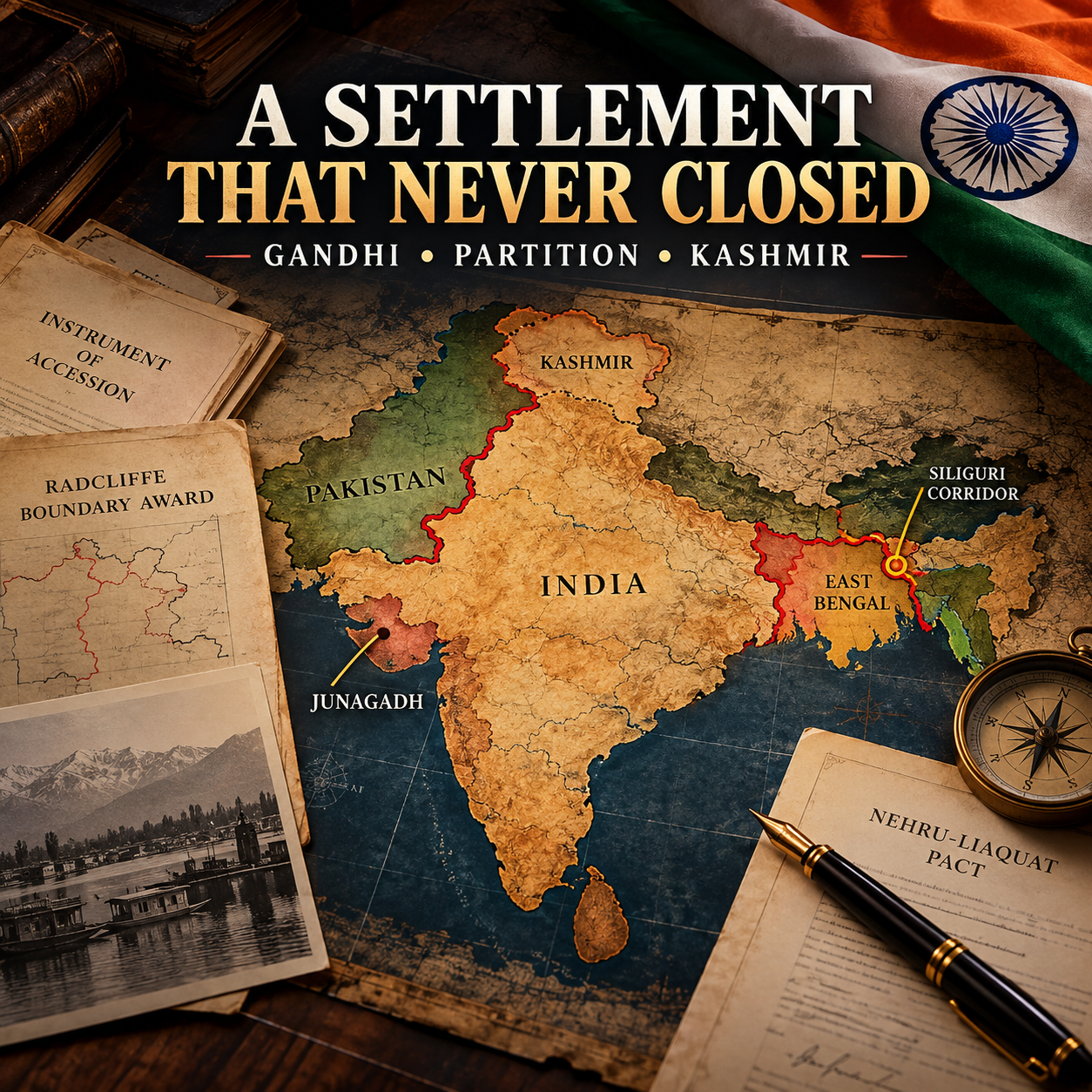
The Lethal Exhibit: Four documents place the settlement’s incompleteness in the institutional record. The Bengal Boundary Commission Award (published August 17, 1947) produced a 22-kilometre corridor connecting eight northeastern states to the Indian Union. Lord Mountbatten’s acceptance letter on the Instrument of Accession (October 27, 1947) attached a unilateral executive pledge of a future plebiscite. Article 370 of the Indian Constitution institutionalised that pledge for seventy-two years. The Nehru-Liaquat Pact of 1950 codified the demographic asymmetry between the western and eastern settlement as an administrative promise rather than a territorial guarantee.
Why it matters: The repartition pressure documented in the filed records of 2022 is not a new phenomenon. It is the continuation of what the Settlement That Never Closed left open in 1947. The prosecution places the four documents before the reader alongside the filed record — and invites the reader to examine what was settled and what was not.
The Flag and the Choice
The Settlement That Never Closed begins on July 22, 1947 — not August 15.
On that date, the Constituent Assembly adopted the national flag of independent India. The tricolour with the spinning wheel, which had been the Congress flag since 1931, was replaced. The charkha was removed. The Ashoka Chakra — the wheel of dharmic law from the Sarnath capital of the Emperor Ashoka — took its place. Jawaharlal Nehru gave the official explanation in the Assembly debate: the spinning wheel lacked bilateral symmetry. It did not look the same from both sides.
Gandhi’s documented response is in CWMG Vol. 88, Document 458, dated August 6, 1947: he would refuse to salute a flag without the charkha. The instrument he had carried for thirty years, which Congress had adopted by his own recorded acknowledgment “only for my sake,” was removed from the national symbol in the same month the national leadership was finalising the partition settlement. The prosecution does not claim the two decisions were connected. It places them before the reader as events of the same five weeks — and notes that the organisation that had carried the charkha as personal deference to one man exercised no difficulty in setting it aside the moment that man was no longer the government.
The five weeks that followed produced three further decisions. Each is in the institutional record. Together they constitute the Settlement That Never Closed.
Gandhi’s Choice of Prime Minister
The 1946 election for Congress President produced a documented result: twelve of fifteen Pradesh Congress Committee votes went to Vallabhbhai Patel. Gandhi asked Patel to stand aside. Patel did. Nehru became Congress President and, when Mountbatten asked the Congress to name a Prime Minister, the natural nominee.
The prosecution places one question before the reader: the democratic verdict of Gandhi’s own organisation was set aside by Gandhi’s personal intervention. The Settlement That Never Closed was negotiated and accepted by the man Gandhi’s intervention installed — not the man Gandhi’s organisation selected.
The Cartographic Bottleneck
The Bengal Boundary Commission, chaired by Sir Cyril Radcliffe, completed its award by August 12, 1947. It was published on August 17 — two days after independence. The suppression of the award during the transfer-of-power ceremonies is itself an exhibit: the boundaries of the new state were withheld from its citizens while the flags were raised.
What the Radcliffe Award produced in the northeast is a matter of geography, not interpretation. Eight states — Assam, Meghalaya, Tripura, Mizoram, Manipur, Nagaland, Arunachal Pradesh, and Sikkim — connect to the Indian Union through a corridor measuring approximately 22 kilometres at its narrowest point. The corridor is bounded on the north by Nepal and Bhutan, on the south by what was then East Pakistan and is now Bangladesh. It is known as the Siliguri Corridor. It is known colloquially as the Chicken’s Neck.
The Settlement That Never Closed did not produce this geography by accident. The Radcliffe Commission was operating under a mandate to complete its work in five weeks, drawing boundaries across territories its chairman had never visited, on maps whose demographic data was contested. The cartographic result was not a defensible sovereign boundary. It was the administrative residue of a rapid British departure. The prosecution places the 22-kilometre measurement before the reader alongside the transfer-of-power timeline — and notes that the geographic vulnerability thus created has remained a documented strategic pressure point from 1947 to the present.
The Conditional Accession
The Instrument of Accession signed by Maharaja Hari Singh of Jammu and Kashmir on October 26, 1947 was the standard legal document used by all 565 princely states. The accession covered defence, external affairs, and communications — the standard three subjects. Clause 5 of the Instrument stated explicitly that its terms could not be varied without the ruler’s consent. Clause 7 stated that nothing in the Instrument committed the state to any future constitution. On its face, and within its four corners, the accession was complete and unconditional.
Lord Mountbatten’s acceptance letter, dated October 27, 1947, placed a condition on the government’s receipt of that accession: that the question of accession would be settled by a reference to the people once law and order was restored. The plebiscite condition was the Government of India’s stated policy — accepted by its Cabinet, consistent with the doctrine the same government would apply to Junagadh four months later. The condition was not an unauthorised insertion. It was the Indian government’s own act, on its own receipt, of a completed legal accession. The prosecution places the government’s choice before the reader: of 565 accessions, one was accepted conditionally. The one accepted conditionally was the one whose accession was militarily contested at the moment of signing.
While the same doctrine was used to close Junagadh in six months, in Kashmir the condition was internationalised at the United Nations and codified into Article 370, transforming a completed legal accession into a multi-decade territorial dispute.
Article 370 of the Indian Constitution, which came into force in 1950, institutionalised the exceptional status. It remained on the statute books for seventy-two years. The prosecution notes the arithmetic: the Settlement That Never Closed required seventy-two years and a constitutional amendment to formally close one of its primary fault lines — and the closure itself remains contested in the documented legal and political record.
The prosecution places one further choice before the reader alongside the conditional accession: the Government of India accepted the accelerated transfer on August 15, 1947 without a constitutional framework in place.
Independent India governed under the adapted Government of India Act 1935 — a British colonial statute — with a British Governor-General and a British Crown, until January 26, 1950. The condition on Kashmir’s accession and the absence of India’s own legal architecture on the day of independence are not two separate exhibits. They are the Settlement That Never Closed, stated in its plainest form: the transfer of office while the executive chose to govern through colonial forms — the King, the British Governor-General, the adapted statute of 1935.
The Doctrine and Its Two Applications
The plebiscite condition was not without precedent. It was Mountbatten’s stated doctrine: that where a ruler’s religion differed from his population’s majority, the wishes of the people had to be consulted before an accession was finalised.
The prosecution places the doctrine’s two applications before the reader.
Junagadh: the Nawab was Muslim; over 80% of the population was Hindu. The Nawab acceded to Pakistan in August 1947. India invoked the doctrine, disputed the accession, and conducted a formal referendum in February 1948. The population voted overwhelmingly for India. The accession was reversed. The case was closed in six months.
Kashmir: the Maharaja was Hindu; the population was majority Muslim. The Maharaja acceded to India on October 26, 1947. Mountbatten invoked the same doctrine in his acceptance letter — and attached it as a condition on the accession rather than as grounds to dispute it. Nehru carried the condition to the United Nations on January 1, 1948. The referendum was never held. Article 370 codified the conditionality for seventy-two years. The Line of Control has not moved since January 1, 1949. The condition that was never fulfilled and the line that never moved produced one further documented outcome: the Kashmiri Pandits — the Hindu minority of the Valley — were displaced from their homes and properties in 1990, refugees in the land whose accession India had accepted as legally complete in 1947.
Same doctrine. Same Governor-General. Same autumn of 1947. One application closed a territorial question in six months. The other has kept one open for seventy-eight years.
The prosecution does not claim the doctrine was designed to produce this asymmetry. It places the two applications before the reader — and notes that in Junagadh, the doctrine served India’s territorial interest; and in Kashmir, the same doctrine, applied by the same man, produced the one territorial question the Settlement That Never Closed has never resolved.

The Demographic Asymmetry
The Two-Nation Theory that produced the partition rested on one premise: that religious identity constituted sovereign nationhood. The settlement applied this premise selectively.
In the western settlement — Punjab, Sindh, the North-West Frontier Province — the logic was executed through demographic transfer. The population movement of 1947 in the west was violent, catastrophic, and near-total. By 1951, the demographic geography of West Punjab had been transformed. The border held what it was drawn to hold.
In the eastern settlement — Bengal and Assam — no equivalent transfer occurred. The Radcliffe Line divided Bengal along administrative boundaries while leaving the demographic logic of the Two-Nation Theory structurally unresolved. The Hindu minority in East Pakistan and the Muslim population in West Bengal remained on both sides of the border. The Settlement That Never Closed in the east was a different settlement from the one in the west — drawn on the same premise, applied to different conclusions.
The Nehru-Liaquat Pact of April 1950, signed after communal violence in East Pakistan drove hundreds of thousands of Hindus into West Bengal, codified this asymmetry. The Pact established minority rights guarantees in both dominions as administrative undertakings rather than secured territorial or physical guarantees.
The prosecution places the documented record of that guarantee before the reader. In East Bengal, the Hindu population stood at 33% in 1901 and 22.05% in the 1951 Census — the baseline at the moment the Pact was signed. The trajectory across successive censuses is in the institutional record: 18.4% in 1961, 13.5% in 1974, 10.5% in 1991, 7.95% in 2022. The promise of property restoration was answered by the Enemy Property Act of 1965 — later renamed the Vested Property Act — which codified the confiscation of minority-owned land under cover of law, in direct statutory contradiction of the Pact’s administrative undertakings. Decennial Indian census figures from 1951 through 2011 document the inverse: uninterrupted cross-border demographic displacement into Assam, West Bengal, and Tripura across six decades. The Radcliffe Line in the east functioned not as a closed sovereign international border but as a one-way demographic pipeline — the structural consequence of a 1950 pact that substituted unenforceable diplomatic assurances for territorial finality. The Muslim population of India grew from under 9% at partition to over 14% by the 2011 census. The Two-Nation Theory was applied in one direction only. The Settlement That Never Closed drew a line. The line held for one community and not the other.
The Filed Record
The prosecution places one further exhibit before the reader — with the precision the series standard requires.
In September 2022, the National Investigation Agency filed chargesheets in connection with the proscribed Popular Front of India. Among the documents placed in evidence was a dossier titled India 2047: Towards Rule of Islamic India. The prosecution places the filed chargesheet before the reader — not the dossier’s contents as established fact, but the fact of its filing as a document in the institutional record.
The chargesheet identifies, as the specific geographic targets of the documented organisational strategy: the Siliguri Corridor and the demographic enclaves created by six decades of unresolved cross-border displacement.
The Settlement That Never Closed is not, on this record, a matter of historical analysis alone. The cartographic bottleneck produced by the Radcliffe Award in 1947, the demographic asymmetry codified by the Nehru-Liaquat Pact in 1950, and the statutory ambiguity institutionalised in Article 370 are identified in a 2022 chargesheet as the structural fault lines of a documented contemporary strategy. The prosecution places the 1947 settlement and the 2022 chargesheet before the reader in sequence — and notes that the distance between them is seventy-five years of an open border.
What the Five Weeks Produced
The Settlement That Never Closed was not produced in a single decision. It was produced in five weeks — July 22 to August 17, 1947 — through a sequence of decisions each of which, taken alone, might be explained by the pressures of a rapid transfer of power.
The charkha was removed from the flag on July 22. The NWFP Congress ministry and its Khudai Khidmatgar allies were conceded to a binary referendum in July — Khan Abdul Ghaffar Khan’s documented rebuke, “You have thrown us to the wolves,” is in the institutional record. The Chittagong Hill Tracts, with a 97% non-Muslim population that raised the Indian flag on August 15, were awarded to East Pakistan for port access. The Radcliffe Award was suppressed until August 17, two days after independence, during which time the minorities of West Punjab did not know where the border fell.
The prosecution does not claim that each decision was made by the same hand or in coordination. It places the sequence before the reader: five weeks, four decisions, one settlement. The Settlement That Never Closed is the documented record of what those five weeks produced.
The Prosecution’s Position
Gandhi’s Thirty Years places three questions before the reader.
- Does the documented record — the Radcliffe Award’s 22-kilometre corridor, the Mountbatten acceptance letter’s conditional pledge, Article 370’s seventy-two-year statutory life, and the Nehru-Liaquat Pact’s administrative asymmetry — constitute an exhibit the reader places alongside the claim that the 1947 partition settlement closed the question of India’s territorial integrity?
- Does the five-week sequence of July 22 to August 17, 1947 — the flag, the frontier, the Chittagong concession, and the suppressed boundary award — constitute an exhibit the reader places alongside the claim that the Congress leadership negotiated the strongest available settlement for the new Indian state?
- Does the doctrine’s two applications — Junagadh resolved in six months under the same Governor-General invoking the same principle, Kashmir left open for seventy-eight years — constitute an exhibit the reader places alongside the claim that Mountbatten’s plebiscite condition was a neutral instrument applied consistently across the partition settlement?
- Does the 2022 NIA chargesheet identifying the Siliguri Corridor and the eastern demographic fault lines as the structural targets of a documented contemporary strategy constitute an exhibit the reader places alongside the claim that the Settlement That Never Closed is a matter of historical interpretation rather than active institutional record?
The series does not answer. Gandhi’s Thirty Years places the five weeks, the four documents, and the seventy-five years before the reader. The reader will examine what the settlement established — and what it left open.
Invitation To Defence
The floor belongs to the defense. We now invite them to present their exhibits and challenge the narrative established by the prosecution.
The 1947 transfer of power produced a settlement. The Settlement That Never Closed left a 22-kilometre corridor connecting eight states, a conditional accession that took seventy-two years to formally close, a demographic asymmetry codified in 1950, and a boundary suppressed for two days after independence. The same Governor-General who attached the plebiscite condition to Kashmir’s accession had used the same doctrine to close Junagadh in six months. One application served India’s territorial interest. The other produced the one dispute that remains open. The prosecution places the five weeks and the two applications before the reader. The reader will complete the sentence.
← Part 167 | Series Index | Exhibits Table | Forensic Archive
Feature Image: Click here to view the image.
Videos
Glossary of Terms
1. A Settlement That Never Closed: A phrase describing the unresolved political, territorial and constitutional questions associated with India’s Partition and the decisions made around Independence.
2. Indian Independence: The end of British rule in India on fifteen August, nineteen forty-seven, accompanied by the creation of India and Pakistan.
3. Radcliffe Boundary Award: The boundary decision dividing British India’s Punjab and Bengal between India and Pakistan. It was published on seventeen August, nineteen forty-seven.
4. Provincial Congress Committees: Regional units of the Indian National Congress that participated in the party’s internal leadership selection process in nineteen forty-six.
5. Ashoka Chakra: The navy-blue wheel with twenty-four spokes placed at the centre of India’s national flag.
6. Instrument of Accession: The legal document through which a princely state agreed to accede to India or Pakistan under the arrangements accompanying British withdrawal.
7. Junagadh: A princely state whose Muslim ruler chose accession to Pakistan despite its predominantly Hindu population. A referendum held in February, nineteen forty-eight, overwhelmingly favoured India.
8. Plebiscite: A direct vote by a population to decide a political or territorial question. A proposed plebiscite in Kashmir did not take place.
9. Article Three Hundred Seventy: A provision of the Indian Constitution that established a special constitutional arrangement for Jammu and Kashmir. Its status changed in August, two thousand nineteen.
10. Nehru–Liaquat Pact: The nineteen fifty agreement between India and Pakistan that addressed the protection of minorities in both countries.
11. East Bengal: The eastern part of Bengal that became part of Pakistan in nineteen forty-seven and later became Bangladesh in nineteen seventy-one.
12. Demographic Vulnerabilities: Population-related conditions that may create social, political or security concerns in a particular region.
13. Siliguri Corridor: A narrow strip of Indian territory connecting the country’s northeastern states with the rest of India. It is strategically important because of its geographical position.
14. National Investigation Agency (NIA): India’s central agency responsible for investigating and prosecuting specified offences affecting national security and other matters covered by its legal mandate.
15. Popular Front of India (PFI): An organisation banned by the Indian government in September, two thousand twenty-two. The video refers to chargesheets filed by the NIA concerning the organisation.
#HinduinfoPedia #IndianHistory #Gandhi #Partition #Kashmir #Junagadh #Article370 #India #Independence
Scan Through The Entire Series at
Gandhi’s Peace Efforts: The Questions Before the Mahatma (0)
Refer to Various Arks Referred to in the Blog