
Gandhi’s Swaraj Postponement: “I Would Postpone the Issue of Swaraj” — for Khilafat (107)
भारत / GB
Part 107: Mahatma Gandhi’s Peace Efforts | Series Index
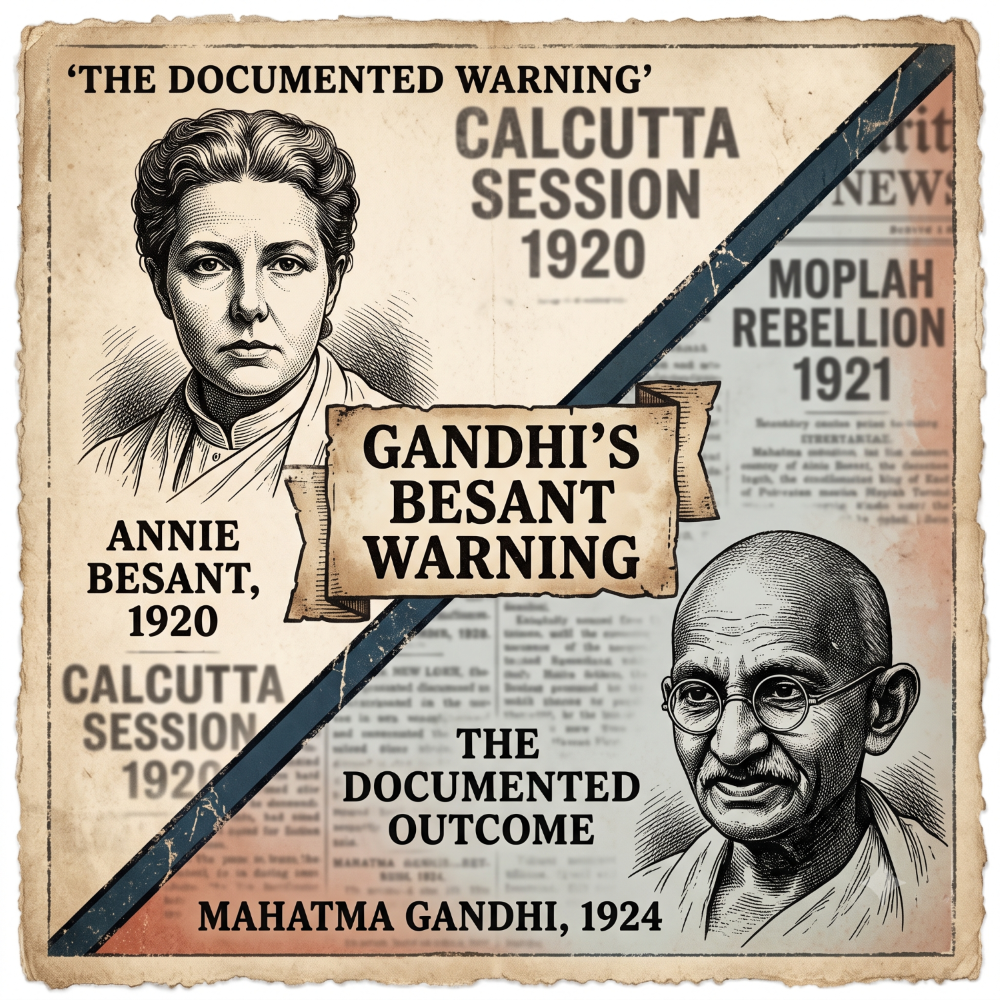
Blog 106 documented Annie Besant’s warning at the September 1920 Calcutta session and the documented outcome that followed within one year. This post places Gandhi’s own documented counter-position at the September 1920 Calcutta session itself before the reader — the statement he made in direct response to those who questioned the merger of the Khilafat cause with the Indian freedom movement.
Thank you for reading this post, don't forget to subscribe!The Action Taken: Massive public funds raised under the Tilak Swaraj Fund were funneled into Khilafat agitation committees without demanding joint financial accounting or non-violent vetting of expenditures.
Who Paid the Price: The Indian public whose donations for Swaraj were diverted into an autonomous, clerically controlled agitation machinery.
The Alternative Bypassed: Establishing strict, independent audit committees to ensure all disbursed national funds complied with non-violent guidelines.
Why This Matters: Provided financial liquidity to pan-Islamic mobilization networks, underwriting an organizational infrastructure that operated without Congress executive oversight.
Gandhi’s Own Documented Words — September 1920
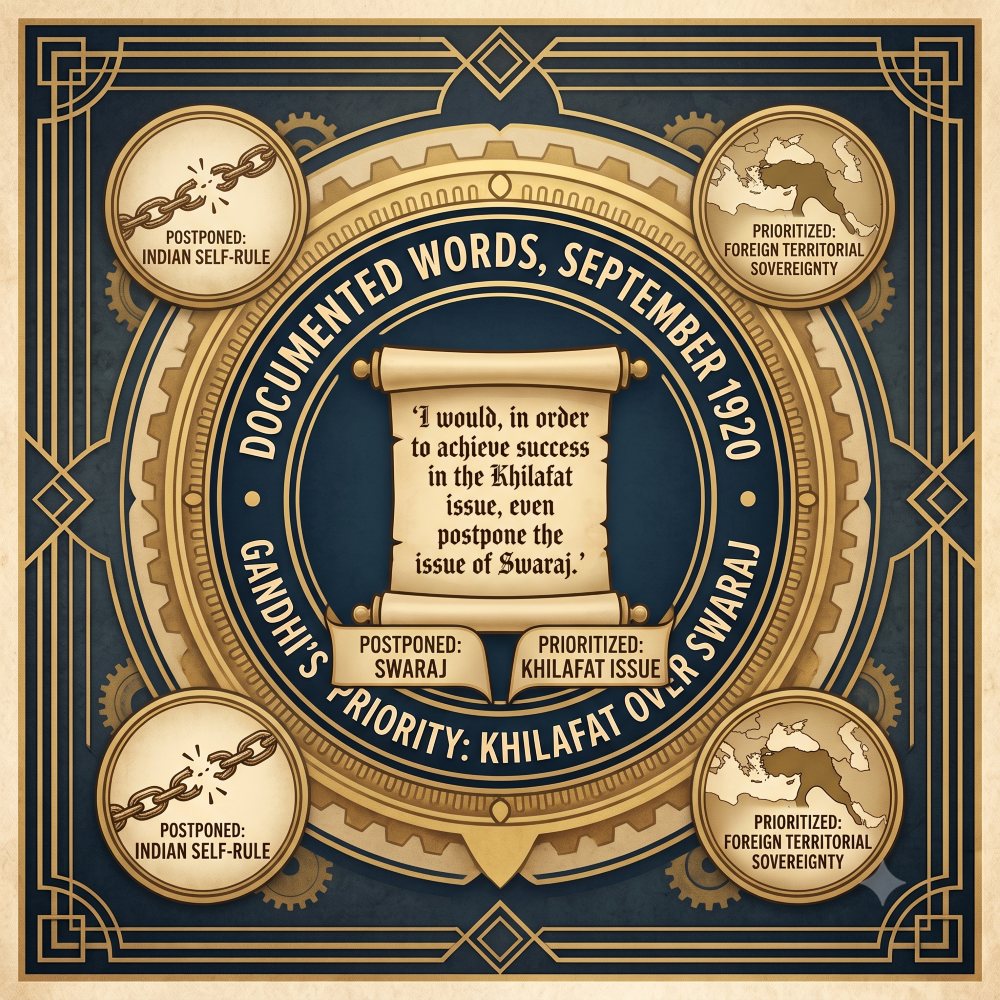
Gandhi’s Swaraj Postponement places the primary exhibit before the reader without preamble. Gandhi’s own documented statement at the September 1920 Calcutta session:
“I would, in order to achieve success in the Khilafat issue, even postpone the issue of Swaraj.”
The cause being prioritised is named: the Khilafat issue. The cause being postponed is named: Swaraj — Indian self-rule, the documented primary purpose of the Indian National Congress from its founding in 1885. The conditional logic is explicit: success in the Khilafat issue was the stated condition under which India’s independence would be deferred.
Gandhi’s Swaraj Postponement places no characterisation alongside this statement. The series does not interpret what Gandhi meant or did not mean. It places the documented words before the reader and asks the reader to examine them.
What the Statement Was Made Against
Gandhi’s Swaraj Postponement places the context of the statement before the reader precisely. This was Gandhi’s documented counter-position to those who questioned the merger — at the same session at which Besant and five other documented dissenters stood against the Non-Cooperation and Khilafat merger. Gandhi’s documented statement was not a private letter or an off-the-record remark. It was made at the Indian National Congress’s own session, as the man holding documented unchallengeable authority over Congress, in direct response to documented opposition from senior Congress figures.
The series has already established across Blogs 102-106 what the Khilafat issue was: a demand for the restoration of a defeated foreign empire’s territorial sovereignty, whose institution the British had not attacked as a religion, whose demands were territorial not religious, and which the Turks themselves would abolish in 1924. Gandhi’s Swaraj Postponement places Gandhi’s own documented willingness to defer India’s independence for this specific documented cause before the reader.
What Swaraj Was — Documented
This blog places one further documented fact before the reader. Swaraj was not an abstract term. It was the documented culmination of India’s independence movement — the specific political objective for which the Indian National Congress had existed since 1885, for which documented generations of Indian leaders had organised, agitated, been imprisoned, and died. Gandhi himself had placed Swaraj at the centre of every documented Congress campaign he had led.
Gandhi’s documented statement placed this cause — Indian self-rule — in a documented subordinate position to the Khilafat issue at the September 1920 session. The prosecution does not characterise what Gandhi privately valued. It places his documented public statement, made at Congress’s own session with his documented authority behind it, before the reader. The documented authority Gandhi held over Congress is established across the series — from the 1920 Nagpur session through the 1946 Patel-Nehru succession documented in Blog 91. That documented authority gives the September 1920 statement its weight: this was not a rhetorical flourish from a peripheral figure. It was a stated position from the man whose documented unchallengeable authority would carry the session.
The Documented Arc This Statement Closes
The documented arc the series has built places this statement in full context. Blog 102 established what the Khilafat cause was. Blog 103 placed Gandhi’s own word for his decision — “opportunity of a lifetime.” Blog 104 placed Gandhi’s own chronological record on Islam. Blog 105 documented what Congress formally became when Gandhi merged the two causes. Blog 106 placed Besant’s documented warning and Gandhi’s documented counter-position in the same session.
This blog places the counter-position itself — the documented statement Gandhi made when Besant and five others dissented — before the reader as a standalone exhibit. Gandhi’s Swaraj Postponement is the documented moment at which the head of India’s independence movement stated, in his own words, that he would postpone India’s independence for a foreign religious-political cause.
The Prosecution’s Position
Gandhi’s Swaraj Postponement places three questions before the reader.
- Did Gandhi’s own documented statement at the September 1920 Calcutta session place India’s independence — Swaraj, the documented primary purpose of the Indian National Congress — in a subordinate position to the Khilafat issue, in his own documented words?
- Did the documented character of the Khilafat issue — established across Blogs 102-106 as a demand for a defeated foreign empire’s territorial restoration, whose institution the British had not attacked as a religion — belong before the reader alongside Gandhi’s documented willingness to postpone Swaraj for it?
- Did Gandhi make this documented statement at Congress’s own session, with his documented unchallengeable authority behind it, as a direct counter to documented senior Congress figures who questioned the merger — placing it on the public record as a stated position, not a private reservation?
The series does not answer. Gandhi’s Swaraj Postponement places Gandhi’s own documented words — the cause named, the cause deferred, the conditional stated — before the reader. The reader will examine what Gandhi placed above India’s independence — and complete the sentence.
Invitation To Defence
The floor belongs to the defense. We now invite them to present their exhibits and challenge the narrative established by the prosecution.
September 1920, Calcutta. Besant and five others dissented. Gandhi’s documented counter-position: “I would, in order to achieve success in the Khilafat issue, even postpone the issue of Swaraj.” The cause prioritised: restoration of a defeated foreign empire’s territorial sovereignty. The cause postponed: Indian independence — the documented purpose of the Indian National Congress since 1885. The prosecution places Gandhi’s own documented words before the reader. The reader will complete the sentence.
HinduinfoPedia, Gandhi, Swaraj Postponement, Khilafat, Indian National Congress, Calcutta Session, Annie Besant, Non-Cooperation, Ottoman Caliphate, Documentary Evidence, Primary Exhibit, Freedom Movement, Independence Movement, September 1920, Historical Records, reader, documented, statement, authority, session, independence
HinduinfoPedia, गांधी, स्वराज स्थगन, खिलाफत, भारतीय राष्ट्रीय कांग्रेस, कलकत्ता अधिवेशन, एनी बेसेंट, असहयोग आंदोलन, उस्मानी साम्राज्य, प्रलेखित साक्ष्य, प्रमुख प्रलेख, स्वतंत्रता आंदोलन, सितंबर 1920, ऐतिहासिक अभिलेख, प्रलेखित, कथन, पाठक, प्रश्न, अधिकार, उद्देश्य
Feature Image: Click here to view the image.
Videos
Glossary of Terms
- Gandhi’s Swaraj Postponement: The documented September 1920 statement in which Mahatma Gandhi declared that he would postpone Swaraj to secure success for the Khilafat cause.
- Swaraj: Self-rule or national independence; the principal political objective of the Indian National Congress since its founding in 1885.
- Khilafat Movement: A political movement supporting the continuation of the Ottoman Caliphate after the First World War.
- Calcutta Session (1920): The September 1920 session of the Indian National Congress where Gandhi promoted the Non-Cooperation and Khilafat programme.
- Indian National Congress (INC): The political organization established in 1885 that led much of India’s organized struggle for independence.
- Non-Cooperation Movement: A mass political campaign initiated by Gandhi encouraging Indians to withdraw cooperation from British institutions.
- Annie Besant: Congress leader and Home Rule advocate who publicly opposed merging the Khilafat cause with India’s freedom movement.
- Documented Counter-Position: A recurring series term referring to Gandhi’s recorded public response to objections raised by senior Congress leaders.
- Documented Arc: A series-specific term describing a chronological sequence of documentary evidence developed across multiple blogs.
- Primary Exhibit: A central documentary statement or record presented directly to readers without interpretative commentary.
- Prosecution’s Position: The analytical framework used throughout this series to present documentary evidence without asserting a final verdict.
- Defence Invitation: The series’ concluding invitation encouraging readers to examine documentary evidence and present alternative interpretations.
- Unchallengeable Authority: The documented influence Gandhi exercised over Congress decision-making during the period covered by this series.
- Territorial Restoration: The demand to restore the territorial sovereignty of the defeated Ottoman Empire, presented as the political objective of the Khilafat movement.
- Gandhi’s Swaraj Postponement: The central theme of this blog, referring to Gandhi’s documented willingness to defer India’s independence in support of the Khilafat cause.
#Gandhi #Swaraj #Khilafat #Congress #History #India #Freedom #Independence #Politics #HinduinfoPedia
Gandhi’s Peace Efforts: The Questions Before the Mahatma (0)
Refer to Various Arks Referred to in the Blog