
Gandhi’s Unchallengeable Authority: Why Nobody Could Stop Him (22)
भारत / GB
Part 22: Mahatma Gandhi’s Peace Efforts | Series Index
Blog 21 established the institutional fact: Gandhi held no electoral mandate for any defining decision of his career. No election produced the authority. No institution granted it. No vote could remove it. This post examines what the authority actually consisted of — how it was built, how it was maintained, and why the people most qualified to challenge it were structurally unable to do so.
Thank you for reading this post, don't forget to subscribe!The Action Taken: Disagreement with Gandhi’s political decisions was framed as moral apostasy—opposing him was treated as equivalent to striking a saint—rendering tactical dissent culturally impossible.
Who Paid the Price: Senior nationalist colleagues (Lajpat Rai, C.R. Das, Motilal Nehru) whose strategic critiques were suppressed.
The Alternative Bypassed: Open, deliberative democratic debate within the nationalist leadership.
Why This Matters: This moral insulation prevented the Congress Working Committee from challenging or revising controversial tactical decisions across three decades.
The Mechanism of the Unchallengeable
Gandhi’s Unchallengeable Authority was not constructed through force, not secured through election, and not inherited through birth. It was assembled over thirty years through a precise mechanism: the public identification of one man’s will with the moral fate of a nation. Once that identification was complete, opposing Gandhi was not a political act. It was a moral one — and in the moral climate he had built, the cost of moral opposition was prohibitive.
Blog 21 showed that Gandhi held no institutional position at the moments of his largest decisions. This post shows why that absence of institutional position was not a weakness. It was the source of the authority. An elected leader can be voted out. An appointed official can be removed. A man whose authority rests on perceived moral sanctity cannot be touched by any of those mechanisms — because the mechanisms themselves derive their legitimacy from a moral framework he controls.
How It Was Built — Four Stages
Stage One — South Africa: The Mahatma Label
Gandhi arrived in South Africa as a barrister representing commercial interests. He left in 1914 as a figure whose title — Mahatma, great soul — attached permanently. The South Africa years produced the method: petition, suffering, moral appeal, negotiated settlement. The South Africa years produced the method: petition, suffering, moral appeal, negotiated settlement. But they produced something more important — a persona. The man who had gone to jail, who had marched, who had organised the poor and suffered alongside them, who wore the simplest cloth and ate the simplest food. The persona was not fabricated. It was real. But it was also, from that point onward, a political instrument.
A man with the Mahatma label cannot be criticised without the critic appearing to attack something sacred. This is not a conspiracy. It is the natural logic of moral authority: once the authority is established, the act of challenging it carries a cost that most people — most politicians, most colleagues, most followers — cannot pay.
Stage Two — Champaran: The National Scale
South Africa had made Gandhi a figure of Indian politics. Champaran made him a national one. The walking investigation, the affidavits, the refusal to leave when ordered, the colonial administration forced into a committee — all of this was real, all of it was remarkable, and all of it confirmed the persona at the scale of the entire country. By 1917, Gandhi was not merely a figure of the Gujarati merchant community or the South African Indian diaspora. He was the man who had walked the villages of Bihar and made the administration blink.
The Mahatma label now had a national stage. The authority now had a national audience. And a national audience cannot be persuaded, by any individual political opponent, that its Mahatma is wrong — because the audience’s investment in the Mahatma is also an investment in their own moral self-image. To accept that Gandhi was wrong would require accepting that the movement they had believed in, the sacrifices they had made, the identity they had formed around his leadership — were also, in some measure, wrong.
Stage Three — Non-Cooperation: The Demonstration
The Non-Cooperation suspension of February 1922 was the moment Gandhi’s Unchallengeable Authority was demonstrated rather than merely asserted. The movement had nearly brought the government to its knees. Thirty thousand were in jail. The British administration was visibly shaken. Gandhi suspended everything because twenty-two policemen had been killed at Chauri Chaura.
Motilal Nehru was furious. C.R. Das was furious. Lajpat Rai, who had given years to the movement, said the words that define what that authority meant in practice: “Our defeat is in proportion to the greatness of our leader.” It is the most precise statement of political helplessness in the independence movement’s record. The defeat is not despite the leader’s greatness. It is in proportion to it. The greater the authority, the more complete the inability to resist its exercise.
Das and Motilal formed the Swaraj Party. They went into the councils Gandhi had told them to boycott. Their opposition to his decision was real and documented. It changed nothing. The movement Gandhi had suspended stayed suspended. The authority that had suspended it remained intact — larger, in fact, than it had been before the suspension, because Gandhi had now demonstrated that the revolution existed only as long as he permitted it to exist.
Stage Four — The Pact and After: Consolidation
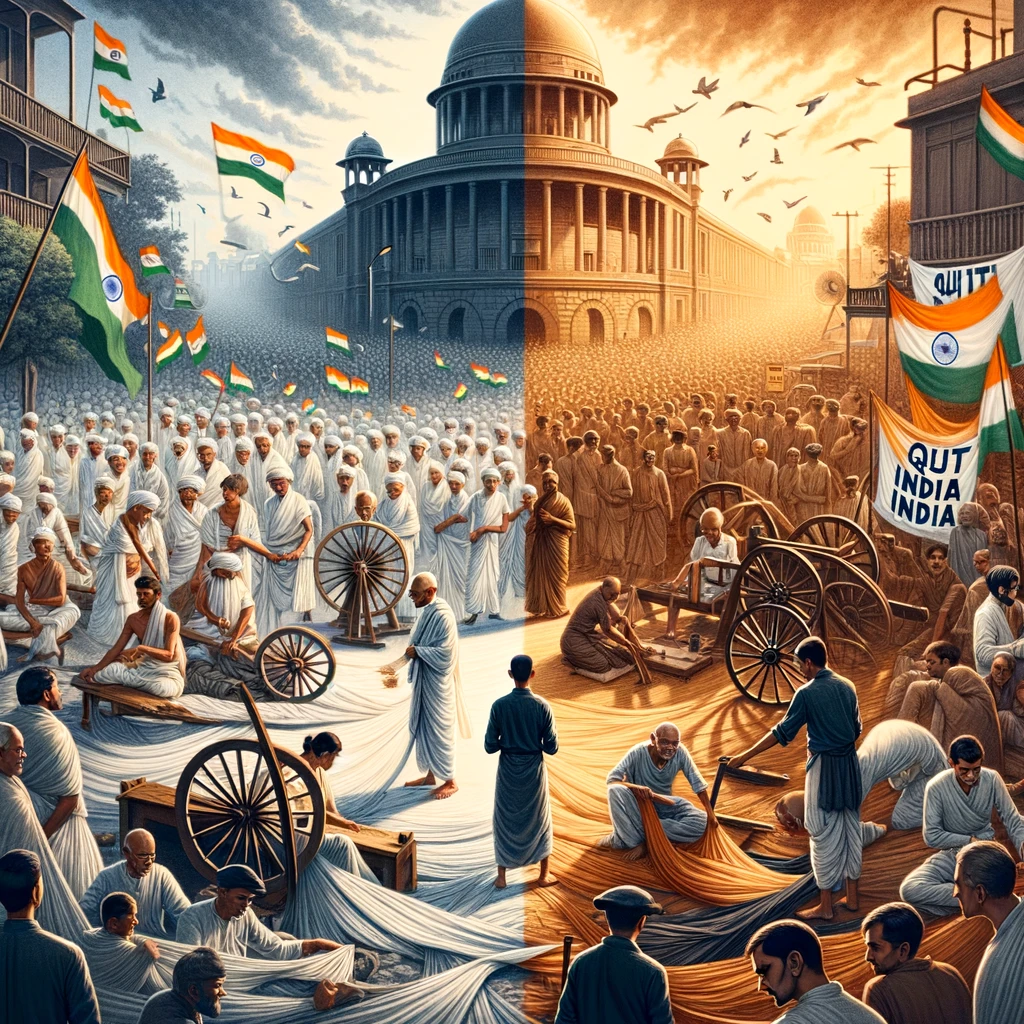
The Irwin Pact of 1931 did not diminish Gandhi’s Unchallengeable Authority. It confirmed it. He had negotiated alone, without mandate, and the Karachi Congress had ratified his decision without the institutional capacity to do otherwise. He had sailed to London as Time magazine’s Man of the Year, received by the King, greeted by crowds, recognised as the equal of the Empire. The movement’s outcome was partial. Gandhi’s authority was total.
By 1932, when the Poona Pact compelled Ambedkar to surrender the separate electorate, his authority had reached its operational peak. The mechanism was no longer simply the Mahatma label. It was the full weight of a nation’s moral self-image — a nation that had built its independence movement on the premise that Gandhi was its conscience, and that could not, without destroying that premise, permit him to die.
Why the Most Qualified Critics Could Not Act
The people most qualified to challenge Gandhi’s Unchallengeable Authority were those closest to the evidence — the leaders who had been present at Chauri Chaura’s aftermath, who had negotiated the pact’s clauses, who had watched the settlement’s gaps widen. They were also the people least able to act on what they knew.
Subhas Chandra Bose came closest to sustained opposition. He won the Congress presidency in 1939 against Gandhi’s preferred candidate — a direct institutional challenge, the only one that succeeded in the entire history of Gandhi’s public career. Gandhi’s response was not to accept the institutional verdict. It was to make Bose’s presidency unworkable through the withdrawal of cooperation by Gandhi’s supporters in the Working Committee, until Bose resigned. The authority did not need a vote. It needed only the withdrawal of the moral framework that made the institution function — and without Gandhi’s blessing, the institution could not function.
Bose resigned. He formed the Forward Bloc. He eventually left India. The institutional challenge had succeeded and been rendered irrelevant simultaneously.

The Structural Impossibility
Gandhi’s Unchallengeable Authority created a structural impossibility at the heart of the independence movement. The movement required mass participation — millions of ordinary Indians whose sacrifice gave the movement its moral weight. Those millions participated because they believed in Gandhi. To challenge Gandhi publicly was to risk fracturing the belief that held the millions together. No serious political leader could accept that risk. The cost of being right about Gandhi was the possibility of destroying the movement that Gandhi had built.
This is the mechanism that Lajpat Rai identified in the most compressed form available: defeat in proportion to greatness. The greater the leader’s moral authority, the more completely that authority immunises itself against challenge. The institution cannot vote against the saint not because the institution lacks the formal mechanism — it has one — but because using the formal mechanism against the saint destroys the institution’s own claim to moral purpose.
The Congress could not remove Gandhi without removing the basis of its own legitimacy in the eyes of the millions who had marched, spun, been jailed, and lost their land for a movement they understood as Gandhi’s.
What this authority protected, and what it was used to build and maintain, is the subject of the next two posts. Blog 23 examines how Gandhi’s Unchallengeable Authority operated in practice — the specific methods through which decisions were made, dissent managed, and succession controlled. Blog 24 examines the final act: how an unchallengeable authority chose its successor.
The mechanism was not force. It was not election. It was the identification of one man’s will with the moral fate of a nation — so completely that opposing the man meant opposing the nation’s belief in itself. Gandhi’s Unchallengeable Authority was the most effective political instrument in the independence movement’s history. It was also the one no institution ever voted for.
Series Index
Feature Image: Click here to view the image.
Videos
Glossary of Terms
- Gandhi’s Unchallengeable Authority: A form of leadership where Gandhi’s moral position became so dominant that no political or institutional mechanism could effectively oppose him. (Key phrase)
- Moral Authority: Influence derived from perceived ethical integrity rather than formal power or institutional position.
- Electoral Mandate: Authority granted through elections; notably absent in Gandhi’s major decisions.
- Persona: The carefully built public image of Gandhi as a self-sacrificing and morally superior leader.
- Champaran Movement: A 1917 campaign in Bihar that elevated Gandhi from a regional figure to a national leader.
- Non-Cooperation Movement: A mass movement (1920–1922) against British rule, suspended by Gandhi after the Chauri Chaura incident.
- Chauri Chaura Incident: A 1922 event where a violent clash led Gandhi to halt the Non-Cooperation Movement.
- Swaraj Party: A political group formed by Motilal Nehru and C.R. Das to oppose Gandhi’s strategies within legislative councils.
- Irwin Pact: A 1931 agreement between Gandhi and the British government, reinforcing his negotiating authority.
- Poona Pact: A 1932 agreement between Gandhi and B.R. Ambedkar concerning electoral representation of depressed classes.
- Karachi Congress: The 1931 session of the Indian National Congress that ratified Gandhi’s decisions.
- Structural Impossibility: A situation where institutional opposition becomes impossible due to dependence on a central figure.
- Moral Climate: The collective ethical environment shaped by Gandhi that made dissent morally costly.
- Working Committee (Congress): The executive body of the Indian National Congress, influenced heavily by Gandhi’s supporters.
#Gandhi #IndiaHistory #FreedomMovement #Leadership #Politics #Congress #Independence #History #Power #HinduinfoPedia