
Gandhi’s Bomb Design: The Avoidable Design (198)
भारत / GB
Part 198: Mahatma Gandhi’s Peace Efforts | Series Index
Blogs 193–198 documented the construction, the warnings, the detonation, the managed narrative, and the underlying theological compact. Blog 193 established the Simla confrontation. Blog 194 established the narrowed retraction to fulfil the tacit deal. Blog 195 established the four-channel knowledge record. Blog 196 documented the detonation. Blog 197 documented the managed narrative. Blog 198 documented the ideological compact. This blog, Gandhi’s Bomb Design, places the full cast and the full list of stop points before the reader in one place. What was already covered is noted and cited. What is new is documented here for the first time in this series.
Thank you for reading this post, don't forget to subscribe!GANDHI’S BOMB DESIGN — THE CAST AND THE STOP POINTS
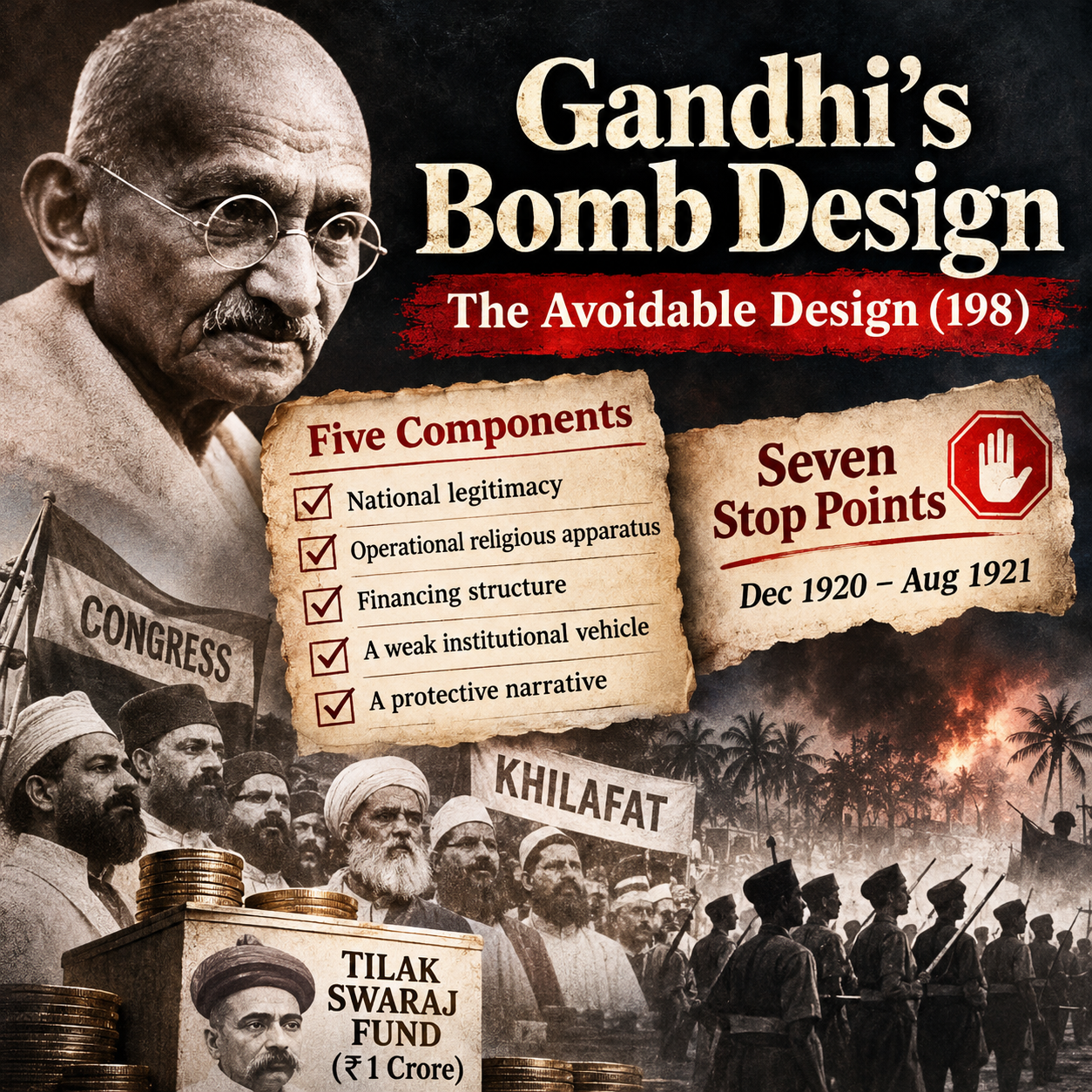
The design: Gandhi’s bomb design required five things simultaneously: a source of national legitimacy, an operational religious apparatus, a financing structure, an institutional vehicle too weak to refuse its architect, and a political cover narrative that reframed each warning as enemy propaganda. All five were in place before 20 August 1921.
The stop points: Seven moments between December 1920 and August 1921 at which the design could have been halted. At each moment, at least one party held the power to act. At each moment, that party chose not to.
Why it matters: The machine was not an accident of history. It was built, financed, enabled, and protected — before the detonation and after it. The cast is on the record. The choices are on the record. This blog places both before the reader.
The Architects
- Gandhi — incorporated Khilafat into Non-Cooperation at Nagpur, December 1920, by facilitating the takeover of the Congress institution by the radical Muslim clergy; gave the apparatus national Hindu legitimacy and the Congress organisational umbrella. (Documented: Blog 187)
- Mohamed Ali and Shaukat Ali — operational voice of the Khilafat movement; delivered inflammatory speeches framing armed resistance to the British as a religious duty, inter alia inviting an invasion by the Islamic rulers of Afghanistan to establish Islamic sovereignty over India; mobilized the radical recruitment base across UP, Punjab, and Malabar. (Documented: Blog 193)
- Ali Musaliar and the Ponnani tangal network — the theological layer that converted national Khilafat rhetoric into local Quranic obligation; Friday sermons in Ernad and Walluvanad explicitly overriding Gandhi’s Ahimsa doctrine. (Documented: Blog 195)
The Financiers
The Tilak Swaraj Fund is new to this series and requires documentation here. Bal Gangadhar Tilak died on 1 August 1920 — four months before the Nagpur session at which Gandhi restructured the Congress and incorporated Khilafat into Non-Cooperation. Gandhi launched a public fundraising campaign in Tilak’s name immediately after his death, with a target of one crore rupees. The fund was presented as a vehicle for Swaraj — Tilak’s own stated life’s work. By the time of Nagpur, Gandhi controlled a fund of this scale while simultaneously controlling the Congress’s new organisational agenda. The provincial Congress committees, stripped of independent financial capacity, were structurally dependent on the centre Gandhi directed. The Tilak Swaraj Fund was not the Khilafat’s money — but it was Gandhi’s money, and Gandhi’s money was the Khilafat apparatus’s guarantee of organisational survival.
Mian Mohamed Chotani — President of the Bombay Khilafat Committee — was the Khilafat movement’s dedicated financier. Chotani funded the Ali brothers’ national speaking tours, the All-India Khilafat Conference apparatus, and the volunteer recruitment network that became the Khilafat Volunteer Corps in the districts. Without Chotani’s financial infrastructure the Khilafat apparatus would have remained a rhetorical movement without operational reach into Ernad and Walluvanad. Gandhi’s bomb design required Chotani’s money to travel from Bombay to Malabar. It did.
The Institutional Enablers
At the Nagpur session of December 1920, Gandhi moved to reduce the Congress membership fee from Rs 6 to four annas. The stated purpose was democratisation — making the Congress accessible to the rural poor. The operational consequence was the overnight conversion of a deliberative body into a mass mobilisation instrument. A substantial majority of these new entrants joined directly on the basis of pastoral calls, decrees, and Friday pulpit appeals issued by Muslim religious leaders and the newly minted Jamiat Ulema-e-Hind network, rather than from any secular nationalist commitment. Millions of new members joined who had no prior political formation, no institutional memory of the Congress’s constitutional tradition, and no capacity to evaluate the theological-political fusion Gandhi was introducing. The annual session ceased to function as a deliberative body and became a plebiscite on Gandhi. Besant opposed the Khilafat incorporation at Nagpur. She was outvoted. Lajpat Rai opposed it. He was outvoted. The old Congress structure had the argument and lost the numbers — because Gandhi had designed the numbers.
The Congress structure itself offered no institutional resistance because it had no mechanism to offer any. It had no permanent secretariat with executive authority, no standing financial audit independent of its leadership, no procedure to remove or override a dominant figure between annual sessions. It was a morally governed organisation in an era when its dominant figure held the moral authority, the financial leverage, and the mass membership simultaneously. The structure was not captured by Gandhi. It was redesigned by Gandhi to be uncapturable by anyone else.
The Lal-Bal-Pal triumvirate — Lajpat Rai, Bal Gangadhar Tilak, Bipin Chandra Pal — had been the only institutional counterweight with independent mass bases, independent finances, and the organisational standing to say no and be heard. Tilak died August 1920. Pal had already withdrawn from active politics. Lajpat Rai remained — opposed the Khilafat incorporation, said so at Nagpur, and was outvoted. By December 1920 the Congress had no figure with the institutional authority to stop what Gandhi was building. The timing of Tilak’s death four months before Nagpur was not Gandhi’s doing. What Gandhi did with that vacuum was.
IV. The Operational Layer
- The Khilafat Volunteer Corps — drilling in formation in Ernad and Walluvanad through spring 1921; uniformed with green armbands and badges; operating under explicit organisational guidance from the pan-Islamic Khilafat apparatus Gandhi had endorsed and integrated at Nagpur. (Documented: Blog 194)
- Gandhi’s personal advocacy for arrested Khilafat cadres — throughout 1920–21, Gandhi’s public interventions on behalf of arrested Khilafat workers signalled that his national moral and political umbrella shielded the apparatus. Each intervention communicated directly to the cadre that the movement’s supreme architect stood behind its field operatives against local magistrates. (Documented: Blog 194)
- Gandhi’s Young India articles, February–March 1921 — publicly delegitimised the district administration’s alarm; informed the national public that Section 144 orders and the powder-keg warnings were manufactured British divide-and-rule tactics; providing political cover at the precise moment the Corps was drilling and arms were being collected. (Documented: Blog 195)
- The systematic dismissal of multi-channel alarms — persistently brushed aside repeated, specific warnings emerging simultaneously from the public press (Besant and Sankaran Nair), official administrative intelligence (Thomas and the Madras Government), and internal Congress field reports (Kesava Menon and Madhavan Nair), actively neutralizing every internal and external alarm that threatened the operational continuity of the apparatus. (Documented: Blog 195)
V. The Seven Stop Points
- Nagpur, December 1920 — Gandhi alone. Khilafat need not have been incorporated into Non-Cooperation. Besant opposed it. Lajpat Rai opposed it. Gandhi proceeded. (Documented: Blog 187)
- Theological override report, early 1921 — Gandhi and the AICC hierarchy. Kesava Menon and Madhavan Nair reported that the Moplah congregations explicitly rejected Ahimsa when the Caliphate was at stake. A demobilisation order could have issued. None did. (Documented: Blog 195)
- Besant and Sankaran Nair warnings, spring 1921 — Gandhi. Two former Congress Presidents warned Gandhi by name in the national press. His Young India response dismissed their alarm as British-inspired. He actively closed this stop point. (Documented: Blog 195)
- Thomas’s March 1921 intelligence summary — Madras Government and Reading’s administration. The district magistrate’s summary naming the Corps, the arms, and the surpassing of the 1896 benchmark was filed and forwarded. No action on the Malabar apparatus followed. (Documented: Blog 194)
- Simla, May 1921 — Gandhi and Reading jointly. Six sessions. The Tirurangadi intelligence reports were directly before the Viceroy in the Viceregal Lodge. Both parties chose to ignore Malabar’s powder-keg realities in pursuit of a mutual political bargain: the settlement was narrowly drafted to cover only the Ali brothers’ speeches, extracting a vague, toothless statement of regret in exchange for the Viceroy staying criminal prosecution and Gandhi guaranteeing the movement’s peaceful veneer. The most consequential stop point, jointly abandoned. (Documented: Blogs 193–194)
- Post-Simla, June–August 1921 — Gandhi, the AICC, the MDCC. Ten weeks. No instruction to stand down the Volunteer Corps. No AICC resolution. No MDCC directive. The cadres drilled. (Documented: Blog 194)
- 20 August 1921, the arrest — Reading’s administration and the Madras Government. Ali Musaliar was arrested without first standing down the Corps. The district was at flash point. The arrest was the trigger. The British administration held this stop and did not take it. (Documented: Blog 196)
VI. The Aftermath Managers
- Gandhi — Young India condemnation of the violence; British-provocation framing of the cause; silence on all prior warning channels; Non-Cooperation Movement continued without suspension. (Documented: Blog 197)
- All-India Khilafat Committee — issued a statement condemning the violence; Gandhi welcomed it; the theological apparatus that produced the violence was not examined or dismantled. (Documented: Blog 197)
- Congress leadership collectively — no suspension of the movement; no inquiry into the Volunteer Corps or the AICC hierarchy’s receipt of the ground reports; the alliance preserved. (Documented: Blog 197)
- Administrative and Non-Official Inquiries — official government inquiries (including the Knapp Special Commission) and non-official bodies (the Central Relief Committee and the Arya Samaj) documented the displacement and forced conversions, but treated the crisis strictly as an administrative and agrarian failure, leaving the political and theological coalition engineered at Nagpur entirely unindicted.
- Simla, May 1921 — Gandhi and Reading jointly: The Quid Pro Quo. Six sessions in the Viceregal Lodge. Both parties held the Tirurangadi intelligence reports and deliberately bypassed Malabar to close a mutual political trade:
- Reading’s concession: Shelved the arrest warrants against the Ali brothers under Sections 124A and 153A, averting a troop crisis and leaving their mass rural apparatus intact.
- Gandhi’s counter-guarantee: Needing to ride the roaring Khilafat wave to salvage his own waning post-Rowlatt momentum, Gandhi protected the brothers with a toothless retraction while personally guaranteeing the movement’s peaceful veneer to the Viceroy.
- The transaction cost: Reading bought immediate imperial stability; Gandhi preserved his crowds and undisputed leadership. The unacknowledged cost was Malabar, left to simmer under that “peaceful veneer” until it exploded twelve weeks later. The most consequential stop point, jointly passed. (Documented: Blogs 193–194)
Invitation To Defence
The cast is on the record. The choices are on the record. If Gandhi’s bomb design was an accident of history, the defence has seven stop points and a full cast of parties with the power to act to explain. Name the stop point that was taken. Name the financier whose money was refused. Name the Congress session that overruled Gandhi. Name the AICC resolution that stood down the Corps. We invite that explanation.
The machine required a full cast. Architects. Financiers. Institutional enablers. An operational layer. Seven parties who held stop points and passed them. And a managed narrative that ensured no one was held accountable after it detonated. It got everything it required. The Hindus of Ernad and Walluvanad got what the machine produced.
Feature Image: Click here to view the image.
Videos
Glossary of Terms
1. Gandhi’s Bomb Design: A coined analytical phrase describing the political, religious, financial and organisational structure that Gandhi helped establish through the incorporation of the Khilafat movement into Non-Cooperation, and the subsequent failure to intervene before the Malabar uprising.
2. Khilafat Movement: A political and religious movement organised around the preservation of the Ottoman Caliphate, which Gandhi incorporated into the Indian Non-Cooperation Movement in December nineteen hundred and twenty.
3. Non-Cooperation Movement: A political movement led by Mahatma Gandhi against British rule, which involved withdrawing cooperation from British institutions and authorities.
4. Tilak Swaraj Fund: A fund launched by Gandhi after Bal Gangadhar Tilak’s death in August nineteen hundred and twenty, with a fundraising target of one crore rupees, presented as a means of advancing Swaraj.
5. Khilafat Volunteer Corps: An organised volunteer network associated with the Khilafat movement, whose cadres conducted military-style drills in Ernad and Walluvanad during nineteen hundred and twenty-one.
6. Ponnani Tangal Network: A local religious network associated with Ali Musaliar and religious leadership in the Ponnani region, which translated national Khilafat mobilisation into local religious obligations through Friday sermons.
7. Pan-Islamic Apparatus: An organisational and ideological network connecting Islamic political mobilisation across geographical regions, including the Khilafat movement and its associated volunteer structures.
8. AICC (All-India Congress Committee): The central Congress organisation whose leadership received reports about the rejection of Ahimsa among Moplah congregations and whose intervention could have included ordering the Volunteer Corps to demobilise.
9. MDCC: The district-level Congress organisation referred to alongside the AICC in connection with the failure to issue instructions to withdraw the Khilafat Volunteer Corps after the Simla meetings.
10. Quid Pro Quo: A reciprocal political arrangement in which one party provides a concession in exchange for a corresponding benefit. In the Simla understanding, Reading held back criminal prosecution of the Ali brothers while Gandhi guaranteed the movement’s peaceful appearance.
11. Seven Stop Points: A coined analytical framework identifying seven opportunities between December nineteen hundred and twenty and August nineteen hundred and twenty-one when the political and organisational developments leading to the Malabar uprising could have been interrupted.
12. Theological Override: The rejection of Gandhi’s Ahimsa doctrine by Moplah congregations when the Caliphate was at stake, as reported by Kesava Menon and Madhavan Nair.
13. Peaceful Veneer: A phrase describing the outward appearance of peaceful conduct guaranteed by Gandhi to Viceroy Reading, despite the continuing mobilisation and military-style activities of the Khilafat Volunteer Corps.
14. Lal-Bal-Pal Triumvirate: The nationalist leadership grouping comprising Lala Lajpat Rai, Bal Gangadhar Tilak and Bipin Chandra Pal, which represented an institutional counterweight to Gandhi through its independent public support, financial resources and organisational standing.
15. Stop Point Abandonment: A coined analytical expression describing the failure of political and administrative authorities to act at identifiable opportunities when they possessed the information and authority to prevent further escalation.
#Gandhi #Malabar #Khilafat #Congress #India #History #Moplah #HinduHistory #HinduinfoPedia
Scan Through The Entire Series at