
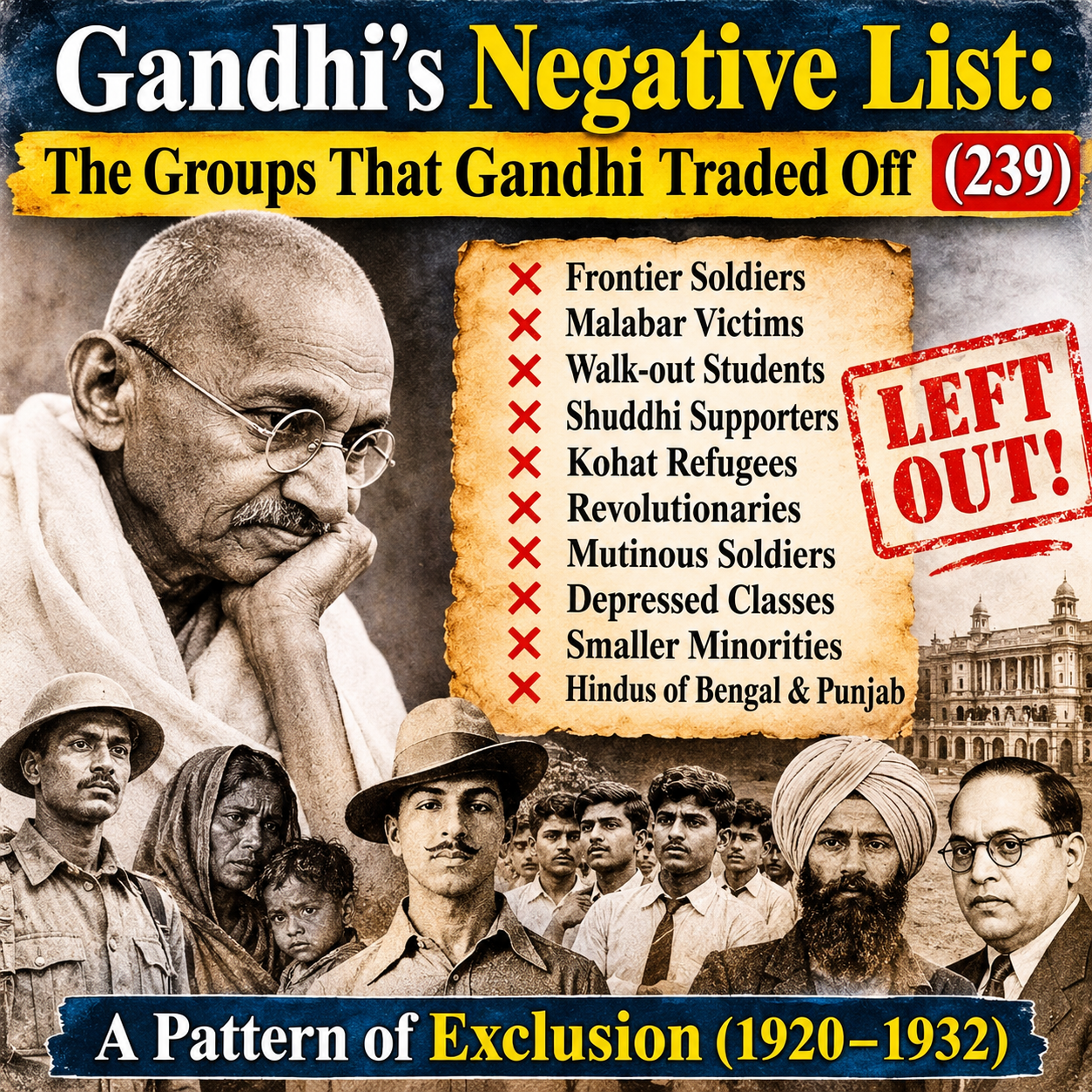
Gandhi’s Negative List: The Groups That Gandhi Traded Off (239)
भारत / GB
Part 239: Mahatma Gandhi’s Peace Efforts (Residue Enters Constitution) | Series Index
Blog 238 showed that under the August 1932 Communal Award, Gandhi left the Muslim seat allocations in the Punjab (86 of 175) and Bengal (119 of 250) untouched while contesting only the Depressed Classes’ electorate. Why did he yield to organized blocs yet override vulnerable ones? This consolidated list is placed here to show that whenever Gandhi dealt with a class or group he judged too weak to resist—or too independent to control—he treated their claims as expendable, placing them on Gandhi’s Negative List..
THE PATTERN: 1920 – AUGUST 1932
The Action Taken: Across twelve years of negotiations with British officials and Khilafat or Muslim League leaders, Gandhi repeatedly excluded specific Indian constituencies from Congress protection, denied them bargaining priority, or sought to isolate their claims.
Who Paid the Price: Frontier soldiers, Malabar and Kohat Hindu victims, walk-out students, Hindu revivalist movements, revolutionaries, mutinous soldiers, the Depressed Classes, smaller minorities, and the Hindus of Bengal and the Punjab.
Why This Matters: Every group placed on this exclusion ledger either acted independently of Gandhi’s personal control or stood in the way of a bilateral pact with the Crown or pan-Islamic leadership.
1. How the Exclusion Ledger Worked
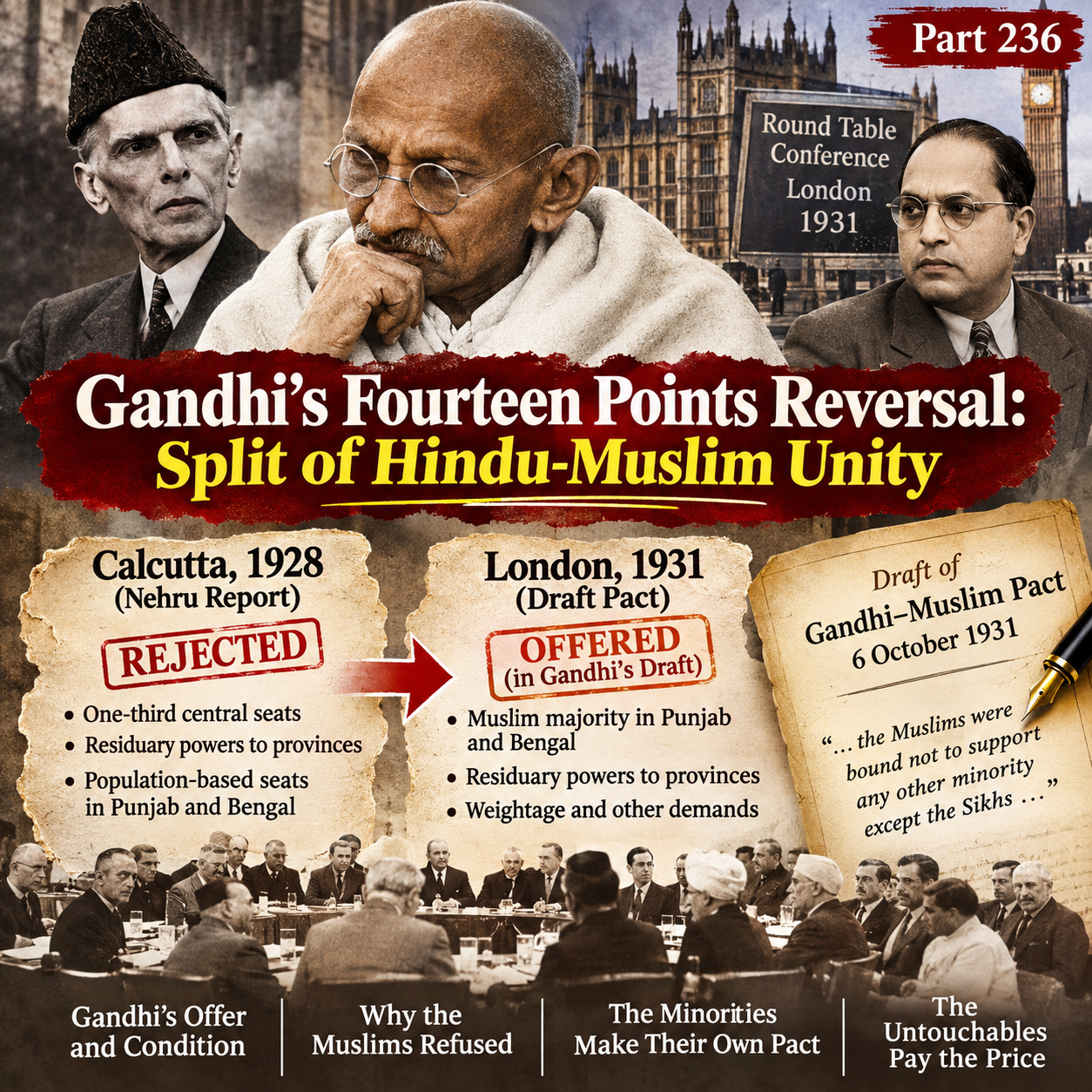
In London in October 1931 (Blog 236), Dr. B.R. Ambedkar summed up Gandhi’s secret offer to the Muslim delegation in a single sentence: Gandhi “agreed to give them their fourteen points on condition that they withdrew their support from the Untouchables.”
That transaction captures the exact mechanism of Gandhi’s Negative List. Whenever Gandhi sought a political settlement with British authority or Muslim leadership between 1920 and 1932, specific Indian groups were placed outside the circle of Congress protection—either left off the bargaining table altogether or used as the price paid to secure agreement elsewhere.
2. Four Phases of Exclusion (1920–1932)
1920–1922: Frontier Defenders, Malabar Victims, and Walk-Out Students
The pattern began during the Khilafat and Non-Cooperation alliance. In 1920–1921, Gandhi declared it religiously forbidden for Indians to serve in the British Indian Army or defend the North-West Frontier, placing Indian soldiers and frontier defence below the claims of the Ottoman Caliphate. When the Malabar uprising broke out in August 1921, the December 1921 Ahmedabad Working Committee resolution downplayed forced conversions and killings of Hindus to preserve the Khilafat alliance, leaving Malabar victims without Congress relief or condemnation of the perpetrators. Two months later, on 12 February 1922, Gandhi unilaterally halted the entire movement at Bardoli—stranding tens of thousands of boycotting students and teachers whom he had induced to abandon schools and colleges, without creating any institutional safety net for them.
1923–1925: Shuddhi, Sangathan, and the Kohat Refugees+6+++
Once the Khilafat coalition collapsed, the same asymmetry governed internal religious organization. In 1923–1924, Gandhi publicly criticized Swami Shraddhanand’s Shuddhi (reconversion) and Madan Mohan Malaviya’s Sangathan (Hindu self-organization) as divisive obstacles to unity, while treating pan-Islamic Tanzim and Tabligh as legitimate religious duty. When the entire Hindu population of Kohat was driven out in September 1924, Gandhi’s February 1925 inquiry report refused to back the refugees’ demand for unconditional return or collective accountability—and refused to allocate Swaraj Fund resources for their resettlement even while large balances from the ₹1,30,19,415 Tilak Swaraj Fund remained unaccounted for, despite Congress-Khilafat networks having funded the 1920 Hijrat mobilization and its returnees. Instead, Gandhi instructed the displaced Kohat Hindus that they must learn to suffer without retaliation or live at the mercy of their neighbours.
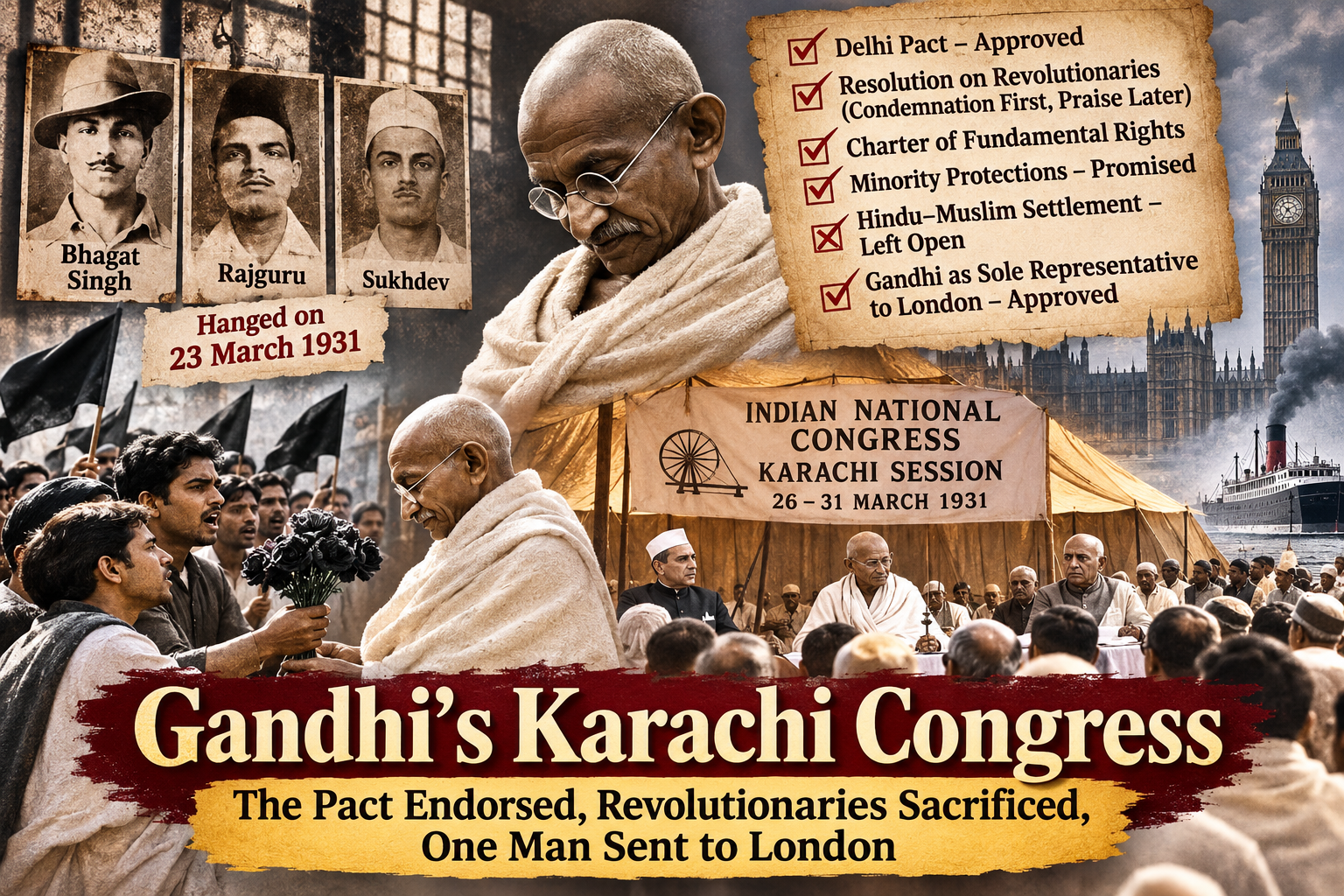
March 1931: Revolutionaries and Mutinous Soldiers in the Delhi Pact
In his one-on-one talks with Viceroy Lord Irwin leading to the 5 March 1931 Delhi Pact (Blog 234), Gandhi secured the release of non-violent Civil Disobedience prisoners while leaving two groups explicitly off the bargaining table. The first was Bhagat Singh, Rajguru, and Sukhdev, whose execution proceeded just days before the Karachi Congress—where the resolution drafted under Gandhi opened by dissociating the Congress from their political violence. The second was Chandra Singh Garhwali and the men of the 2/18 Royal Garhwal Rifles, imprisoned for refusing to fire on unarmed Pathan demonstrators in Peshawar in April 1930, whom Gandhi declined to press for in order to respect British military discipline.
October 1931 – August 1932: Untouchables, Smaller Minorities, and Bengal/Punjab Hindus
At the Second Round Table Conference in London, Gandhi’s Negative List took constitutional form. In his 6 October 1931 draft pact with the Muslim delegation (Blog 236), Gandhi offered Jinnah’s Fourteen Points on condition that Muslims support no other minority except the Sikhs—isolating Dr. Ambedkar and the Depressed Classes. On 13 November 1931, Gandhi drew a hard exclusion line around smaller minorities as well, declaring that while Congress would accept special electorates for Muslims and Sikhs, it “will be no party to the special electorates for any other minorities,” shutting out Indian Christians and Anglo-Indians. Finally, in August 1932 (Blog 237), Gandhi raised no protest against the Communal Award’s reduction of Bengal Hindus (80 of 250) and Punjab Hindus (43 of 175) into permanent legislative minorities, reserving his 18 August fast-unto-death threat solely against the separate electorate of the Depressed Classes.
3. The Four-Phase Bargaining Matrix
Placed side by side, the four phases of Gandhi’s Negative List show a single recurring trade-off between 1920 and August 1932:
| Phase & Exhibit | Placed on the Negative List | Who Received the Concession Instead |
|---|---|---|
| 1920–1922 Khilafat & Bardoli |
Frontier soldiers, Malabar Hindu victims, boycotting students | Ottoman Caliphate, Khilafat leadership, unilateral moral prestige |
| 1923–1925 Post-Khilafat & Kohat |
Arya Samaj (Shuddhi), Sangathan, Kohat Hindu refugees | Tanzim/Tabligh preachers and local Kohat leadership |
| March 1931 Delhi Pact & Karachi |
Bhagat Singh, Rajguru, Sukhdev, and the Garhwali Rifles | Viceroy Lord Irwin, British military discipline |
| Oct 1931 – Aug 1932 London & Communal Award |
Depressed Classes, Christians, Anglo-Indians, Bengal/Punjab Hindus | Muslim League Fourteen Points, Sikh quotas, British Award |
4. An Open Ledger, Not a Closed Total
Across all four phases, Gandhi’s Negative List followed one consistent rule. Groups that organized independently of Gandhi’s personal authority—whether revolutionaries in Lahore, mutinous soldiers in Peshawar, Hindu reformers under Shraddhanand and Malaviya, or the Depressed Classes under Dr. Ambedkar—were denied Congress backing or traded away whenever their claims complicated a deal with the British executive or Muslim leadership.
This ledger is not a closed total. It records only the documented political and constitutional bargains between 1920 and August 1932. Every major political negotiation—and even the personal and ashram rules Gandhi imposed on followers—carried its own exclusions, with later political entries continuing into the 1939 Tripuri crisis and the 1946–1948 Partition years. Even within the 1920–1932 window alone, the pattern is enough to show how Indian unity was fractured from within before the broader divide-and-rule reckoning of the next instalment.
Prosecution’s Position
The prosecution places on the record the twelve-year pattern of Gandhi’s Negative List from 1920 to August 1932. Rather than an isolated misstep in London, Gandhi’s attempt to trade away the Depressed Classes in October 1931 and his selective opposition to their separate electorate in August 1932 followed a documented sequence: Frontier soldiers, Malabar victims, walk-out students, Shuddhi and Sangathan workers, Kohat refugees, Bhagat Singh’s group, the Garhwali Rifles, smaller minorities, and Bengal and Punjab Hindus were each excluded from bargaining protection while unilateral concessions went to British officials or Muslim negotiators.
Invitation To Defence
The Ahmedabad resolution of December 1921, the Bardoli suspension of February 1922, the Kohat inquiry reports of February 1925, the Gandhi–Irwin Pact of March 1931, the London draft of 6 October 1931, Gandhi’s statement of 13 November 1931, and his letter of 18 August 1932 are established exhibits. The defence is invited to produce any binding bargaining condition Gandhi ever placed on the British Government or Muslim negotiators on behalf of the Depressed Classes, the Garhwali Rifles, or the Hindus of Kohat, Bengal, and the Punjab between 1920 and August 1932.
From Malabar and Kohat to Bhagat Singh, the Garhwali Rifles, and Dr. Ambedkar’s Depressed Classes, Gandhi’s Negative List reveals a twelve-year rule: independent Indian claimants and vulnerable Hindu constituencies were repeatedly left off the bargaining table so Gandhi could pursue bilateral deals with the Crown or pan-Islamic leaders.
Feature Image: Click here to view the image.
Videos
Glossary of Terms
1. Gandhi’s Negative List: A term coined in this series to describe the groups and communities allegedly excluded from Gandhi’s political negotiations or whose demands were not given bargaining priority between 1920 and August 1932.
2. Khilafat Movement: A political and religious movement launched by Indian Muslims after the First World War to protect the Ottoman Caliphate, which Gandhi supported as part of the Non-Cooperation alliance.
3. Non-Cooperation Movement: A mass political campaign launched by Gandhi in 1920 that encouraged Indians to boycott British institutions, schools, courts, and government services.
4. North-West Frontier: The strategically important frontier region adjoining Afghanistan, where British Indian forces maintained military positions and defended the north-western boundaries of British India.
5. Depressed Classes: The historical administrative and political term used during British rule for communities subjected to untouchability and social discrimination, including communities later constitutionally recognized as Scheduled Castes.
6. Shuddhi: A Hindu reconversion movement associated particularly with the Arya Samaj, intended to facilitate the return of individuals who had converted to other religions.
7. Sangathan: A movement promoting Hindu social organization, unity, and collective mobilization, particularly associated with leaders such as Madan Mohan Malaviya.
8. Tanzim: An organizational movement among sections of Indian Muslims during the 1920s that promoted religious and community organization.
9. Tabligh: Religious propagation and preaching, particularly associated with efforts to communicate and strengthen Islamic religious beliefs and practices.
10. Hijrat Movement: The migration of sections of Indian Muslims to Afghanistan in 1920, motivated by the belief that British-ruled India was no longer suitable for Muslims to live under Islamic principles.
11. Tilak Swaraj Fund: A fund established by the Indian National Congress in 1921 to finance the Non-Cooperation Movement and related nationalist activities, named after Bal Gangadhar Tilak.
12. Delhi Pact (Gandhi–Irwin Pact): The agreement signed on 5 March 1931 between Mahatma Gandhi and Viceroy Lord Irwin, under which Congress agreed to suspend the Civil Disobedience Movement in exchange for specified concessions from the British Government.
13. Garhwali Rifles: The soldiers of the 2/18 Royal Garhwal Rifles associated with the 1930 Peshawar incident, particularly Chandra Singh Garhwali, who refused to fire on unarmed demonstrators.
14. Communal Award: The constitutional arrangement announced by British Prime Minister Ramsay MacDonald on 16 August 1932, which provided separate electorates and other forms of political representation to specified communities.
15. Special Electorates: An electoral arrangement under which members of a designated religious or social community elect representatives from their own community rather than through a common electorate.
#Gandhi #MahatmaGandhi #IndianHistory #IndianPolitics #Ambedkar #Congress #Khilafat #CommunalAward #BhagatSingh #HinduinfoPedia
Scan Through The Entire Series at
Refer to Various Arks Referred to in the Blog