
Gandhi’s Khilafat Veteran Failure: Gandhi Labelled Below “Any Fallen Musalman” (229)
Thank you for reading this post, don't forget to subscribe!भारत / GB
Part 229: Mahatma Gandhi’s Peace Efforts (Residue Enters Constitution) | Series Index
Blog 228 opened the Congress’s own Kanpur inquiry of 1931 and recorded the testimony its majority had cut: witnesses who told the committee that almost none of Kanpur’s thirty leading Congressmen stood above communal feeling, saved only in Zafar-ul-Mulk’s note of dissent. That was the evidence on Congress’s rank and file. This instalment turns to the apex of the alliance Gandhi built in 1920 — to Maulana Mohamed Ali, the Khilafat leader whose street-mobilization machine Gandhi repurposed as “Non-Cooperation”, rescued at Simla, and enabled to capture the Congress presidency while Gandhi was in jail — and documents Gandhi’s Khilafat Veteran Failure: Mohamed Ali’s public declaration labelling Gandhi inferior in religion to “an adulterous and a fallen Musalman”, Gandhi’s published acceptance of that creedal ranking on 10 April 1924, and the collision of universal brotherhood with creedal exclusivism that ended at the separate-electorate table in London.
THE RANKING AND THE ACCEPTANCE: 1920–1931
The Action Taken: Without Mohamed Ali’s pan-Islamic network, Gandhi could neither sideline constitutionalists at Nagpur in 1920 nor sustain Non-Cooperation. Gandhi repackaged the Ali brothers’ Khilafat agitation as “Non-Cooperation” for Hindus and the English media, brokered their May 1921 Simla apology with Viceroy Lord Reading to keep them out of prison, saw Mohamed Ali elected Congress President at Cocanada in December 1923 while Gandhi was in Yerawada Jail, and held his 21-day unity fast under Mohamed Ali’s roof in September 1924. Yet in 1924 Mohamed Ali publicly declared at Aligarh, Ajmer, and Lucknow’s Aminabad Park that from the standpoint of religion Gandhi stood inferior to any Musalman — confirming without hesitation that by his creed he held “an adulterous and a fallen Musalman to be better than Mr. Gandhi”. Gandhi replied in Young India on 10 April 1924, calling the ranking of creeds logical and honest, stating he was not offended, and urging Hindus to accept it without demanding a withdrawal. By 1928–30 Mohamed Ali opposed the Nehru Report, urged Muslims to keep out of Civil Disobedience, and sat at the First Round Table Conference in London that Congress boycotted.
Who Paid the Price: The Hindus who had been asked since Nagpur 1920 to fund and treat Khilafat leaders as equal partners in a national movement — and whose own universalist tradition was subordinated to an exclusivist creedal hierarchy that Gandhi formally validated in print.
Why This Matters: The alliance continued without any demand that the religious hierarchy be withdrawn. By accepting a doctrine that placed even a fallen Muslim above any non-Muslim regardless of character, the record shows that Gandhi, in effect, left that hierarchy unchallenged inside the Congress — validating the very exclusivism that had driven centuries of forced conversions, migrations, and territorial ruptures, and later allowing court historians to blame Hindu society rather than confront the creed he had endorsed.
1. The Operational Crutch and the Statements
Mohamed Ali was not a peripheral recruit in Gandhi’s Muslim policy; he was the operational pillar on which Gandhi erected his control over Congress in 1920:
- 1920–21 (Dual Branding & the Simla Rescue): Alongside his brother Shaukat Ali, Mohamed Ali commanded the pan-Islamic clerical network that Gandhi repurposed and renamed as “Non-Cooperation” for Hindus and the English-language press. Using the Ali brothers’ street reach to marginalise constitutionalists at Nagpur in December 1920, Gandhi tied his own political ascendancy to theirs. When Viceroy Lord Reading moved to prosecute the brothers for incitement in May 1921, Gandhi intervened at Simla to broker their public apology — trading credibility to keep his indispensable mobilization partner out of prison until the Karachi trial of September 1921.
- December 1923 (The Presidency): While Gandhi was serving his prison sentence in Yerawada Jail, the Congress apparatus he had handed over to his Khilafat alliance elected Mohamed Ali President of the Cocanada (Kakinada) session, where Mohamed Ali praised Gandhi in terms Ambedkar reads as a comparison with Jesus.
- 1924 (The Public Ranking): Even as Turkey abolished the Ottoman Caliphate in March 1924 (Blog 209), Mohamed Ali stated the exact doctrinal terms of the alliance across three public occasions recorded by Dr. B.R. Ambedkar in Pakistan or the Partition of India (Chapter XII, “National Frustration”, p. 332):
| Occasion (Ambedkar’s Record) | Mohamed Ali’s Recorded Words | Evidentiary Status |
|---|---|---|
| Cocanada Congress, December 1923 | Presidential address praising Gandhi in terms Ambedkar reads as a comparison with Jesus | Documented Congress presidential address (Ambedkar, p. 332) |
| Aligarh and Ajmer (1924) | However pure Gandhi’s character may be, from the point of view of religion he must appear “inferior to any Musalman”, even one without character | Recorded by Ambedkar (p. 332); addressed by Gandhi in Young India, 10 April 1924 |
| Aminabad Park, Lucknow | Confirmed without hesitation: by his religion and creed he held “an adulterous and a fallen Musalman to be better than Mr. Gandhi” | Recorded by Ambedkar (p. 332, fn. 75); exact verbatim press text unlocated |
The words recorded by Ambedkar are unambiguous. They assert a formal religious hierarchy in which Gandhi — and by the same rule any non-Muslim, specifically any Hindu — ranks below any Muslim of the lowest conduct. They are not a comment on Gandhi’s personal character; they are a ranking of creeds.
2. Gandhi’s Published Acceptance (10 April 1924)
On 10 April 1924, after his release from Yerawada Jail, Gandhi addressed the controversy directly in Young India (Collected Works of Mahatma Gandhi, Vol. 23, pp. 416–418). He published Mohamed Ali’s explanatory letters and wrote that the press had distorted the speeches into a personal attack. He then validated the substance of what remained (p. 417):
- Explicit Creedal Ranking: Gandhi acknowledged that Mohamed Ali had stated the creed of Islam is superior to Gandhi’s creed.
- Endorsement as “Logical and Honest”: Gandhi called this the logical and honest position of a religious man.
- Public Submission: He stated plainly that he was not offended by being ranked below any Musalman.
- Instruction to Hindus: He described the letters as proof of Mohamed Ali’s transparent honesty and urged Hindus to accept them as such.
Gandhi did not ask Mohamed Ali to withdraw the ranking. He did not treat the hierarchy as incompatible with the claim of Hindu–Muslim unity on equal terms. Five months later, in September–October 1924, Gandhi staged his 21-day fast for communal unity under Mohamed Ali’s own roof in Delhi (Blog 155) — operating inside the household of a leader whose declaration of religious superiority he had already accepted in print.
That is the documented core of Gandhi’s Khilafat Veteran Failure: the religious subordination was stated publicly, and Gandhi published his acceptance of it to preserve his political coalition.
3. Two Civilizational Frameworks: Universal Brotherhood vs. Creedal Exclusivism
What collided in the Aligarh–Ajmer–Lucknow controversy and Gandhi’s 10 April 1924 reply was not a personal misunderstanding between two politicians. It was the structural collision between two opposing civilizational premises — one built on universal human brotherhood, the other on an exclusivist brotherhood bound strictly by creed:
| Dimension | Dharmic / Hindu Civilizational Premise | Exclusivist Brotherhood (Khilafat Juridical Premise) |
|---|---|---|
| Criterion of Human Worth | Universal brotherhood (Vasudhaiva Kutumbakam): moral conduct (Dharma), character, and truth define worth regardless of sect or form of worship. No rule ranks every non-Hindu below every Hindu. | Exclusivist brotherhood (Ummah / Millat): membership in the creed overrides character. As Ambedkar recorded Mohamed Ali’s rule (p. 332), even “an adulterous and a fallen Musalman” ranks above a non-Muslim of pure character. |
| Political & Territorial Rule | Civic coexistence across communities without demanding conversion or theological submission as the price of citizenship. | As Ambedkar documented (Pakistan or the Partition of India, pp. 293–296, 330–332), under the classical juridical categories cited by Khilafat leaders, land not ruled by Muslims is Dar-ul-Harb (abode of war), and scriptural mandates (including Surah 9:5 against polytheists) supersede political pacts with non-Muslims. |
| Historical Consequence on the Ground | A millennium of genuine sanctuary without conversion — exemplified in Kerala itself, where Hindu rulers sheltered early Muslim traders, Syrian Christians, and Jews fleeing existential persecution elsewhere — followed under Gandhi by asymmetric restraint that left Hindu populations exposed when the alliance fractured (Malabar 1921, Kohat 1924, Partition 1947). | Centuries of religious exclusivism translated into forced conversions, temple destruction, and mass expulsions of non-believers — striking even in Kerala during the 1921 Malabar uprising against the very Hindu society that had sheltered those communities for centuries, and culminating in territorial partition. |
That asymmetry explains why the Khilafat alliance could never produce equal partnership. When a culture grounded in universal brotherhood enters an unconditional pact with an exclusivist brotherhood that explicitly places every believer — even a fallen one — above every non-believer, and the leader of the former publishes his formal acceptance of that inferiority, the result is not synthesis; it is institutional surrender.
Even worse was the historiographical distortion that followed. Rather than confronting the exclusivist creedal doctrine that Mohamed Ali stated openly and that had driven centuries of forced conversions and displacements across India, Gandhi and subsequent court historians inverted the record — blaming Hindu social divisions and caste for communal estrangement while treating creedal exclusivism as “transparent honesty.” Gandhi’s 10 April 1924 reply in Young India supplied the template for that inversion: validate the exclusivist claim, instruct Hindus to accept it without complaint, and call the arrangement national unity.
4. The Subsequent Record: From Congress President to London
The ranking was never withdrawn, and the political trajectory that followed over the next six years obeyed the hierarchy Mohamed Ali had declared:
| Year | Mohamed Ali’s Position | Congress Position |
|---|---|---|
| 1923–1924 | Elected Congress President while Gandhi is in jail (Dec 1923); declares Gandhi inferior in religion to any Musalman (1924) | Gandhi accepts the ranking in Young India (10 April 1924) and fasts at Mohamed Ali’s house (Sept 1924) |
| 1928 | Opposes the Nehru Report’s joint-electorate constitution | Adopts the Nehru Report as its constitutional offer (Blog 83) |
| 1930 | Urges Muslims to stay out of Civil Disobedience, warning it would leave them dependent on the Hindu Mahasabha | Launches the Salt March and Civil Disobedience |
| Nov 1930 – Jan 1931 | Sits as a delegate at the First Round Table Conference in London pressing for separate Muslim safeguards; dies in London on 4 January 1931 | Boycotts the conference entirely |
At the plenary session of the First Round Table Conference on 19 November 1930, a gravely ill Mohamed Ali declared that he would not return to a slave country without freedom in hand, adding: “you will have to give me a grave here.” He died in London on 4 January 1931 and was buried on 23 January at the Haram al-Sharif in Jerusalem — speaking from inside a British-convened conference Congress had boycotted, alongside the separate-electorate Muslim delegation, with not a single Congress delegate beside him.
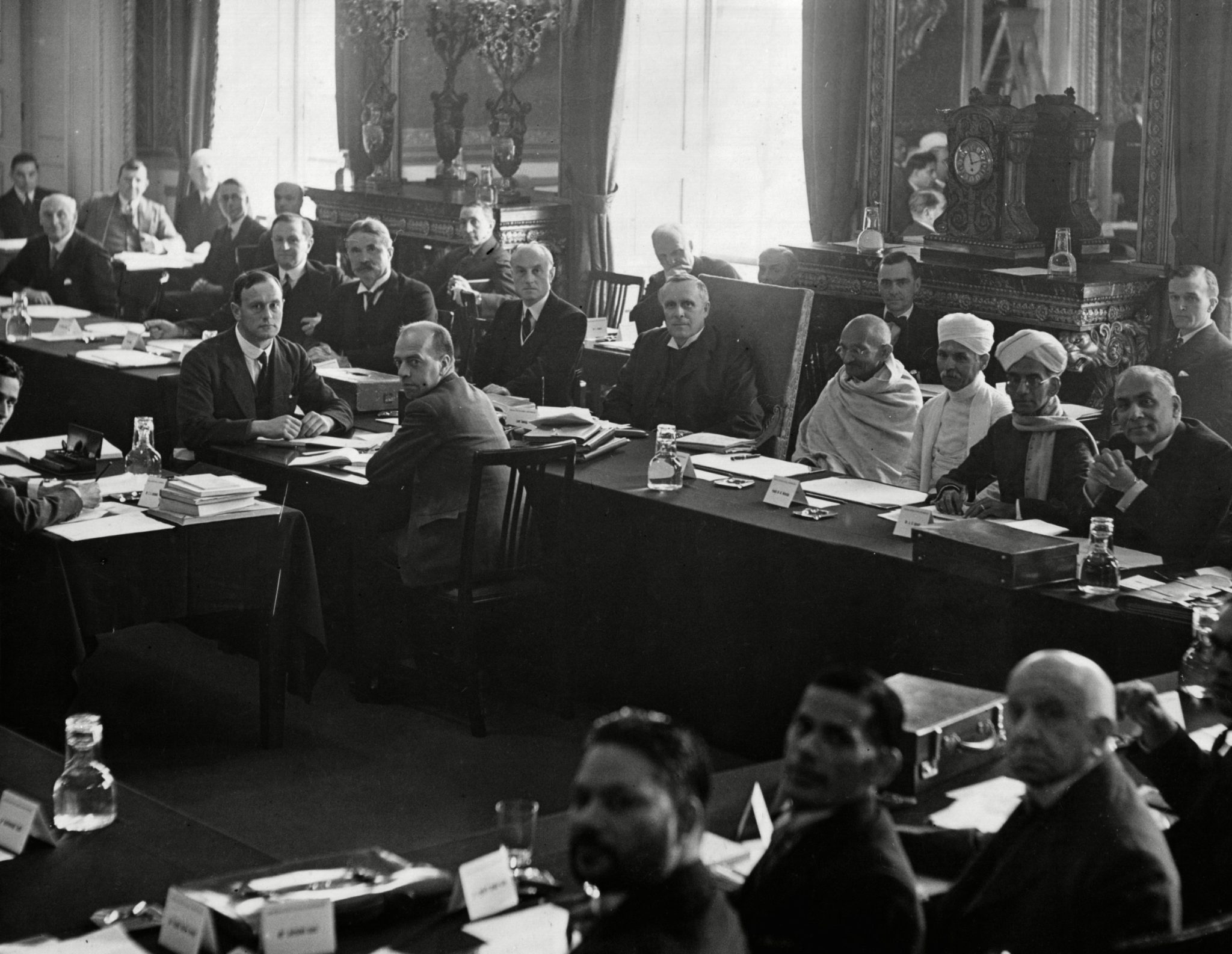
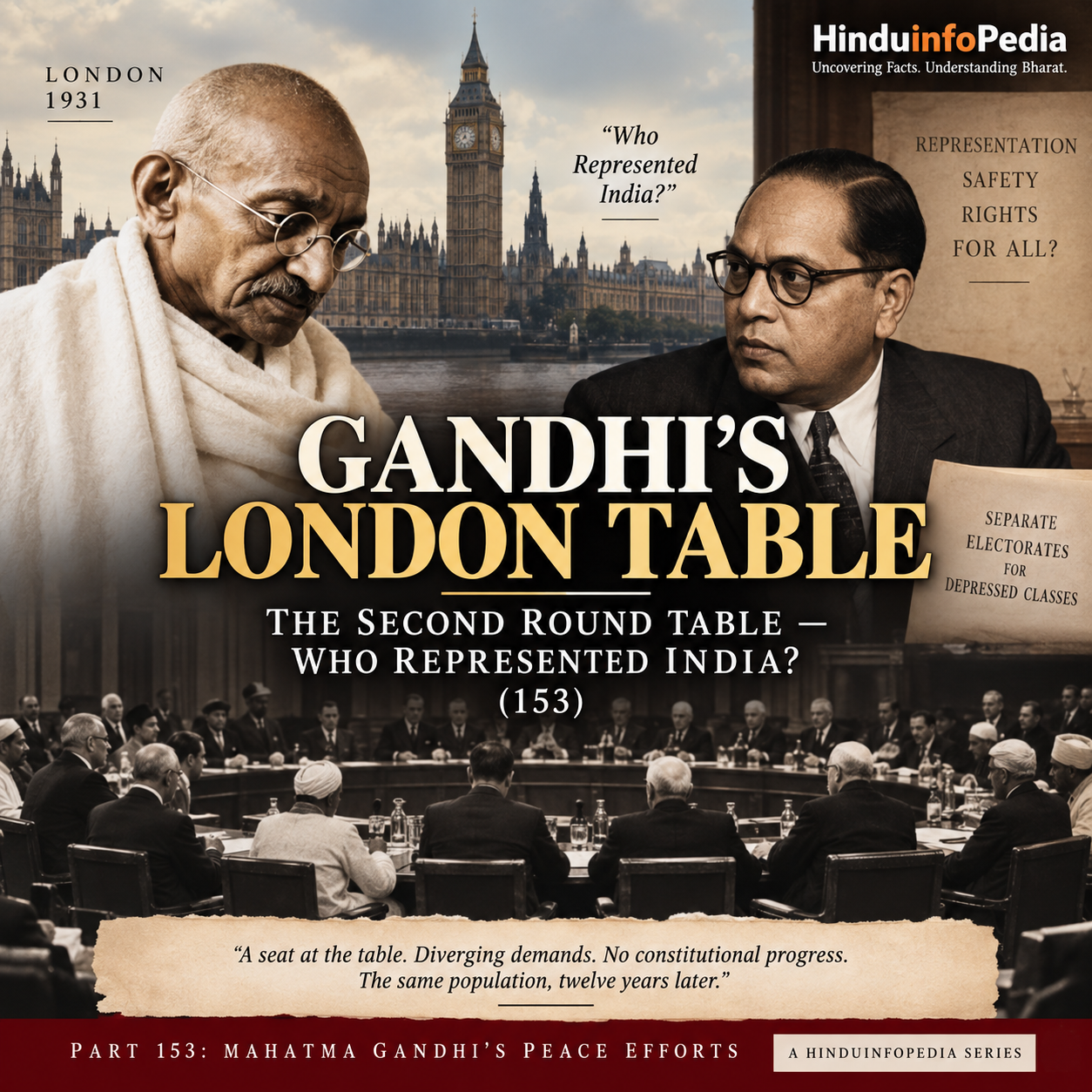
The policy reversal that followed eight months later exposes the full contradiction of Gandhi’s Khilafat Veteran Failure. In India in December 1928, Gandhi and the Congress had rejected every constitutional amendment sought by Mohamed Ali and Jinnah to the Nehru Report, refusing separate communal safeguards. Yet when Gandhi arrived in London in September 1931 for the Second Round Table Conference (Blog 153), he reversed course — offering to concede the Muslim delegation’s separate-electorate and statutory-majority demands (while opposing separate electorates for the Depressed Classes) in exchange for their political support, even as he claimed that Congress alone spoke for every Indian community on equal terms. That claim collided directly with Gandhi’s own published record: the man he had used as a mobilization crutch in 1920, rescued at Simla in 1921, and enabled to capture the Congress presidency in 1923 had already asserted an exclusivist religious hierarchy placing Gandhi below even a fallen Musalman, Gandhi had accepted that hierarchy in Young India on 10 April 1924, and Mohamed Ali had finished his life at the London table opposing Congress.
Invitation To Defence
Mohamed Ali’s statements as recorded in B.R. Ambedkar, Pakistan or the Partition of India (Chapter XII, p. 332 & fn. 75), Gandhi’s published reply in Young India (10 April 1924, CWMG Vol. 23, pp. 416–418), and Mohamed Ali’s plenary speech in the Proceedings of the First Round Table Conference (19 November 1930) are established exhibits. The defence is invited to produce any public statement by Gandhi, between 10 April 1924 and his 1931 London claim of equal representation, that treated Mohamed Ali’s exclusivist creedal ranking as incompatible with the assertion that Congress spoke for Hindus and Muslims on equal terms, or that required the ranking to be withdrawn as a condition of continued cooperation.
Mohamed Ali labelled Gandhi inferior in religion to “an adulterous and a fallen Musalman”. Gandhi published his acceptance of that exclusivist ranking in Young India on 10 April 1924, called it logical and honest, and instructed Hindus to accept it. Seven years later, his former Congress President died in London opposing the party he once led.
Feature Image: Click here to view the image.
Videos
Glossary of Terms
1. Khilafat Movement: A pan-Islamic political and religious movement that sought to preserve the Ottoman Caliphate and mobilised Indian Muslims during the early twentieth century.
2. Maulana Mohamed Ali: A prominent Khilafat leader who became Congress President at the Cocanada session in December 1923 and later opposed Congress’s constitutional position.
3. Shaukat Ali: Brother of Mohamed Ali and a leading Khilafat activist who worked with him to mobilise support for the movement in India.
4. Non-Cooperation Movement: A political campaign launched under Gandhi’s leadership in 1920, involving the withdrawal of cooperation from British institutions and authorities.
5. Pan-Islamic Network: A political and religious network connecting Muslims across national boundaries through shared religious and political objectives.
6. Creedal Exclusivism: A religious position in which membership of a particular creed is treated as more important than individual character or moral conduct when determining religious standing.
7. Universal Brotherhood: The principle that humanity shares a common moral and social bond irrespective of religious affiliation, reflected in the Dharmic expression Vasudhaiva Kutumbakam.
8. Ummah / Millat: Terms referring to the worldwide Muslim religious community and collective Muslim identity, respectively, as discussed in the blog’s examination of religious solidarity.
9. Vasudhaiva Kutumbakam: A Sanskrit expression meaning “the world is one family”, representing the universalist principle of human brotherhood.
10. Young India: The newspaper published under Gandhi’s editorship, in which he addressed Mohamed Ali’s religious ranking of him on 10 April 1924.
11. Yerawada Jail: The prison in Pune where Gandhi was incarcerated when Mohamed Ali was elected Congress President in December 1923.
12. Nehru Report: The 1928 constitutional proposal prepared under Motilal Nehru’s chairmanship, which became a major point of disagreement over separate electorates and minority safeguards.
13. First Round Table Conference: The constitutional conference held in London from November 1930 to January 1931 to discuss India’s constitutional future, attended by Mohamed Ali but boycotted by Congress.
14. Second Round Table Conference: The 1931 London constitutional conference attended by Gandhi, during which questions of minority representation and separate electorates became central issues.
15. Gandhi’s Khilafat Veteran Failure: The distinctive analytical phrase coined for this blog to describe the failure of Gandhi’s long-standing political partnership with the Khilafat leadership, particularly the contradiction between his acceptance of Mohamed Ali’s religious ranking and his subsequent claim of equal national representation.
#Gandhi #Khilafat #MahatmaGandhi #MohamedAli #IndianHistory #Congress #NonCooperation #YoungIndia #Ambedkar #RoundTableConference #HinduinfoPedia
Scan Through The Entire Series at
Refer to Various Arks Referred to in the Blog
Gandhi’s Khilafat Veteran Failure: Gandhi Labelled Below “Any Fallen Musalman” (229)