
Gandhi’s Living Flood India: The Method Without a Ceiling (176)
भारत / GB
Part 176: Mahatma Gandhi’s Peace Efforts | Series Index
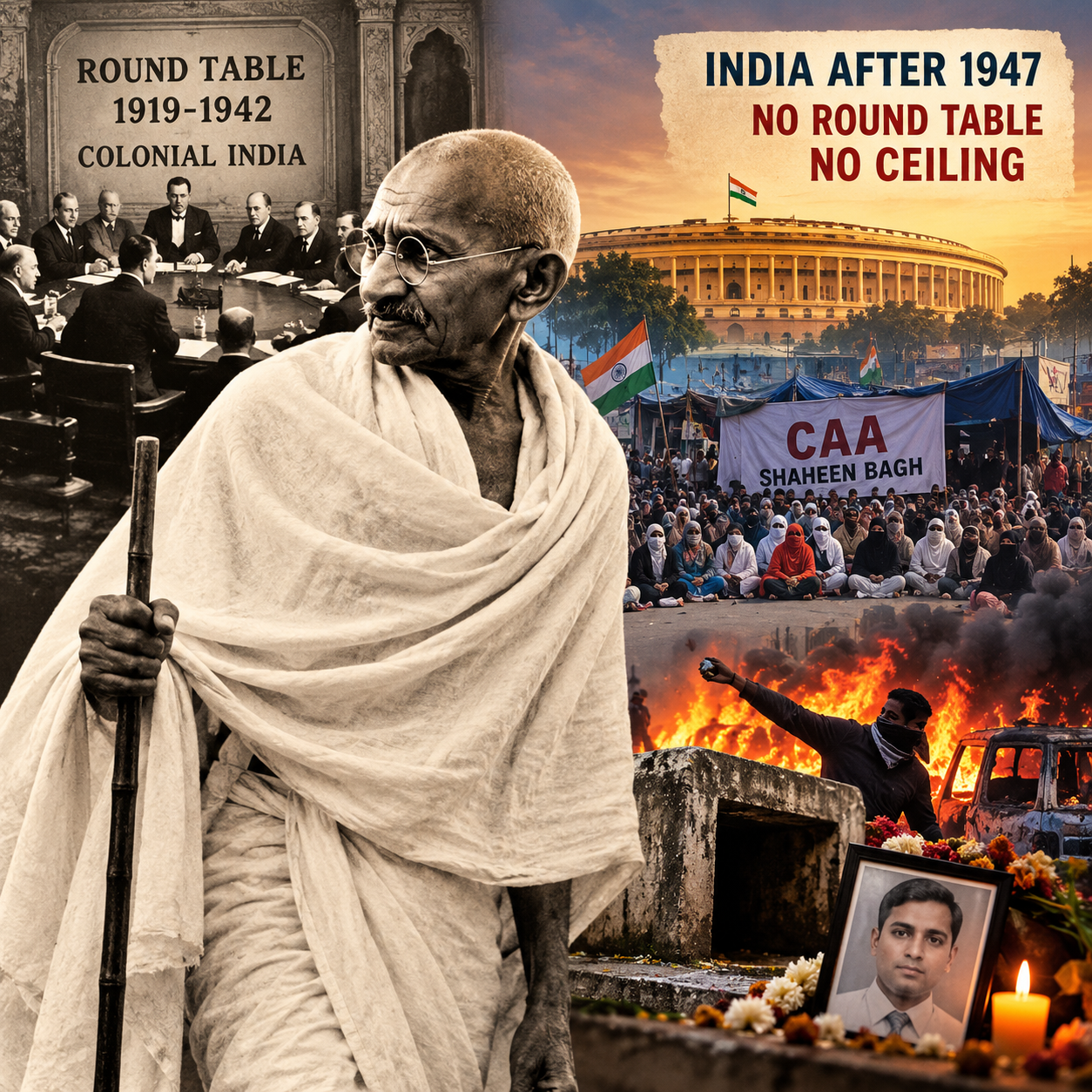
Blog 175 placed before the reader Gandhi’s untouchables abandoned ledger — the functional political category of persons whose suffering, sacrifice, or inconvenient stance could not be acknowledged without destroying the myth of the Mahatma, from Chauri Chaura to Sandeshkhali. Blog 174 established the macro architecture — the two keys Gandhi turned between 1919 and 1947, and what is still running seventy-six years after his death. This post, Gandhi’s Living Flood India, brings the prosecution’s record to the present. The method Gandhi demonstrated was demonstrated under one condition that no longer applies: the colonial ruler had institutional reasons to negotiate, offer Round Tables, and accept the Himalayan miscalculation as an exit. The Gandhi’s Living Flood India of the present runs against rulers who are Indian, elected, and accountable to the same population the method is deployed against. There is no Round Table. There is no Himalayan miscalculation. And there is no ceiling.
Thank you for reading this post, don't forget to subscribe!THE HISTORICAL RECORD — THE METHOD WITHOUT A CEILING
The Pattern: The method Gandhi demonstrated between 1919 and 1942 — spatial occupation, economic disruption, moral-authority shield, mass mobilisation through existing community networks — has been reproduced in independent India without interruption. The colonial condition under which the method operated contained a structural ceiling: British restraint, the Round Table exit, the Himalayan miscalculation available as a self-suspension mechanism. In post-Independence India, that ceiling is absent. The Gandhi’s Living Flood India is the prosecution’s name for what the method produces when the ceiling is removed.
The Lethal Exhibit: Ankit Sharma, an Intelligence Bureau official, was stabbed more than fifty times during the Delhi riots of February 2020 and thrown into a drain. Constable Ratan Lal was killed in the same events. The movement that preceded the riots had occupied arterial roads in Delhi for months, under judicial hesitation that treated an illegal blockade as an exercise of free speech. No leader of that movement announced a Himalayan miscalculation. No Bardoli Resolution was passed. The movement continued. The prosecution places this sequence before the reader as the defining exhibit of the method without a ceiling.
Why it matters: Gandhi suspended the Non-Cooperation Movement because a crowd burned a police station and killed twenty-two constables. The sequence is on the record: the crowd reacted to police firing; Gandhi called it a Himalayan miscalculation and suspended a national movement. In February 2020, an Intelligence Bureau official was stabbed more than fifty times and thrown into a drain. The prosecution places the two sequences side by side. The reader will complete the sentence.
The Missing Ceiling
The colonial condition contained a ceiling that the prosecution has documented across seven arcs of this series.
The ceiling operated as follows. Every mass mobilisation Gandhi led reached a point of maximum administrative pressure. At that point, one of three things happened: the colonial state offered a negotiated exit (the Gandhi-Irwin Pact, the Round Table Conference); Gandhi announced a suspension citing collective moral unreadiness (Rowlatt 1919, Non-Cooperation 1922); or the British administration arrested Gandhi and waited out the movement (Quit India 1942). In each case, the ceiling was real: the colonial state had institutional reasons to contain escalation, and Gandhi had a doctrinal mechanism — the Himalayan miscalculation — to suspend without surrender.
The Gandhi’s Living Flood India identifies what is absent in the contemporary reproduction of the method. The rulers are Indian and elected. They cannot offer a Round Table without political cost. They cannot arrest the movement’s leaders without generating international pressure from the fuel line the prosecution will identify below. And the movement’s leadership has no doctrinal mechanism for self-suspension — no Himalayan miscalculation, no Bardoli Resolution, no announced threshold at which retaliatory violence by their own side triggers withdrawal.
When Gandhi’s Non-Cooperation Movement produced the Chauri Chaura incident — a crowd, fired upon by police, burning a police station and killing twenty-two constables — Gandhi suspended the entire national movement within days. The Bardoli Resolution of February 11-12, 1922 is in the documented record. The suspension was Gandhi’s response to violence by his own side.
The prosecution places the contrast before the reader without elaboration. In February 2020, Ankit Sharma was stabbed more than fifty times and thrown into a drain. The documented record of what was done to him is on the record at this series’ own archive. No Bardoli Resolution followed. No Himalayan miscalculation was announced. The Gandhi’s Living Flood India is the prosecution’s name for what the method produces when the ceiling is gone and the doctrine of self-suspension has not been transferred along with the method.

Shaheen Bagh: The Structural Template
The Citizenship Amendment Act of 2019 fast-tracks citizenship for persecuted religious minorities — Hindus, Sikhs, Jains, Buddhists, Parsis, and Christians — from Pakistan, Bangladesh, and Afghanistan who arrived in India before December 31, 2014. It contains no provision to revoke or strip the citizenship of any Indian citizen.
The Shaheen Bagh occupation that followed did not challenge the Act in court, where its provisions are examinable on their text. It deployed the method: prolonged spatial occupation of an arterial road junction, women placed at the front as a moral shield, the stated cause tethered not to the Act’s text but to a hypothetical future National Register of Citizens framed as an existential disenfranchisement of Indian Muslims.
The structural parallel to Gandhi’s method is exact. The Non-Cooperation Movement marched on two platforms simultaneously—Hindus for Swaraj, Muslims for Caliphate—with the stated cause of each platform serving a different objective. The prosecution placed that record before the reader in Blog 46. Shaheen Bagh marched on one stated cause: opposition to the CAA. Meanwhile, the operative objective—as made explicit by the “now or never” rhetoric from political stages, declared by one of the most senior leaders of Congress in a rally days before the road was occupied—was the mass street veto: demonstrating that an elected government could be brought to a functional standstill through continuous spatial occupation.
The judiciary appointed interlocutors rather than ordering clearance of an illegal arterial blockade. The Supreme Court’s Amit Sahni judgment — that public places cannot be occupied indefinitely — came after the damage was done. The prosecution notes what the colonial judiciary never offered Gandhi: months of judicial hesitation that treated an illegal blockade as a protected exercise of free speech.
The Fuel Line
Gandhi’s Khilafat alliance had an external institutional backer: the Ottoman Caliphate restoration movement, organized from outside India with its own geopolitical architecture. The prosecution placed that structural fact before the reader in Blog 102. The alliance injected a foreign-backed cause into the Indian independence movement, with Gandhi’s own documented words placing Khilafat above Swaraj in his hierarchy of priorities. In return, the movement received what domestic resources alone could not provide: a readymade, transnational ideological network capable of instant mass mobilization.
The contemporary equivalent is the battle over the Foreign Contribution (Regulation) Act (FCRA). On paper, the FCRA merely regulates foreign funding to non-governmental organizations. When the Indian state tightened enforcement—cancelling the licenses of entities that diverted funds away from their declared charitable objectives—the international outcry was immediate, aggressive, and entirely out of proportion to a routine auditing measure.
Modern Parallel
Mass street occupations cannot sustain themselves for months on organic goodwill alone. A prolonged siege—like Shaheen Bagh or the highway blockades around the capital—requires a continuous supply line: round-the-clock logistics, rapid-response legal teams filing coordinated writs within hours, digital PR rooms feeding international wire services, and salaried activist cadres.
This apparatus cannot be assembled overnight when an agitation begins; it must be funded, housed, and staffed between agitations. Foreign capital, funneled through layers of philanthropic fronts, human rights consortiums, and foreign-backed foundations—including networks tied to George Soros and transnational evangelical federations—is what pays the retainer for this ecosystem during peacetime.
The inference is structural, not speculative:
-
The Peacetime Subsidy: Foreign capital sustains the legal, media, and activist cadre under the cover of “research,” “advocacy,” or “social welfare.”
-
The Wartime Mobilization: The moment a controversial reform or legislative bill is tabled, that same salaried network pivots into an agitational strike force to execute the street veto.
-
The Coercive Veto: The foreign funding pipeline ensures the movement never needs domestic popular consent to survive financially; it answers only to the external ledger that finances it.
The FCRA dispute is therefore not an administrative argument over receipts and ledgers. It is a sovereign struggle over the fuel line. In 1920, Gandhi allied with an external political cause to power a domestic movement, prioritizing that foreign alignment over Swaraj itself. Today, the modern machinery runs on external capital to build a domestic veto proofed against democratic elections. The method is Gandhi’s; the pipeline has simply been converted from foreign theology to foreign capital.
The Narrative Inversion
Gandhi’s response to the Moplah massacre of 1921 established an operational template documented across six blogs of this series. The template relies on three sequential moves:
- Acknowledge the violence in abstract, tragic terms to establish superficial objectivity.
- Dilute accountability by laundering the perpetrators into righteous or provoked actors.
- Redirect the primary guilt onto the state or the victims’ side for having created the “conditions” that provoked the outcome.
The prosecution named this Gandhi’s appeasement template in Blog 121. The Delhi riots of February 2020 executed this exact three-move inversion with contemporary institutional precision.
Consider the forensic ground reality: coordinated road blockades at Jaffrabad and Chand Bagh, rooftop slingshots, industrial-scale petrol bomb rigs, and the targeted killing of state personnel—Intelligence Bureau officer Ankit Sharma stabbed more than fifty times and dumped in a drain, and Head Constable Ratan Lal shot dead on duty.
The institutional response executed the three moves in order:
- Move 1: Acknowledge the Event, Strip the Specifics. In 1921, Gandhi acknowledged that violence had occurred in Malabar, but avoided detailing the forced conversions, temple desecrations, and slaughtered families. In 2020, global commentary acknowledged a “wave of violence” in Delhi, but stripped it of its ground reality—erasing the fallen security personnel, the Hindu casualties, and the documented weapons stockpiles, reducing multi-sided street warfare into a one-sided “anti-Muslim pogrom.”
- Move 2: Dilute Accountability. In 1921, Gandhi softened the brutality by characterizing the rioters as “brave, God-fearing Moplahs” who had acted out of religious zeal without proper instruction in non-violence. In 2020, the ecosystem sanitized the key conspirators—those organizing the blockades and managing logistical WhatsApp groups—as “peaceful student activists,” “human rights defenders,” and “civil society leaders exercising constitutional dissent.”
- Move 3: Redirect the Culpability. In 1921, Gandhi concluded that the real blame rested not with the perpetrators, but with the British government’s colonial repression and the systemic agrarian tensions caused by Hindu landlords. In 2020, the narrative apparatus redirected the entire culpability onto the state: the riots were framed as the inevitable outcome of the Citizenship Amendment Act itself, and when police filed chargesheets documenting the money trails and planning, the prosecution was branded a “state-sponsored witch-hunt.”
The template is identical. In 1921, a single charismatic figure used the moral prestige of non-violence to invert accountability for mass sectarian bloodshed. In 2020, an institutional matrix of digital media, international NGOs, and legal networks executed the same inversion at industrial scale. The mechanism has survived intact; it has simply acquired a larger transmission system.
The Adversary’s Applause
The prosecution’s inquiry extends beyond internal methods of street mobilization to their external geopolitical consequences.
The historical precedent is documented: Gandhi’s operational choices—postponing Swaraj to champion the Khilafat, or abruptly aborting national movements at moments of peak leverage—produced tangible geopolitical outcomes. The prosecution does not need to litigate private intent. It asks the reader to evaluate the objective consequences: when domestic national interests were subordinated to an external theological cause, it was the Pan-Islamic clergy and the British administration’s counter-balancing strategy that gained breathing room.
The contemporary parallel operates on the same functional principle. When domestic opposition strategies deploy rhetoric that directly mirrors the diplomatic dossiers of hostile foreign states, the convergence ceases to be theoretical:
- The Subcontinental Echo: Speeches and press statements originating from domestic political platforms disputing sovereign legislative acts have been adopted verbatim by Pakistani diplomats and state media to indict India at multilateral forums. When state officials in Islamabad publicly commend domestic opposition stances, that applause enters the documentary record as functional alignment, regardless of private intent.
- The Northern Border Standoff: Publicly echoing the narrative lines of Beijing during active border clashes along the Line of Actual Control—interrogating the operational reporting of the Indian military while accepting adversary communiqués—erodes national deterrence from within.
- Transnational Pressure Networks: Domestic agitational campaigns routinely interface with political factions abroad—such as elements within the Canadian government under Justin Trudeau—that grant diplomatic cover and institutional legitimacy to violent, anti-India separatist networks.
A political actor’s declared motivation, the concrete operational consequence of their rhetoric, and the geopolitical advantage gained by a hostile state are three distinct realities. When these three elements converge repeatedly across different crises, the pattern cannot be dismissed as accidental.
The forensic record settles the issue: neither an assertion of patriotic motive nor the public praise of a foreign adversary can rewrite what the actions delivered on the ground.
The Extraterritorial Appeal: Foreign Campuses and Supranational Oversight
When domestic street vetoes and electoral contests fail to produce the desired halt, the method expands its theater beyond India’s borders. The prosecution places before the reader the pattern of domestic political leaders taking the platform abroad — addressing elite Western universities, foreign media networks, and policy think tanks.
The substance of these international appearances follows a single trajectory: declaring that Indian democracy has structurally collapsed, that the judiciary and investigative agencies are compromised, and that the electoral process itself lacks legitimacy. The implicit and often explicit plea before Western audiences is for external diplomatic, academic, and economic pressure to discipline an elected Indian government.
This outward appeal is mirrored simultaneously from within domestic institutions. Sitting parliamentarians — such as Mahua Moitra during controversies surrounding regulatory investigations and expulsion proceedings — have directly appealed to international forums and invoked United Nations intervention against sovereign parliamentary and legal processes.
The structural parallel to Gandhi’s method remains unbroken: when domestic numbers in the legislature do not suffice, the actor appeals over the heads of the Indian population to outside arbiters. In the colonial era, Gandhi leveraged British liberal opinion and American press networks to constrain the administrative state. In independent India, modern political actors deploy foreign academic podiums and supranational appeals to delegitimize the very constitutional and electoral systems that gave them standing.
The Demand Behind the Demand
The prosecution has documented across this series a foundational operating rule: Gandhi’s stated objectives were systematically detached from his operative objectives. Swaraj was publicly deferred for Khilafat. The Round Table was declared as the exit from Civil Disobedience, but its operational purpose was preserving Gandhi’s monopoly as the sole negotiating voice for India. The switch mechanism was placed on the record in Blog 144.
The contemporary demand structure executes this identical double ledger across two distinct exhibits:
- Exhibit A: The NEET Agitation and the Education Ministry. When activist-litigation organizations like Cockroach Janata Party (CJP) and allied opposition fronts staged nationwide protests demanding the resignation of Union Education Minister Dharmendra Pradhan, the stated battle cry was student welfare, test integrity, and alleged paper leaks in the NEET examination. The administrative reality: exam administration is conducted by an autonomous testing agency, entirely outside the minister’s operational remit. The operative target lay in what the minister had overseen in the classroom: the systematic rationalisation of NCERT and CBSE history syllabi, which removed chapters glorifying the Mughal era and dismantled a subsidized ideological narrative. The administrative friction of an examination was seized as a convenient battering ram to punish the dismantling of curriculum hegemony.
- Exhibit B: The Demand for the CEC’s Resignation. The current theatre reproduces the exact same mechanic. The stated demand — opposition marches and memoranda calling for the immediate resignation of the Chief Election Commissioner under the banner of “electoral integrity” and roll revision — is staged right as Parliament prepares to debate statutory tightening of foreign funding regulations under the Foreign Contribution (Regulation) Act (FCRA). The stated crusade against an election umpire is the moral smokescreen; the operative imperative is paralyzing parliamentary proceedings to stall the legislative choking of the external funding fuel line.
In both instances, the method remains unbroken:
- Manufacture an emotive public front (student futures or democratic elections) to mobilize street outrage.
- Direct the assault against an institutional figure who has no operational control over the stated grievance.
- Execute the real, unstated objective: protecting ideological dominance in the classroom and shielding foreign funding networks from sovereign legislative scrutiny.
The stated cause is the battering ram. The operative cause is the preservation of narrative and capital. The method is Gandhi’s. The ceiling is missing.

The Prosecution’s Position
The Gandhi living flood India places three questions before the reader. Each concerns the same proposition: that the method Gandhi demonstrated between 1919 and 1942 is running in independent India without the structural ceiling that contained it under colonial rule.
- Does the sequence — Shaheen Bagh occupation, judicial hesitation, Jaffrabad blockade replication, Delhi riots of February 2020, Ankit Sharma stabbed more than fifty times — constitute an exhibit the reader places alongside Gandhi’s suspension of the Non-Cooperation Movement after Chauri Chaura killed twenty-two constables, and the absence of any equivalent self-suspension in 2020?
- Does the FCRA dispute — foreign funding of mass movement infrastructure in independent India, international anxiety at its regulation, the organisational ecosystem that keeps the method running between deployments — constitute an exhibit the reader places alongside Gandhi’s Khilafat alliance with a foreign-backed religious cause placed by Gandhi’s own documented statement above Indian independence?
- Does the adversary’s applause — documented instances where Pakistani authorities or public figures praised domestic Indian opposition statements, where Chinese official narratives were echoed in domestic political positioning during active border standoffs, and where Canadian political factions under the Trudeau government provided institutional cover to separatist anti-India networks — constitute an exhibit the reader places alongside Gandhi’s postponement of Swaraj in favour of a foreign-backed Islamic restoration cause, and the question of whose interests were practically served by the consequences of that postponement?
- Does the demand behind the demand — the stated cause of electoral integrity masking the operative cause of curriculum control — constitute an exhibit the reader places alongside Gandhi’s documented pattern of stated objectives distinct from operative objectives, across thirty years and three suspended movements?
The series does not answer. The Gandhi living flood India places the method before the reader — demonstrated in 1919, running in 2024, without a ceiling, without a Bardoli Resolution, without a Himalayan miscalculation available to those who inherited the instrument but not the doctrine. The reader will place the downstream record before the claim that Gandhi’s method and its contemporary reproductions are unconnected — and complete the sentence.
Invitation To Defence
The floor belongs to the defense. We now invite them to present their exhibits and challenge the narrative established by the prosecution.
Gandhi suspended the Non-Cooperation Movement after Chauri Chaura — a crowd burned a police station and killed twenty-two constables. In February 2020, an Intelligence Bureau official was stabbed more than fifty times and thrown into a drain. No Bardoli Resolution followed. Gandhi allied with the Khilafat movement — a foreign-backed religious cause he placed above Indian independence. The FCRA dispute concerns foreign funding of the infrastructure that keeps the same structural mechanism running in independent India. Gandhi’s stated objectives were regularly distinct from his operative objectives. The demand for the Chief Election Commissioner’s resignation concerns curriculum, not elections. The Gandhi living flood India places the method before the reader — the ceiling is missing, the fuel line is documented, the template is running. The reader will complete the sentence.
Feature Image: Click here to view the image.
Videos
Glossary of Terms
- Gandhi’s Living Flood India: A distinctive phrase coined in the blog to describe the continuing reproduction of Gandhi’s political methods in independent India, without the institutional restraints that the author argues existed under colonial rule.
- Method Without a Ceiling: The blog’s central concept describing mass mobilization, road occupation, economic disruption, and appeals to moral authority operating without a clear mechanism for suspension or negotiated withdrawal.
- Structural Ceiling: The institutional limits that, according to the blog, constrained mass movements under British rule through negotiations, movement suspensions, or arrests.
- Himalayan Miscalculation: Gandhi’s expression for a grave error in judgment, used in the blog to explain his decision to suspend the Non-Cooperation Movement after the Chauri Chaura violence.
- Bardoli Resolution: The resolution of February eleven to twelve, nineteen twenty-two, associated with the suspension of the Non-Cooperation Movement following the Chauri Chaura incident.
- Non-Cooperation Movement: Gandhi-led mass movement launched in nineteen twenty to oppose British rule through non-cooperation with colonial institutions; it was suspended in nineteen twenty-two.
- Round Table Conference: A series of conferences convened by the British government to discuss constitutional reforms in India, representing a negotiated political avenue during the colonial period.
- Shaheen Bagh Occupation: The prolonged protest against the Citizenship Amendment Act at Shaheen Bagh, Delhi, which the blog examines as an example of sustained occupation of public roads to exert political pressure.
- Citizenship Amendment Act (CAA): India’s twenty nineteen law providing an expedited citizenship pathway for specified religious minorities from Afghanistan, Bangladesh, and Pakistan who entered India before the statutory cutoff date.
- Foreign Contribution (Regulation) Act (FCRA): Indian legislation regulating foreign contributions received by individuals and organizations, including non-governmental organizations.
- Fuel Line: A metaphor used in the blog for the financial and organizational support that allegedly sustains protest infrastructure, activist networks, legal teams, and media operations between mass mobilizations.
- Narrative Inversion: The process described in the blog in which violence is acknowledged, responsibility for perpetrators is diluted, and blame is redirected toward the state or the opposing side.
- Coercive Veto: The blog’s term for using prolonged street mobilization and disruption to pressure an elected government into halting or altering its decisions outside ordinary electoral processes.
- Demand Behind the Demand: A phrase describing the distinction between a publicly stated grievance and the underlying political objective that the blog argues may motivate a campaign.
- Extraterritorial Appeal: The practice discussed in the blog of taking domestic political disputes to foreign universities, media organizations, policy institutions, or international bodies to seek external pressure on India’s government.
#Gandhi #IndianHistory #IndianPolitics #India #ShaheenBagh #CAA #FCRA #Democracy #Politics #HinduinfoPedia