
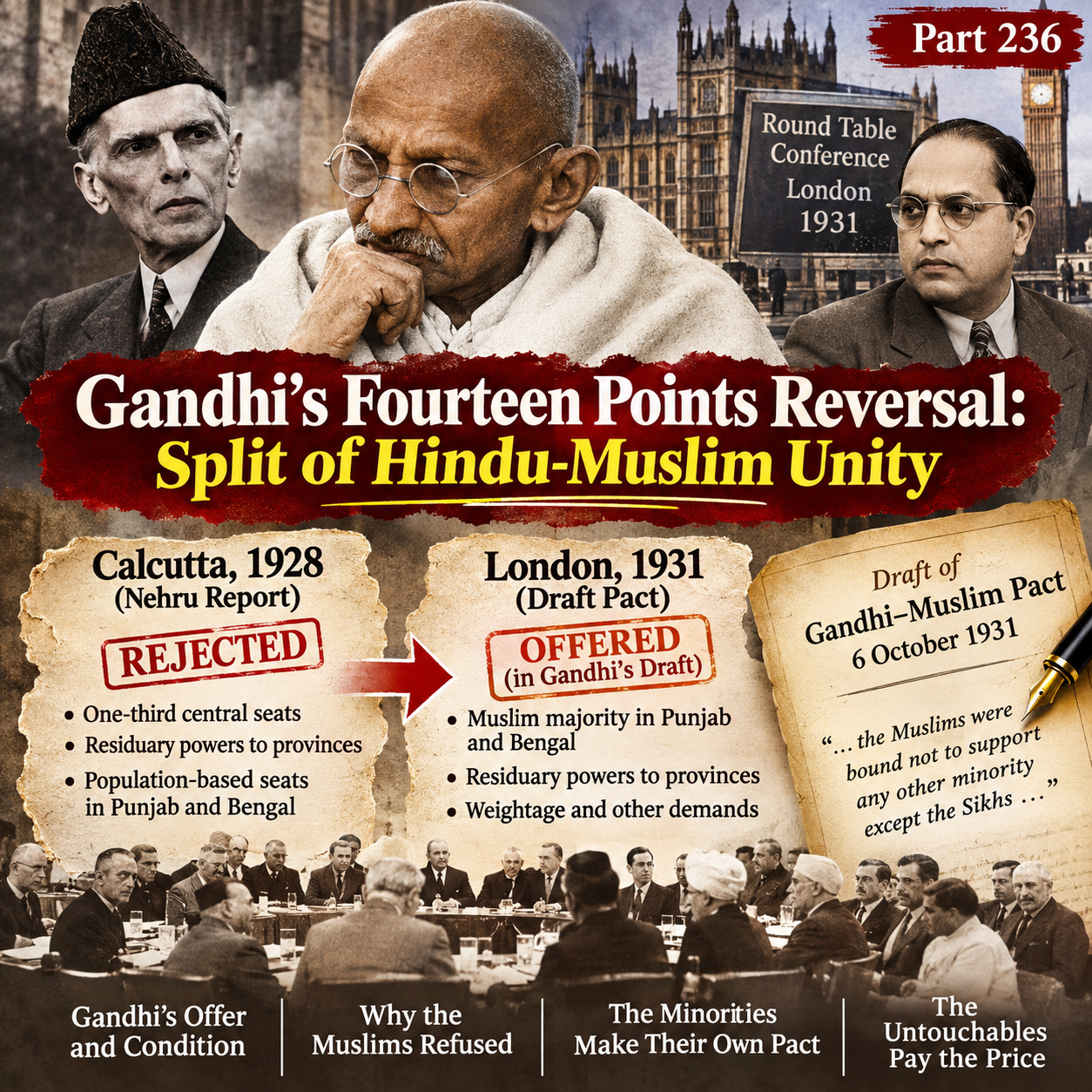
Gandhi’s Fourteen Points Reversal: Split of Hindu-Muslim Unity (236)
भारत / GB
Part 236: Mahatma Gandhi’s Peace Efforts (Residue Enters Constitution) | Series Index
Blog 235 covered Gandhi at the Second Round Table Conference in London. He said the Congress represented over 85 per cent of Indians and all the minorities. The Muslim, Depressed Classes, Sikh and Christian delegates made their own demands. This blog covers what Gandhi offered the Muslim delegation in October 1931, what he asked in return, and what the minorities did next.
Thank you for reading this post, don't forget to subscribe!THE OCTOBER–NOVEMBER 1931 RECORD
The Action Taken: In December 1928 the Calcutta convention rejected Jinnah’s Muslim demands. In October 1931, in London, Gandhi discussed a draft pact with the Muslim delegation. Ambedkar printed the draft. By his account, Gandhi agreed to the Muslims’ Fourteen Points on one condition: that the Muslims stop supporting the Untouchables’ claims.
Who Paid the Price: The Depressed Classes. The offer was made at their cost. The Muslims refused it. Instead, the Muslims, the Depressed Classes, the Christians, the Anglo-Indians and the Europeans signed their own pact without the Congress.
Why This Matters: Demands refused at home in 1928 were offered in London in 1931 to the delegation that had stayed out of the Congress, and the price was to be paid by a third party.
1. What Was Refused in 1928
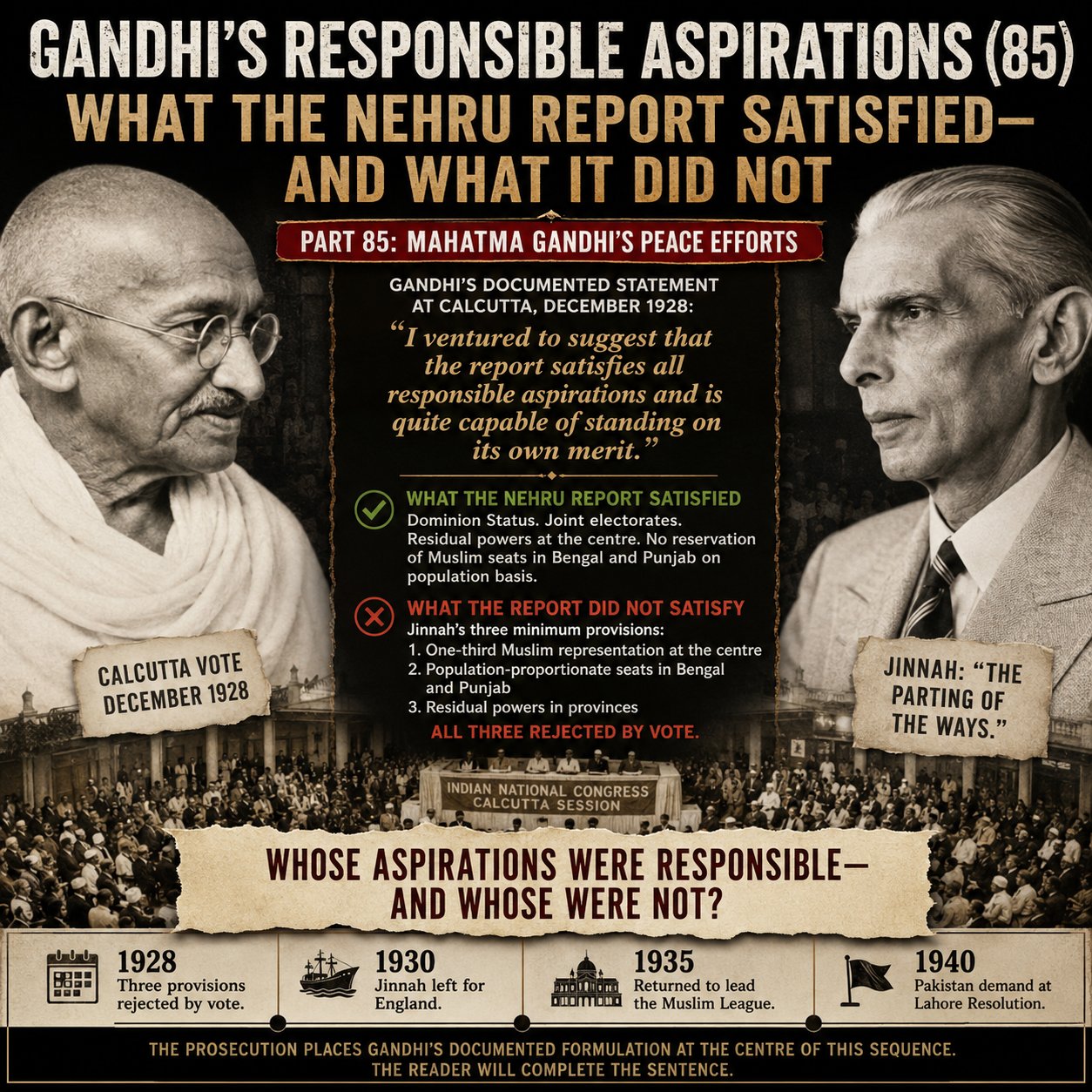
In December 1928 the All Parties Convention met at Calcutta to approve the Nehru Report. Jinnah moved amendments on behalf of the Muslim League. He asked for:
- One-third of the seats in the central legislature for Muslims
- Residuary powers to go to the provinces, not the centre
- Seats in the Punjab and Bengal to be reserved on the basis of population
The convention rejected the amendments. This is covered in Blogs 83 and 84.
In March 1929 Jinnah put the Muslim demands into his Fourteen Points. They kept separate electorates. They also asked again for one-third of central seats, residuary powers to the provinces, and the separation of Sind from Bombay.
Gandhi’s Fourteen Points Reversal begins here: the very demands the Congress side rejected at home in 1928, Gandhi agreed to concede in London in 1931 — on the condition that the Muslim delegation sever its relationship with Dr. Ambedkar’s group.
2. Gandhi Meets the Muslim Delegation
The Minorities Committee met in London on 28 September 1931. It adjourned to allow private talks.
On 1 October Gandhi met the Aga Khan and other Muslim leaders at the Ritz Hotel. The same day he asked the Minorities Committee to adjourn for another week. The talks went on for several nights.
By then the Muslims and the other minorities had begun to work together. According to Ambedkar, the other minorities, including the Muslims, had agreed to back the Depressed Classes’ claims.
3. The Draft of 6 October 1931
Ambedkar printed a document headed “Draft of Gandhi–Muslim Pact”, dated 6 October 1931. It said the proposals had been discussed by Gandhi and the Muslim delegation at 10 p.m. the night before, and were given “as approved by Mr. Gandhi”.
The draft set the Muslim proposals beside Gandhi’s. Its main points were:
- A Muslim majority in the Punjab and Bengal, with the Muslim voters to decide later between joint and separate electorates
- The existing extra seats (weightage) for Muslims in provinces where they were a minority
- Residuary powers to the provinces
- Agreed points on Sind, the North-West Frontier Province, the services and the Cabinet
- On Gandhi’s side: adult suffrage, no special seats for any community except the Sikhs and the Hindu minorities, and the Congress demands for complete independence
- The Muslims were bound not to support any other minority except the Sikhs
The draft did not mention the Untouchables. But the last point meant the Muslims would have to drop their support for them.
Ambedkar’s summary was direct: Gandhi “agreed to them their fourteen points on condition that they withdrew their support from the Untouchables.”
This is the centre of Gandhi’s Fourteen Points Reversal. The residuary powers and the Punjab and Bengal seats refused at Calcutta were now in a draft approved by Gandhi. The condition was that the Depressed Classes be left without Muslim support.
4. The Muslims Said No
The draft did not become a pact. According to Ambedkar, the plan failed because “the Musalmans refused to disgrace themselves by joining in it.”
The table below sets out Gandhi’s Fourteen Points Reversal, 1928 beside 1931.
| Point | Calcutta, December 1928 | London, October 1931 |
|---|---|---|
| Residuary powers to the provinces | Rejected | In the draft approved by Gandhi |
| Muslim seats in the Punjab and Bengal | Rejected | A Muslim majority in the draft |
| Separate electorates | Not asked at Calcutta; kept in the Fourteen Points (1929) | Left to a later vote of Muslim voters |
| Who the Muslims could support | No condition | Only the Sikhs; not the Untouchables |
| Outcome | Muslim League walked away | Muslim delegation refused |
5. “Utter Failure”: 8 October 1931
The Minorities Committee met again on 8 October. Gandhi opened by saying: “it is with deep sorrow and deeper humiliation that I have to announce utter failure” to reach an agreed solution.
He blamed the make-up of the Indian delegation, which the British had chosen. He proposed that the Minorities Committee be adjourned sine die, that is, with no date to meet again.
Ambedkar objected at once: “I, for one, cannot consent to this proposition.” The committee did not close. The minorities went on talking among themselves.
So the failure Gandhi announced was the failure of his own talks with the Muslims. It was not the end of talks among the minorities. That is part of Gandhi’s Fourteen Points Reversal: when his offer failed, he tried to close the committee.
6. The Minorities Make Their Own Pact
6. The Minorities Make Their Own Pact
On 13 November 1931 the Minorities Committee met for the last time. The Aga Khan handed the Prime Minister an agreement. It is known as the Minorities Pact. It was agreed by:
- The Aga Khan, for the Muslims
- Dr. B.R. Ambedkar, for the Depressed Classes
- Rao Bahadur Pannir Selvam, for the Indian Christians
- Sir Henry Gidney, for the Anglo-Indians
- Sir Hubert Carr, for the Europeans
The Sikhs did not join. The Spectator noted that the representatives of 46 per cent of India’s population were now united.
The pact was made without the Congress. It was not a failure to agree. The minorities did agree, with each other. What failed was Gandhi’s offer — and his claim that the Congress represented 85 per cent of India and that he was the sole representative of all Indians.
7. Gandhi’s Reply on 13 November
Gandhi spoke against the pact the same day. Ambedkar printed his words:
- He called the Untouchables’ claim the “unkindest cut of all”.
- “I claim myself in my own person to represent the vast mass of the Untouchables.”
- “I would far rather that Hinduism died than that Untouchability lived.”
- “If I was the only person to resist this thing I would resist it with my life.”
- “Congress will always accept any solution that may be acceptable to the Hindus, the Mohammedans and the Sikhs, Congress will be no party to the special electorates for any other minorities.”
The last line sums up Gandhi’s Fourteen Points Reversal. Special electorates were open for the Muslims and the Sikhs. They were closed for the Untouchables. In October Gandhi had tried to buy Muslim agreement by asking the Muslims to drop the Untouchables. In November he said he would resist the Untouchables’ claim with his life. What he did with that promise in 1932 is covered later in this series.
Prosecution’s Position
The prosecution does not claim that Gandhi signed a pact with the Muslims; the draft of 6 October 1931 never became one. It places on the record that the residuary powers and the Punjab and Bengal seats refused at Calcutta in 1928 appeared in a draft that, by its own heading, Gandhi approved in London in 1931; that the draft bound the Muslims not to support any minority except the Sikhs; that Ambedkar recorded the offer as the Fourteen Points in return for dropping the Untouchables; that when the Muslims refused, Gandhi announced “utter failure” and proposed closing the committee; and that when the minorities made their own pact, he said the Congress would accept special electorates for Muslims and Sikhs but would resist them for the Untouchables with his life.
Invitation To Defence
The Calcutta rejection of December 1928, the Fourteen Points of March 1929, the Draft of Gandhi–Muslim Pact of 6 October 1931 as printed by Ambedkar, Gandhi’s statement of 8 October 1931, the Minorities Pact of 13 November 1931 and Gandhi’s speech of the same day are established exhibits. The defence is invited to produce any Congress or Gandhi document showing that the clause binding the Muslims “not to support any other minority except the Sikhs” was not part of what Gandhi approved, or any offer Gandhi made in London to the Depressed Classes that matched what he offered the Muslims.
At Calcutta in 1928 the Muslim demands were refused. In London in 1931 Gandhi discussed a draft that met them, on condition that the Muslims drop the Untouchables. The Muslims refused. The minorities then made their own pact. Gandhi replied that the Congress would accept special electorates for Muslims and Sikhs, but would resist them for the Untouchables with his life.
Feature Image: Click here to view the image.
Videos
Glossary of Terms
1. Gandhi’s Fourteen Points Reversal: A phrase coined in this blog to describe the contrast between the rejection of Jinnah’s Muslim demands at Calcutta in 1928 and Gandhi’s subsequent discussion of similar demands in the proposed London draft pact of October 1931.
2. Fourteen Points: The constitutional demands presented by Muhammad Ali Jinnah in March 1929, including separate electorates, one-third Muslim representation in the central legislature and provincial residuary powers.
3. Nehru Report: The 1928 constitutional proposal prepared under Motilal Nehru’s chairmanship, which became the subject of debate at the All Parties Convention in Calcutta.
4. All Parties Convention: The December 1928 political gathering in Calcutta convened to consider the Nehru Report, where Jinnah’s proposed amendments concerning Muslim representation were rejected.
5. Residuary Powers: Legislative powers over subjects not specifically assigned to the central or provincial governments. Jinnah demanded that these powers remain with the provinces.
6. Weightage: Additional legislative representation granted to a community beyond what its population share would ordinarily provide, particularly in provinces where Muslims were a minority.
7. Separate Electorates: An electoral arrangement under which members of a particular community elect representatives from their own designated electorate.
8. Minorities Committee: A committee of the Second Round Table Conference responsible for discussing minority representation and constitutional safeguards in India.
9. Draft of Gandhi–Muslim Pact: A document dated 6 October 1931, printed by Dr. B.R. Ambedkar, recording proposals discussed between Gandhi and the Muslim delegation, including the condition concerning Muslim support for other minorities.
10. Depressed Classes: The historical administrative and political designation used for communities subjected to untouchability and social exclusion, represented by Dr. B.R. Ambedkar during the constitutional negotiations.
11. Untouchables: A historical term used in the period’s political discourse for communities subjected to the practice of untouchability. In this blog, it refers to the Depressed Classes and their demand for political safeguards.
12. Minorities Pact: The agreement presented to the British Prime Minister on 13 November 1931 by representatives of Muslims, Depressed Classes, Indian Christians, Anglo-Indians and Europeans, without Congress participation.
13. Adult Suffrage: An electoral principle under which adult citizens are entitled to vote, subject to the applicable constitutional provisions.
14. Sine Die: A Latin expression meaning that a meeting or proceeding is adjourned indefinitely, without fixing a date for its resumption.
15. Prosecution’s Position: The evidentiary argument presented in this blog, examining the 1928 rejection, the 1931 draft pact, the condition concerning minority support and Gandhi’s subsequent response to the Minorities Pact.
#Gandhi #Ambedkar #Jinnah #IndianHistory #Congress #Constitution #Minorities #RoundTableConference #HinduinfoPedia
Scan Through The Entire Series at