
Gandhi’s Khilafat Bomb Architecture — Unfolded (187)
भारत / GB
Part 187: Mahatma Gandhi’s Peace Efforts | Series Index
The previous blog placed before the reader what Gandhi knew — in his own signed, dated words — as the apparatus was operating: his description of the Moplah fighters as “brave God-fearing” men as they were killing unarmed Hindus, converting women and men at sword-point, and destroying temples; his January 1922 acknowledgment that Hindus had died and the programme continued; his own public distinction between policy and creed proving he understood the theological framework he allied with; and Shraddhanand’s inside witness account of the Dar-ul-Harb language used in Congress sessions in Gandhi’s presence. Gandhi’s Khilafat bomb architecture — unfolded — now opens the hood of the machine itself: the theological engine, the live operational proof, the extraterritorial sovereign claim, and the parallel state apparatus Gandhi placed at the centre of Indian national politics between 1919 and 1922.
Thank you for reading this post, don't forget to subscribe!THE HISTORICAL RECORD — GANDHI’S KHILAFAT BOMB ARCHITECTURE UNFOLDED
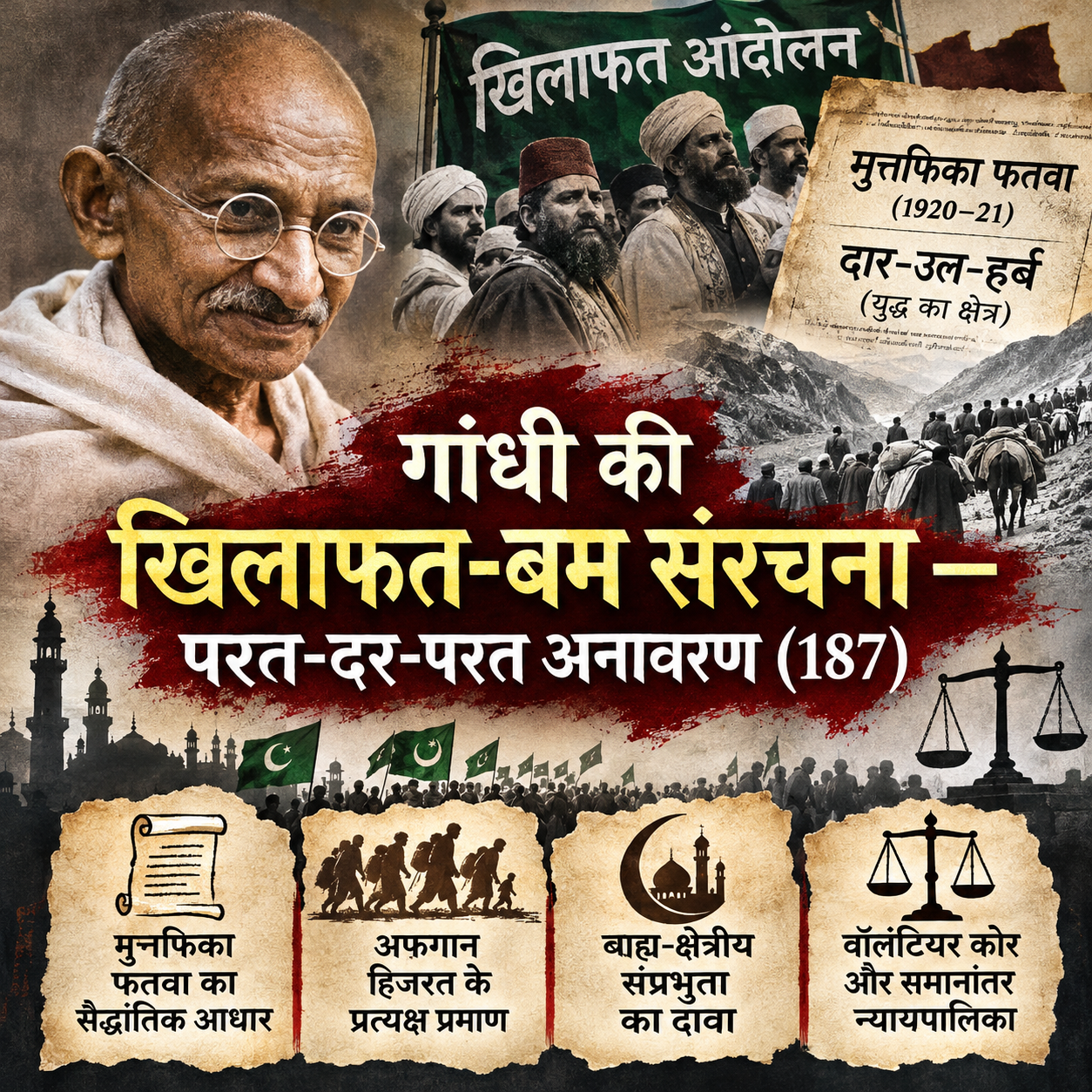
The Pattern: The Khilafat movement was not a civil rights auxiliary, an anti-imperialist trade union, or a religious pressure group seeking toleration under colonial law. It was an explicit theological mobilisation premised on extraterritorial sovereignty, the restoration of the Caliph’s temporal dominion over Muslim lands, and the juridical classification of British India as Dar-ul-Harb — the Abode of War. Gandhi did not borrow a neutral megaphone. He harnessed an apparatus whose core doctrines made constitutional secular democracy structurally impossible. Gandhi’s Khilafat bomb architecture — unfolded — places four exhibits before the reader: the doctrinal foundation in the Mutafiqa Fatwa; the live operational proof in the Afghan Hijrat catastrophe; the extraterritorial sovereign claim in the Khilafat Manifesto and public declarations; and the parallel state apparatus in the Khilafat Volunteer Corps and the shadow judiciary.
The Lethal Exhibit: Between May and August 1920 — while Gandhi was touring the country assuring Hindu audiences that Khilafat was a campaign for “righteousness” and “inter-communal honour” — an estimated 40,000 to 60,000 Indian Muslim peasants liquidated their ancestral lands and livestock at distress prices and crossed the Khyber Pass into Afghanistan, acting on the Dar-ul-Harb doctrine as a live religious obligation. Amir Amanullah Khan closed the Afghan border and turned them back under armed guard. Thousands died of starvation, disease, and exposure along the pass. The survivors returned destitute, dispossessed, and structurally radicalised. The Hijrat is not a metaphor. It is physical, documented proof that the apparatus Gandhi had placed at the centre of the national movement was operationally live in 1920 — one year before Malabar.
Why it matters: The prosecution does not charge Gandhi with designing the theological engine. It charges him with harnessing it — knowing its doctrinal basis, knowing its operational capacity, and providing it with national legitimacy, Hindu financial support, and Congress endorsement while its ulema preached Tark-e-Mawalat as a Shariat obligation in every mosque the apparatus reached. The reader is placed before the machine’s specifications to decide what the engineer who fires a boiler is responsible for when the explosion follows.
Exhibit One: The Doctrinal Foundation — The Mutafiqa Fatwa and Dar-ul-Harb
The theological engine of the Khilafat apparatus rested on a formal legal classification. Under Islamic jurisprudence, a territory governed by non-Muslim authority in which Muslims cannot freely practise their faith is classified as Dar-ul-Harb — the Abode of War. The classification is not merely descriptive; it is juridically operational. It triggers mandatory obligations: the duty to resist the ruling authority, to sever association with it, and — where emigration or armed resistance are constrained — to execute Tark-e-Mawalat, the severing of all cooperative ties with the inimical power.
The Mutafiqa Fatwa — the Consensus Decree of 1920–21 — formalised this classification for British India. The reader will note what “British India” meant in 1920: not a few thousand colonial administrators in Calcutta and Delhi, but a subcontinent of approximately 315 million people — Hindus, Muslims, Sikhs, Christians, and others — sharing the same land, the same villages, the same markets, the same wells. The Fatwa classified that land and its entire population as the Abode of War. Drafted under the authority of Maulana Abdul Bari of Firangi Mahal and signed by hundreds of leading Sunni ulema across the subcontinent under the Jamiat Ulema-e-Hind, the Fatwa issued three operative rulings: first, that British India — the land and all who lived on it — constituted Dar-ul-Harb; second, that Muslim service in the British Indian Army, police, and civil administration was haram — religiously prohibited; third, that Tark-e-Mawalat was an obligation incumbent on every Muslim in British India, not an elective political tactic.
The prosecution places the parallel texts before the reader. On the Congress floor, Gandhi translated Tark-e-Mawalat into the secular English idiom of “Non-Cooperation” — a constitutional programme of progressive institutional withdrawal. In the mosques the apparatus controlled, the ulema were preaching the identical stages as a mandatory Shariat decree carrying the authority of signed scholars. The engine did not run on satyagraha. It ran on religious obligation. Gandhi’s Khilafat bomb architecture — unfolded — places the Mutafiqa Fatwa before the reader as Exhibit One: the same programme, two languages, two audiences, one machine.
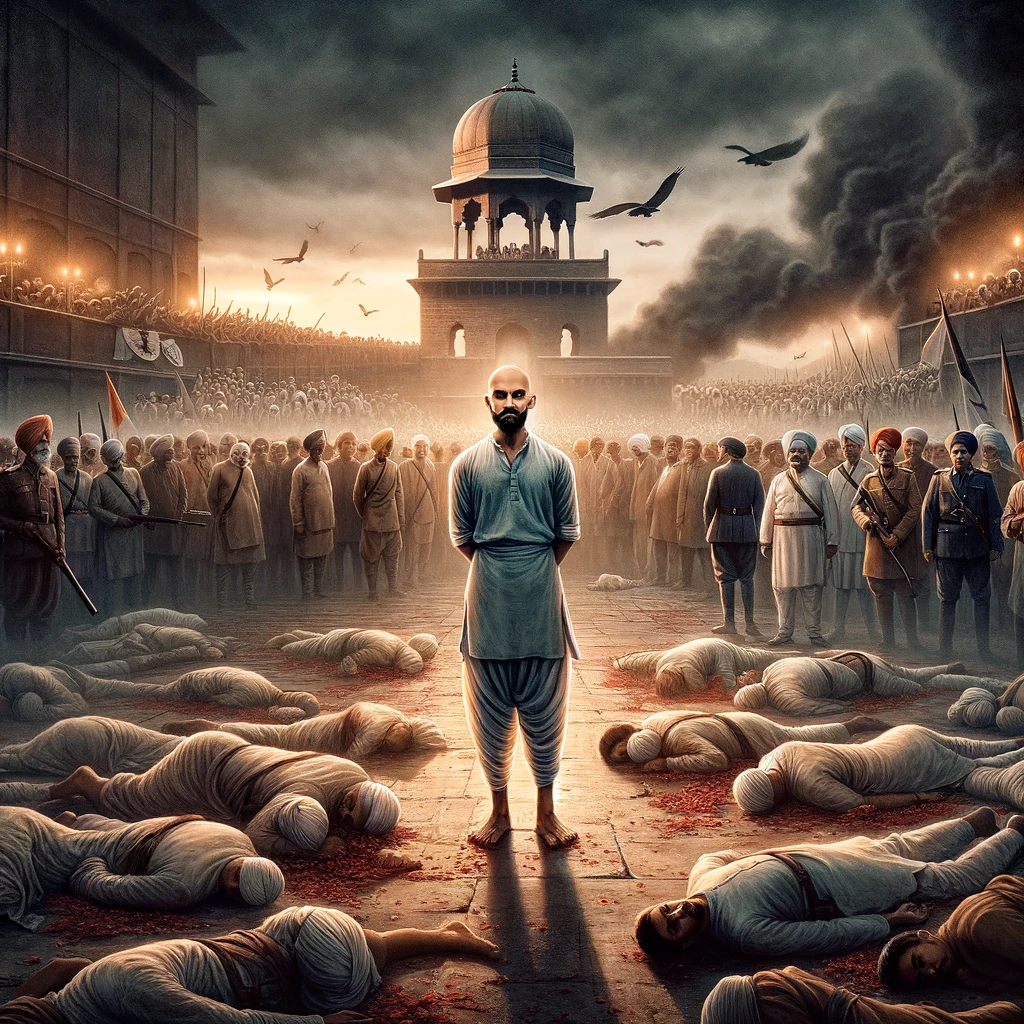
Exhibit Two: The Live Operational Proof — The Afghan Hijrat Catastrophe (1920)
A doctrine is tested by what it produces when believed. In the summer of 1920, the Dar-ul-Harb classification produced the Hijrat.
Maulana Abul Kalam Azad and Maulana Abdul Bari issued proclamations in early 1920 declaring emigration a religious obligation while the Dar-ul-Harb classification was operative. The operational result is documented in British Intelligence Reports compiled by H.D. Craik and P.C. Bamford in the Home Political Files of 1920–21. Between May and August 1920, an estimated 40,000 to 60,000 Indian Muslim peasants — predominantly from Sindh and the North-West Frontier Province — liquidated their property and ancestral lands at ruinous distress prices and crossed the Khyber Pass on foot, heading for Afghanistan.
Amir Amanullah Khan closed the Afghan border. Thousands died of starvation, disease, and exposure along the passes. The survivors returned destitute, dispossessed, and structurally radicalised — having acted on a religious obligation that the secular Congress press had simultaneously described as a mere political strategy.
The prosecution places the Hijrat before the reader as Exhibit Two not as an indictment of its victims, but as forensic proof of the apparatus’s operational capacity. In 1920, before Malabar, before the Deobandi pulpits had reached Ernad — the apparatus Gandhi had harnessed was already capable of detonating mass civilian populations across an entire region on the authority of a theological classification. Gandhi’s Khilafat bomb architecture — unfolded — places the Hijrat before the reader: 50,000 people dispossessed and hundreds dead, one year before Malabar, on the same doctrinal foundation.
Exhibit Three: The Extraterritorial Sovereign Claim
The Khilafat Manifesto presented to Viceroy Chelmsford in January 1920 stated its demand with precision: the Jaziratul-Arab — the Arabian Peninsula, Mesopotamia, Syria, and Palestine — must remain under exclusive Islamic sovereignty and the Caliph’s direct military custody. The demand was not addressed to the Indian political settlement. It was addressed to the post-war territorial disposition of the Ottoman Empire — a sovereign question 3,000 miles from the Punjab.
Gandhi endorsed this demand without reservation and placed the Indian National Congress behind it. In doing so, he subordinated the domestic political interests of India’s 330 million people to an Ottoman territorial settlement whose outcome no Indian institution had the power to influence, and whose failure — structurally inevitable given Britain’s post-war commitments — would leave the apparatus’s mass constituency radicalised without an objective.
The recorded statements of Khilafat leaders during 1921 place a further exhibit on record. Shaukat Ali and Abdul Bari made declarations regarding the eventuality of an Afghan invasion of British India. Their position, documented in the political records of 1921 and debated across the Indian press, was unambiguous: should the Amir of Afghanistan invade British India to liberate it from non-Muslim rule, it would be the religious duty of Indian Muslims to assist the invading army. Not to remain neutral. Not to protect civilian lives. To assist the invasion.
Gandhi’s Khilafat bomb architecture — unfolded — places this exhibit before the reader alongside the question: a leader who publicly endorsed the apparatus that produced this recorded position, who provided it with Congress legitimacy and Hindu financial contributions, and who described its leaders as men of “righteousness” — what did that leader understand the apparatus to be?
Exhibit Four: The Parallel State Apparatus
The Khilafat movement did not operate as a political party within the Indian constitutional framework. It operated as a parallel state.
The Central Khilafat Committee’s constitution and the Khilafat Volunteer Corps regulations — documented in the Khilafat Akali intelligence summaries of 1920–21 compiled by British provincial intelligence — describe an organisation with four operational components that replicated state functions outside any colonial or constitutional accountability.
The Treasury
The Khilafat Fund, financed primarily by Bombay merchant cartels under Seth Chotani, collected lakhs of rupees outside any Congress audit mechanism. The fund financed the Ali Brothers’ agitation tours, the chartering of special trains to Congress sessions, the maintenance of the Volunteer Corps, and the distribution of Khilafat literature across the subcontinent. It operated as an independent exchequer answerable to the Central Khilafat Committee, not to the Congress Working Committee.
The Uniformed Cadre
The Khilafat Volunteer Corps was organised into battalions with a defined command structure. Volunteers drilled in uniform, wore green armbands, carried lathis and ceremonial swords, and reported to district Khilafat committees rather than to provincial Congress bodies. In Malabar, this cadre became the organisational skeleton of the 1921 uprising — the same men who had drilled under green armbands became the commanders of the Khilafat Raj’s administrative zones.
The Parallel Judiciary
Local Shariat panchayats were established across the apparatus’s operational territory to adjudicate disputes outside colonial courts. The panchayats answered to clerics rather than municipal boards, applied Islamic personal law without reference to colonial statute, and operated as proto-judicial institutions that habituated their constituencies to the concept of a separate legal sovereignty operating beneath the surface of colonial administration.
The Clerical Communication Network
The Firangi Mahal ulema network, activated by Maulana Abdul Bari’s alliance with Gandhi in April 1919, provided the apparatus with a pre-existing communication infrastructure that penetrated every mosque, madrasa, and Friday congregation across the United Provinces, Punjab, and eventually the Malabar coast. This network carried the Dar-ul-Harb classification, the Tark-e-Mawalat obligation, and the Khilafat Raj proclamations with a speed and reach that no Congress provincial committee could match.
Gandhi’s Khilafat bomb architecture — unfolded — places this parallel state before the reader as Exhibit Four. The question is not whether Gandhi designed these institutions. He did not. The question is whether a leader who placed the Congress behind an organisation that operated its own treasury, its own uniformed cadre, its own judiciary, and its own clerical communication network — while assuring the country that he was leading a movement of constitutional non-violence — can be said to have been unaware of what he had harnessed.
The Prosecution’s Position
Three questions now stand before the reader.
- Does the primary record of the Mutafiqa Fatwa — hundreds of ulema signing a decree that classified British India as Dar-ul-Harb, prohibited Muslim civil and military service as haram, and mandated Tark-e-Mawalat as a Shariat obligation — constitute an exhibit the reader places alongside the claim that Non-Cooperation was born of Gandhian ethics rather than Islamic jurisprudence?
- Does the documented displacement of 40,000 to 60,000 peasants in the summer of 1920 — acting on the Dar-ul-Harb doctrine as a live religious obligation, dying in the Khyber passes, returning destitute and radicalised, one year before Malabar — constitute an exhibit the reader places alongside the claim that the Khilafat apparatus’s violence was unforeseeable?
- Does the fact that Gandhi provided national legitimacy, Hindu financial contributions, and Congress endorsement to a movement that operated its own treasury, its own uniformed cadre, its own shadow judiciary, and openly proclaimed loyalty to an extraterritorial Caliphate — and that he did all this having been warned at Nagpur in December 1920, and having watched the Hijrat destitute thousands in the same year — constitute an exhibit the reader places alongside the key phrase: Gandhi’s Khilafat bomb architecture — unfolded?
The series does not answer. This blog places the machine’s specifications before the reader. The next blog places before the reader where this engine was deployed in the field — the pre-rebellion signals in Malabar, the Ponnani pulpits, and the intelligence dossiers of early 1921.
Invitation To Defence
The floor belongs to the defence. We now invite them to present their exhibits and challenge the record.
The Mutafiqa Fatwa classified British India as Dar-ul-Harb and mandated Tark-e-Mawalat as a Shariat obligation signed by hundreds of ulema. Forty to sixty thousand peasants crossed the Khyber Pass in 1920 on that doctrine’s authority — one year before Malabar. The Khilafat Volunteer Corps drilled in uniform under its own command structure. The Khilafat Fund operated outside Congress audit. The Shariat panchayats operated outside colonial statute. Shaukat Ali and Abdul Bari declared that Indian Muslims should assist an Afghan invasion of British India. Gandhi provided this apparatus with Congress legitimacy, Hindu financial contributions, and his personal authority — after Shraddhanand had warned him at Nagpur what the verses meant. Gandhi’s Khilafat bomb architecture — unfolded — places the machine before the reader. The reader will decide what the engineer who fires a boiler is responsible for when the explosion follows.
Feature Image: Click here to view the image.
Videos
Glossary of Terms
- Khilafat Movement: A political and religious movement in India between 1919 and 1922 that sought to defend the position of the Ottoman Caliph following the First World War. It became associated with Gandhi’s Non-Cooperation programme and wider questions of religious authority and political mobilisation.
- Ottoman Caliph: The religious and temporal head associated with the Ottoman Empire. The preservation of the Caliph’s position was the principal concern of the Khilafat Movement.
- Mutafiqa Fatwa: The Consensus Decree of 1920–21, described in the article as a religious legal declaration signed by hundreds of leading Sunni ulema. It classified British India as Dar-ul-Harb, prohibited Muslim service in British governmental institutions, and prescribed Tark-e-Mawalat as a religious obligation.
- Dar-ul-Harb: An Islamic jurisprudential classification translated as the Abode of War. In the context of the article, it refers to the classification applied to British India, with associated religious obligations concerning resistance, emigration and withdrawal of cooperation.
- Tark-e-Mawalat: The severing of cooperative relationships with a ruling or opposing authority. The article discusses its presentation by Khilafat ulema as a mandatory Shariat obligation rather than merely a political choice.
- Ulema: Islamic religious scholars who interpret and explain religious doctrines and legal principles. In the article, the term refers particularly to the Sunni religious scholars associated with the Khilafat movement and the Mutafiqa Fatwa.
- Jamiat Ulema-e-Hind: A religious scholars’ organisation associated with the preparation and signing of the Mutafiqa Fatwa by leading Sunni ulema across the Indian subcontinent.
- Non-Cooperation: A political programme associated with Mahatma Gandhi that advocated progressive withdrawal from British institutions. The article examines the distinction between its presentation as a constitutional political programme and its religious interpretation by Khilafat preachers.
- Afghan Hijrat: The mass migration of Indian Muslims towards Afghanistan in 1920, undertaken by people who regarded emigration as a religious obligation under the Dar-ul-Harb classification. The closure of the Afghan border resulted in extensive displacement, deprivation and loss of life.
- Jaziratul-Arab: A geographical and political expression used in the Khilafat Manifesto discussed in the article. The manifesto’s territorial demand included the Arabian Peninsula, Mesopotamia, Syria and Palestine under exclusive Islamic sovereignty and the Caliph’s protection.
- Extraterritorial Sovereignty: The exercise or assertion of sovereign authority over territories beyond a country’s own geographical boundaries. In the article, it refers to the Khilafat demand for exclusive Islamic sovereignty over territories outside India under the Caliph’s authority.
- Khilafat Volunteer Corps: The organised volunteer body associated with the Khilafat Movement. It had a defined command structure, uniformed volunteers, battalion organisation and district-level reporting arrangements. The article examines its role as part of the movement’s independent organisational structure.
- Shariat Panchayats: Local religious adjudication bodies described in the article as operating outside colonial courts. They handled disputes through Islamic personal law and functioned alongside the established colonial judicial system.
- Parallel State Apparatus: An analytical expression used to describe the Khilafat Movement’s organisational arrangements functioning alongside or outside established constitutional and colonial institutions. The article identifies four principal components: an independent treasury, a uniformed volunteer cadre, local religious judiciary and clerical communication networks.
- Gandhi’s Khilafat Bomb Architecture — Unfolded: The distinctive analytical phrase coined as the article’s title. It uses the metaphor of a bomb’s architecture to examine the doctrinal foundation, operational consequences, extraterritorial sovereignty demands and parallel organisational structures associated with Gandhi’s political alliance with the Khilafat Movement. The expression is metaphorical, not a reference to a literal explosive device.
#Gandhi #Khilafat #IndianHistory #BritishIndia #IndianNationalism #AfghanHijrat #NonCooperation #History #HinduinfoPedia
Scan Through The Entire Series at