
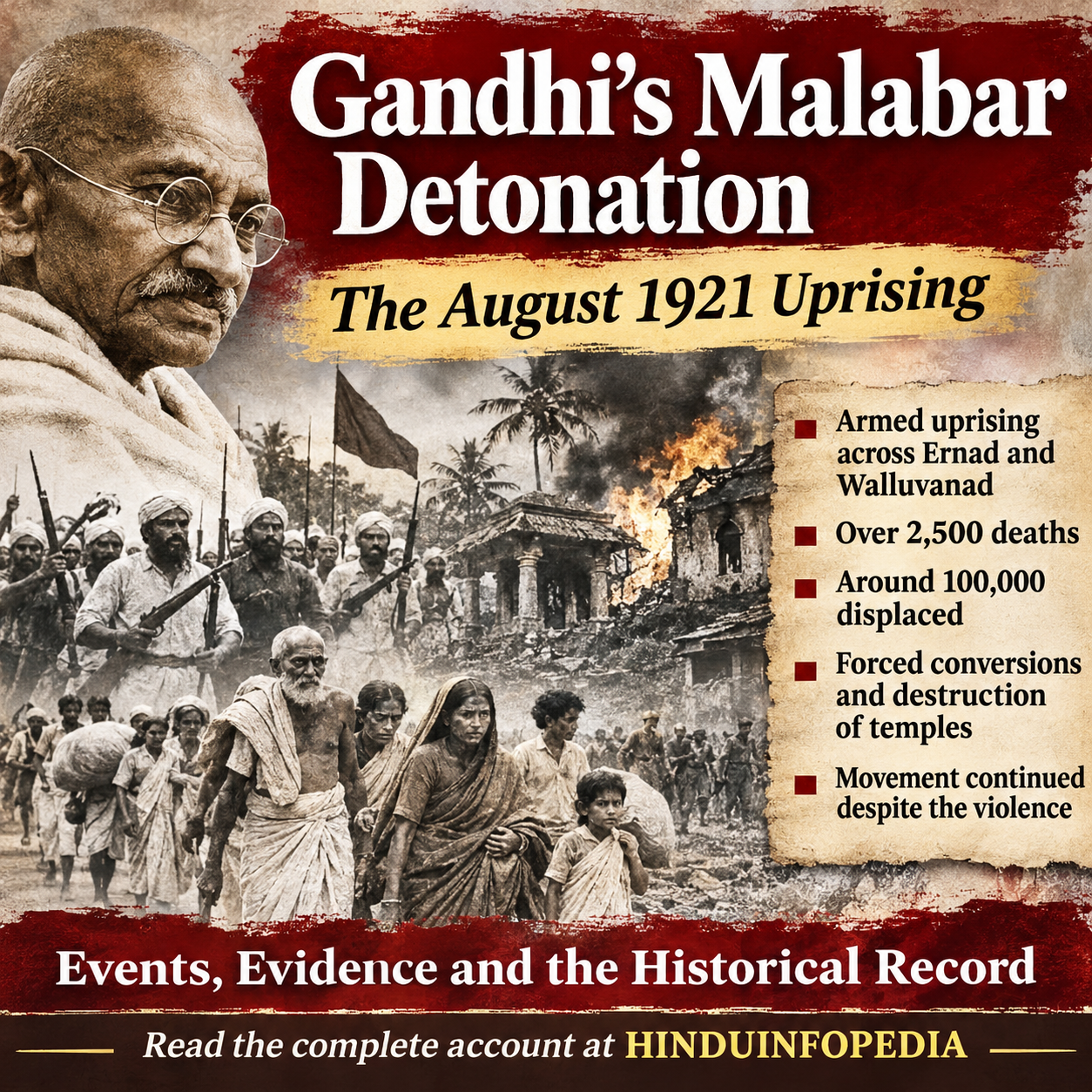
Gandhi’s Malabar Detonation: The August 1921 Uprising (196)
भारत / GB
Part 196: Mahatma Gandhi’s Peace Efforts | Series Index
The previous blog established Gandhi’s live bomb knowledge — Malabar across four independent channels: his own Young India articles responding to Section 144 orders, his own Congress officers’ field reports of arms collections and theological override, former Congress Presidents’ warnings in the national press, and the Viceroy’s direct briefing at Simla in May 1921. This blog documents what the machine Gandhi left running produced. The uprising began on 20 August 1921. This is the record of what happened.
Thank you for reading this post, don't forget to subscribe!THE MALABAR UPRISING — THE OFFICIAL RECORD
The event: On 20 August 1921, the arrest of Ali Musaliar — the senior tangal religious authority in Tirurangadi — triggered an armed uprising across Ernad and Walluvanad taluks that the district administration had been predicting for months. The Moplah Khilafat Volunteer Corps, which had been drilling in formation since the spring, mobilised. Police stations were attacked. British officials were killed or driven from the interior. The uprising spread across approximately 2,000 square miles of territory and was not suppressed until November 1921.
The victims: The uprising’s violence fell overwhelmingly on the Hindu population of the interior taluks. The Hindus of Ernad and Walluvanad — tenants, landlords, traders, professionals — were killed, expelled from their homes, subjected to forced conversion to Islam, and dispossessed of property accumulated across generations. The Khilafat movement’s local apparatus, which Gandhi had built, endorsed, and left untouched after Simla, produced the largest communal massacre of the Non-Cooperation period.
Why it matters: Gandhi’s Malabar detonation is not a footnote to the Non-Cooperation Movement. It is the movement’s most direct consequence. The apparatus Gandhi constructed, the warnings Gandhi received, and the instructions Gandhi did not issue between May and August 1921 are the proximate chain between the Simla transaction and the bodies in Ernad. This blog places the event record before the reader. The next blog documents Gandhi’s public response.
20 August 1921: The Trigger
On 20 August 1921, District Magistrate E.F. Thomas led a police raid on the Tirurangadi mosque complex with the objective of arresting Ali Musliyar — the Islamic scholar and senior religious authority at Tirurangadi — along with other Khilafat leaders. The raid failed to secure the arrests. Rumours spread through the town that the mosque had been desecrated. Armed Moplah volunteers — members of the Khilafat Volunteer Corps that had been drilling in Ernad and Walluvanad since the spring — mobilised. The Tirurangadi police station was attacked and the Sub-Inspector killed. The uprising spread outward from Tirurangadi into the surrounding taluks within hours.
Ali Musliyar surrendered and was taken into custody on 30–31 August 1921. He was tried and executed in February 1922. Variankunnath Kunjahammed Haji — a separate rebel commander who had declared a parallel administration in the interior hills — was captured in January 1922 and executed on 20 January 1922. The two men are distinct: Ali Musliyar was the senior religious authority whose arrest was the immediate trigger; Variankunnath Haji was the military commander of the prolonged insurgency in the hills.
The uprising spread with the speed and coordination that the district administration’s own intelligence had predicted: unlike previous outbreaks in 1836, 1849, 1851, and 1896 — which Hitchcock’s official record characterised as localised and uncoordinated — the 1921 uprising was organised, geographically extended, and sustained. District Magistrate Thomas, whose March 1921 intelligence summary had warned the Madras Government that the situation had surpassed the 1896 Manjeri benchmark — no longer “an isolated fanatical rush as in former days, but a widespread armed rising” — was vindicated within five months of filing that warning. Gandhi’s Malabar detonation confirmed every prediction the district administration had placed on record.
The Scale of the Uprising
The uprising covered approximately 2,000 square miles of territory across Ernad and Walluvanad taluks. It was not suppressed until late November 1921 — three months after it began. The official account of the suppression is in R.H. Hitchcock’s A History of the Malabar Rebellion, 1921, compiled for the Madras Government in 1925 from district records, police reports, and military dispatches.
Hitchcock’s figures record over 2,500 killed in the uprising — insurgents killed in military operations, civilians killed in the violence, and prisoners who died in transit including in the Wagon Tragedy. Contemporary relief accounts — Annie Besant’s reports in New India and the Central Relief Committee based in Calicut — documented the territorial extent of the displacement: approximately 100,000 people were driven from their homes in the interior taluks. Many of the displaced were Hindus who could not return to their villages because the villages had changed hands — their properties seized, their temples desecrated, their economic position destroyed.
The Malabar Special Police, the Indian Army’s 34th Sikh Pioneers, and the 1st Battalion Leinster Regiment were all deployed before the uprising was contained. This was not a riot that burned itself out. It required sustained military operation across three months.
The Hindu Victims
The violence of Gandhi’s Malabar detonation fell primarily on the Hindu population of the interior taluks. The pattern documented in Hitchcock, in the Macleod Commission report, and in the memoirs of Kesava Menon and Madhavan Nair was consistent: Hindu landlords, tenants, and traders in Ernad and Walluvanad were killed, their properties seized, their temples converted or destroyed, and those who survived were given the choice of conversion or expulsion.
Forced conversions occurred on a scale without precedent in the region’s modern administrative history. The figures were compiled by the Arya Samaj Malabar Relief Committee — whose shuddhi missions under Pandit Rishi Ram operated in the district during and after the uprising — and are recorded in Sankaran Nair’s Gandhi and Anarchy (1922, Appendix). The converted were often forcibly circumcised, made to eat beef, and their caste marks removed. Some who returned to Hinduism after the uprising was suppressed faced renewed violence. Annie Besant’s New India documented individual cases throughout the autumn of 1921.
The temples of the interior taluks were among the most systematically targeted structures. The Manjeri and Ponnani areas recorded mosque flags planted on temple premises. Temple idols were broken. The economic infrastructure of the Hindu community — the money-lending networks, the rice-trading establishments, the land records — was disrupted in ways that took years to reconstruct.
The victims of Gandhi’s Malabar detonation were not combatants. They had no seat at Simla. They had not been consulted when the Khilafat cause was packaged as the Non-Cooperation Movement in the name of “Swaraj within one year.” They had not been told that the Khilafat Volunteer Corps drilling in their districts operated on theological premises that explicitly overrode Gandhi’s prohibition on violence. They bore the full material consequence of a settlement negotiated in a viceregal lodge in the hills.
What the Movement Did
The Non-Cooperation Movement continued through August and September 1921 without interruption. Gandhi seemingly condemned the outrages in Young India, offering lip-service regret over the violence and admitting that “a Mussulman must naturally feel the shame and humiliation of the Moplah conduct.” Yet in reality, every criticism was systematically neutralized: in the very same breath, he excused the perpetrators as “brave God-fearing Moplahs who were fighting for what they consider as religion and in a manner which they consider as religious” (8 September 1921), rebuked the Hindu victims for fleeing in a “cowardly manner” instead of finding the “cool courage to die without killing” (20 October 1921), and ultimately declared that the “Hindus… will find that they are not without blame” (26 January 1922). The future blogs document the full textual mechanics of that nominal condemnation and actual evasion. But the movement itself was not called off. No AICC resolution suspended operations. No instruction issued from Gandhi to the provincial Congress hierarchy directing the Malabar Khilafat apparatus to stand down.
The movement that had survived the Malabar uprising — over 2,500 dead, 100,000 displaced, mass forced conversions — was called off five months later when 22 constables were killed at Chauri Chaura on 4 February 1922. Gandhi announced the suspension within days. The asymmetry between those two triggers — which Blog 194 placed on the record as the proof of the tacit understanding — is confirmed by the event sequence: the Malabar death toll did not trigger suspension; the Chauri Chaura constable deaths did.
Gandhi’s Malabar detonation was not, from the perspective of the Non-Cooperation Movement’s leadership, a reason to stop. It was treated merely as a communal inconvenience — Moplah violence against Hindus — that could be nominally deplored in Young India, rationalized away, and contained as a local aberration. The movement’s operational continuity after August 1921 is itself a document. It records whose deaths, and whose suffering, fell within the scope of the guarantee Gandhi had given Reading.
The Record Before the Reader
Hitchcock’s 1925 official history. The Arya Samaj Malabar Relief Committee reports. Kesava Menon’s Kazhinja Kaalam. Madhavan Nair’s Malabar Kalapam. Sankaran Nair’s Gandhi and Anarchy. The contemporary accounts of Annie Besant in New India. The Madras Government fortnightly intelligence reports of March through July 1921. District Magistrate Thomas’s March 1921 intelligence summary. The Reading Papers’ record of the Simla confrontation. Gandhi’s own Young India articles of 23 February and 9 March 1921. Swami Shraddhanand’s contemporaneous warnings recorded in Inside Congress.
Gandhi’s Malabar detonation is not established by inference. It is established by the convergence of official government records, military after-action dispatches, the memoirs of his own Congress officers, and the contemporaneous warnings of two former Congress Presidents. It fulfilled precisely what Swami Shraddhanand had warned Gandhi about in December 1920 at the Nagpur Congress — when the Swami heard Khilafat clerics chanting verses of jihad and the slaying of kafirs, only to have Gandhi dismiss the danger with the claim that they were aimed strictly at the British. What Shraddhanand foresaw, Malabar suffered. The machine that produced August 1921 had been documented, warned against, and left running.
Invitation To Defence
The official Madras Government record of the 1921 Malabar uprising is in Hitchcock’s A History of the Malabar Rebellion, 1921 (Madras, 1925). The forced conversion figures are in the Madras Revenue Department compilation of 1922. The Macleod Commission documented the displacement. Kesava Menon and Madhavan Nair — Gandhi’s own Congress officers in Malabar — recorded what their apparatus had reported and what the uprising produced. We invite the defence to identify which of these sources is fabricated, and on what basis.
20 August 1921: Ali Musaliar is arrested at Tirurangadi. The Khilafat Volunteer Corps that had been drilling since the spring mobilises within hours. The uprising covers 2,000 square miles and runs for three months. Over 2,500 are killed. 100,000 are displaced. Forced conversions are documented in the thousands. The Hindu temples of Ernad and Walluvanad are desecrated. The Non-Cooperation Movement continues. Gandhi’s Malabar detonation produced exactly what every informed observer had predicted. The question is not whether Gandhi knew. The previous blog answered that. The question is what he said when it happened.
Feature Image: Click here to view the image.
Videos
Glossary of Terms
1. Gandhi’s Malabar Detonation: The central phrase coined in this blog to describe the August nineteen twenty-one Malabar uprising and examine the political decisions, warnings, mobilisation, and consequences associated with it.
2. Malabar Rebellion: The armed uprising that began on twenty August nineteen twenty-one in the Malabar region of the Madras Presidency and spread across Ernad and Walluvanad.
3. Tirurangadi: A locality in Malabar where the police raid on the mosque complex on twenty August nineteen twenty-one became the immediate trigger for the uprising.
4. Ernad and Walluvanad: Two taluks of Malabar across which the uprising spread, covering approximately two thousand square miles.
5. Khilafat Volunteer Corps: An organised body of volunteers associated with the Khilafat movement who had been drilling in Ernad and Walluvanad before the uprising.
6. Ali Musaliar: A senior religious authority in Tirurangadi who was among the Khilafat leaders sought during the police raid. He surrendered later in August nineteen twenty-one, was tried, and was executed in February nineteen twenty-two.
7. Variankunnath Kunjahammed Haji: A separate rebel military commander who established a parallel administration in the interior hills, was captured in January nineteen twenty-two, and executed on twenty January nineteen twenty-two.
8. Section 144: A provision of Indian criminal procedure law used by authorities to prohibit certain assemblies and activities in the interest of public order. The blog refers to its use in the Malabar context.
9. Malabar Special Police: A special police force deployed during the campaign to suppress the uprising.
10. Wagon Tragedy: The incident involving prisoners who died during transportation in a railway goods wagon; it is included among the deaths associated with the Malabar events.
11. Forced Conversion: The coercion of individuals to change their religious identity against their will. The blog discusses reports of Hindu victims being subjected to forced conversions during the uprising.
12. Shuddhi: A purification and reconversion ceremony associated with the Arya Samaj, referred to in the blog in connection with efforts to assist people who had undergone forced religious conversion.
13. Theological Override: A phrase used in the blog to describe the conflict between the religious premises attributed to sections of the Khilafat mobilisation and Gandhi’s stated prohibition on violence.
14. Non-Cooperation Movement: The political movement led by Gandhi against British rule. The blog examines its continuation during the Malabar violence and its later suspension following the Chauri Chaura incident.
15. AICC (All-India Congress Committee): The principal central deliberative body of the Indian National Congress, referred to in the blog in connection with the absence of a resolution suspending the movement during the Malabar uprising.
#Gandhi #Malabar #History #India #Khilafat #Moplah #Congress #HinduHistory #HinduinfoPedia
Scan Through The Entire Series at
Refer to Various Arks Referred to in the Blog