
Gandhi’s Communal Award: Opposition Only to the Untouchables? (237)
भारत / GB
Part 237: Mahatma Gandhi’s Peace Efforts (Residue Enters Constitution) | Series Index
Blog 236 covered Gandhi’s offer to the Muslim delegation in October 1931: the Muslim demands refused at Calcutta in 1928, in return for dropping the Untouchables. The Muslims refused. The minorities then made their own pact, and Gandhi said he would resist the Untouchables’ claim with his life. This blog, Gandhi’s Communal Award, covers how the decision passed to the British Prime Minister, what his Communal Award of August 1932 gave each community, and which part of it Gandhi opposed. The arrests of 1932 and the Award’s place in the balance sheet of the Irwin Pact are covered in Blog 138.
THE RECORD: NOVEMBER 1931 – AUGUST 1932
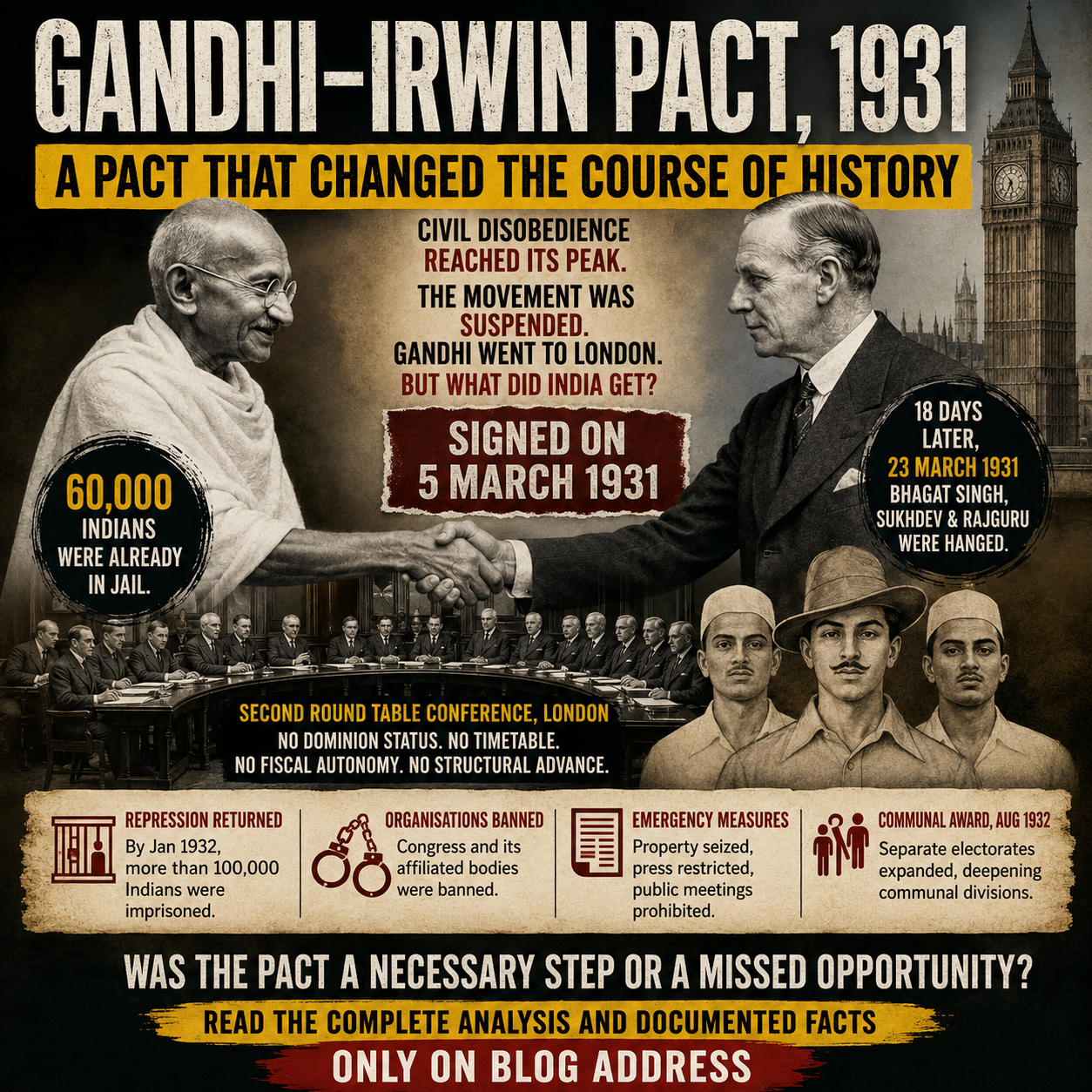
The Action Taken: In November 1931 the Prime Minister offered to decide the communal question if the Indians could not agree. Gandhi did not sign the request, but said the Congress would not resist the decision. The Communal Award of August 1932 gave separate electorates to the Muslims, Sikhs, Indian Christians, Anglo-Indians, Europeans and the Depressed Classes. Gandhi announced a fast unto death against one part only: the separate electorate for the Depressed Classes.
Who Paid the Price: The Hindus of Bengal and the Punjab, whose seats were fixed by communal shares, and the Depressed Classes, whose separate electorate became the one part of the Award Gandhi staked his life against.
Why This Matters: Separate electorates for the Muslims, Sikhs and Europeans passed without a protest from Gandhi. Only the Untouchables’ electorate drew his fast.
1. How the Decision Passed to London
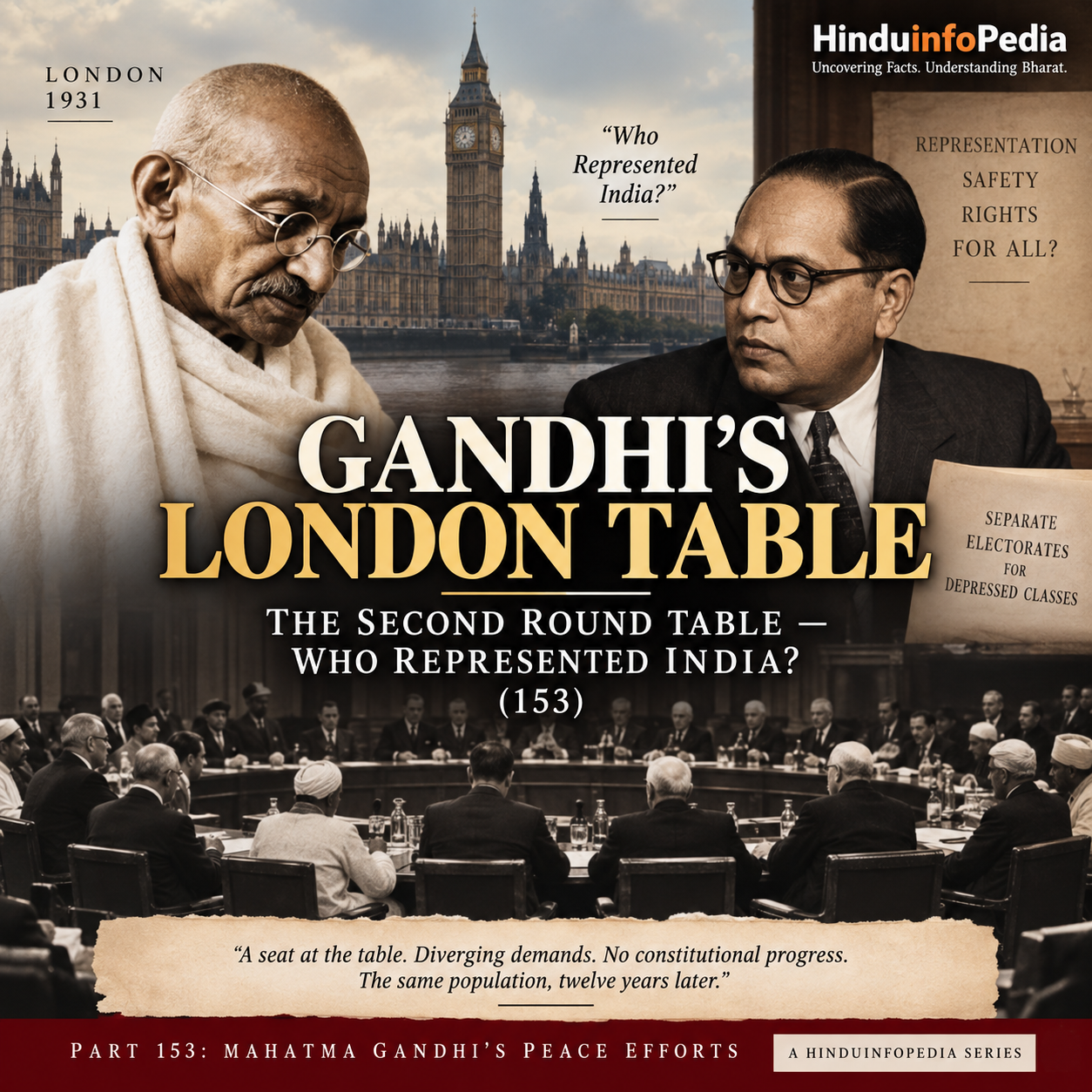
After the Minorities Pact of 13 November 1931, the Prime Minister, Ramsay MacDonald, made an offer. He would settle the communal question himself if all the parties asked him to and agreed to accept his decision.
The delegates answered in letters:
- A group led by Madan Mohan Malaviya asked him to arbitrate on the question as it affected the Hindus, Muslims and Sikhs.
- A group of ten led by Srinivasa Sastri accepted his arbitration without conditions.
- The Muslims said they would agree only if all the other groups did, and they would not drop the smaller minorities they had made their pact with.
Gandhi did not sign. He told the News Chronicle he could not sign such a request, though he had no objection to MacDonald as arbitrator. He also said his not signing did not mean the Congress would resist the Prime Minister’s award. The Congress would approve any solution acceptable to the Hindus, the Muslims and the Sikhs.
On 1 December 1931 MacDonald closed the conference. He said that if the Indians did not reach a settlement, the Government would apply a provisional scheme of its own. That is how Gandhi’s Communal Award came to be written in London.
2. The Letter from Prison: 11 March 1932
Gandhi returned to India on 28 December 1931 and was arrested on 4 January 1932 (Blog 138). The decision behind Gandhi’s Communal Award had not yet been made.
On 11 March 1932 he wrote from Yerwada jail to Sir Samuel Hoare, the Secretary of State for India. He said a separate electorate was harmful for the Depressed Classes and for Hinduism. He told the Government that if it decided to create a separate electorate for the Depressed Classes, he must fast unto death.
The letter was about one community only. It set a condition on the Depressed Classes before the Award was made. It set none on the Muslims, the Sikhs or the Europeans.
3. What the Award Gave
The Government’s decision is dated 4 August 1932 and was announced on 16 August. It gave separate electorates to:
- The Muslims
- The Sikhs
- The Indian Christians
- The Anglo-Indians
- The Europeans
- The Depressed Classes, who also kept a vote in the general constituencies. Their special constituencies were to end after 20 years.
The Award could be changed only if the communities concerned agreed among themselves on a workable alternative.
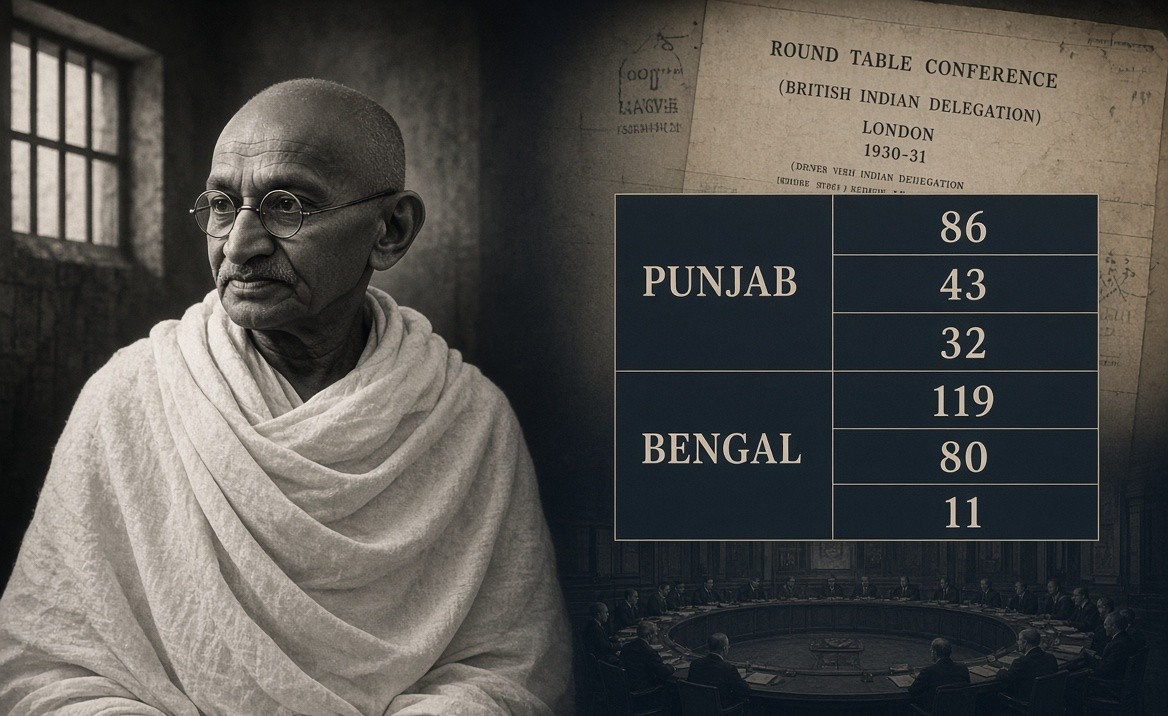
The seats in the two Muslim-majority provinces were fixed like this:
| Seats | Bengal (total 250) | Punjab |
|---|---|---|
| Muslim | 119 | 86 |
| General (mainly Hindu) | 80 | 43 |
| Sikh | 0 | 32 |
| European | 11 | 1 |
The rest of the seats went to commerce, landholders, universities, labour and smaller communities. The Muslims were almost 56 per cent of the Punjab but got 86 seats, short of a majority. They were unhappy, but prepared to accept the Award.
Gandhi’s Communal Award therefore fixed every community’s share by religion and caste. The Hindus of Bengal and the Punjab got the general seats left over after the communal shares were set.
4. The One Part Gandhi Fought
On 18 August 1932, two days after the announcement, Gandhi wrote to MacDonald from Yerwada. He wrote: “I have to resist your decision with my life.”
He then set the condition. The fast would cease if the Government revised its scheme of communal electorates for the Depressed Classes, so that their representatives were elected by the general electorate.
The letter asked for no change in the electorates for the Muslims, the Sikhs, the Christians, the Anglo-Indians or the Europeans. This matches what he had said in London on 13 November 1931: the Congress would accept any solution acceptable to the Hindus, Muslims and Sikhs, but would be no party to special electorates for any other minority (Blog 236).
The table below sets out Gandhi’s Communal Award and his response to each part.
| Separate electorate for | Gandhi’s response in 1932 |
|---|---|
| Muslims | No fast; no condition |
| Sikhs | No fast; no condition |
| Europeans, Anglo-Indians, Indian Christians | No fast; no condition |
| Depressed Classes | “I have to resist your decision with my life” |
What followed the letter is covered later in this series. The record of Gandhi’s Communal Award up to 18 August 1932 is this: he did not ask for the arbitration, said the Congress would not resist it, and then opposed only the part that applied to the Untouchables.
Prosecution’s Position
The prosecution does not claim that Gandhi wrote the Communal Award or asked for it; the Award was the British Government’s, and Gandhi did not sign the request for arbitration. It places on the record that he said the Congress would not resist the Prime Minister’s award and would approve any solution acceptable to the Hindus, Muslims and Sikhs; that his letter of 11 March 1932 set a condition on the Depressed Classes alone; that the Award gave separate electorates to the Muslims, Sikhs, Indian Christians, Anglo-Indians, Europeans and Depressed Classes; and that on 18 August 1932 he staked his life against only one of them, the electorate of the Untouchables.
Invitation To Defence
The arbitration letters of November 1931 and Gandhi’s statement on them, the Prime Minister’s statement of 1 December 1931, Gandhi’s letter to Sir Samuel Hoare of 11 March 1932, the text of the Communal Award and Gandhi’s letter to Ramsay MacDonald of 18 August 1932 are established exhibits. The defence is invited to produce any letter, statement or fast by Gandhi in 1932 against the separate electorates given to the Muslims, Sikhs or Europeans, or any explanation by him of why those electorates were acceptable and the Depressed Classes’ electorate was not.
In November 1931 Gandhi said the Congress would not resist the Prime Minister’s award. In August 1932 the Award gave separate electorates to six groups. Gandhi wrote that he would resist it with his life, and named one group only: the Depressed Classes.
Feature Image: Click here to view the image.
Videos
Glossary of Terms
1. Gandhi’s Communal Award: The British Government’s decision of August 1932, announced by Prime Minister Ramsay MacDonald, which granted separate electorates to six communities, including the Depressed Classes.
2. Communal Award: The constitutional arrangement of 1932 that allocated separate electoral representation to different religious and social communities in British India.
3. Separate Electorates: An electoral system under which members of a designated community elect their own representatives through a separate constituency.
4. Depressed Classes: The historical official term used during British rule for communities subjected to untouchability and social discrimination. Gandhi opposed their separate electorate under the Communal Award.
5. Untouchables: A historical social designation used in the article for members of the Depressed Classes who faced caste-based exclusion and discrimination.
6. Minorities Pact: The agreement reached by minority representatives on 13 November 1931 concerning political representation and communal safeguards.
7. Arbitration: A process in which an independent authority settles a dispute between parties. In 1931, Prime Minister Ramsay MacDonald offered to arbitrate the communal representation question.
8. Ramsay MacDonald: The British Prime Minister who announced the Communal Award in August 1932 after Indian political representatives failed to reach an agreement.
9. Sir Samuel Hoare: The British Secretary of State for India to whom Gandhi wrote from Yerwada Jail on 11 March 1932, opposing a separate electorate for the Depressed Classes.
10. Yerwada Jail: The prison in Pune where Gandhi was detained in 1932 and from where he communicated his opposition to the Depressed Classes’ separate electorate.
11. General Electorate: The broader electoral constituency in which voters were not restricted to a particular community. Gandhi proposed that representatives of the Depressed Classes should be elected through it.
12. Anglo-Indians: A recognised community in British India comprising people of mixed European and Indian ancestry, granted separate electoral representation under the Communal Award.
13. Indian Christians: Members of Christian communities in India who received separate electoral representation under the Communal Award.
14. Provisional Scheme: The temporary constitutional arrangement that the British Government indicated it would introduce if Indian representatives failed to agree on communal representation.
15. Residue Enters Constitution: The series expression used in the subtitle to describe how unresolved communal and minority representation questions entered the constitutional decision-making process.
2. SEO Hashtags
#Gandhi #CommunalAward #MahatmaGandhi #BritishIndia #IndianHistory #SeparateElectorates #IndianPolitics #History #HinduinfoPedia
Scan Through The Entire Series at
Refer to Various Arks Referred to in the Blog
A https://hinduinfopedia.in/gandhis-communal-award-opposition-only-to-the-untouchables-237/