
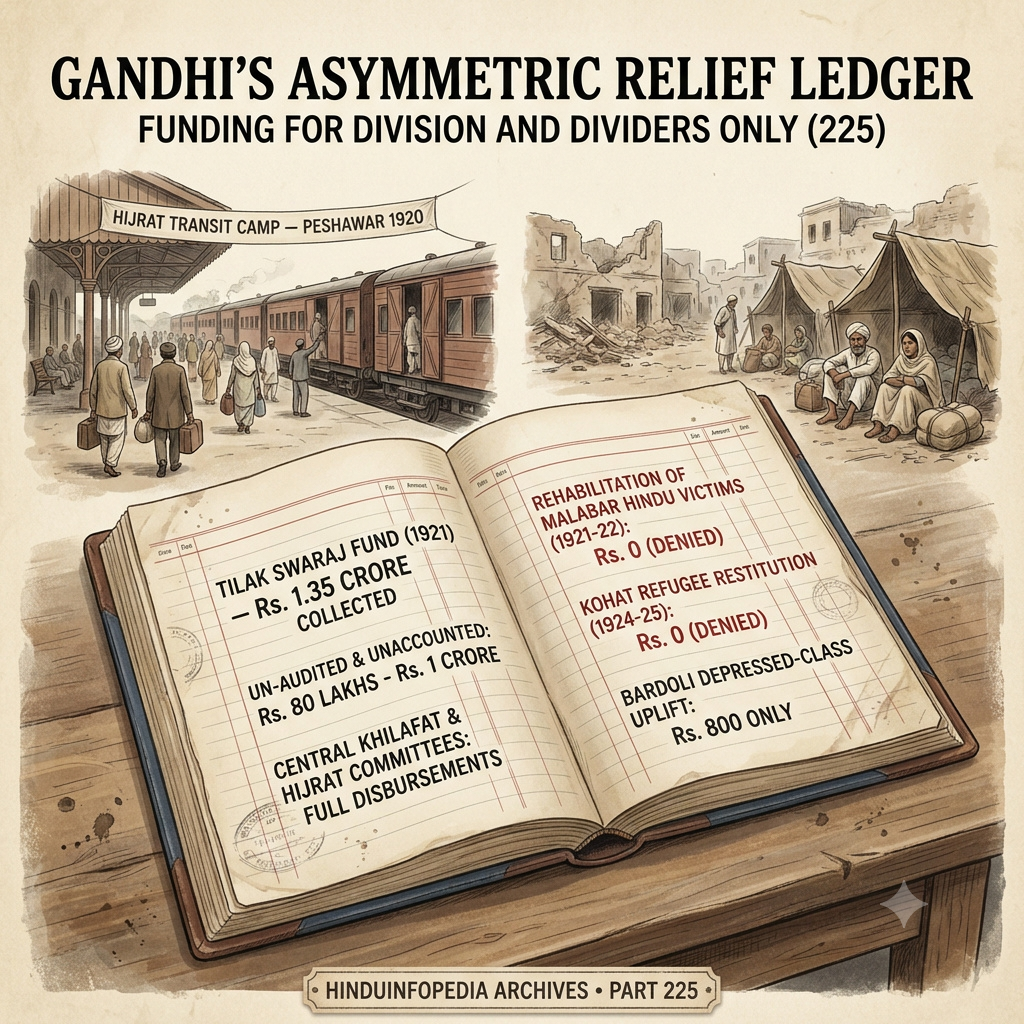
Gandhi’s Asymmetric Relief Ledger: Funding for Division and Dividers Only (225)
भारत / GB
Part 225: Mahatma Gandhi’s Peace Efforts (Replication Wave + Financial Audit) | Series Index
Blog 224 documented how official Census tables, British parliamentary records, Dr. B.R. Ambedkar, and Lala Lajpat Rai exposed the demographic and territorial fracture between 1921 and 1929 while Congress rejected every shrinking settlement from ~30 demands down to just 3 amendments at Calcutta. This instalment places the primary financial and relief records on the exhibit table: auditing Gandhi’s asymmetric relief ledger across 1920–1925 and the un-audited bungling of Rs. 80 lakhs to Rs. 1 crore documented by Dr. B.R. Ambedkar — where dedicated committees funded Hijrat transit camps and Hindu-donated Tilak Swaraj Fund crores provided institutional and political subsidisation for the Congress–Khilafat agitation apparatus, while Congress refused institutional rehabilitation for Malabar’s forcibly converted Hindus and left Kohat’s 3,500 displaced refugees with zero restitution. The 1920 Hijrat transmission machine is in Blog 215; the Kohat distress sales are in Blog 223.
Thank you for reading this post, don't forget to subscribe!THE PRIMARY FINANCIAL LEDGER: ONE-WAY RELIEF AND WEAPONISED FUNDS (1920–1925)
The Action Taken: Across five years of Khilafat–Congress mobilisation, public money moved along a strict one-way channel. In 1920, dedicated Khilafat and Hijrat committees (Delhi’s Khuddam-ul-Muhajireen and the May 1920 Peshawar Hijrat Committee) funded transit camps, hospital care at Peshawar’s Namak Mandi Sarai, and rations for muhajirin. In 1921–1922, funds collected overwhelmingly from Hindu donors for the Rs. 1.35 Crore Tilak Swaraj Fund — of which Dr. B.R. Ambedkar documented roughly Rs. 80 lakhs to Rs. 1 crore left un-audited and unaccounted for — provided the institutional and political subsidisation of the Congress–Khilafat alliance, financing Provincial Congress Committees, joint volunteer mobilisations, and joint agitation machinery alongside separate Central Khilafat Fund clerical stipends. Yet when Swami Shraddhanand requested Congress funds to rehabilitate forcibly converted Malabar Hindus (1922) or uplift depressed classes (receiving just Rs. 800 out of Rs. 1.35 crores), Congress refused Hindu victim relief as “communal,” and gave zero restitution to Kohat’s 3,500 evacuees in 1924–1925.
Who Paid the Price: Hindu donors who financed Congress’s national war chest believing they were funding Swaraj, alongside the forcibly converted Hindu survivors of Malabar (1921) and the 3,500 expelled Hindus and Sikhs of Kohat (1924) who were left to liquidate ancestral property at distress prices without a rupee of Congress institutional backing.
Why This Matters: Routine accounting lapses are secondary; the primary documentary record proves a deliberate structural policy — Hindu-donated money provided institutional and political subsidisation for the agitation apparatus that targeted Hindus, while victim relief flowed exclusively to campaign participants and never to Hindu sufferers.
1. The 1920 Hijrat Relief Infrastructure: Dedicated Committees and Transit Camps
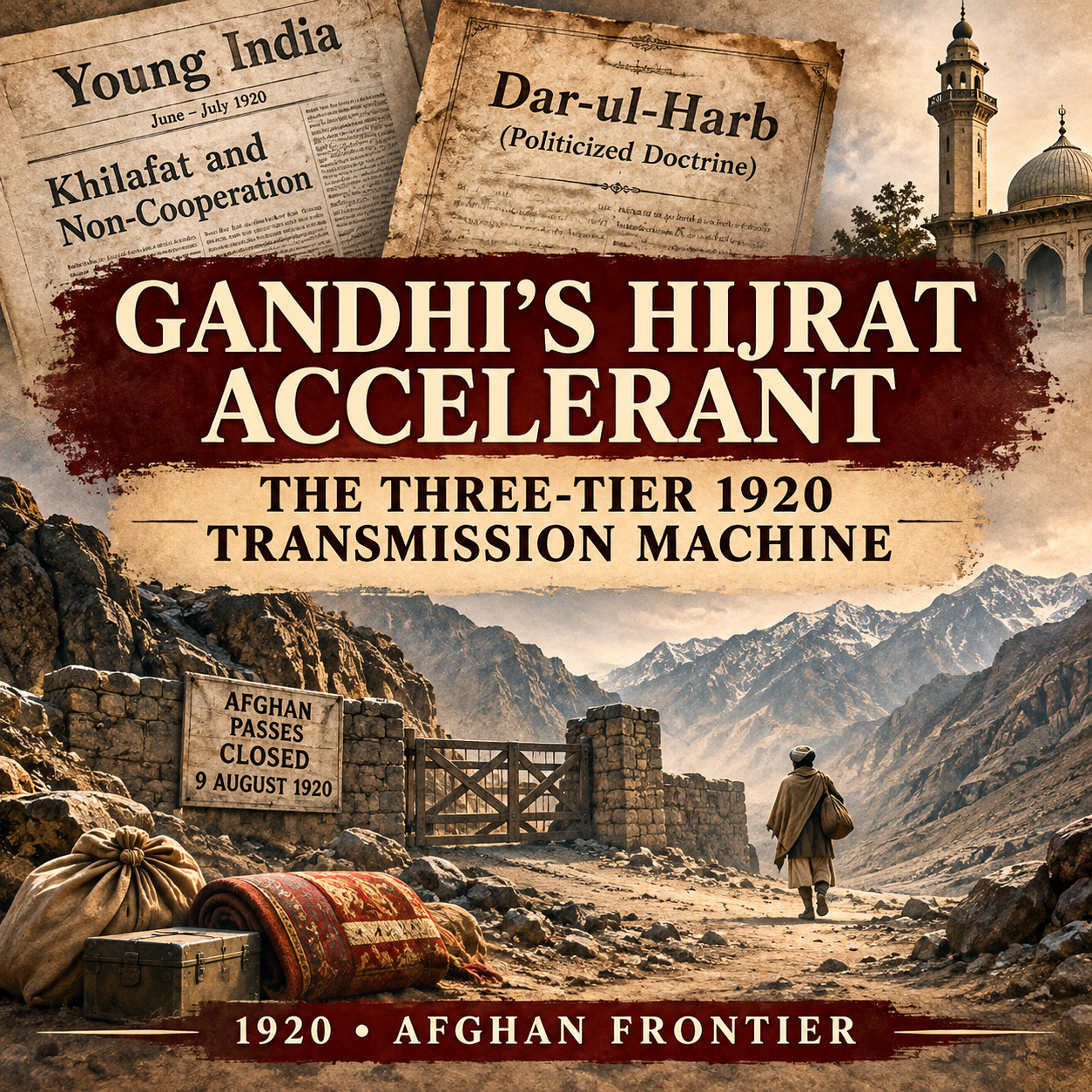
India Office Political and Judicial records (P&J File 5703/20) and contemporary Peshawar administrative files document the formal relief machinery built to support Muslim muhajirin who sold their lands during the 1920 Hijrat agitation promoted by Gandhi’s July–August 1920 Frontier and Sindh tours (Blog 215):
- Central and Frontier Hijrat Offices: In mid-1920, the Central Khilafat Committee established the Khuddam-ul-Muhajireen headquarters in Delhi alongside the formal Peshawar Hijrat Committee (constituted on 20 May 1920 under Mir Yahya, Syed Maqbool Shah, and Treasurer Haji Jan Muhammad) to organise border departures toward Kabul.
- Dedicated Transit Housing, Rations, and Hospitalisation: Local and provincial Khilafat subscriptions funded railway tickets, border rations, and a dedicated reception and medical facility at Peshawar’s Namak Mandi Sarai — housing, feeding, and treating muhajirin both during their outward march and when thousands returned destitute from the Afghan frontier in August 1920.
- Full Political Endorsement from Gandhi: Gandhi praised the muhajirin in Young India as brave practitioners of religious duty, treating structured relief for agitation participants as an unquestioned national obligation.
This immediate mobilisation of committee offices, sarais, and transit stipends for campaign participants forms the baseline entry of Gandhi’s asymmetric relief ledger.
2. The 1921 Tilak Swaraj Fund Audit: Hindu Collections vs. Agitation Disbursements
In mid-1921, Congress raised over Rs. 1.35 crores for the Tilak Swaraj Fund — collected overwhelmingly from Hindu merchants, middle-class households, and donors across Bombay, Gujarat, Punjab, Bengal, and the United Provinces. Dr. B.R. Ambedkar’s forensic audit in What Congress and Gandhi Have Done to the Untouchables (Chapter X) exposed that roughly Rs. 80 lakhs to Rs. 1 crore of that war chest remained un-audited and unaccounted for across Provincial Congress Committees, while contemporary Congress Working Committee (CWC) ledgers show how institutional priorities were allocated:
| Recipient / Programme | Documented Allocation / Support | Primary Source & Outcome |
|---|---|---|
| Congress–Khilafat Alliance Infrastructure & Joint Mobilisation | Institutional and political subsidisation via Provincial Congress Committee grants from the Rs. 1.35 Crore Tilak Swaraj Fund — including Rs. 80 lakhs to Rs. 1 crore un-audited per Ambedkar (alongside separate Central Khilafat Fund clerical stipends) | CWC 1921–1922 allotment records & Ambedkar Ch. X; subsidised the joint agitation apparatus while leaving clerical Khilafat networks unchecked. |
| Depressed-Class Uplift (1922 Bardoli Scheme) | Rs. 43,000 allotted out of Rs. 1.35 crores (0.3%); only Rs. 800 released to Shraddhanand’s committee | Dr. B.R. Ambedkar, What Congress and Gandhi Have Done to the Untouchables (Ch. X); committee dissolved without meeting once. |
| Malabar Hindu Massacre & Forced-Conversion Survivors (1921–1922) | Rs. 0 for reclamation / Shuddhi rehabilitation | CWC declined to fund reconversion or Hindu-specific relief as outside Congress’s non-communal mandate (Jordens 1981). |
| Kohat Evacuees in Rawalpindi (1924–1925; Rs. 9 Lakh Loss) | Rs. 0 Congress restitution or property-defence fund | ~3,500 displaced Hindus and Sikhs forced into distress property sales while Gandhi barred return without local Muslim invitation. |
Hindu donors supplied the capital, yet Congress deployed that war chest for the institutional and political subsidisation of the Congress–Khilafat alliance while allocating zero institutional relief to Hindu victims of the resulting violence — the central structural indictment of Gandhi’s asymmetric relief ledger (reserved for the 300-series analysis for consolidated balance-sheet synthesis).
3. Refusing Malabar Reclamation as “Communal” (1922 CWC Records)
When the August 1921 Malabar rebellion left thousands of Hindus dead, temples desecrated, and thousands more forcibly converted at sword-point, Swami Shraddhanand pressed the Congress Working Committee in early 1922 to allocate institutional funds to reclaim and rehabilitate the victims:
- Treating Hindu Victim Rehabilitation as Improper Use of Funds: Congress leadership refused to sanction Tilak Swaraj Fund money for the reclamation of forcibly converted Malabar Hindus, ruling that funding religious restoration or targeted Hindu rehabilitation violated Congress’s “non-communal” mandate — even while Congress funds routinely subsidised Khilafat committees whose entire charter was pan-Islamic religious mobilisation.
- The Rs. 800 Tokenism and Shraddhanand’s 1922 Resignation: Simultaneously, when Shraddhanand sought promised funds for depressed-class uplift under the Bardoli programme, the Working Committee stalled disbursements, handing his sub-committee a token Rs. 800 for working expenses even after sanctioning Rs. 43,000. In mid-1922, Shraddhanand resigned in disgust from Congress sub-committees and raised independent public donations to carry out the 1923 Shuddhi reclamation himself.
Under Gandhi’s asymmetric relief ledger, subsidising religious agitation for one community was celebrated as nationalism, while rehabilitating the religious victims of that agitation was rejected as sectarian misuse of funds.
4. Kohat’s 3,500 Evacuees in Rawalpindi (1924–1925): Zero Restitution, Forced Distress Sales
The exact same ledger operated during the September 1924 Kohat crisis (Blog 213; Blog 223):
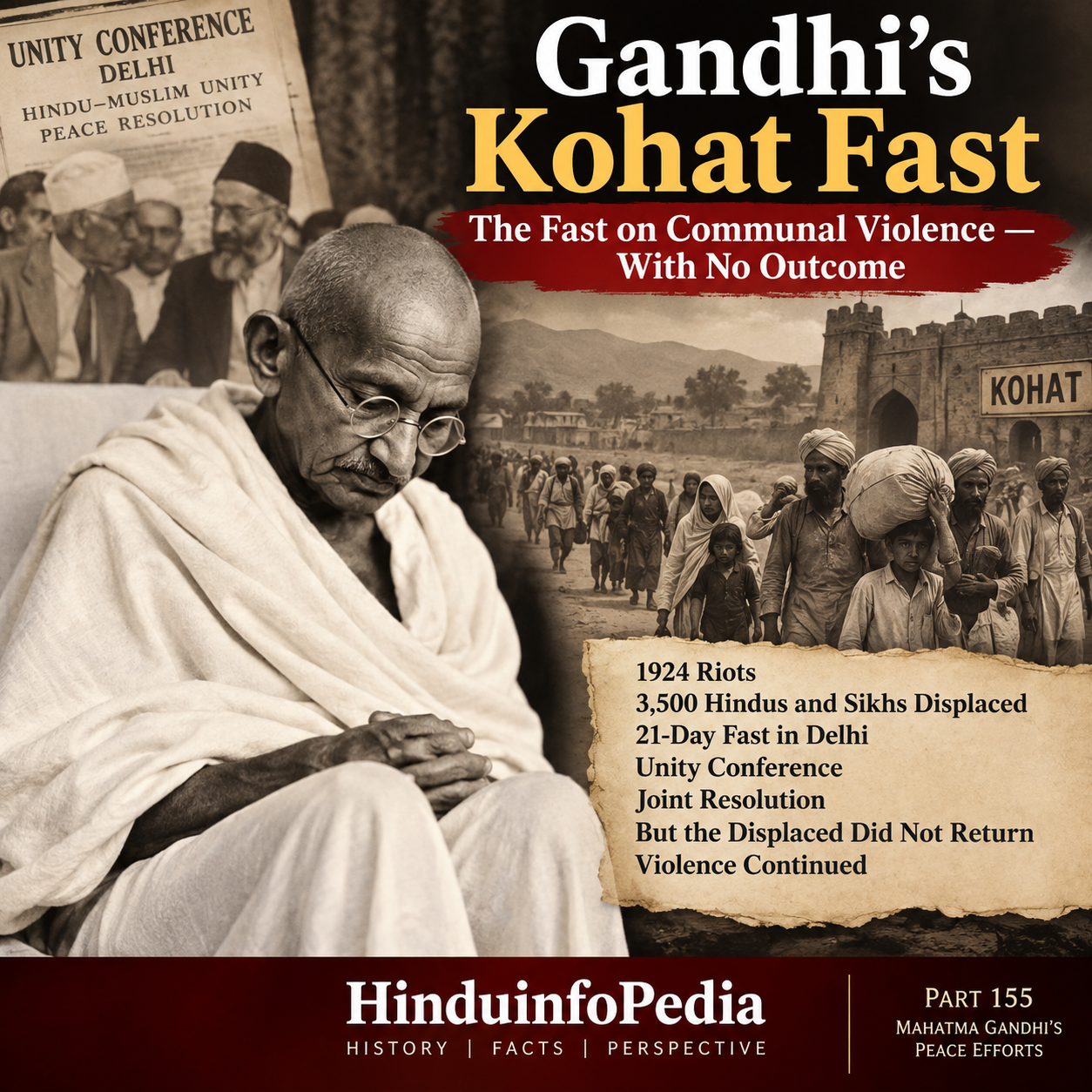
- Rs. 9 Lakhs Destroyed, Zero Congress Compensation Mechanism: Official inquiry records documented 473 Hindu and Sikh shops and homes burned or looted in Kohat, inflicting Rs. 9 lakhs in direct losses and stranding ~3,500 evacuees in Rawalpindi refugee camps. Congress established no restitution fund, no legal-aid trust, and no credit facility to prevent bankruptcies.
- Forcing Distress Liquidation Through the February 1925 Non-Return Rule: By advising Kohat’s displaced Hindus and Sikhs in February 1925 (CWMG Vol. 26) not to return unless invited by local Muslim leaders — while withholding any institutional financial lifeline — Gandhi left the refugees with no option except selling ancestral houses, shops, and orchards at steep distress discounts.
From Peshawar’s Namak Mandi Sarai in 1920 to Rawalpindi’s refugee camps in 1924–1925, every entry in Gandhi’s asymmetric relief ledger rewarded political agitation while leaving Hindu and Sikh victims financially stranded.
Modern Parallel
The institutional template codified in Gandhi’s asymmetric relief ledger — collecting funds from the general public while treating targeted shelter and rehabilitation for displaced Hindu and Sikh victims as secondary to political or communal optics — resurfaced repeatedly in later decades. During the winter of 1947–1948 in Delhi, as documented in the Collected Works of Mahatma Gandhi and Pyarelal’s Mahatma Gandhi: The Last Phase, Gandhi campaigned to clear mosques occupied by destitute Hindu and Sikh refugees from West Punjab even before adequate alternative housing was secured — prioritizing symbolic communal gestures over immediate victim shelter just as he had done after Kohat in 1925.
A parallel controversy over the boundary between public relief trusts and politically aligned organisations emerged decades later: Right to Information (RTI) disclosures in 2020 recorded that between 2005 and 2008, the Prime Minister’s National Relief Fund (PMNRF) transferred ₹1.45 crore to the Rajiv Gandhi Foundation (RGF), a private trust chaired by senior Congress leadership. While RGF trustees maintained the grants funded disability-relief initiatives, critics pointed out that routing public emergency donations into a party-linked NGO replicated the same institutional opacity documented in Ambedkar’s Chapter X audit of the 1921 Tilak Swaraj Fund — confirming how Gandhi’s asymmetric relief ledger established a durable precedent in Indian public life.
Invitation To Defence
India Office Political and Judicial File 5703/20 (recording the 1920 Peshawar Hijrat Committee and Namak Mandi Sarai relief operations), Dr. B.R. Ambedkar’s What Congress and Gandhi Have Done to the Untouchables (Chapter X, documenting the Rs. 1.35 Crore Tilak Swaraj Fund, Rs. 80 lakhs to Rs. 1 crore in un-audited balances, and the Rs. 800 allotment to Swami Shraddhanand’s sub-committee), the 1922 Congress Working Committee minutes, and the 1924–1925 Rawalpindi refugee camp records are all established archival exhibits. The defence is invited to produce any Congress ledger entry showing institutional funds allocated to reclaim forcibly converted Malabar Hindus in 1921–1922 or to compensate Kohat’s 3,500 displaced Hindus and Sikhs for their Rs. 9 lakh property loss in 1924–1925.
In 1920, dedicated committees funded transit camps and hospital care at Peshawar’s Namak Mandi Sarai for Hijrat participants; in 1921–1922, Hindu-donated crores from the Tilak Swaraj Fund provided the institutional and political subsidisation of the Congress–Khilafat alliance while Congress rejected Malabar forced-convert rehabilitation as “communal” and left Kohat’s 3,500 evacuees with zero restitution — proving Gandhi’s asymmetric relief ledger in black and white.
Feature Image: Click here to view the image.
Videos
Glossary of Terms
1. Asymmetric Relief Ledger: A term coined in this blog to describe the alleged imbalance in financial assistance, where organised political mobilisation received institutional support while rehabilitation and restitution for displaced or forcibly converted victims received little or no assistance.
2. Hijrat: The migration undertaken by Indian Muslims in 1920 towards Afghanistan, influenced by the belief that British-ruled India was unsuitable for Muslims to live in under religious principles.
3. Muhajirin: People who undertake Hijrat; in this historical context, Indian Muslims who migrated towards Afghanistan during the 1920 movement.
4. Khuddam-ul-Muhajireen: A relief and organisational body established in Delhi by the Central Khilafat Committee to assist people participating in the Hijrat movement.
5. Namak Mandi Sarai: A transit facility in Peshawar that provided accommodation, food, and medical assistance to returning and departing muhajirin.
6. Tilak Swaraj Fund: A fundraising initiative launched by the Indian National Congress in 1921 to support the Non-Cooperation Movement. The fund reportedly collected approximately Rs. 1.35 crore.
7. Congress Working Committee (CWC): The principal executive body of the Indian National Congress, responsible for making important organisational and policy decisions.
8. Dr. B.R. Ambedkar: Indian jurist, social reformer, and principal architect of the Indian Constitution, whose book What Congress and Gandhi Have Done to the Untouchables examined Congress’s financial and organisational record.
9. Bardoli Scheme: A programme associated with Congress efforts towards the uplift of depressed classes, discussed in this blog in connection with the allocation and release of funds to Swami Shraddhanand’s committee.
10. Swami Shraddhanand: An Indian religious and social reformer who sought institutional assistance for the rehabilitation of forcibly converted Malabar Hindus and later undertook independent Shuddhi activities.
11. Shuddhi: A religious purification and reconversion movement associated with efforts to bring people who had left or been converted away from Hinduism back into the Hindu fold.
12. Distress Sale: The forced or financially compelled sale of property at substantially reduced prices because the owner faces displacement, financial hardship, or an urgent need for money.
13. Restitution: Financial compensation or restoration intended to address property losses and other damages suffered by victims of violence or displacement.
14. Institutional Subsidisation: The provision of organisational or financial support through established committees, funds, and administrative structures to sustain a political or social movement.
15. Financial Accountability: The responsibility of organisations managing public or donated funds to maintain transparent records, disclose expenditure, and demonstrate that money was used for its intended purposes.
#Gandhi #MahatmaGandhi #IndianHistory #Congress #Ambedkar #Khilafat #Malabar #Kohat #HistoricalResearch #FinancialAudit #HinduHistory #HinduinfoPedia
Scan Through The Entire Series at
Refer to Various Arks Referred to in the Blog