
Gandhi’s Structural Trap: Gandhi’s Moral Authority as a Counter-Movement Instrument (139)
भारत / GB
Part 139: Mahatma Gandhi’s Peace Efforts | Series Index
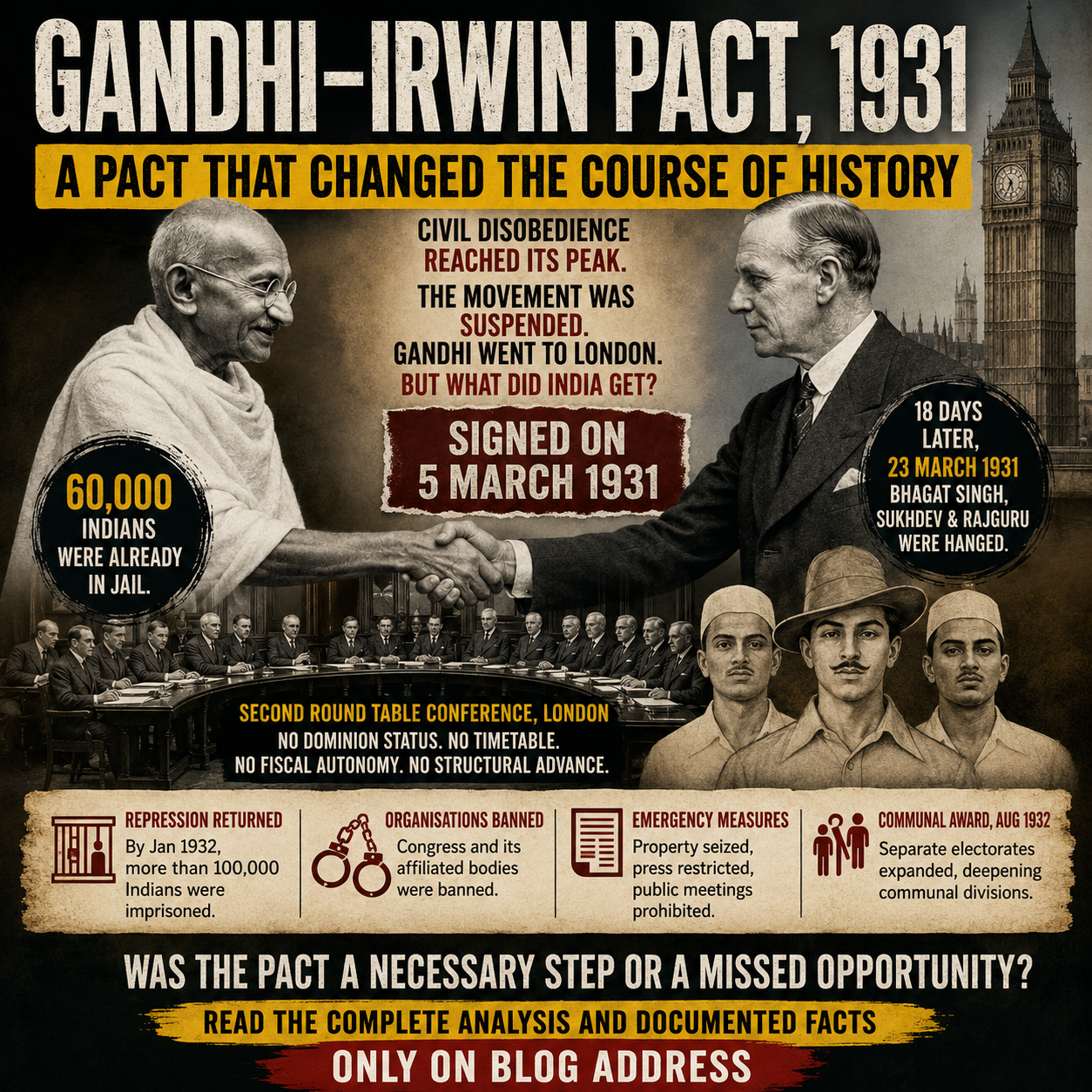
Blog 138 placed the balance sheet of the Irwin Pact before the reader — zero constitutional progress, the empty chair in London, Bhagat Singh eighteen days after the signature. This post places something different before the reader: not what the trade failed to deliver, but how the trade itself operated as a documented structural instrument — and the three sequential steps by which it converted Gandhi’s documented moral authority into the colonial administration’s most effective counter-movement tool.
Thank you for reading this post, don't forget to subscribe!The Action Taken: Gandhi’s personal entourage, ashram networks, publication deficits, and travel logistics were heavily underwritten by prominent industrialists, primarily G.D. Birla and Jamnalal Bajaj.
Who Paid the Price: The independence of nationalist economic policy, which consistently accommodated the interests of domestic industrial benefactors.
The Alternative Bypassed: Funding nationalist movement operations strictly through transparent, small-denomination democratic public subscriptions.
Why This Matters: The commercial foundation of the saint-image: personal asceticism was sustained by a private network of major industrial capital, creating a symbiotic bond between donors and leadership.
The Structural Trap
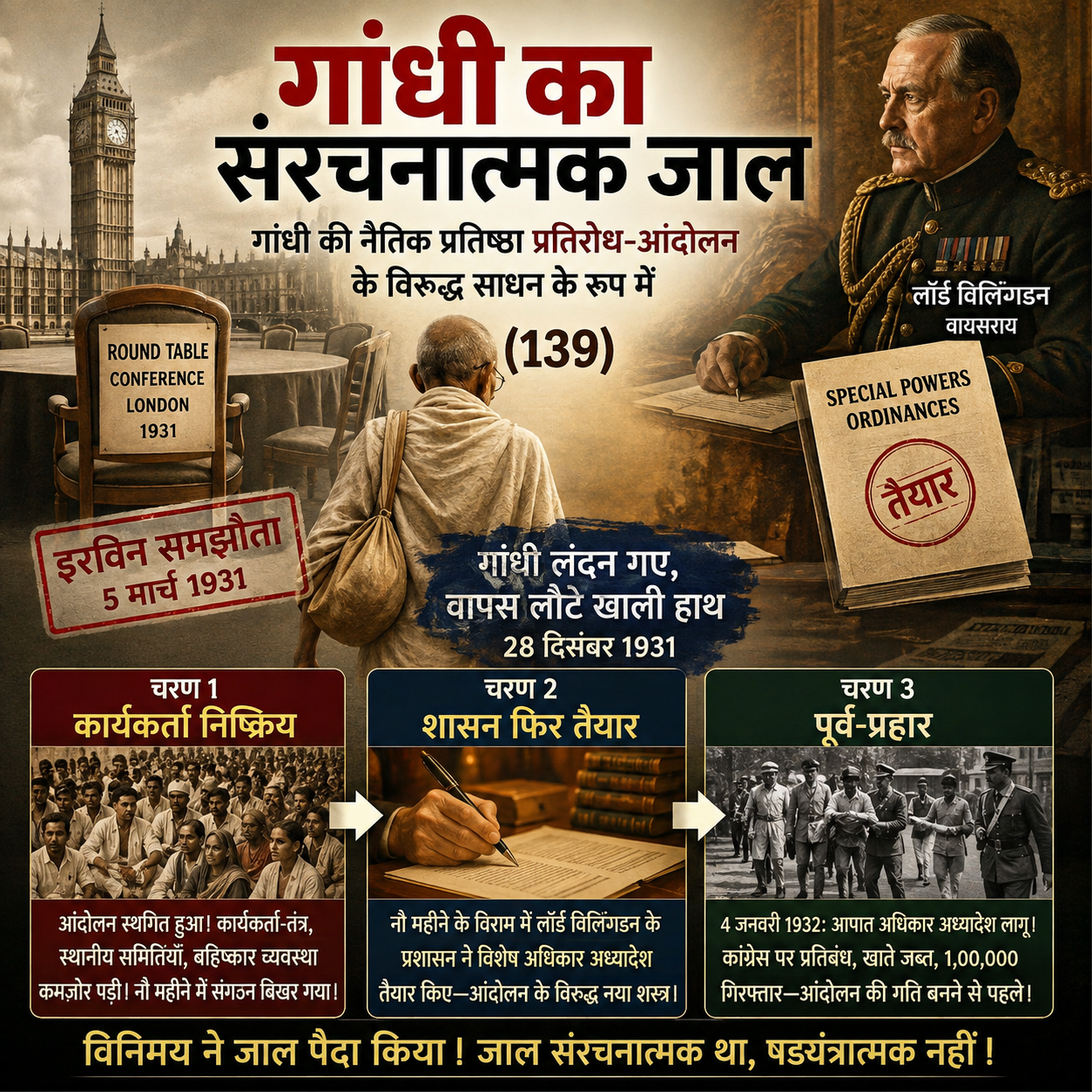
Gandhi’s Structural Trap places one documented observation before the reader at the outset. The Irwin Pact of March 5 1931 worked — from the colonial administration’s perspective — precisely because it leveraged Gandhi’s documented willingness to trade street power for moral dialogue. The prosecution places this observation before the reader not as a characterisation of Gandhi’s intent, but as the documented structural consequence of a specific documented exchange: peak movement leverage for a conference seat.
The three documented steps that followed are placed before the reader in sequence.
Step 1 — Paralyzed Cadres
Gandhi’s Structural Trap places the documented first step before the reader.
The rank-and-file of the Civil Disobedience movement — the men and women who had endured documented lathi charges, land seizures, imprisonment, and economic retaliation across 1930-31 — were told to stand down. The suspension was Gandhi’s unilateral documented decision. The reason placed before the participants: the movement was being traded for a seat at the Second Round Table Conference in London.
The documented consequence is on the record from Gandhi’s own inner circle. The volunteer networks, local Congress committees, boycott infrastructure, and cadre organisation built across the documented peak of 1930-31 were disbanded or allowed to atrophy during the nine-month conference window between March 1931 and December 1931. The movement’s grassroots infrastructure — the documented reservoir Blog 137 placed before the reader — was not preserved in suspension. It was allowed to dissipate while Gandhi was in London.
The prosecution places the documented demoralisation of movement infrastructure before the reader alongside one question: once a mass movement’s cadre has been stood down for nine months and its infrastructure has been allowed to atrophy, what does it take to rebuild the documented momentum that had placed 60,000 in jail and brought the British administration to its documented defensive?
Step 2 — Re-Armed the State
Gandhi’s Structural Trap places the documented second step before the reader.
The nine-month window between the Pact signing (March 5 1931) and Gandhi’s return to Bombay (December 28 1931) was not idle time for the colonial administration. Viceroy Lord Willingdon’s administration used the documented truce window to prepare what it could not have deployed against a movement at its documented peak: the Special Powers Ordinances.
The ordinances were comprehensive. They were drafted during the conference window and were ready for deployment before Gandhi returned. When Gandhi arrived back in Bombay in December 1931 empty-handed — established in Blog 138 of this series — the colonial administration did not need to wait for the movement to rebuild. The ordinances were ready. The preparation had happened during the nine months Gandhi spent at the conference.
The prosecution places the documented sequence before the reader: the movement stood down, the colonial apparatus rearmed. Both happened simultaneously — during the same nine-month window the Pact produced.
Step 3 — The Pre-Emptive Strike
Gandhi’s Structural Trap places the documented third step before the reader.
Gandhi returned from London in December 1931. The British administration did not negotiate. It did not wait for the movement to rebuild. It struck immediately — before any momentum could reform.
Congress was banned. Congress bank accounts were seized. Over 100,000 Indians were jailed within weeks — documented as exceeding the 60,000 jailed during the original movement’s peak. The arrests came before any mass civil disobedience had resumed, before any volunteer corps had reformed, before any boycott infrastructure had been rebuilt.
The prosecution places the documented pre-emptive nature of the strike alongside the documented preparation of Step 2: the ordinances were ready because the colonial administration had used the conference window to prepare them. The strike was pre-emptive because the movement’s cadre had been paralysed by Step 1. The sequence was not coincidental. Each step created the conditions for the next.
The Structural Mechanism
Gandhi’s Structural Trap places the three documented steps before the reader as a single structural sequence.
Step 1 — cadres paralysed — created the documented condition in which the movement could not rebuild during the window.
Step 2 — state re-armed — used that window to prepare the instrument that Step 3 would deploy.
Step 3 — pre-emptive strike — struck before the cadres of Step 1 could reconstitute the momentum the ordinances of Step 2 were designed to prevent.
The prosecution places one documented observation alongside this sequence: the Irwin Pact produced this three-step outcome not because the British secretly designed it as a trap, but because Gandhi’s documented willingness to trade street power for moral dialogue — established across this series as a documented pattern from Champaran through Civil Disobedience — created the structural conditions in which any colonial administration that understood Gandhi’s method could deploy the three steps. Understanding Gandhi’s method required only reading the 1919 record: Gandhi self-suspends when moral authority is engaged, he accepts settlements short of structural change, and he does not preserve cadre infrastructure during suspension.
The trade produced the trap. The trap was structural, not conspiratorial.
The Prosecution’s Position
Gandhi’s Structural Trap places three questions before the reader.
- Did the Irwin Pact’s documented nine-month conference window simultaneously produce two documented outcomes — the paralysis of the movement’s cadre infrastructure and the preparation of Willingdon’s Special Powers Ordinances — establishing that the truce window served the colonial administration’s operational requirements more than the movement’s?
- Did the documented pre-emptive strike of December 1931-January 1932 — Congress banned, bank accounts seized, 100,000 jailed before any movement momentum could reform — constitute a deployment of the three-step sequence in a form that was only possible because the Pact had produced Steps 1 and 2?
- Does the documented structural sequence — cadres paralysed, state re-armed, pre-emptive strike — placed alongside Gandhi’s documented willingness to trade street power for moral dialogue, constitute an exhibit the reader places alongside Gandhi’s documented role as the movement’s unilateral decision-maker in signing the Pact?
The series does not answer. Gandhi’s Structural Trap places the three documented steps and their documented structural connection before the reader. The reader will examine what the Irwin Pact produced — not just in its documented failure to deliver constitutional progress, but in the documented operational sequence it enabled — and complete the sentence.
Invitation To Defence
The floor belongs to the defense. We now invite them to present their exhibits and challenge the narrative established by the prosecution.
March 5 1931: Pact signed. Nine months: cadres stood down, infrastructure atrophied, Special Powers Ordinances drafted. December 28 1931: Gandhi returned to Bombay empty-handed. January 4 1932: Emergency Powers Ordinances promulgated. Gandhi and Patel arrested in the early hours. Congress banned. Bank accounts seized. 100,000 jailed — before any momentum could reform. The three documented steps placed in sequence: cadres paralysed, state re-armed, pre-emptive strike. The trade produced the trap. The prosecution places the structural sequence before the reader. The reader will complete the sentence.
Feature Image: Click here to view the image.
Videos
Glossary of Terms
- Structural Trap: The documented three-stage sequence in which movement cadres were paralysed, the colonial state re-armed during the truce, and a pre-emptive strike followed before the movement could rebuild.
- Moral Authority: Gandhi’s documented political influence arising from his moral standing, which enabled him to suspend mass action and negotiate with the colonial administration.
- Gandhi-Irwin Pact: The agreement signed on March 5, 1931, under which Gandhi suspended the Civil Disobedience Movement and agreed to attend the Second Round Table Conference in London.
- Civil Disobedience Movement: The mass movement led by Gandhi against British rule through organised non-cooperation with colonial laws and institutions during 1930–31.
- Cadres: The organised rank-and-file workers and volunteers who sustained the movement through local committees, volunteer networks, boycotts and other forms of mobilisation.
- Cadre Infrastructure: The organisational network of volunteers, local Congress committees, boycott arrangements and other structures that converted public support into sustained movement activity.
- Second Round Table Conference: The constitutional conference held in London in 1931, which Gandhi attended as the representative of the Indian National Congress following the Gandhi-Irwin Pact.
- Special Powers Ordinances: Extraordinary legal measures prepared by the colonial administration during the nine-month truce period to strengthen its ability to suppress renewed political agitation.
- Pre-emptive Strike: The colonial action in December 1931–January 1932 against Congress and its organisation before the Civil Disobedience Movement could rebuild its previous momentum.
- Emergency Powers Ordinances: Emergency legal measures promulgated on January 4, 1932, as part of the British administration’s renewed suppression of the Congress movement.
- Lord Willingdon: The Viceroy of India whose administration used the truce period following the Gandhi-Irwin Pact to prepare for renewed repression of the movement.
- Conference Window: The nine-month period between the signing of the Gandhi-Irwin Pact on March 5, 1931, and Gandhi’s return to Bombay on December 28, 1931, during which the movement remained suspended while the colonial administration prepared its response.
- Round Table Conference: A series of constitutional conferences held in London to discuss India’s constitutional future; the Second Round Table Conference was attended by Gandhi in 1931.
- Constitutional Progress: Structural political or constitutional change toward greater Indian participation or self-government, which the Gandhi-Irwin Pact did not produce to the extent expected in the blog’s analysis.
- Structural Consequence: An outcome produced by the interaction of Gandhi’s documented political method and the colonial administration’s response, without requiring a claim of a secret conspiracy.
#Gandhi #India #History #Congress #BritishRule #CivilDisobedience #IndianHistory #HinduinfoPedia
Scan Through The Entire Series at