
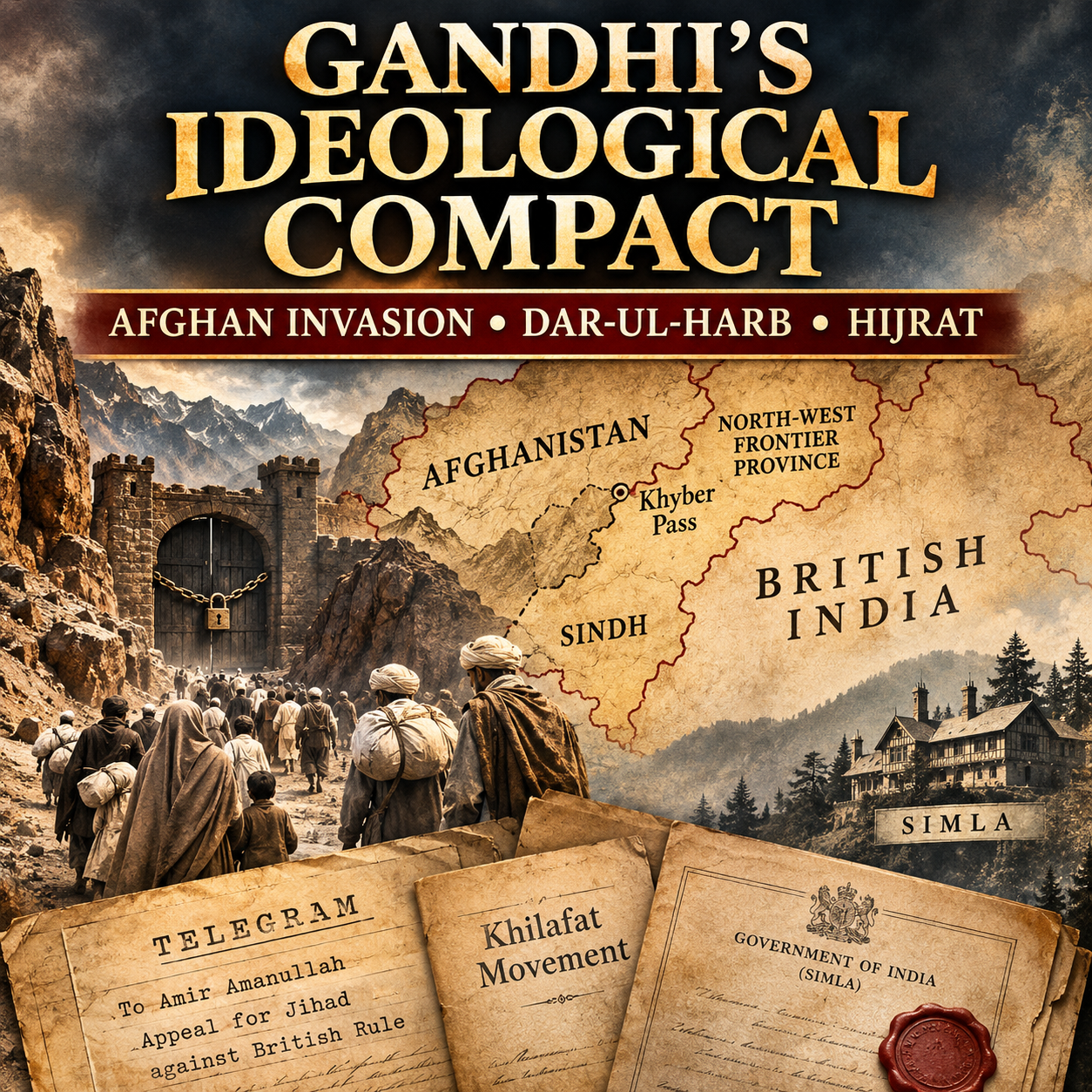
Gandhi’s Ideological Compact: Afghan Invasion, Dar-ul-Harb, and the Hijrat Catastrophe (199)
भारत / GB
Part 199: Mahatma Gandhi’s Peace Efforts | Series Index
The previous blog documented the full cast and the seven stop points: the architects, the financiers, the institutional enablers, and the operational layer that produced the Malabar, August 1921. Why could no one stop it? Why was the coverup in Young India mandatory? This blog, Gandhi’s Ideological Compact, documents the ideological compact Gandhi had underwritten before the uprising began—the theological machinery of Dar-ul-Harb, the invitation to the Afghan Amir, and the catastrophic doctrine that made Malabar inevitable.
Thank you for reading this post, don't forget to subscribe!THE IDEOLOGICAL COMPACT — THE DOCTRINAL SUB-STRUCTURE
The motive: Gandhi could not disown the Moplah rebels in August 1921 because he had spent the preceding eighteen months validating and sheltering the exact theological doctrine on which they acted. The Malabar uprising was not a deviation from the Khilafat programme; it was its literal, operationalised execution.
The apparatus: British India had been canonicalized as Dar-ul-Harb (Abode of War) by the clerical leadership. The Islamic canon offered two absolute obligations: armed Jihad or religious migration (Hijrat). When the 1920 Hijrat to Afghanistan collapsed in human ruin, armed mobilization remained the sole theological recourse.
The Afghan pact: Khilafat leaders openly invited the Amir of Afghanistan to wage Jihad against the Raj, a project Gandhi publicly defended in Young India. When Viceroy Reading threatened criminal prosecution at Simla, Gandhi actively intervened to protect the Ali brothers, preserving the clerical mobilization apparatus that detonated across Malabar three months later.
The Doctrinal Foundation: Dar-ul-Harb and the Ulema
Under the theological guidance of Maulana Abul Kalam Azad, who later became the first education minister of India, and the Jamiat Ulema-e-Hind, a body created for this very cause, British India had been formally declared Dar-ul-Harb (the Abode of War). Islamic canon dictated two responses: either offensive Jihad to re-establish Islamic supremacy or Hijrat (religious flight) to an Islamic land (Dar-ul-Islam).
Gandhi did not merely tolerate this theological framework; he incorporated it into the operational foundation of his mass mobilization, endorsing a clerical worldview whose core categories admitted no concept of equal, secular citizenship.
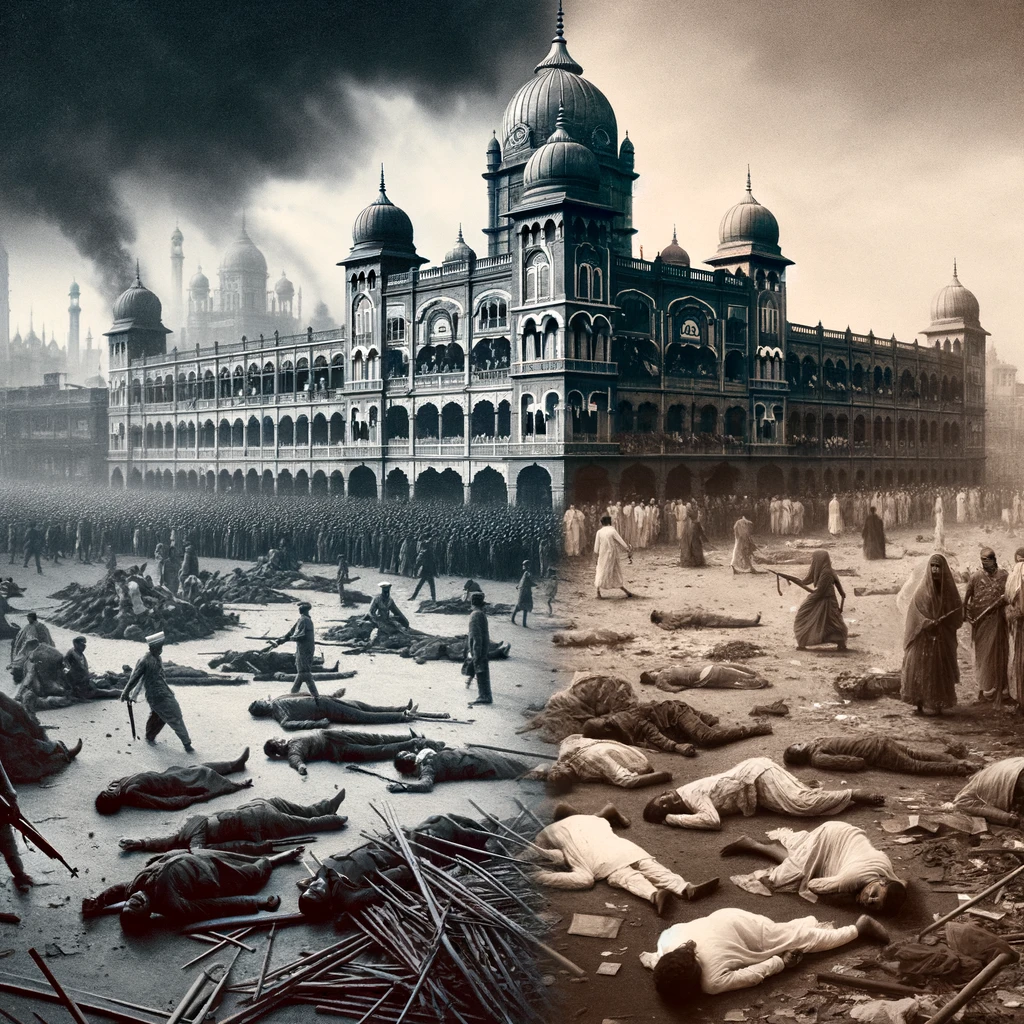
The Hijrat Catastrophe of 1920
The first practical output of this theological doctrine was the disastrous Hijrat movement of mid-1920. Believing that remaining under British Christian rule endangered their eternal salvation, upwards of 40,000 to 50,000 Indian Muslims sold their lands, abandoned their ancestral homes across Sindh and the North-West Frontier Province, and marched in long caravans toward Afghanistan.
The result was unmitigated catastrophe. Amir Amanullah Khan of Afghanistan, unable and unwilling to absorb an impoverished mass of tens of thousands, closed his borders and turned them back at bayonet point. Thousands died of disease, heat exhaustion, and starvation along the Khyber Pass; those who returned to India found themselves landless, destitute, and deeply radicalized.
With the exit-route of Hijrat thoroughly foreclosed by August 1920, the theological imperative inside Dar-ul-Harb swung inexorably toward the remaining canonical alternative: armed Jihad.
Inviting the Amir: The Afghan Invasion Compact
In early 1921, Khilafat leader Maulana Muhammad Ali delivered speeches (notably at Madras in April 1921) asserting that Muslims must not resist an Afghan invasion, while British intelligence dossiers intercepted communications revealing clandestine appeals urging Amir Amanullah Khan to wage Jihad against the Raj—an invitation whose logical end was the subjugation of India to foreign Islamic rule, exposing Hindus to the Jizia system of Aurangzeb period and other destructions as caused under him.
When the national press and moderate leaders expressed sheer horror at the prospect of an Afghan invasion, Gandhi stepped forward in Young India (4 May 1921, “The Afghan Alarm”) not to repudiate Muhammad Ali, but to provide him with intellectual and political cover:
“I would, in a sense, certainly assist the Amir of Afghanistan if he waged war against the British Government… It is no part of the duty of a non-violent non-co-operator to assist the Government against war made upon it by others.”
Gandhi explicitly legitimized the idea of a foreign Islamic potentate invading India to overthrow the British, treating the existential security of the non-Muslim population as a secondary detail subordinate to the Khilafat demand.
Gandhi’s Ideological Compact: The Simla Protection
During the six historic Simla interviews in May 1921, Viceroy Lord Reading presented Gandhi with direct transcripts of the Ali brothers’ inflammatory speeches openly calling for violence and foreign intervention, demanding an explicit public retraction to avert nationwide insurrection — in an effort to protect the Ali brothers from punitive action under British laws, Gandhi brokered a narrow public apology and retraction on their behalf.
The Viceroy had the warrants ready under Sections 124A and 153A of the Indian Penal Code. Gandhi’s legal intercession saved the Ali brothers from prison, but he deliberately narrowed their retraction to a vague regret for any unintended incitement to violence, leaving their organizational apparatus intact. The Khilafat Volunteer Corps continued drilling in uniform, armed with knives and spears, through the summer of 1921. Reading noted with satisfaction that he had extracted an apology; Gandhi congratulated himself on keeping the coalition alive. Three months later, the machine left untouched at Simla erupted in Malabar.
Gandhi’s Ideological Compact: The Ambedkar Documentation
Dr. B.R. Ambedkar, in Chapter 7 of his monumental work Pakistan or the Partition of India (1940), cut through decades of hagiography to document the direct structural link between Gandhi’s Khilafat bargain and the communal explosions that followed:
“The Ali Brothers did not hesitate to enter into a conspiracy with the Amir of Afghanistan to invade India… Gandhi was so much obsessed by the necessity of establishing Hindu-Muslim unity that he was prepared to make light of the doings of the Moplahs and the Khilafats… He began to justify the Afghan invasion. The resolution of the Congress passed at Ahmedabad was an apology to the Moplahs.”
Ambedkar demonstrated what the national narrative had suppressed: Gandhi’s Malabar coverup was not an ad-hoc reaction to an unexpected local riot. It was a structural necessity. Had Gandhi honestly condemned the Moplah insurgents, he would have been forced to condemn the very theological doctrines of Dar-ul-Harb, Jihad, and the Khilafat Volunteer Corps that he had legitimized on the national stage.
The Seminary Without Cadres: Abdul Bari’s Private Admissions
Prior to Gandhi’s direct patronage, the ulema networks possessed zero administrative capacity to run a sustained, nationwide political agitation. The Firangi Mahal network in Lucknow and the Deobandi fraternity were traditional scholarly guilds: their historic remit was limited to issuing fatwas on ritual jurisprudence (fiqh) to localized circles of disciples across the United Provinces and Bihar. They had no district secretariats, no cadre rolls, and no propaganda machinery capable of mass civil disruption.
The primary record settles their operational impotence. When Gandhi visited Firangi Mahal in March 1919, Maulana Abdul Bari’s private correspondence reveals a leadership stranded without logistics. As documented in the archival records surveyed by Francis Robinson (Separatism Among Indian Muslims, Ch. 7–8), Abdul Bari repeatedly complained of a desperate shortage of funds, an absence of organized field workers, and an inability to mobilize urban Muslim commercial classes.
In his May 1919 communications to Gandhi (CWMG Vol. 15, pp. 272–274), Bari conceded that the ulema were politically disarmed without mass patronage. The ulema did not possess the logistical scaffolding to reach the illiterate rural masses in distant provinces like Malabar until the Indian National Congress opened its provincial committees, subsidized travel, and provided the organizational sinews of secular political agitation.
The Machine That Was Left Running
The victims of Gandhi’s Malabar detonation were not combatants. They had no seat at Simla. They had not been consulted when the Khilafat cause was adopted as the Non-Cooperation Movement in the name of “Efforts for Swaraj within one year.” They had not been told that the Khilafat Volunteer Corps drilling in their districts operated on theological premises that explicitly overrode Gandhi’s prohibition on violence. They bore the full material consequence of a settlement negotiated in a viceregal lodge in the hills.
Gandhi’s Malabar detonation is not established by inference. It is established by the convergence of official government records, military after-action dispatches, the memoirs of his own Congress officers, and the contemporaneous warnings of two former Congress Presidents. It fulfilled precisely what Swami Shraddhanand had warned Gandhi about in December 1920 at the Nagpur Congress—when the Swami heard Khilafat clerics chanting verses of Jihad and the slaying of kafirs (invoking the Quran’s sword verses), only to have Gandhi dismiss the danger with the claim that they were aimed strictly at the British. What Shraddhanand foresaw, Malabar suffered. The machine that produced August 1921 in Malabar had been documented, warned against, and left running.

Invitation To Defence
The doctrinal evidence of the Khilafat movement is preserved in Maulana Abul Kalam Azad’s 1920 Hijrat Ka Fatwa, the founding resolutions of the Jamiat Ulema-e-Hind, and Maulana Muhammad Ali’s Madras address of April 1921. Gandhi’s explicit defense of an Afghan invasion is on the record in Young India (4 May 1921). The CID intelligence transcripts and the Simla minutes are preserved in the Reading Papers (MSS. EUR. E. 238). Dr. B.R. Ambedkar documented the entire conspiracy in Chapter 7 of Pakistan or the Partition of India. We invite the defence to demonstrate that the Moplah rebellion operated on any doctrine other than the very pan-Islamic theology Gandhi underwrote and protected at Simla.
“The coverup in Young India was not a momentary lapse of moral judgment. It was legal and political self-defense. To tell the truth about Malabar was to confess that the entire theological premise of the Khilafat alliance—Dar-ul-Harb, the invitation to Afghanistan, the armed volunteer corps—was fundamentally irreconcilable with non-violence, civic equality, and national freedom. Gandhi chose to preserve the compact and let the dead of Ernad bear the cost.”
Feature Image: Click here to view the image.
Videos
Glossary of Terms
1. Gandhi’s Ideological Compact: The central phrase of the blog, describing the political and ideological understanding between Gandhi and Khilafat leadership, as examined through the theological doctrines, Afghan invasion appeals and organizational arrangements discussed in the article.
2. Dar-ul-Harb: Literally, the “Abode of War”; a theological classification applied by the clerical leadership to British India, according to the blog, with consequences for the religious obligations of Muslims living under that authority.
3. Dar-ul-Islam: Literally, the “Abode of Islam”; a territory regarded in the theological framework discussed in the blog as being under Islamic authority, and the intended destination of religious migration.
4. Ulema: Muslim religious scholars who interpret religious law, issue religious rulings and provide theological guidance. The term is used in the blog for the clerical leadership associated with the Khilafat movement.
5. Jihad: A religious term referring to struggle or striving. In this blog, it specifically refers to the armed struggle discussed as one of the prescribed responses to the classification of British India as Dar-ul-Harb.
6. Hijrat: Religious migration from a territory classified as Dar-ul-Harb to a territory regarded as Dar-ul-Islam. The blog uses the term particularly for the mass migration to Afghanistan in nineteen twenty.
7. Khilafat Movement: A political and religious movement in British India that sought to defend the position of the Ottoman Caliph. The blog examines its alliance with Gandhi and the Indian National Congress.
8. Afghan Invasion Compact: A phrase used in the blog for the appeals by Khilafat leaders inviting Amir Amanullah Khan to wage war against British India, alongside Gandhi’s recorded statement concerning such a conflict.
9. Simla Protection: The blog’s term for Gandhi’s intervention during his six meetings with Viceroy Lord Reading in May nineteen twenty-one, which resulted in a limited apology and retraction by the Ali brothers.
10. Khilafat Volunteer Corps: An organized body associated with the Khilafat movement. The blog describes its continued drills in uniform, with knives and spears, during the summer of nineteen twenty-one.
11. Moplah: A historical name for the Muslim community of the Malabar region of Kerala. In this blog, the term is used in connection with the Moplah uprising of nineteen twenty-one.
12. Jizia: A tax historically imposed on certain non-Muslim subjects under Islamic rule. The blog refers to the Jizia system associated with the period of Aurangzeb while discussing the consequences feared from an Afghan invasion.
13. Indian Penal Code (IPC): The principal criminal code applicable in British India. The blog refers specifically to Sections 124A and 153A in connection with the contemplated legal action against the Ali brothers.
14. CWMG: Abbreviation for The Collected Works of Mahatma Gandhi, the documentary collection cited in the blog for Maulana Abdul Bari’s communications with Gandhi in May nineteen nineteen.
15. The Seminary Without Cadres / Malabar Detonation: Two distinctive expressions used in the blog. “The Seminary Without Cadres” describes the claimed lack of administrative and organizational capacity within the ulema networks before Congress support. “Malabar Detonation” describes the blog’s interpretation of the uprising in Malabar as the eventual eruption of an organizational and ideological apparatus previously left intact.
#Gandhi #Khilafat #Hijrat #Afghanistan #Malabar #IndianHistory #BritishIndia #Jihad #HinduinfoPedia
Scan Through The Entire Series at