
Gandhi’s Kanpur Dissent: Cut Evidence Against Congress’s All-India Claim (228)
भारत / GB
Part 228: Mahatma Gandhi’s Peace Efforts (Residue Enters Constitution) | Series Index
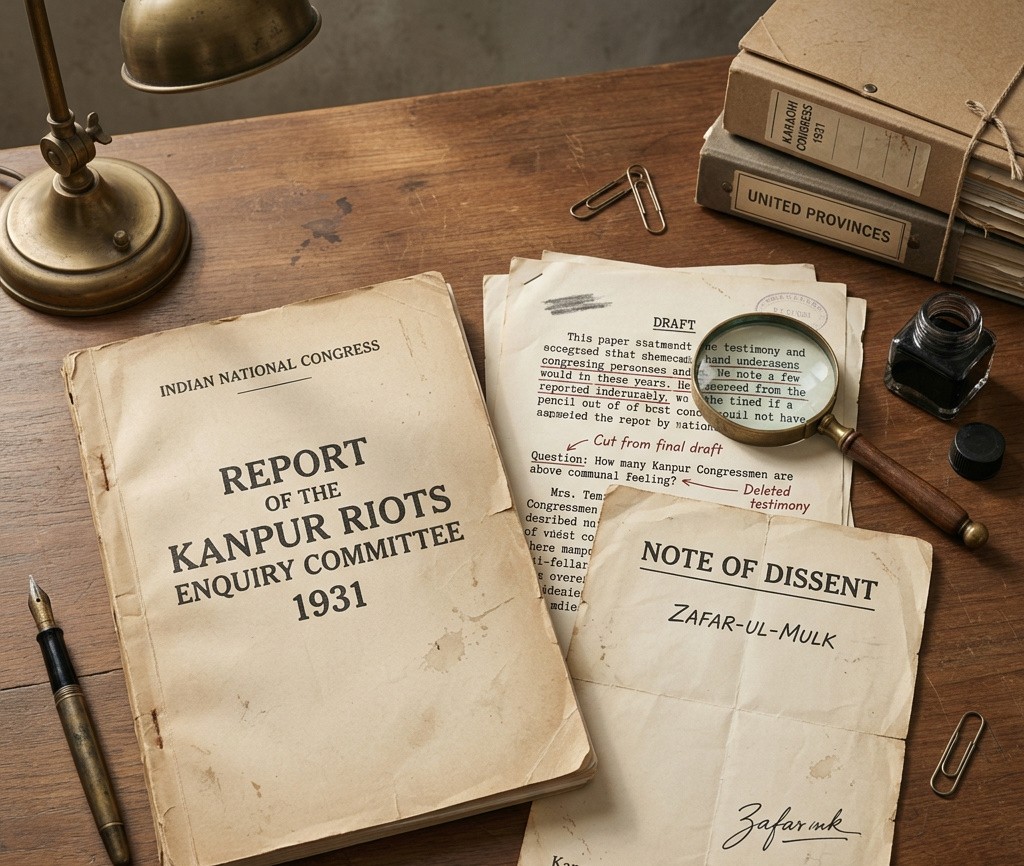
Blog 227 documented the Kanpur riot of March 1931: a protest hartal nineteen days into the Delhi Pact truce, between 400 and 500 dead by the Government commission’s count, a Government verdict published by June 1931, and a Congress inquiry whose report reached the Congress President in October 1931 — while Gandhi was in London — and was not in print until 1933. This instalment opens that Congress report and examines the one part of it its own committee did not agree on: the note of dissent by member Zafar-ul-Mulk, and the witness testimony about Kanpur’s Congressmen that, by his account, was removed from the final text.
THE DISSENT RECORD: THE CONGRESS KANPUR RIOTS ENQUIRY COMMITTEE, 1931
The Action Taken: The Congress’s own six-member committee asked witnesses how many of the thirty prominent Congressmen of Kanpur were above communal feeling. The answers ran from “two or three” to “about 5 per cent”. Passages carrying that testimony were, according to committee member Zafar-ul-Mulk, deleted from the final draft after the whole committee had approved them; the chairman, Bhagwan Das, recorded that after Zafar-ul-Mulk left Benares practically the whole report was revised and re-arranged. Zafar-ul-Mulk restored the testimony to the record the only way left to him — in a signed note of dissent.
Who Paid the Price: The readers of the report, who received a portrait of Congress workers that the committee’s own evidence did not support; and the dissenting member, whose request to restore the deleted passages was refused without a satisfactory reason.
Why This Matters: The Congress’s claim to stand above community — the claim Gandhi carried to London in 1931 — was preserved in its own inquiry by editing its own evidence. The testimony survives only because one member put it in a dissent.
1. The Question the Committee Asked
The committee appointed at the Karachi Congress in March 1931 — Bhagwan Das (chairman), Pandit Sunderlal (secretary), Purushottam Das Tandon, Manzar Ali Sokhta, Abdul Latif Bijnori and Zafar-ul-Mulk — took evidence on more than the riot itself. It put a direct question to witnesses: of the thirty prominent Congressmen in Kanpur, how many were absolutely above communal feeling? The answers, as reproduced in Gandhi’s Kanpur Dissent, the note Zafar-ul-Mulk appended to the report (Barrier reprint, pp. 462–465), were these:
| Witness (as numbered in the note) | Answer on the thirty prominent Kanpur Congressmen | Reprint page |
|---|---|---|
| Witness 1 | Men wholly above Hindu–Muslim feeling were “a microscopic minority” in the Congress organisation there — “not more than two or three”; the rest were “defensive communalists and not offensive communalists” | p. 462 |
| Witness 3 | Among the thirty there were “all grades of people” in communal feeling | p. 464 |
| Witness 8 | Roughly 5 per cent were absolutely above communal feeling | p. 465 |
The note excerpts nine witnesses in all, and every excerpt describes communal attitudes among Congress members. Two limits must be stated plainly. The testimony concerns the Congress organisation in Kanpur, not the national party. And the witnesses spoke of “defensive” communalism — men who had taken a side, not men who had started the fight. Neither limit changes what the evidence was: the Congress’s own inquiry was told that, in the city where the riot happened, almost none of its leading local members stood above community.
2. What Was Cut — and Who Said So
The note is not only a disagreement over conclusions. It is a record of how the report was put together:
- Approved, then deleted: Zafar-ul-Mulk wrote that the passages he reproduced had been discussed and approved by the whole committee, and were deleted afterwards. He protested; no satisfactory reason was given; the passages were not restored even at his request. The interviews of about thirty Congress members, he said, were left out of the final draft (Barrier reprint, p. 432).
- The chairman’s own account: Bhagwan Das did not deny the revision. He wrote that after Zafar-ul-Mulk left Benares, “practically the whole Report was revised and re-arranged” (p. 432).
- The chairman’s explanation: Das treated the testimony as showing that many Kanpur Congress workers had not been able to rise to the standard set by Ganesh Shankar Vidyarthi (p. 434) — a measure of individual failing rather than a finding about the organisation.
The final report, as historians have read it, presented the Congress as the party of all Indians regardless of creed and traced the communal problem to British divide-and-rule. The testimony in Gandhi’s Kanpur Dissent did not fit that frame, and the frame was kept. The historian Priya Agarwal, working from the reprint, concludes that on the evidence of the witnesses in the note the Congress was not wholly free of religious antagonism.
3. Who Zafar-ul-Mulk Was — and What the Record Does Not Say
The documented facts about the dissenter are few, and this series will not add to them. He was one of six authors, all well-known members of the All-India Congress Committee active in the United Provinces Congress committees, and he appears to have been based in Lucknow. He was appointed by the Congress itself, at its own session, to its own inquiry.
What the record does not establish is his political camp. No source consulted for this instalment places him with the Nationalist Muslims around Abul Kalam Azad and M. A. Ansari, with the radicalism of Hasrat Mohani (Blog 218), or with the constitutionalism Jinnah stood for before Nagpur. Labelling him would add an inference the evidence cannot carry.
The weight of Gandhi’s Kanpur Dissent does not depend on his politics. It depends on his position. The witness answers were not offered by a British official, a League spokesman or a hostile press; they were gathered by a Congress committee and preserved by a Congress member, against the decision of the committee’s majority to leave them out.
4. The Edited Report and the London Claim
The calendar set out in Blog 227 now has a second layer:
- March–October 1931: The committee took its evidence, including the answers on the thirty Kanpur Congressmen, and its final text was revised after the dissenting member left Benares.
- September–December 1931: At the Second Round Table Conference, Gandhi argued that the Congress represented all of India across communities (Blog 153).
- 1933 onward: The report reached print with the dissent attached. Advance copies were seized and the Government demanded security from the press. The full text, note included, returned to readers only with N. Gerald Barrier’s reprint in 1976, and the National Book Trust issued the report again in 2005.
Whether Gandhi saw the testimony before London is not shown by any source consulted here, and this instalment does not assert it. What the record does show is narrower: the claim of a single, community-free national representation was made in London while the Congress’s own inquiry held evidence against it from the riot city — evidence its majority had already cut. That is the second entry of Gandhi’s Kanpur Dissent into the constitutional record that the following instalments trace.
The note of dissent, the chairman’s own acknowledgment of the revision, and the witness answers printed at pages 432–465 of the 1976 reprint leave the sequence clear: Gandhi’s Kanpur Dissent is the Congress inquiry’s own testimony about its own members, approved by its own committee, removed from its own report, and saved by its own dissenting member.
Invitation To Defence
The Note of Dissent by Zafar-ul-Mulk and Bhagwan Das’s account of the report’s revision, both reprinted in N. Gerald Barrier (ed.), Roots of Communal Politics (1976), are established exhibits. The defence is invited to produce the committee’s recorded reason for deleting the approved passages, any version of the final report that restored them, or any Congress statement before 1933 that addressed the witnesses’ evidence on the thirty prominent Congressmen of Kanpur.
Asked how many of Kanpur’s thirty leading Congressmen stood above communal feeling, the Congress’s own witnesses answered “two or three” and “about 5 per cent”. The passages were approved by the committee and then cut; the chairman conceded that the report was revised once the dissenting member left Benares — and the evidence survived only in his note of dissent.
Feature Image: Click here to view the image.
Feature Image: Click here to view the image.
Videos
Glossary of Terms
1. Kanpur Riots of 1931: Communal violence that occurred in Kanpur in March 1931, resulting in hundreds of deaths and prompting separate Government and Congress inquiries.
2. Congress Kanpur Riots Enquiry Committee: A six-member committee appointed at the Karachi Congress in March 1931 to investigate the Kanpur riots and examine the conduct and circumstances surrounding the violence.
3. Note of Dissent: A separate statement submitted by a committee member who disagrees with the final report or its treatment of evidence. In this blog, it refers to Zafar-ul-Mulk’s account of testimony allegedly removed from the approved report.
4. Zafar-ul-Mulk: A member of the six-person Congress inquiry committee who challenged the removal of witness testimony and preserved the disputed passages in his signed note of dissent.
5. Bhagwan Das: Chairman of the Congress Kanpur Riots Enquiry Committee, who acknowledged that practically the whole report was revised and rearranged after Zafar-ul-Mulk left Benares.
6. Communal Feeling: Attitudes, loyalties or prejudices associated with religious community identity. The inquiry used this expression when questioning witnesses about the outlook of prominent Kanpur Congressmen.
7. Defensive Communalism: A term used in the witness testimony to describe individuals who had adopted a communal position defensively rather than initiating communal hostility.
8. Offensive Communalism: A term contrasting with defensive communalism, referring to actively initiating or promoting communal hostility rather than responding defensively to perceived threats.
9. All-India Claim: The Congress’s political claim to represent Indians across religious and community divisions, including its assertion of national representativeness during the Second Round Table Conference of 1931.
10. Second Round Table Conference: The constitutional conference held in London from September to December 1931, where Gandhi represented the Congress and argued for its claim to speak for India across communities.
11. Delhi Pact: The agreement concluded between Gandhi and the British Government in March 1931, also known as the Gandhi-Irwin Pact, which established a temporary political truce.
12. Ganesh Shankar Vidyarthi: A Congress leader and journalist who died while attempting to protect people during the Kanpur riots. His conduct was cited by Bhagwan Das as a standard that other Congress workers had failed to achieve.
13. N. Gerald Barrier: Historian and editor of the 1976 reprint of the historical material in Roots of Communal Politics, which preserved the inquiry report and its note of dissent for subsequent readers.
14. Congress Inquiry Report Revision: The alteration and rearrangement of the committee’s report after the departure of Zafar-ul-Mulk from Benares, including the disputed removal of witness testimony described in his dissent.
15. Constitutional Record: The documentary and historical evidence relevant to understanding India’s constitutional development, political representation and competing claims of national legitimacy.
#Gandhi #Kanpur #Congress #IndianHistory #GandhiHistory #CommunalRiots #KanpurRiots #IndianPolitics #History #HinduinfoPedia
Scan Through The Entire Series at