
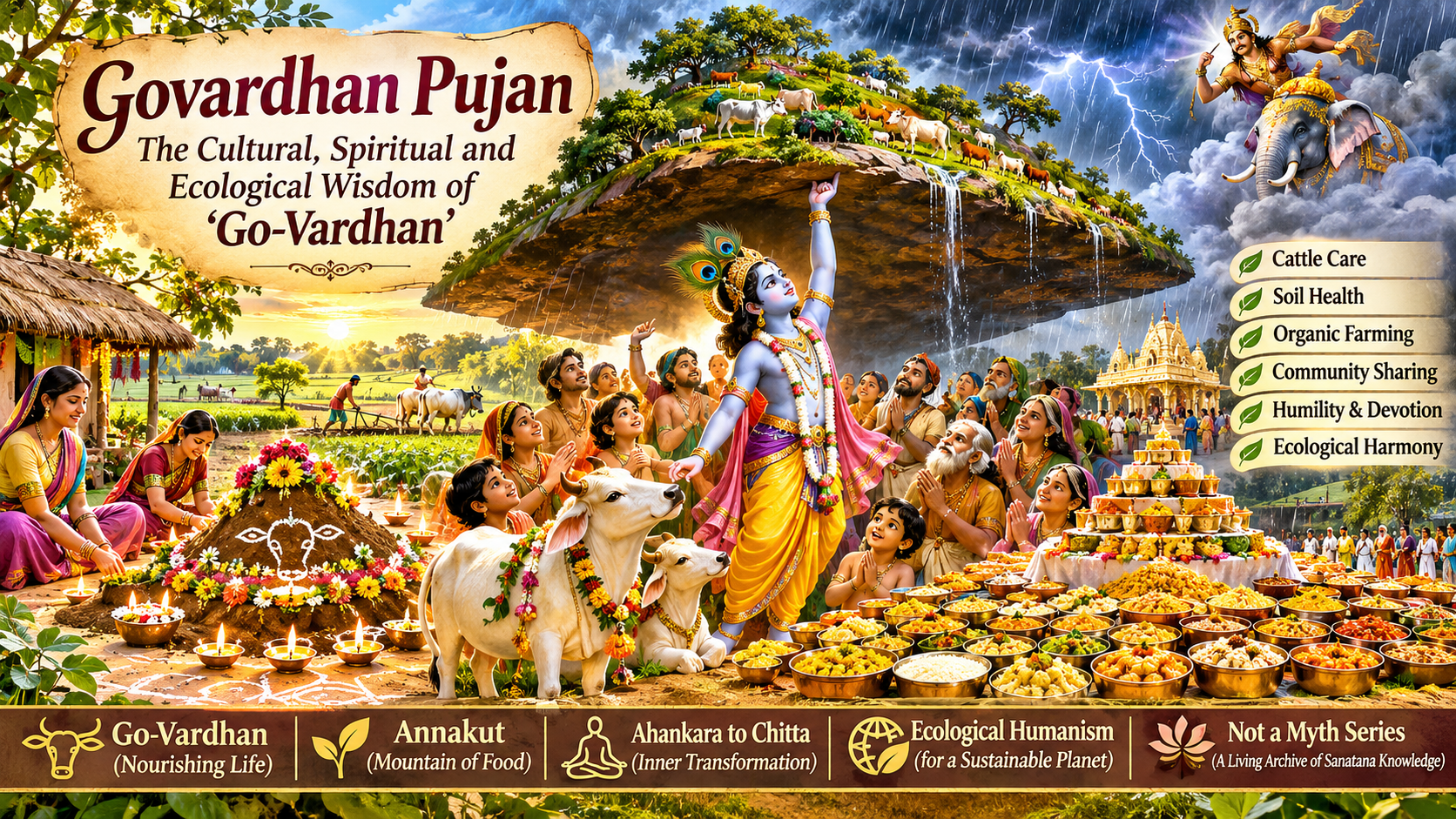
Govardhan Pujan: The Cultural Engine of Rural Bharat and the Living Science of ‘Go-Vardhan’
Hinduism is not an “ism,” a faith to be signed up for, or a belief system closed by a single book. It behaves like a living organism: it renews itself from age to age while keeping a defined system for every part of human life, so that society stays engaged, productive and whole. Its festivals are the clearest example. They are not only acts of worship; they are annual occasions that gather people, rejuvenate them after hard work and teach something practical every single time.
Thank you for reading this post, don't forget to subscribe!Govardhan Pujan, also called Annakut, shows this design at work. It is observed on Kartika Shukla Pratipada, right after the Deepavali Amavasya, opening Kartika, the month the Skanda Purana praises with the verse “na kārtika-samo māso”: there is no month equal to Kartika. In 2026 the tithi timing places Govardhan Pujan in India on Tuesday, 10 November, one day later than usual after Deepavali. In the same Pratipada, Gujarat celebrates its New Year (Bestu Varas), and the South welcomes back King Bali on Bali Padyami. One day, many regional faces: a living tradition, not a fixed dogma.
What ‘Go-Vardhan’ Really Asks of Us
The name carries its own instruction. ‘Go’ means the cow, and by extension the earth and the senses; ‘Vardhan’ means nourishing, increasing and helping to flourish. Beyond the beloved story of Sri Krishna lifting the hill, the festival is an annual reminder to grow the cow, the pasture and the soil together. In many villages cattle are bathed, their horns painted, garlands and bells placed on their necks, and they are fed first before the family eats. It is a yearly check on the health of the herd that keeps the farm alive.
The Govardhan mound shaped from cow dung (gomaya) in courtyards carries the same message. On a farm, dung is not waste. It is manure, compost, fuel and plaster for the floor. By shaping it into a sacred hill and worshipping it, families kept alive, without a textbook, the idea that fertile soil depends on returning organic matter to the land. This is what the Not a Myth series on HinduinfoPedia calls a knowledge system woven into custom: people practise the science long before they can name it.
Vardhan of Go in Today’s Bharat
The challenge is real. India’s 20th Livestock Census (2019) counted about 142 million indigenous and non-descript cattle, roughly 6% fewer than in 2012, while crossbred cattle rose sharply; the same census estimated around 50 lakh stray cattle. Govardhan’s message, that the cow must be cared for across her whole life, is a direct answer to this.
Bharat is responding in its own way. The Rashtriya Gokul Mission, launched in December 2014, works to conserve and improve native breeds such as Gir, Sahiwal, Rathi, Tharparkar and Red Sindhi, with a revised outlay of ₹3,400 crore for 2021–26. The GOBARdhan scheme (April 2018) under Swachh Bharat Mission (Grameen) helps villages turn cattle dung and crop waste into biogas and organic manure, so that an unproductive cow still adds value to her family. Thousands of community gaushalas, many funded by festival-season donations, look after old and abandoned cattle. Govardhan Pujan is the right day for every household to support one of these efforts.
Annakut: The Architecture of Community Nourishment
The feast of Annakut, a “mountain of food,” completes the picture. Tradition says Krishna held the hill for seven days, missing his eight daily meals, so devotees offer Chhappan Bhog, 56 dishes, and many temples offer far more. Grains, pulses, greens and milk products from the new harvest are cooked together and shared with everyone, regardless of caste or income. After the spending of Deepavali, Annakut pools what each home has, so no family goes without, and it welcomes winter with warming foods like millets, jaggery, sesame and ghee.
Related Investigation: See how Sanatana knowledge systems are documented across astronomy, medicine and ecology in the
Not a Myth Series: A Living Archive of Sanatana Knowledge Systems, and read the global perspective on this festival:
A Festival That Teaches Every Year
Each part of the day trains the community: children learn to shape the mound and tend the cattle, women and men cook and serve together, and elders retell why the hill, not a distant ritual, deserved worship. In a time of chemical farming, falling native breeds and lonely city lives, reviving the true spirit of ‘Go-Vardhan’ is not nostalgia. It is a practical plan for soil health, humane dairying and a village that feeds itself. That is not a myth. That is Hinduism at work.
Glossary of Terms
1. Spiritual Physics: A distinctive phrase used in this blog to describe the inner principles governing spiritual transformation, consciousness and the relationship between individual awareness and the Divine.
2. Ahankara: The sense of individual ego or identification with oneself as the independent doer, often creating pride, attachment and the illusion of personal control.
3. Chitta: The mind-stuff or field of consciousness in which thoughts, memories, impressions and mental tendencies arise and are processed.
4. Ṛta: The Vedic principle of cosmic order, universal harmony and the natural law governing the functioning of the universe.
5. Dāmodara-māsa: Another name for the Hindu month of Kartika in Vaishnava tradition, associated with Sri Krishna in his Dāmodara form.
6. Govardhan Dhāraṇa: The sacred episode in which Sri Krishna lifts Govardhan Hill to protect the people and cattle of Vraja from torrential rain sent by Indra.
7. Mada: Pride, arrogance or intoxication with power, status or personal achievement, which obstructs humility and spiritual understanding.
8. Indriyas: The sensory faculties through which human beings perceive and interact with the external world. In philosophical discussions, the term includes the organs of perception and action.
9. Sāṁvartaka Clouds: The destructive clouds associated with cosmic dissolution, described in the Govardhan narrative as the forces unleashed by Indra to devastate Vraja.
10. Ātman: The eternal Self or innermost spiritual reality, distinct from the temporary body, ego and changing mental states.
11. Surabhi: The celestial mother of cows, also associated with Kamadhenu, who appears in the Govardhan narrative to honour Krishna following Indra’s surrender.
12. Kamadhenu: The divine wish-fulfilling cow in Hindu tradition, representing abundance, nourishment and the sacred importance of cattle.
13. Govinda: A name of Sri Krishna meaning the protector and benefactor of cows and, in broader interpretations, the earth and the senses.
14. Sattva: One of the three Gunas in Hindu philosophy, representing purity, harmony, clarity, balance and spiritual elevation.
15. Govardhan Śilā: Sacred stones associated with Govardhan Hill and worshipped by devotees as manifestations of Sri Krishna.
#Govardhan #Krishna #Govinda #BhagavadGita #Bhagavatam #Vedanta #Hinduism #SanatanDharma #Spirituality #Ahankara #Chitta #Bhakti #Kartika #HinduinfoPedia