
Gandhi’s Great Trial: Two Hours, Six Years, and the Thirty Thousand Left Behind (203)
भारत / GB
Part 203: Mahatma Gandhi’s Peace Efforts | Series Index
Blog 202 documented the instrument: the Bardoli Resolution of 11–12 February 1922, by which Gandhi suspended the Non-Cooperation Movement without a British concession, without consulting the thirty thousand then in jail, and without a date for resumption. The movement’s leverage was surrendered at the peak of its mass commitment. Three weeks later, with the threat of mass explosion removed, the colonial state executed the arrest order it had been holding back. This blog, Gandhi’s Great Trial, documents what followed: the trial of 18 March 1922, the exchange between Gandhi and Judge Broomfield, the six-year sentence, and the operational vacuum the Congress was left in when its dominant figure was removed from the field he had already emptied.
GANDHI’S GREAT TRIAL — WHAT THE RECORD SHOWS
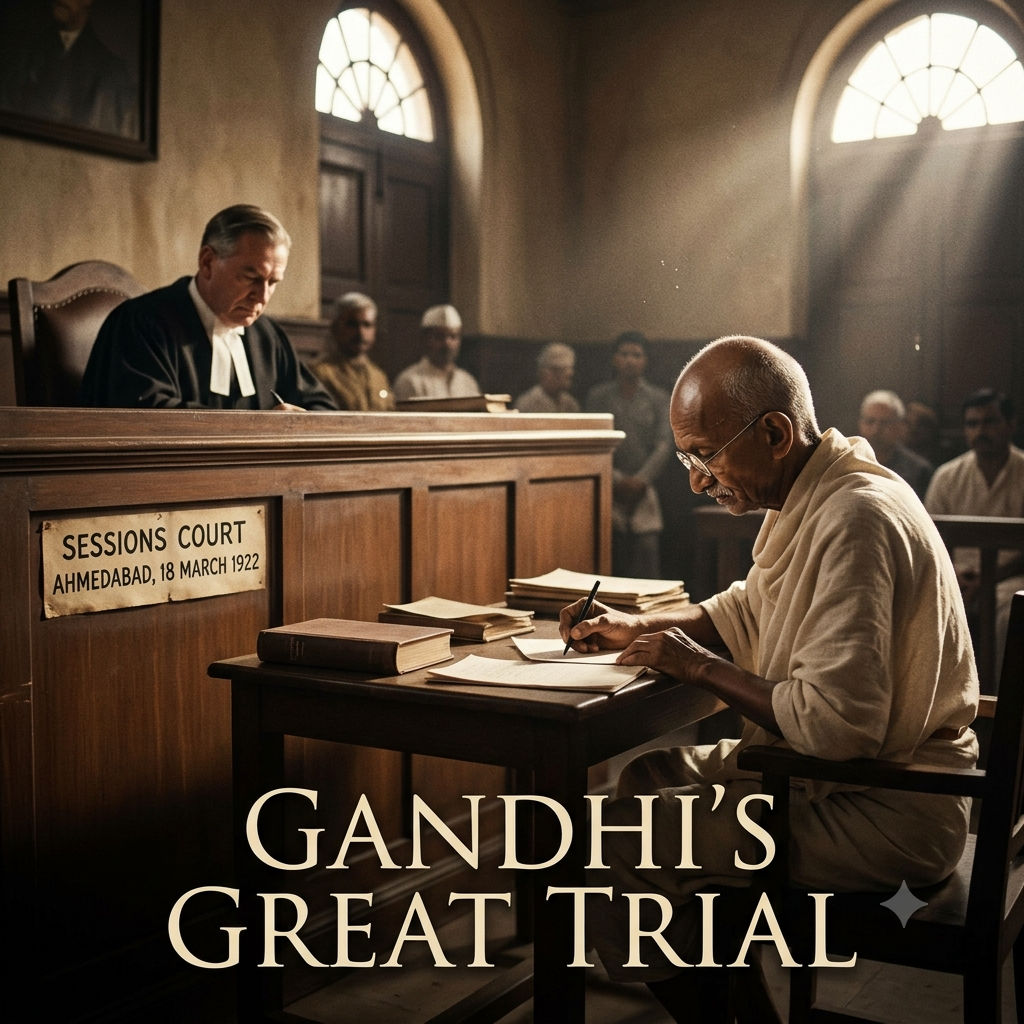
On 18 March 1922, Gandhi appeared before Judge C.N. Broomfield at Ahmedabad on three counts of sedition under Section 124A of the Indian Penal Code. Gandhi pleaded guilty to all three counts. Broomfield sentenced him to two years’ simple imprisonment on each of the three counts — six years in all, running consecutively — while expressing from the bench that he wished the law allowed him to do less. Gandhi thanked him and said the sentence was as light as it could be. The trial lasted less than two hours. Gandhi’s Great Trial is the name the prosecution gives to this proceeding. This blog places its record before the reader.
The Setting: Ahmedabad, 18 March 1922
Gandhi was arrested at Sabarmati Ashram on 10 March 1922 by Superintendent of Police Daniel Healy. The arrest was conducted without incident — no crowd, no hartal, no protest. The movement’s organising apparatus had been stood down by the Bardoli Resolution twenty-seven days earlier. The colonial state had prepared the arrest order months before and had held it back while gauging whether a mass movement would erupt. With the movement suspended by Gandhi’s own hand, the political calculation had changed. The order was now executed in silence. Gandhi’s Great Trial was now eight days away.
The charges rested on three articles Gandhi had written and published in Young India: “Tampering with Loyalty” (29 September 1921), “The Puzzle and Its Solution” (15 December 1921), and “Shaking the Manes” (23 February 1922). Each had called, in varying degrees of directness, for Indians to withdraw cooperation from the colonial administration. Gandhi had not retracted any of them.
The Charges
The indictment charged Gandhi under Section 124A IPC — the colonial sedition provision — for bringing or attempting to bring into hatred or contempt, or exciting or attempting to excite disaffection toward, His Majesty’s Government established by law in British India. The prosecution was conducted by Advocate-General Sir J.T. Strangman. The case was straightforward: Gandhi had written the articles, Gandhi had published them, Gandhi had not denied their content or intent. There was nothing to contest. The charges that opened Gandhi’s Great Trial were not in dispute from the first moment of the proceeding.
Gandhi’s Plea and Written Statement
Gandhi pleaded guilty to all three counts. He submitted a written statement to the court — not a mitigation but an elaboration of his position. The statement set out his evolution from what he described as a “staunch loyalist and cooperator” to a person who had come to regard the continuance of British rule as a “curse.” He did not attribute this to the character of individual British administrators but to the nature of the system itself, which he said produced evil regardless of the intentions of those who administered it.
Gandhi told the court that it was the “highest honour” to be charged with sedition under Section 124A — that the section was designed to suppress the liberty of the citizen, and that it was “a British citizen’s duty” to do as he had done. He asked for no leniency. He invited the court to impose the heaviest penalty.
Broomfield’s Response: The Mutual Elevation
Judge Broomfield’s statement from the bench is the element that gave Gandhi’s Great Trial its place in nationalist memory. The statement is in the trial record.
Broomfield said it was impossible to ignore that Gandhi was in a different category from any person he had ever tried or was likely to try. He acknowledged that in the eyes of millions of Indians Gandhi was a great patriot and a great leader. He said that even those who differed from Gandhi in politics looked upon him as a man of high ideals and of noble and even saintly life. He then stated that he was not trying Gandhi for his politics or his saintliness but for the articles — and that the articles clearly came within the definition of sedition as the law stood. Having credited Gandhi’s preaching against violence and his efforts to prevent it, Broomfield added the sentence that completed the judicial portrait: “how you could have continued to believe that violence would not be the inevitable consequence it passes my capacity to understand.” In judicial prose, a British Sessions Judge stating that a defendant’s professed belief “passes my capacity to understand” is a formal rejection of Gandhi’s claimed innocence regarding the violence his movement had produced.
Broomfield stated that if the law allowed him to do so he would impose a different sentence, and that no one would be better pleased than he if the government of India saw fit to reduce the period. He sentenced Gandhi to two years’ simple imprisonment on each of the three counts — six years in all, the sentences running consecutively — following the precedent set by the Tilak case of 1908. He asked Gandhi if he wished to say anything. Gandhi thanked him for his courtesy and said the sentence was as light as anyone could inflict on him, and that he would consider it a privilege to lay down his life in what he regarded as his country’s service.
The exchange elevated both men in the record it produced. Gandhi’s guilty plea removed any possibility of a contested proceeding that might have embarrassed the government or generated unfavourable legal precedents. His written statement converted the criminal dock into a platform for his moral position. Broomfield’s bench statement — separating personal admiration from institutional obligation — allowed the colonial judiciary to convict Gandhi while simultaneously placing on record its own discomfort with doing so. The colonial administration received the conviction and the removal of the Congress’s dominant figure from the political field. Gandhi received a martyrdom of his own engineering, delivered with the court’s express acknowledgement of his exceptional standing. The proceeding lasted less than two hours. It produced no witnesses, no cross-examination, no legal contest of any kind.
The Sentence and Yerwada
Gandhi was transferred to Yerwada Central Jail in Pune. He was classified as a first-class political prisoner — the highest classification within the colonial prison system — with access to books, writing materials, and limited visitors. He remained at Yerwada until February 1924, when he was released on medical grounds following an emergency appendicitis operation, having served approximately two years of a six-year sentence. No political concession accompanied the release.
The Operational Vacuum
The institutional consequence of the conviction was not merely one man’s absence from the political field. The Congress had been restructured by Gandhi at Nagpur in 1920 to concentrate executive authority in the Working Committee and — by the December 1921 Ahmedabad session — in Gandhi personally as sole executive authority. That machine had no second-in-command with equivalent authority, no succession mechanism, and no plan for the resumption of the movement Gandhi had suspended before his arrest.
The thirty thousand Indians who had gone to jail for the movement remained in colonial custody. The Bardoli Resolution had set no date for resumption. Gandhi’s Great Trial ended without any announcement of when or whether civil disobedience would restart. The Congress Working Committee had a mandate only to administer the constructive programme — khadi, national schools, temperance — that Gandhi had substituted for political action at Bardoli. That programme was not a path to Swaraj.
C.R. Das and Motilal Nehru, released from prison in the months after Bardoli, drew their own conclusion from the vacuum. By December 1922 they had formed the Swaraj Party — a direct repudiation of the Gandhian boycott of the legislative councils. The movement Gandhi had built, suspended, and been imprisoned for had fractured before he was released from the jail its suspension had made possible.
What the Trial Left Intact
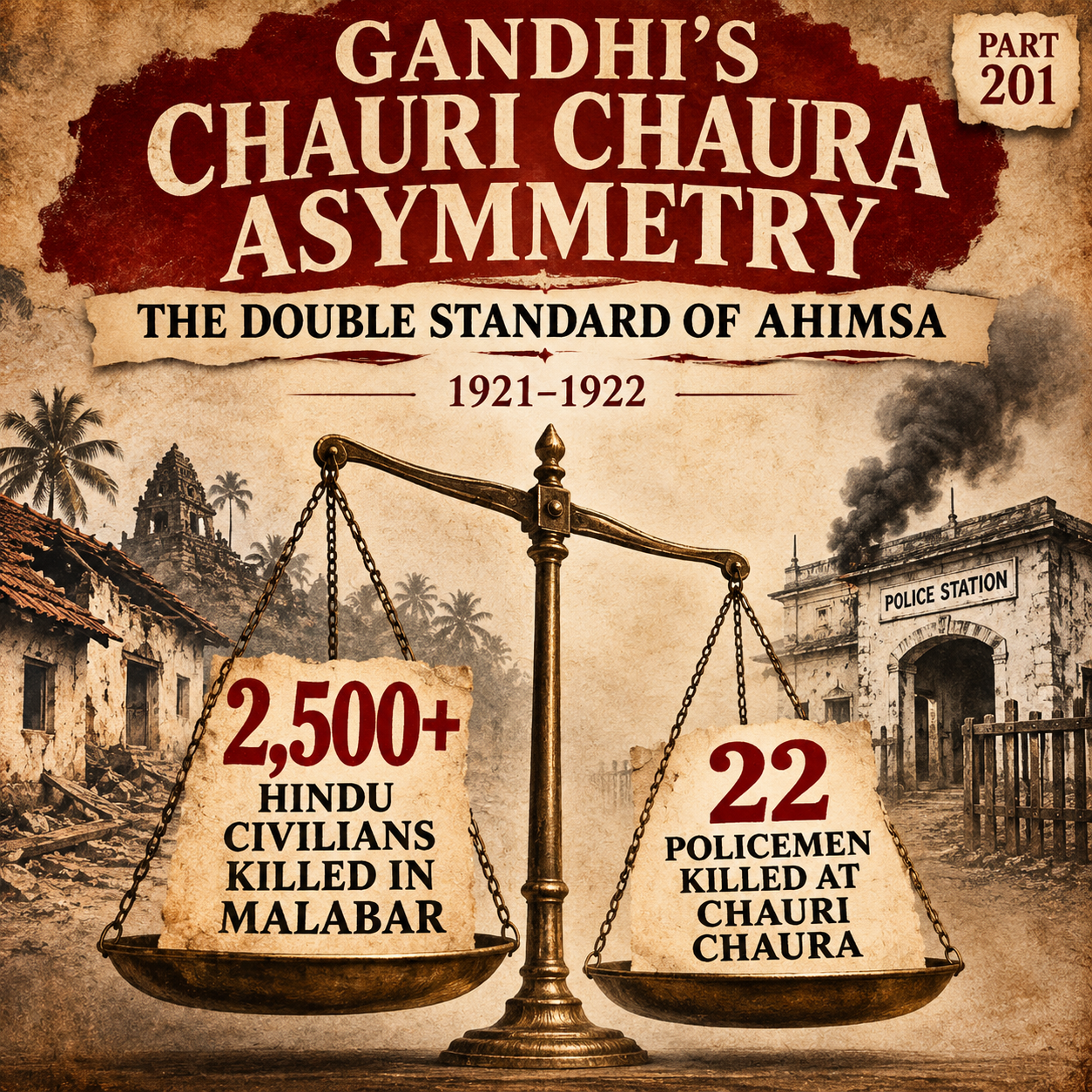
The conviction of 18 March 1922 removed Gandhi from the Congress’s operational field. It did not remove the apparatus he had empowered. The All-India Khilafat Committee remained active. The Jamiat Ulema-e-Hind continued its institutional consolidation. The clerical networks that had operated through 1920–21 — whose theological apparatus had explicitly overridden Gandhi’s Ahimsa doctrine in Malabar — were not examined, disciplined, or held to account in the aftermath of Gandhi’s Great Trial. The Working Committee that had suspended the Non-Cooperation Movement on account of a police station in Gorakhpur had never held to account the formations responsible for over 2,500 deaths in Malabar. That asymmetry survived the trial intact.
Invitation To Defence
The trial record is in the archive. Gandhi’s written statement is in the record. Broomfield’s bench statement is in the record. The sentence is in the record. The thirty thousand Indians who remained in jail after Gandhi’s Great Trial ended — without a date for resumption, without a plan, without the leader who had recruited them to a movement he had then suspended — are in the record. The defence is invited to identify what the trial delivered for those thirty thousand beyond the celebrated exchange between one man’s guilty plea and another man’s regret.
Gandhi pleaded guilty. Broomfield expressed regret. The sentence was six years, served in two. The movement was suspended without a date of resumption. The thirty thousand who had gone to jail for it remained in colonial custody when the trial ended. The courtroom record is celebrated. The operational record is in the same archive. The reader will examine both.
Feature Image: Click here to view the image.
Videos
Glossary of Terms
1. Gandhi’s Great Trial: The sedition trial of Mahatma Gandhi held on 18 March 1922 before Judge C. N. Broomfield in Ahmedabad, in which Gandhi pleaded guilty to all three charges under Section 124A of the Indian Penal Code and received a cumulative six-year sentence.
2. Section 124A IPC: The colonial-era provision of the Indian Penal Code (IPC) dealing with sedition, covering attempts to bring hatred, contempt or disaffection against the government established by law in British India.
3. Sedition: An offence under the colonial legal framework involving the creation or attempted creation of hatred, contempt or disaffection towards the government established by law.
4. Indian Penal Code (IPC): The criminal code applicable in British India under which Gandhi was prosecuted for his published writings.
5. Written Statement: Gandhi’s formal submission to the court explaining his political evolution from a self-described loyalist and cooperator to an opponent of the continuation of British rule. It was an elaboration of his position rather than a plea for reduced punishment.
6. Bench Statement: The formal remarks delivered by Judge Broomfield from the judicial bench, acknowledging Gandhi’s exceptional public standing while explaining the legal basis for his conviction and expressing reservations about the consequences of his political movement.
7. Simple Imprisonment: A category of imprisonment involving confinement without the requirement of hard labour. Gandhi received two years of simple imprisonment on each of the three charges.
8. Consecutive Sentences: Multiple prison sentences served one after another rather than simultaneously. Gandhi’s three two-year sentences therefore amounted to a total of six years.
9. First-Class Political Prisoner: The highest classification within the colonial prison system, providing Gandhi access to books, writing materials and limited visitors during his imprisonment at Yerwada Central Jail.
10. Operational Vacuum: A distinctive expression used in this blog to describe the organisational paralysis within Congress following Gandhi’s arrest, particularly the absence of an equivalent second-in-command, succession mechanism or plan for restarting the suspended movement.
11. Constructive Programme: Gandhi’s prescribed programme of non-political activities, including khadi, national schools and temperance, which the Congress Working Committee was authorised to administer after the suspension of the Non-Cooperation Movement.
12. Swaraj: Self-rule or political independence. In this blog, it refers to the political objective of the national movement, distinguished from the constructive activities substituted for direct political action at Bardoli.
13. Swaraj Party: A political organisation established by C. R. Das and Motilal Nehru in December 1922, advocating participation in legislative councils and directly challenging Gandhi’s policy of boycotting them.
14. Ahimsa Doctrine: Gandhi’s principle of non-violence, which the blog contrasts with the actions of the clerical networks operating during the Malabar uprising and the absence of subsequent institutional accountability.
15. Mutual Elevation: A distinctive expression used in this blog to describe how Gandhi’s guilty plea and Broomfield’s respectful judicial remarks enhanced the public standing of both men while leaving the organisational consequences of the suspended movement unresolved.
#Gandhi #GandhiTrial #IndianHistory #BritishRule #Congress #Swaraj #FreedomMovement #Khilafat #History #HinduinfoPedia