
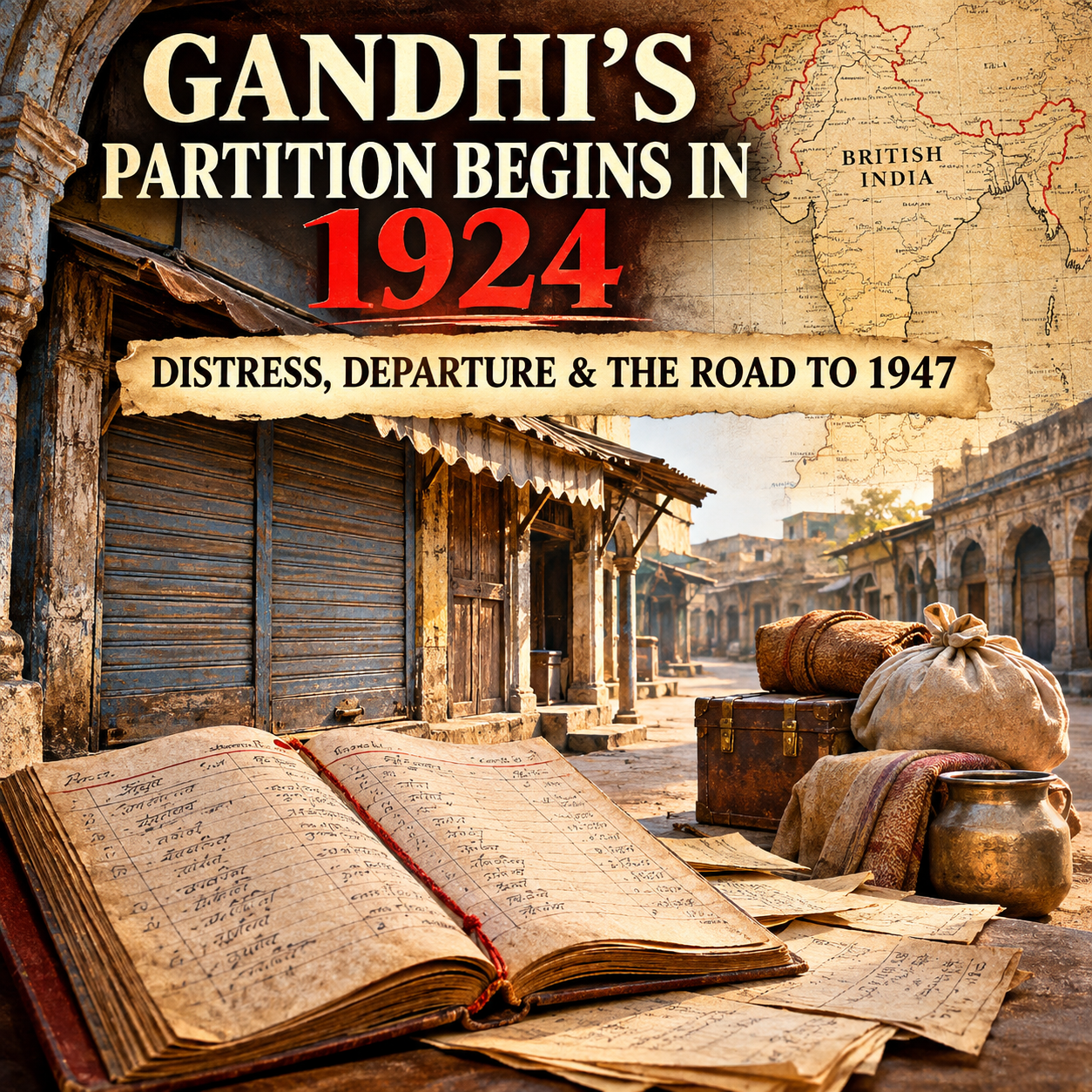
Gandhi’s Partition Begins in 1924: Distress Departure and the Demographic Rehearsal for 1947 (223)
भारत / GB
Part 223: Mahatma Gandhi’s Peace Efforts (Replication Wave + Financial Audit) | Series Index
Blog 222 documented Gandhi’s role in Shraddhanand’s murder — the causal chain from the 1919 Jama Masjid baseline through Gandhi’s wilful blindfolds, the May 1924 Young India attack on the Arya Samaj, and the ignored death threats that left Shraddhanand isolated before his assassination. The murder itself is in Blog 220; Gandhi’s Gauhati “Brother Abdul Rashid” response is in Blog 221. This instalment turns to the economic and demographic reality on the ground that Shraddhanand’s 1924 treatise Hindu Sangathan: Saviour of the Dying Race documented: how Gandhi’s Partition begins in 1924 — when coordinated commercial boycotts, arson of account ledgers, and Gandhi’s refusal to demand unconditional state protection forced Hindus and Sikhs into distress property sales and permanent flight, twenty-three years before August 1947. The commercial fractures that preceded this are in Blog 183; the Kohat fast is in Blog 155.
THE 1924 DEMOGRAPHIC AND ECONOMIC REHEARSAL FOR PARTITION
The Action Taken: Between 1922 and 1924 — culminating in the September 1924 expulsion of 3,500 Hindus and Sikhs from Kohat alongside riots across Multan, Saharanpur, Delhi, and Gulbarga — targeted looting, arson of account books (bahi-khatas), and Tark-e-Mawalat commercial boycotts rendered Hindu and Sikh mercantile communities economically unviable in Muslim-majority towns. Rather than demanding state-enforced restitution and unconditional return, Gandhi’s February 1925 Kohat settlement barred displaced refugees from returning unless invited by local Muslim leaders — institutionalising permanent exile and distress liquidation of shops, homes, and land.
Who Paid the Price: The Hindu and Sikh shopkeepers, traders, moneylenders, and middle-class families across the North-West Frontier Province, Punjab, and north Indian urban belts who had built multi-generational civic and commercial life over centuries, and who were forced to liquidate immovable assets at fraction-of-value distress prices after 1924.
Why This Matters: Standard historiography treats the Partition of India as a sudden political breakdown of 1940–1947. The primary record of 1924 proves otherwise: the economic dispossession, demographic clearing, and moral legitimisation of non-return were rehearsed and normalised on the ground in 1924 — two decades before Radcliffe drew a line on a map.
1. Shraddhanand’s 1924 Warning: Reading the Demographic Balance Sheet
When Swami Shraddhanand published Hindu Sangathan: Saviour of the Dying Race in 1924 — two years before his assassination documented in Blog 220 — he was not offering abstract theological commentary. He was compiling an empirical balance sheet of what four years of Khilafat-era mobilisation had done to Hindu civic survival across north India and the North-West Frontier. Shraddhanand documented how rioters systematically targeted Hindu residences, temples, and commercial records, driving families out of towns where they had lived for generations.
Shraddhanand’s central insight was that riots were no longer temporary street clashes followed by civic restoration; they had become instruments of permanent demographic displacement. Once a minority community’s shops were burned, its credit ledgers destroyed, and its families forced to flee to refugee camps in Rawalpindi or Amritsar, the economic basis for return vanished. In structural and demographic terms, Gandhi’s Partition begins in 1924 — the moment forced flight and distress property liquidation replaced shared civic coexistence.

2. The Economics of Distress Property Sales: From Boycott to Liquidation
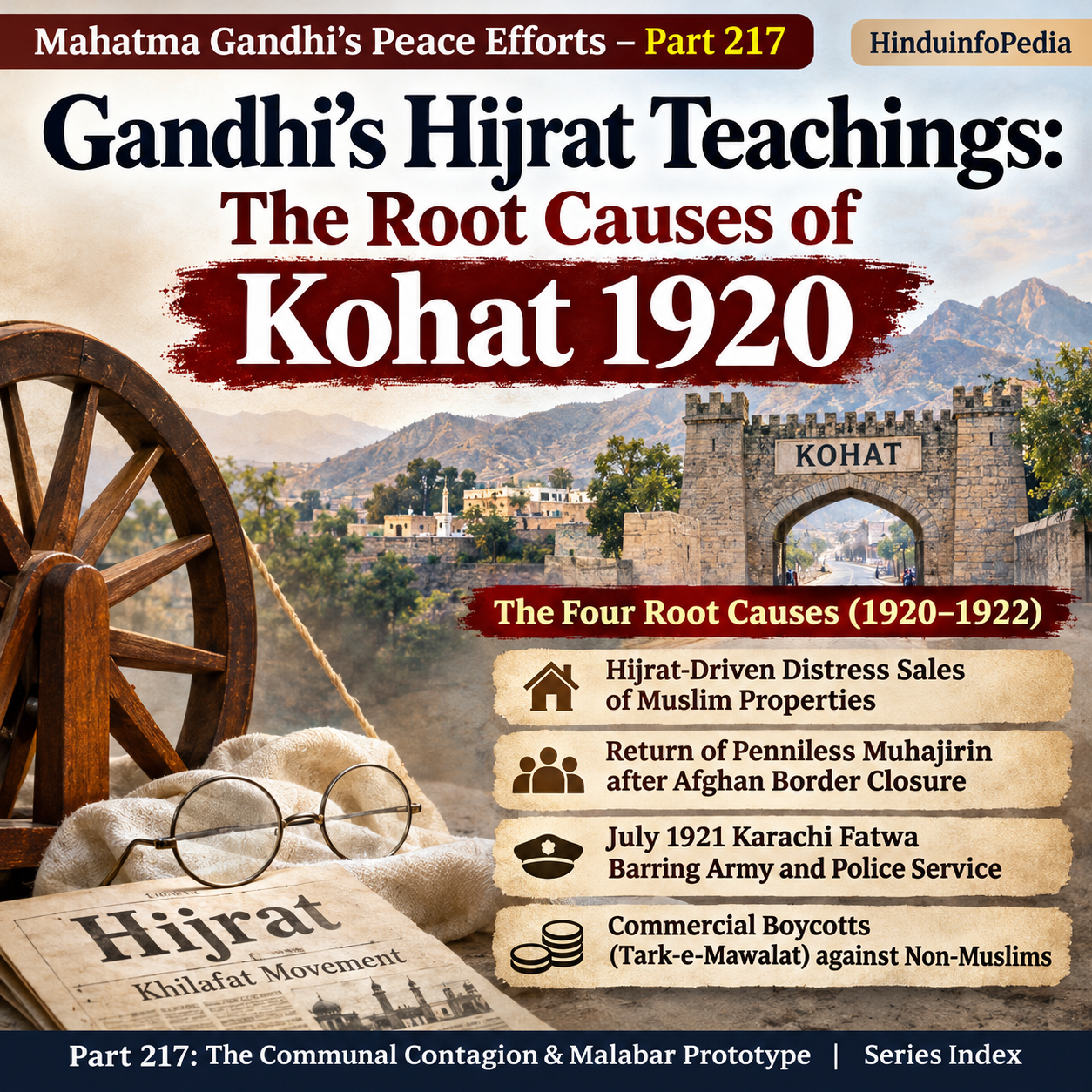
The mechanism that drove distress property sales in 1924 combined economic strangulation with physical insecurity. As documented in Blog 183, the Khilafat-era invocation of Tark-e-Mawalat (severance of social and commercial ties with non-Muslims) had already severed daily trade and credit networks across Delhi, Agra, Mathura, and Punjab towns. When communal violence erupted in Multan (1922), Saharanpur (1923), and Kohat (September 1924), mobs specifically targeted Hindu commercial quarters, burning bahi-khata debt registers so borrowers would never have to repay mercantile loans.
Stripped of working capital, unable to collect commercial debts, and facing repeated threats if they reopened their shutters, displaced Hindu and Sikh families had only one exit: selling their houses, shops, and agricultural plots to local buyers at steep distress discounts before relocating permanently to Hindu-majority districts. This systematic transfer of immovable wealth at distress valuations is why Gandhi’s Partition begins in 1924 — long before any constitutional demand for Pakistan existed, the economic clearing of minority property was already underway on the ground.
Crucially, this demographic clearing was entirely one-sided. While isolated street clashes did occur in several north Indian towns during 1923–1924, no Hindu-majority city witnessed an organised commercial boycott, systematic destruction of minority business records, or mass distress liquidation of Muslim homes and shops. Even after the September 1924 Kohat exodus shocked the country, Hindu-majority districts maintained civic order without any retaliatory displacement of Muslims where they formed a local minority. Yet in his writings of the same period — notably his 29 May 1924 Young India essay diagnosing Hindus as “cowards” — Gandhi inverted this asymmetry, treating lawful civic restraint as moral weakness while accommodating the very intimidation that emptied minority neighbourhoods.
3. Gandhi’s Kohat Formula: Ratifying Exile Instead of Restitution
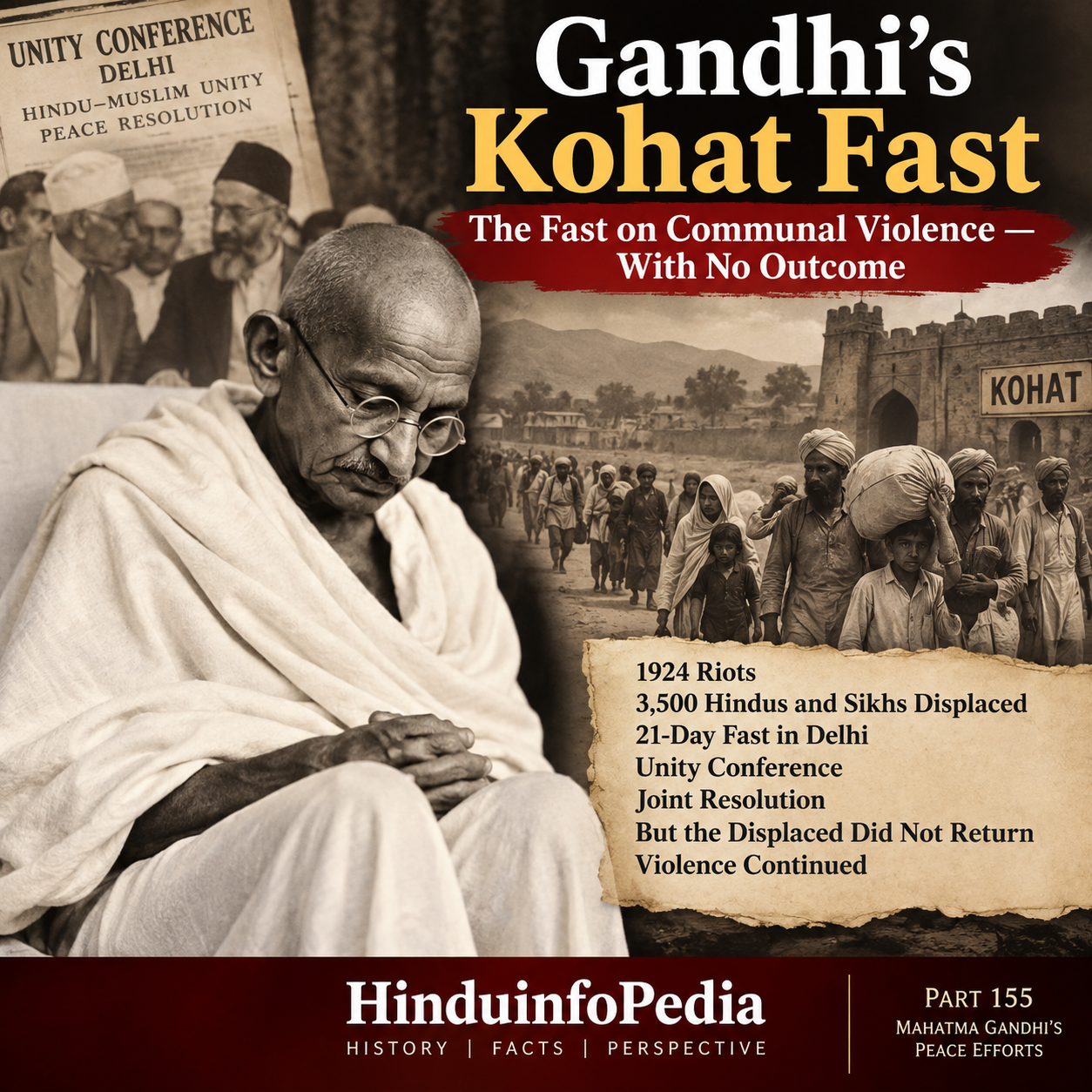
The decisive political turning point that converted temporary refugee flight into permanent demographic partition was Gandhi’s handling of the Kohat exodus between September 1924 and February 1925 (Blog 155; Blog 213). Following the September 1924 pogrom that drove approximately 3,500 Hindus and Sikhs out of Kohat to Rawalpindi, Gandhi undertook a 21-day fast in Delhi at the residence of Khilafat leader and Congress President Maulana Mohammad Ali — who publicly attributed the Kohat violence to Hindu provocation rather than condemning the expulsion — yet neither demanded criminal prosecutions of the perpetrators nor insisted that the British administration guarantee armed civic protection for the refugees’ immediate return.
Instead, in his February 1925 joint statement with Shaukat Ali following their Rawalpindi inquiry (CWMG Vol. 26), Gandhi advised the displaced Kohat Hindus and Sikhs not to return unless invited by the local Muslim community and assured of their goodwill. By making the civic right of citizens to live in their ancestral homes contingent on the permission of the very majority that had expelled them, Gandhi ratified the demographic outcome of the violence. Because that formula left displaced families with no enforceable right of return, distress liquidation of their Kohat properties became irreversible — confirming in administrative practice that Gandhi’s Partition begins in 1924.
4. The 1924 Template Replicated in 1946–1947
Every operational element of the 1946–1947 Partition transfer of population was already visible in miniature in the 1924 distress-sale crisis. First came ideological mobilisation and commercial boycott; second came targeted attacks on minority neighbourhoods and destruction of property records; third came mass flight to safer districts; fourth came distress sale of immovable assets at throwaway prices; and fifth came political leadership advising victims to accept displacement rather than demanding state-enforced restoration.
Contemporary press dispatches and official inquiry files from 1922–1925 preserve concrete case evidence for every step of this sequence:
- Boycott and Ledger Arson (Multan 1922 & Kohat 1924): Both the British official inquiry into the September 1924 Kohat disturbances and Lala Lajpat Rai’s contemporary investigation documented that mobs bypassed random targets to burn Hindu mercantile bazaars and destroy bahi-khata account books and mortgage deeds — wiping out legal proof of debts before driving families out.
- The Rawalpindi Camp Distress Sales (Oct 1924 – Feb 1925): Dispatches in The Tribune (Lahore) and representations by Pandit Madan Mohan Malaviya recorded that the 3,500 Kohat Hindus and Sikhs stranded in Rawalpindi refugee camps — barred from returning to their shops and stripped of income — were forced to sell ancestral houses, shops, and orchards in Kohat through intermediaries at a fraction of pre-riot valuations merely to survive.
- Political Ratification of Exile (February 1925): When Gandhi visited Rawalpindi in February 1925 (CWMG Vol. 26), instead of demanding British administrative guarantees for unconditional return and property restitution, he advised the refugees not to go back without local Muslim invitation — locking in their dispossession twenty-two years before the 1947 Evacuee Property regime.
Between 1924 and 1946, Lala Lajpat Rai (The Hindu-Muslim Problem, 1924) and Swami Shraddhanand warned that tolerating unilateral demographic clearing in Frontier and Punjab towns would end in India’s territorial vivisection — warnings Congress dismissed in favour of unity rhetoric. When the same five-step sequence hit Noakhali, Rawalpindi, and Lahore in 1946–1947, it was merely the nationwide scaling of a prototype already proven when Gandhi’s Partition begins in 1924.
The same 1924 upheaval also reshaped colonial law to lock in that asymmetry. Following the 1924 Rangila Rasul pamphlet controversy and publisher Mahashay Rajpal’s May 1927 acquittal, street agitation pushed the British government to enact Section 295A IPC in September 1927 — criminalising speech deemed to outrage religious feelings rather than curbing the mob intimidation that emptied Kohat and claimed Shraddhanand’s life.
Modern Parallel
The demographic mechanism documented when Gandhi’s Partition begins in 1924 — using sustained street intimidation, commercial boycotts, and targeted violence to depress minority property values and force distress sales without formal legal expulsion — remains one of the most durable instruments of demographic change in South Asia. From the 1990 exodus of Kashmiri Pandits from the Valley (where homes and orchards were abandoned or sold at distress rates while the state failed to enforce return) to recurring distress migrations from sensitive urban neighbourhoods across modern India, silent partition operates through property liquidation long before any formal border is drawn.
Recognising that Gandhi’s Partition begins in 1924 overturns the comfortable myth that India remained an undivided civic society until British departure in August 1947. Once Gandhi’s February 1925 Kohat formula established that expelled citizens could not return without the consent of those who drove them out, the principle of territorial majoritarianism had already defeated equal citizenship on Indian soil.
Invitation To Defence
Swami Shraddhanand’s Hindu Sangathan: Saviour of the Dying Race (1924), Lala Lajpat Rai’s The Hindu-Muslim Problem (1924), the Rawalpindi refugee camp records of September 1924–February 1925, and Gandhi’s February 1925 joint statement on Kohat (CWMG Vol. 26) are all established archival records. The defence is invited to produce any primary document showing that Gandhi demanded state-enforced restitution for distress property sales in Kohat or Multan, that Congress organised legal or financial backing to prevent forced property liquidations by displaced Hindus and Sikhs in 1924–1925, or that the 3,500 Kohat refugees were ever collectively restored to their homes and businesses.
Long before the 1940 Lahore Resolution or the 1947 Radcliffe Line, the economic and demographic clearing of minority communities was rehearsed on the ground in 1924. Through commercial boycotts, burned account ledgers, distress property sales, and Gandhi’s February 1925 rule barring Kohat refugees from returning without local Muslim invitation, Gandhi’s Partition begins in 1924 — twenty-three years before the map was officially cut.
1. Gandhi’s Partition Begins in 1924: The central thesis coined in this blog, arguing that the economic dispossession, forced displacement and distress property sales experienced by Hindu and Sikh communities in 1924 anticipated certain demographic and economic patterns associated with the Partition of 1947.
2. Hindu Sangathan: Saviour of the Dying Race: Swami Shraddhanand’s 1924 treatise documenting his concerns about Hindu civic survival, communal disturbances, economic displacement and demographic changes in northern India.
3. Bahi-Khata (Account Ledger): A traditional Indian merchant’s financial register containing records of loans, debts, payments, transactions and commercial obligations. Its destruction could eliminate important evidence of outstanding debts.
4. Tark-e-Mawalat: A policy of severing social and commercial relationships with non-Muslims. The blog discusses its alleged use as an instrument of economic and commercial exclusion during the Khilafat period.
5. Distress Property Sales: The forced or financially compelled sale of houses, shops, agricultural land and other immovable assets at substantially reduced prices because of insecurity, displacement or economic hardship.
6. Demographic Rehearsal: A distinctive analytical phrase used in the blog to describe the author’s argument that economic dispossession, population displacement and property liquidation in 1924 anticipated patterns that appeared on a larger scale during 1946–1947.
7. Kohat Exodus: The September 1924 displacement of approximately 3,500 Hindus and Sikhs from Kohat, who sought refuge in Rawalpindi following communal disturbances.
8. Kohat Formula: The term used in this blog for Gandhi’s February 1925 advice that displaced Hindus and Sikhs should not return to Kohat without an invitation and assurance of goodwill from the local Muslim community.
9. Unconditional State Protection: Government-guaranteed security and protection of citizens’ rights without making their return to ancestral homes dependent on the permission of local community leaders.
10. Replication Wave + Financial Audit: The series framework used in this instalment to examine the repetition of earlier patterns of commercial disruption, property dispossession, displacement and their economic consequences.
11. CWMG (Collected Works of Mahatma Gandhi): The published collection of Gandhi’s writings, speeches, correspondence and statements. The blog refers particularly to Volume 26 for the February 1925 Kohat statement.
12. Hijrat Movement: The movement associated with the migration of Muslims from India to Afghanistan in 1920, discussed in the blog in connection with earlier economic disruption and property sales.
13. Rawalpindi Refugee Camps: Temporary shelters where displaced Hindus and Sikhs from Kohat reportedly stayed after the September 1924 disturbances. The blog discusses their financial difficulties and property liquidation.
14. Section 295A IPC: Section 295A of the Indian Penal Code, introduced in 1927, dealing with deliberate and malicious acts intended to outrage religious feelings.
15. Evacuee Property Regime: The administrative and legal arrangements concerning properties left behind by people who migrated during Partition. The blog draws a comparison between this later framework and the property dispossession it documents in 1924–1925.
#Gandhi #Partition #India #History #Kohat #HinduHistory #1947 #Punjab #Congress #HinduinfoPedia
Scan Through The Entire Series at
Refer to Various Arks Referred to in the Blog
Gandhi’s Partition Begins in 1924: Distress Departure and the Demographic Rehearsal for 1947 (223)