
Gandhi’s Parallel Streams: Khilafat Movement Was Not Non-Cooperation Movement (205)
भारत / GB
Part 205: Mahatma Gandhi’s Peace Efforts | Series Index
Blog 204 documented Gandhi’s vicarious guilty plea — the uncontested Section 124A confession at Ahmedabad on 18 March 1922, the thirty thousand in colonial custody on identical charges, and the asymmetric exemption of the Khilafat stream from the cost of that plea, showing who bore the legal and material burden when one man entered the dock alone. This blog, Gandhi’s Parallel Streams, steps back to the structural question that made that asymmetry possible: what, precisely, were the two machines operating under the “Congress-Khilafat” label between 1920 and 1922? The record that follows documents their separate launches, separate founding mandates, separate treasuries, separate volunteer corps across every province, and — above all — their separate root causes for joining the agitation, before Blog 206 documents the mid-1922 rupture that dissolved even the nominal label.
Thank you for reading this post, don't forget to subscribe!THE ARITHMETIC OF TWO MACHINES
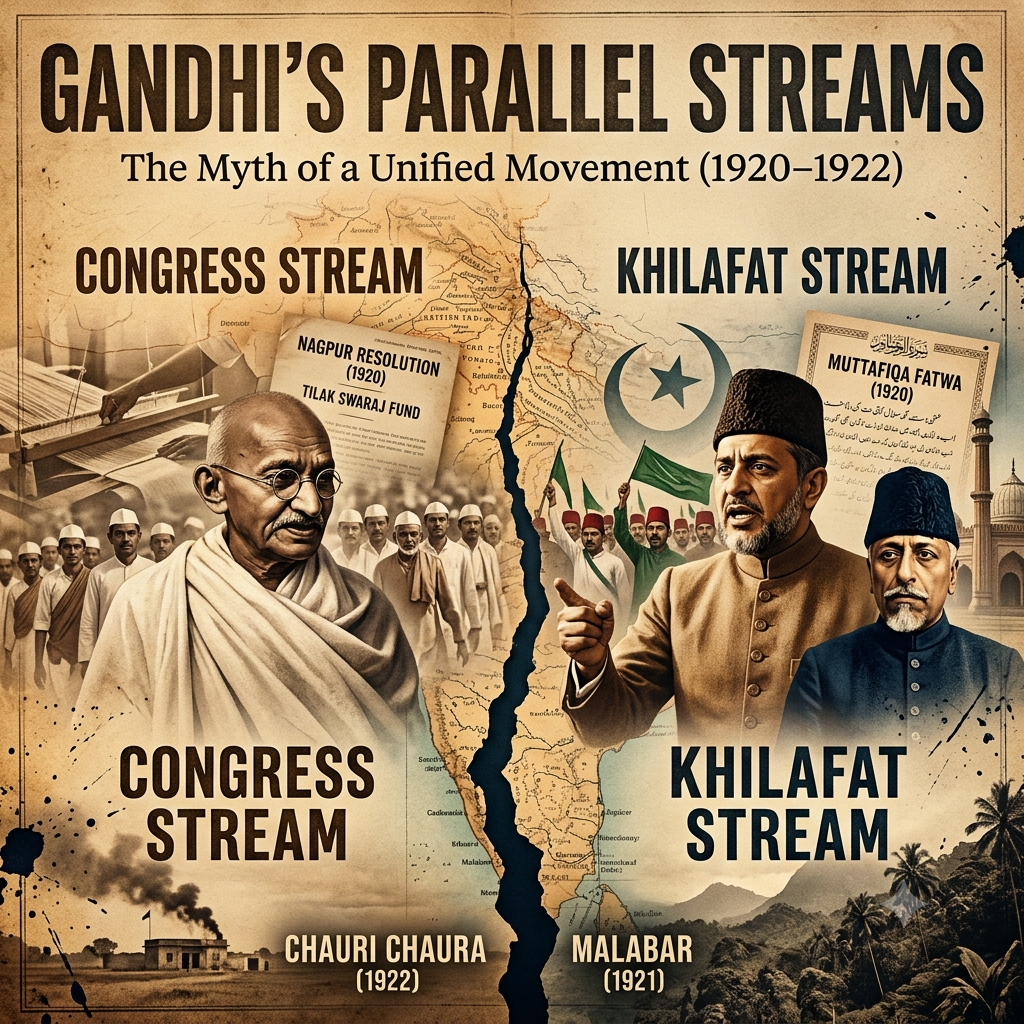
The Action Taken: Between 1920 and 1922, Gandhi presented Congress Non-Cooperation and the Khilafat agitation to India and to the world as one unified movement under a shared “Congress-Khilafat” banner. The reality was different. The Central Khilafat Committee had launched its own Non-Cooperation programme on 1 August 1920 — before the Indian National Congress adopted the Non-Cooperation framework at the Calcutta Special Session in September 1920 and before Nagpur ratified it in December 1920. Neither body amended its constitution to give the other command authority at any point during the alliance. The treasuries, the volunteer corps, and the disciplinary chains of command were separate throughout.
Who Paid the Price: When provincial governments moved to suppress volunteer associations under Part II of the Criminal Law Amendment Act of 1908 in November–December 1921, their official gazette notifications and intelligence abstracts recorded Congress Volunteers and Khilafat Volunteers as distinct, separately named organisations in every province — because they were distinct organisations. The governing mandate of the Khilafat stream was the Muttafiqa Fatwa of November 1920, a clerical decree no Congress resolution could override. At Malabar in August 1921, the Khilafat stream moved in a direction Gandhi could publicly praise in Young India but possessed no authority to stop. Over 2,500 non-combatants paid with their lives while the nominal alliance held its label.
Why This Matters: The Congress Working Committee held no disciplinary authority over the Khilafat volunteer corps at any point between 1920 and 1922. The shared label was a convenience that functioned only while both streams found it useful, and dissolved when it became operationally inconvenient for either party. Gandhi’s parallel streams is the name the prosecution assigns to this structural reality. The record is in the archive.
Separate Launches: Khilafat — The Primary Cause
The standard account places the launch of Non-Cooperation at the Congress Calcutta Special Session of September 1920. The primary record is different. Both launches occurred under Gandhi’s leadership, but through two separate institutional routes: first through the Khilafat platform — after Gandhi was elected President of the All-India Khilafat Conference in November 1919 — when the Central Khilafat Committee in Bombay passed a formal Non-Cooperation resolution on 1 August 1920 and initiated the programme on 31 August 1920; and only weeks later through a literal institutional capture of the Indian National Congress at the Calcutta Special Session in September 1920 and the Nagpur session in December 1920.
The chronology carries a structural implication the standard account omits. The Khilafat movement did not join Congress Non-Cooperation. It was already in motion. What happened at Calcutta and Nagpur was that Gandhi persuaded the Indian National Congress to adopt a programme the Central Khilafat Committee had already launched, under a nominal convergence that served both parties’ immediate political needs. Neither body amended its constitution to give the other command authority. Gandhi’s parallel streams did not begin as one stream that later diverged; they began as parallel, and the nominal convergence of 1920 never closed the gap between them.
Separate Mandates
The governing mandate of the Congress stream was the Nagpur political resolution: Swaraj — self-rule — through withdrawal of cooperation from the colonial administration within one year. Its authority derived from the Congress constitution restructured at Nagpur in December 1920. The Congress Working Committee held disciplinary authority over Congress Volunteers and Congress-affiliated organisations. It held no such authority over the Khilafat formations. While Khilafat members freely participated in Congress activities as members, no Congress member other than Gandhi held any role in Khilafat activities.
The governing mandate of the Khilafat stream was purely theological, derived from the Quranic doctrine of the global Ummah, which does not recognise territorial national boundaries. The Jamiat Ulema-e-Hind’s Muttafiqa Fatwa of November 1920 — signed by approximately five hundred Ulema — declared Non-Cooperation a religious obligation under Islamic law, grounded in the duty to defend the Caliphate. A fatwa issued by assembled Ulema did not derive from Congress resolutions, and it could not be overridden or rescinded by Congress resolution. The clerical leadership owed primary allegiance to the Caliphate question — an external, pan-Islamic matter — not to Indian nationalism or the Indian National Congress. The two mandates were not merely different in emphasis. They were different in kind, in authority, and in the constituency to whom each stream was ultimately answerable.
Dr. B.R. Ambedkar, observing the entire 1920–22 period firsthand and writing at length on its structural consequences, recorded this relationship with precision in Pakistan, or the Partition of India: Gandhi had not brought the Khilafat movement under the Congress; he had placed Congress machinery in service of an extra-territorial pan-Islamic agitation whose clerical leaders answered to the Caliphate question, not to Indian nationalism. The mandates did not merely run in parallel. The Congress mandate, as Ambedkar observed, had been placed in service of the other.
Separate Treasuries: One-Way Flow, Zero Audit
The financial architecture confirmed both structural separation and one-way flow. The Congress stream ran on the Tilak Swaraj Fund — collecting over one crore rupees, overwhelmingly from Hindu donors — under Congress Working Committee audit. At both national and district levels, lakhs of rupees from this fund were routed to Khilafat propaganda, volunteer stipends, and preacher allowances.
The Khilafat stream ran on Seth Mian Mohamed Chotani’s Bombay-based Central Khilafat Fund and mosque collections, completely outside Congress audit. Not a single rupee of Chotani’s fund was ever audited by or shared with Congress. Because Khilafat committees could draw Congress subsidies while spending their own funds beyond Congress oversight, the Congress Working Committee held zero financial leverage to enforce compliance.
Separate Volunteer Corps — All India
The clearest proof of Gandhi’s parallel streams lies in the provincial banning record. When provincial governments banned volunteer associations under Part II of the Criminal Law Amendment Act of 1908 in November–December 1921, official gazettes and intelligence abstracts never recorded a unified Congress-Khilafat corps. They named Congress Volunteers and Khilafat Volunteers as separate organisations in every province, with distinct enlistment registers, command structures, and reporting lines.
- United Provinces: UP Gazette notifications prohibited Congress National Volunteers (Sevak Dal) and Khilafat Volunteers as separate bodies. The Allahabad High Court record for Chauri Chaura (February 1922) likewise identified distinct Congress Mandal and Khilafat volunteer formations marching on the thana under separate local captains, neither subject to the other’s orders.
- Bengal Presidency: C.R. Das’s Bengal Provincial Congress Committee raised the Bengal National Volunteer Corps under its own command, while Maulana Abul Kalam Azad and the Provincial Khilafat Committee maintained a separate Khilafat Volunteer Corps with independent registers and mosque-based recruitment reporting solely to the Khilafat office.
- Punjab and NWFP: In Punjab, Congress Volunteers, Khilafat Volunteers, and Akali Jathas operated under three separate authorities. In the North-West Frontier Province, the Provincial Khilafat Committee mobilised through tribal jirgas and mullahs outside Congress, launching the 1920 Hijrat exodus to Afghanistan under a clerical fatwa without Congress consultation or sanction.
- Bombay, Sindh, Bihar, and Madras: Bombay’s Central Khilafat Committee maintained its own corps apart from Congress volunteers, and at the July 1921 Karachi Khilafat Conference, Mohamed Ali passed an army-disaffection resolution independently of Congress that the CWC neither ratified nor could rescind. In Bihar and Orissa, police abstracts similarly enumerated Congress, Khilafat, and Sevak Dal volunteers as three distinct bodies.
Across the subcontinent, provincial banning orders named Khilafat formations separately — never as Congress subunits or affiliates — confirming two distinct machines under separate commands.
The Live Test: Malabar, 1921
This structural separation was not merely administrative; its operational consequences erupted in August 1921 while the “Congress-Khilafat” banner was still being presented as a unified front. In Ernad and Walluvanad taluks of Malabar district, mosque-centred Khilafat committees under Ali Musaliar and Variankunnath Kunjahammed Haji built an independent infrastructure through 1920–21. When colonial authorities moved against their leaders in August 1921, those formations rejected Congress non-violence directives and launched an open uprising — operating as a state within a state with its own passport and administrative machinery, and producing over 2,500 casualties, mass forced conversions, and the displacement of Hindus across Ernad and Walluvanad.
Gandhi’s response is in the record: in Young India of 20 October 1921, he praised the Moplah fighters as “brave, God-fearing” and attributed Hindu suffering to exaggeration or Hindu cowardice. What Gandhi could not do was issue a binding disciplinary order to halt them. The Muttafiqa Fatwa did not derive from Congress, Malabar’s Khilafat volunteers did not report to the Congress Working Committee, and their clerical leaders answered solely to their own hierarchy.
Malabar was not an aberration in a unified movement; it was the live operational proof of Gandhi’s parallel streams. Even while the nominal alliance held, the Congress Working Committee’s condemnation carried zero authority over the formations that produced the violence.
Modern Parallel
The structural anatomy of Gandhi’s parallel streams — a civic formation financing a parallel religious infrastructure it could not audit, could not command, and could not restrain — has a precise contemporary form. Through legislated amendments to waqf property law, state-funded madrasa networks, state and municipal salary disbursements to madrasa teachers and imams, and public expenditure on boundary walls, maintenance, and enclosure of burial grounds and religious sites, the secular state apparatus has been progressively channelled into sustaining a parallel institutional infrastructure that operates under clerical authority, not civic authority — while simultaneously exercising statutory theological and financial control over Hindu religious structures through state-administered endowment boards. The financing flows in one direction. The audit jurisdiction does not follow.
The mechanism is identical to 1920–22. The Tilak Swaraj Fund — overwhelmingly Hindu donations under Congress audit — subsidised Khilafat volunteer stipends, clerical preachers, and propaganda networks that Congress could neither direct nor restrain. The contemporary equivalent routes public revenue and legislated property protections into institutions whose governing mandate is theological, whose leadership answers to clerical authority, and whose operational decisions are made without reference to the civic formations that supplied the funding. The two machines — civic and clerical — remain separate. The funding remains one-directional. The audit gap remains unbridged.
Invitation To Defence
The separate launch dates are in the record. The Muttafiqa Fatwa — the Khilafat stream’s governing mandate, which no Congress resolution could override — is in the record. The separate treasuries, running under separate audit jurisdictions, are in the record. The provincial volunteer bans, naming Congress Volunteers and Khilafat Volunteers as distinct organisations under the same Act across every province, are in the record. The Chauri Chaura trial record identifying separate Congress Mandal and Khilafat volunteer formations under separate captains is in the record. The Malabar uprising of August 1921 — in which Gandhi’s parallel streams diverged in blood while the nominal alliance was still operating and while Gandhi was still presenting “Congress-Khilafat” as a unified movement — is in the record. The defence is invited to identify any primary source establishing that Gandhi or the Congress Working Committee held disciplinary authority over the Khilafat volunteer corps, the Khilafat treasuries, or the Khilafat clerical leadership at any point between 1920 and 1922.
The Khilafat stream launched before the Congress adopted Non-Cooperation. Its mandate was a clerical fatwa, not a Congress resolution. Its treasury was separate and beyond Congress audit. Its volunteer corps were banned as separate organisations under the same Act across every province. At Malabar, the Khilafat stream moved in a direction Gandhi could praise in print but could not stop in the field. The two machines were always two machines. The record is in the archive.
Feature Image: Click here to view the image.
Videos
Glossary of Terms
1. Gandhi’s Parallel Streams: A term coined in this blog to describe the two separate institutional movements operating under the nominal Congress-Khilafat alliance between 1920 and 1922, each with its own leadership, mandate, treasury, volunteer corps, and disciplinary structure.
2. Khilafat Movement: A political-religious agitation organised to defend the Ottoman Caliphate, which operated through its own clerical leadership and institutional network alongside the Indian National Congress.
3. Non-Cooperation Movement: A political campaign launched against British colonial rule through withdrawal of cooperation from colonial institutions. The Congress formally adopted its programme at the Calcutta Special Session in September 1920 and ratified it at Nagpur in December 1920.
4. Central Khilafat Committee (CKC): The Bombay-based organisation that passed its formal Non-Cooperation resolution on 1 August 1920 and initiated its programme on 31 August 1920, before the Congress formally adopted its own programme.
5. Muttafiqa Fatwa: A collective religious decree issued in November 1920 by approximately five hundred Ulema, declaring Non-Cooperation a religious obligation under Islamic law in support of the Caliphate.
6. Ummah: The global Muslim religious community, understood in the blog as a transnational religious constituency whose identity and obligations extend beyond territorial national boundaries.
7. Tilak Swaraj Fund: A Congress fundraising initiative that collected over one crore rupees, predominantly from Hindu donors, to support the Non-Cooperation programme and related political activities, including financial assistance to Khilafat organisations.
8. Central Khilafat Fund: A separate fund associated with Seth Mian Mohamed Chotani in Bombay, supported by independent contributions and mosque collections, operating outside the financial audit jurisdiction of Congress.
9. Congress Working Committee (CWC): The principal executive body of the Indian National Congress, responsible for organisational decisions and disciplinary authority over Congress Volunteers and affiliated organisations, but without equivalent authority over Khilafat formations.
10. Criminal Law Amendment Act of 1908: Colonial legislation used by provincial governments in November and December 1921 to suppress or prohibit volunteer associations considered unlawful. Its Part II provisions were invoked against separately identified Congress and Khilafat organisations.
11. Hijrat Movement: The 1920 exodus of groups of Indian Muslims, particularly from the North-West Frontier Province, towards Afghanistan, undertaken under religious direction and the belief that British-ruled India was unsuitable for their religious obligations.
12. Moplah Uprising: The armed uprising that began in August 1921 in the Ernad and Walluvanad taluks of Malabar. The blog describes the role of Khilafat committees, attacks, forced conversions, displacement, and extensive loss of life.
13. State Within a State: A phrase used to describe an independent organisational structure exercising its own administrative, disciplinary, and operational functions alongside or beyond the authority of the established government.
14. Extra-Territorial Pan-Islamic Agitation: A religious-political mobilisation centred on concerns extending beyond India’s territorial boundaries, particularly the defence of the Caliphate, rather than being governed exclusively by Indian nationalist objectives.
15. Audit Gap: A term used in the blog to describe the financial and institutional separation in which one organisation provides financial support to another but possesses no corresponding authority to examine, supervise, or control the recipient’s expenditure.
#Gandhi #Khilafat #NonCooperation #Congress #IndianHistory #FreedomStruggle #MoplahRebellion #Malabar #Swaraj #BritishRule #HinduinfoPedia
Scan Through The Entire Series at