
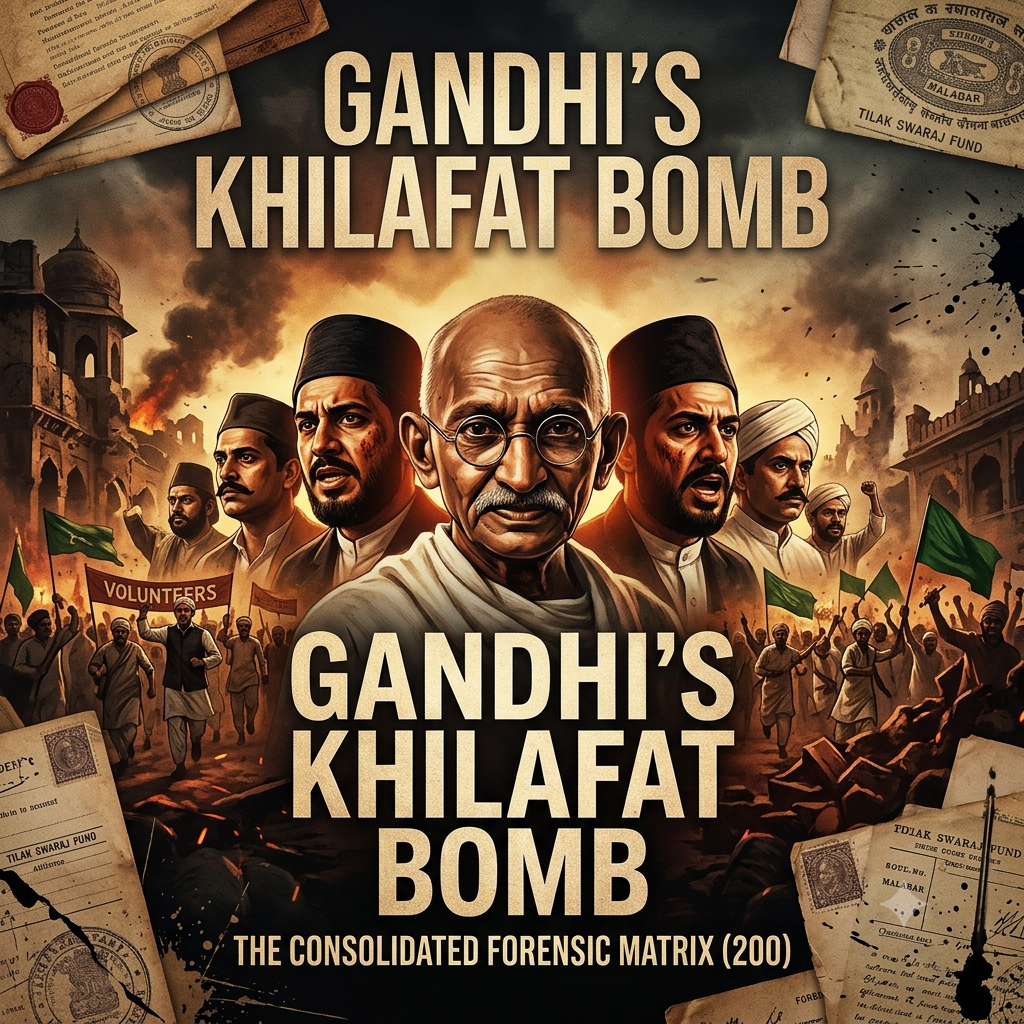
Gandhi’s Khilafat Bomb: The Consolidated Forensic Matrix (200)
भारत / GB
Part 200: Mahatma Gandhi’s Peace Efforts | Series Index
The previous blog documented the theological sub-structure of the Khilafat compact: the Dar-ul-Harb declaration, the Afghan invasion endorsement, the Hijrat catastrophe, and the Ambedkar documentation. This blog, Gandhi’s Khilafat Bomb, places the full arc before the reader in one consolidated forensic ledger — twelve evidentiary exhibits reconstructed as a nine-pillar constitutional and penal indictment.
THE KHILAFAT BOMB — THE CONSOLIDATED INDICTMENT
Gandhi was not managing an anti-colonial movement that spiralled beyond his grasp. He constructed, financed, legally shielded, informationally censored, and continuously operated an asymmetric political apparatus. Gandhi’s Khilafat bomb was a calculated trade: secular civic nationhood was liquidated to purchase an unchallengeable personal monopoly over the Indian National Congress, calibrated under an imperial ceiling negotiated at Simla, fuelled by the formal platforming of theological warfare, funded by fraudulent diversion of Hindu memorial money, protected by an active press embargo, institutionally formalised through victim-blaming as statecraft, paid for with the expendable security of the Hindu population and the territorial sovereignty of the subcontinent, and armoured from public accountability through a documented two-tier financial standard.
The nine-pillar indictment that follows is anchored entirely in Gandhi’s printed columns, committee resolutions, and government transcripts. The defence has been invited at every blog in this arc. It has not appeared.
D-Day reference: This blog is the consolidated reference document for the 30 January 2027 verdict. Every count cited in that blog traces to the evidence assembled here.
The Consolidated Forensic Matrix: 9 Pillars
| # | Pillar | The Forensic Act | The Documented Instrument |
|---|---|---|---|
| 1 | Personal Monopoly | Destroying constitutionalists (Jinnah, Pal, Besant) to seize dictatorial control of the Congress. | Four-anna Nagpur coup (Dec 1920); Jamiat Ulema-e-Hind alliance (Nov 1919); Swaraj formally subordinated to Khilafat in print. |
| 2 | Platforming Religious War | Providing secular Congress legitimacy to medieval theological warfare and the verse of the sword. | Sanctioning Dar-ul-Harb, the 1920–21 Hijrat, and Quran 9:5; ulema given Congress sessions as national platform; Hindu dissent overridden. |
| 3 | The British Deal | Contracting a managed confrontation guaranteeing the Raj would not fall — Ahimsa as imperial governor. | May 1921 unminuted Reading summit; “In Their Opinion” bargain; Ali brothers protected, volunteer cadres untouched. Blogs 193–194. |
| 4 | Ahimsa as Asymmetric Fraud | Weaponising non-violence against Hindus while excusing Islamic militancy as religious passion. | Malabar (2,500+ dead) = no pause; Chauri Chaura (22 colonial police) = Bardoli brake pulled within 72 hours. Blog 198. |
| 5 | Financial Parasitism | Using Hindu memorial money to bankroll clerical armies; granting total immunity to corrupt Muslim financiers. | Tilak Swaraj Fund (₹1.30 crore) diverted to Khilafat Volunteer Corps; Chotani ₹16–17 lakh embezzlement privately settled; audit refused. Blogs 188–190. |
| 6 | Media Embargo | Actively censoring ground reports of Malabar massacres to protect the political alliance in Delhi. | Young India gaslighting; local Congress eyewitness telegrams suppressed; “grossly exaggerated” defence of the ulema’s record. Blog 197. |
| 7 | Institutional Victim-Blaming | Installing the permanent doctrine that communal murderers are morally innocent; their Hindu victims morally guilty. | Young India post-Malabar: killers = “brave, God-fearing men”; Hindu dead = “cowards.” Foundation of secular guilt as statecraft. Blog 197. |
| 8 | Geopolitical Treason | Subordinating Indian territorial sovereignty to foreign pan-Islamic powers; certifying invasion as morally superior to British rule. | Young India (4 May 1921): Afghan invasion defended; extraterritorial ummah allegiance certified as superior to territorial defence. Blog 199. |
| 9 | The Unaudited War Chest | Full transparency for funds he controlled; total opacity for funds he endorsed — differential accountability as deliberate policy. | Ambedkar: ₹80 lakhs–₹1 crore unaccounted, no statutory oversight; Tilak Fund published district by district; Khilafat Fund armoured. Blog 190. |
The Nine Pillars: Forensic Summaries
Pillar 1 — Personal Monopoly. Gandhi’s printed declaration in Young India (October 1920) subordinated Swaraj to the Khilafat as a moral imperative — not a tactical alliance. At the Nagpur session (December 1920), the four-anna membership amendment flooded the Congress with ulema-directed cadres, drove Jinnah from the platform, and converted the party into a personal plebiscite engine. The cow-protection barter completed the trap: at the Delhi Khilafat Conference (November 1919), Gandhi demanded unconditional Hindu support for the Khilafat without reciprocal concession on cow slaughter, declaring such conditionality “unbecoming.” The trade was structurally rigged at inception.
Pillar 2 — Platforming Religious War. Congress sessions (Calcutta 1920, Nagpur 1920) gave the Dar-ul-Harb / tark-e-mawalat framework — India as an abode of war requiring non-cooperation with the British infidel — a national organisational vehicle it had never previously possessed. Gandhi validated the clerical invocation of Surah At-Tawbah (9:5) and underwrote the 1920–21 Hijrat that drove thousands of impoverished Muslim families into ruin in Afghanistan, without public condemnation before or accountability after. The ulema received the Congress platform; Hindu dissent was overridden or silenced.
Pillar 3 — The British Deal. At Simla (May 1921), Gandhi brokered the “In Their Opinion” bargain with Viceroy Reading: warrants against the Ali brothers for seditious speeches calling for military mutiny were stayed in exchange for a cosmetic, narrowed apology. The volunteer cadres drilling in Malabar were left intact. Non-violence ceased to be a moral philosophy; it was contracted as an imperial governor — the guarantee that mass resistance would never force a British exit. The Raj’s survival was written into the compact. (Blogs 193–194.)
Pillar 4 — Ahimsa as Asymmetric Fraud. The differential is a matter of printed record. Over 2,500 Hindu non-combatants butchered and forcibly converted in Malabar between August and December 1921: the Non-Cooperation Movement continued without pause. Twenty-two colonial policemen burned alive at Chauri Chaura on 4 February 1922: within 72 hours Gandhi convened the CWC at Bardoli, suspended the entire national movement, and issued a penitential fast. The asymmetric ceiling was not an inference. It was Gandhi’s operational record, printed and timed. (Blog 198.)
Pillar 5 — Financial Parasitism. The Tilak Swaraj Fund (₹1.30 crore, raised in Tilak’s name on the promise of “Swaraj in one year”) was channelled through provincial Congress committees to subsidise Khilafat Volunteer uniforms, clerical allowances, and the Ali brothers’ speaking tours — the cause Tilak spent his life opposing. When Seth Chotani embezzled ₹16–17 lakhs of Khilafat public subscriptions into failing textile mills, Gandhi demanded no audit, no prosecution, and no donor restitution; the matter was settled privately through a mill transfer. Two-tier accountability: audit terror for Hindu provincial committees, total immunity for the clerical machine’s financiers. (Blogs 188–190.)
Pillar 6 — Media Embargo. When Gandhi’s Khilafat bomb detonated in Malabar, local Congressmen — including K.P. Kesava Menon — submitted eyewitness telegrams documenting forced conversions, mass rapes, and temple demolitions to the national leadership. Gandhi withheld this material from the national press and wrote in Young India that the reports were “grossly exaggerated” fabrications by Anglo-Indian newspapers. He created the template for systemic institutional denial: victim testimony discredited as colonial provocation; aggressor narrative amplified as religiously authentic. This template governed every communal adjudication through 1946. (Blog 197.)
Pillar 7 — Institutional Victim-Blaming. Writing in Young India on Malabar, Gandhi described the killers as “brave, God-fearing Mussalmans” acting from religious conviction, and declared the Hindu dead had suffered because they were “cowards” who failed to win the Moplahs’ hearts through love. This was not a remark under pressure. It was the deliberate installation of a permanent legal and psychological doctrine: self-defence is communalism; offensive religious violence is a theological grievance requiring political accommodation. The victim-blaming framework of post-partition India traces its genealogy to these Young India columns of 1921. (Blog 197.)
Pillar 8 — Geopolitical Treason. Mohamed Ali’s open declaration — that Indian Muslims were religiously bound to assist an Afghan invasion of India to liberate the Caliphate — was validated, not condemned, by Gandhi in Young India (4 May 1921). Gandhi stated he would not ask non-cooperators to assist India’s defence against an Afghan military intervention and that an Afghan conquest was morally preferable to British rule. This certified a permanent principle: religious allegiance to a transnational ummah supersedes citizenship obligations and territorial defence. That principle became the ideological foundation of the two-nation theory. (Blog 199.)
Pillar 9 — The Unaudited War Chest. Gandhi’s own Young India published district-by-district Tilak Swaraj Fund receipts — town by town, province by province. The identical publication apparatus was never deployed for the Khilafat Fund. When Chotani’s diversion became known, the Congress Working Committee — which met freely throughout 1922–23 at Gaya and Cocanada — produced no resolution demanding an audit. Gandhi, released from Yerwada on 5 February 1924, wrote nothing on the diversion thereafter, despite having negotiated the Poona Pact from the same prison walls in 1932. Ambedkar documented the broader pattern: between ₹80 lakhs and ₹1 crore of the Tilak Swaraj Fund disappeared into provincial patronage without verifiable vouchers; the Bardoli Depressed Classes allocation was choked to a fraction of its promised sum while clerical logistics received unquestioned subventions. The differential is the proof: one standard for funds serving Gandhi’s Hindu political base; total opacity for funds serving the clerical alliance. The armour is not a gap in the record. It is the record. (Blog 190;.)
The Post-Abolition Confession: Proof of Intent
On 3 March 1924, Mustafa Kemal Atatürk abolished the Caliphate. The theological cause that had consumed Indian politics and cost thousands of lives was discarded by the Turks themselves. India was left holding the residue: an armed clerical network that immediately turned inward to launch the pogroms of Multan, Saharanpur, and Kohat. Writing in Young India in May 1924, Gandhi issued the confession that locks all nine pillars as deliberate design rather than tactical error:
“I have not a shadow of regret for having raised the Khilafat question… It was a duty I owed to my Muslim fellow-countrymen. That the Turks have abolished the Khilafat does not alter my position in the least.”
He looked upon the dead of Malabar, the collapsed Hijrat, the geopolitical ruin of the cause — and confirmed his actions. The expenditure of Hindu security was not a mistake. It was the recognised, accepted price of his political machine.
The Bridge to Chauri Chaura
The nine pillars resolve into one conclusion: Gandhi constructed a machine where Hindu civilian bloodshed was acceptable operational collateral, the clerical volunteer apparatus was legally shielded, the press was managed from the centre, the financial trail was laundered through a deceased nationalist’s memorial, India’s territorial sovereignty was subordinated to a foreign Islamic sovereign — and all of this was capped under a private imperial ceiling that guaranteed the Raj would survive. When 2,500 Hindu non-combatants were slaughtered across Malabar, the machine kept running. When twenty-two colonial constables were burned at Chauri Chaura, Gandhi pulled the brake in seventy-two hours. The asymmetric ceiling was not a philosophy. It was a contract.
Invitation To Defence
The nine pillars are drawn exclusively from Gandhi’s own columns in Young India, the resolutions of the Indian National Congress, the Reading Papers (MSS. EUR. E. 238), the proceedings of the All-India Khilafat Conference, Ambedkar’s documented audit of the Tilak Swaraj Fund, and the financial record of the Central Khilafat Committee. The defence is invited to identify any single pillar not anchored in Gandhi’s own record — and to explain his May 1924 confession that he had “not a shadow of regret,” written after Malabar, after the Caliphate’s abolition, and after the pogroms of Multan and Saharanpur.
The nine pillars are not a historian’s inference. They are Gandhi’s own operational record, assembled from his own press, his own committees, and the transcripts of his own negotiations. The machine had a designer. The designer left a paper trail. This blog is that trail, consolidated.
1. Gandhi’s Khilafat Bomb: A coined expression describing the political machinery attributed to Mahatma Gandhi’s Khilafat alliance, encompassing organisational control, religious mobilisation, financial arrangements, press management and the consequences for Hindu security and Indian sovereignty.
2. Personal Monopoly: The consolidation of political authority within the Indian National Congress under Gandhi’s leadership by marginalising constitutional opponents such as Muhammad Ali Jinnah, Bipin Chandra Pal and Annie Besant.
3. Dar-ul-Harb: An Islamic theological classification describing territory considered an abode of war, used in the Khilafat movement’s argument for non-cooperation with British authority in India.
4. Tark-e-Mawalat: A religiously framed principle of severing cooperation or relations with an authority considered illegitimate, invoked in the Khilafat and Non-Cooperation movements.
5. Hijrat: Migration undertaken for religious reasons. In the nineteen twenty to nineteen twenty-one Khilafat period, thousands of Muslim families migrated from India towards Afghanistan, many suffering hardship and financial ruin.
6. Ulema: Islamic religious scholars and clerics who played an influential organisational and ideological role in the Khilafat movement and its alliance with the Indian National Congress.
7. Four-Anna Membership Amendment: The membership reform adopted at the Nagpur Congress session in December nineteen twenty, which expanded Congress membership and facilitated the entry of large numbers of politically mobilised cadres.
8. Ahimsa as Asymmetric Fraud: A phrase used in the article to describe the alleged unequal application of Gandhi’s non-violence principle, contrasting the continuation of the movement during Malabar violence with its suspension following Chauri Chaura.
9. In Their Opinion Bargain: The expression associated with the May nineteen twenty-one Simla understanding between Gandhi and Viceroy Reading, concerning the narrowed apology and the suspension of proceedings against the Ali brothers.
10. Tilak Swaraj Fund: A political fund established in the name of Bal Gangadhar Tilak, reportedly collecting one crore thirty lakh rupees for the Swaraj movement and subsequently used, according to the article, to support Khilafat-related activities.
11. Khilafat Volunteer Corps: An organised volunteer network associated with the Khilafat movement, whose activities and financial support are examined in the article.
12. Institutional Victim-Blaming: The alleged practice of assigning moral responsibility to victims of communal violence while portraying perpetrators as acting from religious conviction. The article associates this approach with Gandhi’s statements concerning Malabar.
13. Geopolitical Treason: A coined indictment describing the alleged subordination of India’s territorial security to transnational religious allegiance, particularly in connection with Gandhi’s position on a possible Afghan invasion.
14. The Unaudited War Chest: A coined expression describing the alleged absence of transparent financial accounting and independent auditing of Khilafat funds, contrasted with the publication of district-wise Tilak Swaraj Fund receipts.
15. CWC (Congress Working Committee): The Congress Working Committee, the principal executive body of the Indian National Congress, whose decisions and alleged failure to demand financial accountability are discussed in the article.
#Gandhi #Khilafat #India #History #Malabar #Congress #HinduHistory #PoliticalHistory #HinduinfoPedia
Scan Through The Entire Series at