
Gandhi’s Khilafat Neighbourhood Impact: The Hatred That Was Created(183)
भारत / GB
Part 183: Mahatma Gandhi’s Peace Efforts | Series Index
The previous blog placed before the reader the engine — the Mutafiqa Fatwa that classified British India as Dar-ul-Harb, the three-tier doctrinal hierarchy it activated, and the Hijrat of 1920 as its operational proof: 40,000 to 60,000 peasants destroyed on the authority of a theological classification, as Gandhi inaugurated Non-Cooperation in silence — and his name, his prestige, and his association with the classification helped it spread as a wildfire across every mosque and madrasa the Firangi Mahal network could reach. The doctrine created a hierarchy: where capacity for Jihad exists, war; where it does not, Tark-e-Mawalat — the severing of cooperative ties; where even that is premature, sabr — patience as a tactical posture, not peace as a principle. The neighbour was never neutral. The neighbour was the territory. This blog, Gandhi’s Khilafat Neighbourhood Impact, places before the reader what happened to the territory.
Thank you for reading this post, don't forget to subscribe!THE HISTORICAL RECORD — GANDHI’S KHILAFAT NEIGHBOURHOOD IMPACT
The Pattern: Before 1919, Hindu and Muslim communities across India shared bazaars, pilgrimage roads, harvest cycles, guild structures, and neighbourhood ties built across generations. Between 1919 and 1926, the same territory was reclassified — by theological decree, with Gandhi’s apparatus as its national distributor — as the Abode of War. Gandhi’s Khilafat neighbourhood Impact places before the reader what that reclassification produced when it reached the street, the bazaar, the pilgrimage road, and the village well.
The Lethal Exhibit: The Government of India’s annual report to Parliament, India in 1925–26, recorded that communal violence had ceased to be a phenomenon of major urban centres and had penetrated deep into small rural villages — a geographic spread with no administrative precedent in the pre-1919 period. The report’s own language describes the distribution as qualitatively new: not larger riots in the same places, but the same pattern of rupture reproduced across hundreds of localities that had no prior record of communal conflict. Gandhi’s Khilafat neighbourhood Impact places that qualitative shift — from episodic to endemic, from urban centres to everyday rural villages — before the reader and asks what produced it.
Why it matters: The standard defence holds that the communal violence of the 1920s was a regional aberration — Malabar as a Mappila grievance, the northern riots as a local administrative failure. The Government of India’s own report closes that defence before it is made: the fracture was national, rural, and dateable to the Khilafat mobilisation years.
The Baseline: The Dismantling of Self-Governing Society
The prosecution does not romanticise what existed before 1919. The baseline was not a sentimental utopia of vague tolerance. It was the hard, functional architecture of shared economic survival and indigenous self-governance — structures that required no external political ideology to function, and which required deliberate theological intervention to destroy.
In Dhaka, the Janmashtami procession was an integrated municipal institution. The monumental festival floats were constructed by specialised Muslim hereditary artisans under multi-generational contracts with Hindu guild panchayats, while Muslim zamindars provided the ceremonial logistics as a recognised protocol of civic authority. This was not decorative goodwill. It was structural economic codependency — the livelihood of Muslim artisans tied directly to the continuity of Hindu civic ritual.
In Chandni Chowk, Delhi, Hindu merchants routinely elected a Muslim elder as their chaudhury — vesting in him the ultimate arbitral authority over trade debts, commercial contracts, and credit instruments (hundis). They placed their property and financial survival under the judicial arbitration of an elder of another faith, operating an indigenous guild system that bypassed the colonial state entirely.
Among the Malkana Rajputs of the Agra-Mathura belt, centuries of civilisational synthesis allowed households to maintain their Rajput lineage, customary inheritance, and ancestral observances alongside Islamic rites — living proof that Indian society had historically assimilated religious diversity without demanding cultural or territorial alienation.
This was the fabric that existed on the eve of the Khilafat compact. It was not a Gandhian achievement. It was an ancient, self-regulating immune system. Gandhi’s Khilafat neighbourhood Impact places this baseline before the reader because what the theological engine destroyed was not a polite sentiment — it was the very capacity of Indian communities to live and trade without an external ideological master.
The Mechanism
The Dar-ul-Harb classification reached the neighbourhood through the mosque, the madrasa, and the Firangi Mahal network carrying the Mutafiqa Fatwa‘s rulings to every pulpit across northern India. Its three operative tiers were practical instructions, not abstractions: Jihad where capacity existed; Tark-e-Mawalat — the severing of all cooperative ties — where it did not; sabr — tactical patience — where even that was premature. The business partner became a temporary accommodation. The shared festival became a civic liability. The syncretic household became a theological compromise requiring correction.
On the Congress floor, Gandhi translated this programme as Non-Cooperation. In the mosques, the ulema preached it as mandatory religious law. Gandhi’s Khilafat neighbourhood Impact absorbed the consequences of both translations.
The Rupture — Six Arenas
Civic rituals. The Dhaka Janmashtami pattern — Muslim landlord participation, artisan contracts, civic gathering — is documented in Bengal gazetteers as the pre-1919 administrative norm for festival organisation in mixed localities. By 1926, the same Bengal district records document the music-before-mosque dispute as the primary communal flashpoint: processions that had passed mosque entrances for decades were now contested as provocations, and the contest had acquired theological backing. What changed was not the procession route. It was the doctrinal status of the neighbourhood it passed through.
Commercial life. The Chandni Chowk commercial structure — Hindu traders electing Muslim merchants as chaudhury — rested on multi-generational trust. By 1926, the same quarter had developed segregated hostile zones whose boundaries were observed without formal demarcation. The trust had not simply weakened. It had been replaced by a structure of mutual wariness that maintained itself without any individual act of hostility. The Chandni Chowk of 1918 and the Chandni Chowk of 1926 occupied the same geography. They were not the same neighbourhood.
Village demographics. The Malkana Rajput syncretic communities of the Agra-Mathura belt — three generations observing both Eid and Diwali — attracted no external intervention before 1922 because no external authority had arrived with a doctrinal agenda. After 1922, Shuddhi reconversion campaigns and competing Muslim tabligh networks from Achhnera and Akran arrived simultaneously, each treating the syncretic household as a compromise to be ended. The Malkana communities had not changed. The pressure on them to choose arrived precisely in the years following the Khilafat mobilisation’s collapse and the release of its radicalised volunteer networks into the countryside.
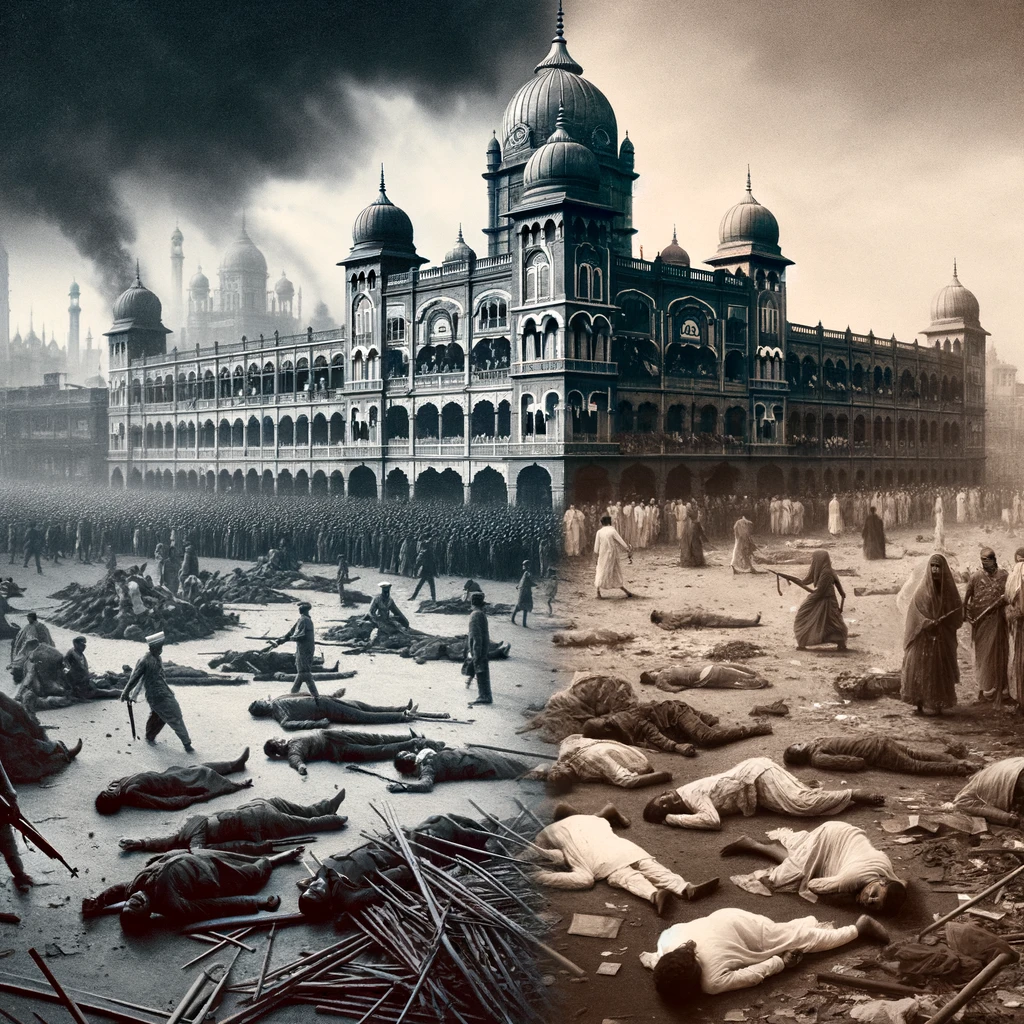
Pilgrimage roads. Shared rural thoroughfares had functioned across community lines because their use was governed by necessity, not doctrine. On 2 March 1927, in Kulkathi, Barisal district (then Bengal), a Shivaratri procession heading to the Ponabalia temple was blocked by a gathering at the local mosque. The district magistrate’s party opened fire. Nineteen dead — documented in the Indian Quarterly Register, 1927, Vol. 1, pp. 81–83, and Bengal Police records. The pilgrimage road had been a shared rural thoroughfare. Under the doctrinal reclassification of the territory, it had become contested ground.
Domestic neighbourhood. In Ruhitpur, 1930, two hundred Hindu households were looted by neighbours — people who had shared the same village for generations. The district administrative record classifies it as a communal disturbance. What the category does not record is the prior relationship: these were not strangers. The looting was not the beginning of a relationship. It was the end of one.
Geographic spread. Before 1919, communal violence was largely episodic and tied to large festival mobilisations or specific urban flashpoints. The Government of India’s report India in 1925–26 documents a qualitative shift: tension had penetrated the routine everyday fabric of small rural villages across the country — localities with no prior history of sustained communal conflict. Local grievance is local. This was national.
The Living Wound
The doctrine did not create strangers. It reclassified neighbours — people with prior relationships, prior commercial ties, prior shared civic life — as residents of the Abode of War, with the authority of hundreds of signed scholars and the organisational infrastructure of the largest mass movement in Indian political history. The hatred that was created in those years did not dissolve when the Khilafat movement collapsed in 1922, when the Ottoman Caliphate was abolished in 1924, when the Ali Brothers fell into irrelevance. It became the substrate of what followed. It is the sediment beneath Partition, beneath Direct Action Day, beneath every communal flashpoint the republic has administered as a law-and-order problem for a hundred and seven years. Gandhi’s Khilafat neighbourhood Impact is not a historical curiosity. It is the origin document of a wound that has not closed.

The Prosecution’s Position
Two questions stand before the reader.
- Does the documented baseline — civic rituals shared across generations, commercial trust institutionalised into guild structures, syncretic households undisturbed for a century — constitute an exhibit the reader places alongside the documented rupture: the music-before-mosque flashpoints, the segregated commercial zones, nineteen dead at Kulkathi, two hundred households looted at Ruhitpur, and the Government of India’s own record of violence spreading into villages with no prior history of conflict?
- Does the three-tier doctrinal hierarchy — Jihad where capacity exists, Tark-e-Mawalat where it does not, sabr as tactical patience — distributed through the same Congress apparatus Gandhi had built, constitute an exhibit the reader places alongside the key phrase: Gandhi’s Khilafat neighbourhood Impact — the hatred that was created?
The series does not answer. The next blog places before the reader what Gandhi knew about the apparatus as it was operating — in his own signed, dated words.
Invitation To Defence
The floor belongs to the defence. We now invite them to present their exhibits and challenge the narrative established by the prosecution.
Before 1919 the neighbourhood existed. After 1922 it did not — not in Chandni Chowk, not in Dhaka, not in Kulkathi, not in Ruhitpur. The Government of India’s own report recorded the fracture spreading into villages with no prior history of communal conflict. The three-tier hierarchy of the Dar-ul-Harb doctrine reached those villages through the apparatus Gandhi had placed at the centre of the national programme. Gandhi’s Khilafat neighbourhood Impact— the hatred that was created — places the cause before the reader. The reader will name what produced the effect.
1. Gandhi’s Khilafat Neighbourhood: The blog’s central key phrase, describing the transformation of neighbourhood relationships during the Khilafat mobilisation and examining how ideological and theological classifications affected established social, commercial, and civic ties.
2. Mutafiqa Fatwa: A collective religious ruling cited in the blog as the basis for classifying British India as Dar-ul-Harb and establishing a hierarchy of religious responses.
3. Dar-ul-Harb: A traditional Islamic jurisprudential term meaning “Abode of War,” used in the blog to describe the theological classification applied to British India.
4. Hijrat of 1920: The migration of Muslims from British India to Afghanistan, encouraged by the belief that India was no longer a suitable place for Muslims to live under non-Muslim rule. The blog cites the resulting hardship among tens of thousands of peasants.
5. Tark-e-Mawalat: A religiously framed principle of withdrawing cooperation and severing social, commercial, or other relationships, presented in the blog as one level of the doctrinal hierarchy.
6. Jihad: A term with several meanings in Islamic thought, including spiritual striving and armed struggle. In this blog, it refers to the armed-conflict option within the three-tier doctrinal framework being discussed.
7. Sabr: An Arabic term meaning patience or steadfastness. The blog describes it as tactical patience within the doctrinal hierarchy rather than peace as a governing principle.
8. Firangi Mahal Network: A network associated with the Islamic scholarly tradition of Firangi Mahal in Lucknow, described in the blog as helping circulate the relevant religious rulings through mosques and madrasas.
9. Non-Cooperation: The political movement led by Mahatma Gandhi that encouraged withdrawal from British institutions and cooperation with colonial authority. The blog examines its relationship with the Khilafat mobilisation.
10. Malkana Rajputs: Communities in the Agra–Mathura region described in the blog as maintaining Rajput lineage and customary practices alongside Islamic rites, illustrating historical religious and cultural synthesis.
11. Chaudhury: A locally recognised community or commercial authority who could mediate disputes and oversee trade-related matters. The blog cites Hindu merchants’ selection of a Muslim elder for this role in Chandni Chowk, Delhi.
12. Hundis: Traditional Indian financial instruments used for credit, remittance, and commercial transactions. They formed part of the indigenous trading relationships discussed in the blog.
13. Syncretic Household: A household in which customs or practices associated with different religious or cultural traditions coexist. The blog uses the concept when discussing Malkana Rajput families.
14. Shuddhi Movement: A movement associated with efforts to reconvert people to Hinduism, including campaigns directed at Malkana Rajput communities during the period discussed.
15. Tabligh Networks: Religious outreach networks involved in communicating Islamic teachings and encouraging religious observance. The blog refers to Muslim tabligh networks operating in the Agra–Mathura region.
#Gandhi #Khilafat #IndianHistory #HinduMuslim #CommunalViolence #NonCooperation #BritishIndia #Partition #HinduinfoPedia
Scan Through The Entire Series at