
Gandhi’s Himalayan Miscalculation: The Admission of Miscalculation — Continued for 26 Years (134)
भारत / GB
Part 134: Mahatma Gandhi’s Peace Efforts | Series Index
Blogs 130-133 placed the Chauri Chaura events, the unilateral suspension, the absence of any settlement, and the documented inner circle verdicts before the reader. This post places something different before the reader: what Gandhi wrote about himself in the weeks after the suspension — and what continued for twenty-six years after he wrote it.
Thank you for reading this post, don't forget to subscribe!The Action Taken: After calling his 1919 anti-Rowlatt campaign a “Himalayan blunder” for mobilizing an unprepared public, Gandhi deployed the exact same unredesigned mass mobilization method in 1920, producing the same result at Chauri Chaura.
Who Paid the Price: The millions of volunteers mobilized into physical confrontations without institutional safeguards or tactical defensive training.
The Alternative Bypassed: Redesigning movement architecture to incorporate disciplined organizational command before launching nationwide direct action.
Why This Matters: Proves structural negligence: the leadership admitted on record that summoning mass civil defiance without organizational discipline was an error, yet repeated the identical model twelve months later.
The First Himalayan Admission — April 1919
Gandhi’s Himalayan Admission places one documented fact before the reader at the outset: the phrase “Himalayan miscalculation” was not first used in February 1922. It was first documented in April 1919 — at Nadiad and Bombay — after the Rowlatt Satyagraha violence.
Gandhi launched the Rowlatt Satyagraha in March 1919. Violence broke out across Gujarat and Punjab. The Jallianwala Bagh massacre followed on April 13 1919. Gandhi suspended the Satyagraha on April 18 1919. At Nadiad — a public meeting in Kheda district, Gujarat — Gandhi placed the documented self-assessment on the written record for the first time. His own words, from An Autobiography: The Story of My Experiments with Truth, Part V, Chapter 33 — “A Himalayan Miscalculation”:
“It was here [Nadiad] that I first used the expression ‘Himalayan miscalculation’ which obtained such a wide currency afterwards… I had called on the people to launch upon civil disobedience before they had thus qualified themselves for it, and this mistake seemed to me of Himalayan magnitude.”
The primary source is Gandhi’s autobiography — his own documented account of the first use of the phrase, the location where it was first spoken, and the reason he applied it: he had called on the people to offer civil disobedience before they had shown spontaneous obedience to laws and qualified themselves for non-violent discipline.
The prosecution places this documented 1919 instance before the reader first — because what followed it is the Khilafat experiment of 1920. Gandhi documented in April 1919 that he had misjudged the masses’ readiness for non-violence. He then launched the largest mass movement in Indian history in 1920 on the same method and with the same population mass he had already documented as a Himalayan miscalculation. The February 1922 statements below are the second documented instance of the same self-assessment — for the same documented reason, three years later.
The Second Himalayan Admission — February 1922
Gandhi’s Himalayan Admission places three documented statements from Gandhi’s own Young India writings before the reader in sequence. All three were written within twelve days of the Bardoli suspension.
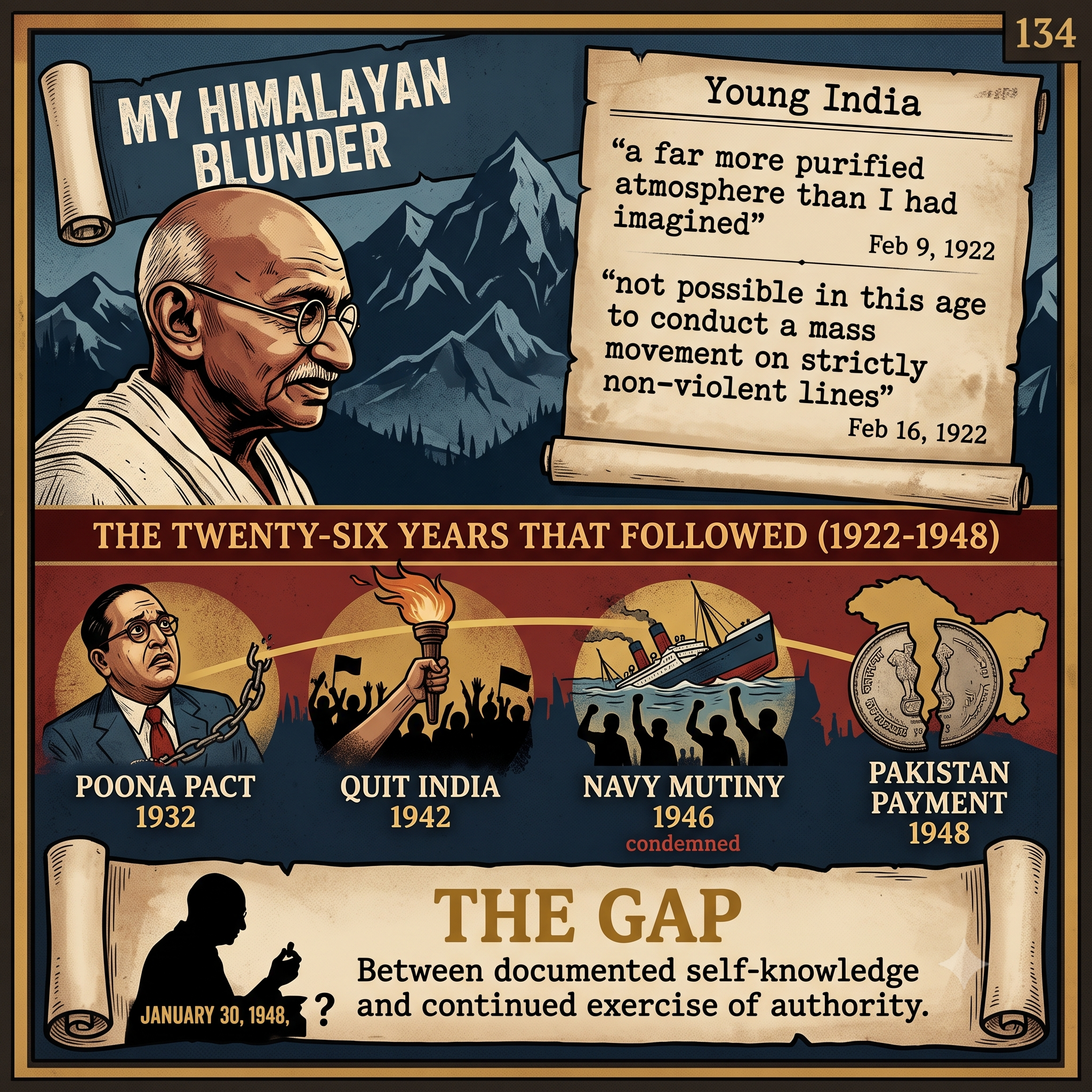
Young India, February 9 1922:
“A Satyagrahi must have a far more purified atmosphere to work in than I had imagined.”
Gandhi documented that the precondition for his method — the purified atmosphere a Satyagrahi requires — was not present. He had not imagined correctly what would be needed. The atmosphere that existed in India in February 1922 was not sufficient for the method he had deployed.
Young India, February 16 1922:
“I am more than ever convinced that it is not possible in this age to conduct a mass movement on strictly non-violent lines.”
Gandhi documented that mass non-violent movements were not achievable in his time. Not that the current attempt had failed — that the method itself was not possible in this age. The word “age” is precise: not this campaign, not this moment, but this historical period.
Young India, February 16 1922:
“I have made a Himalayan miscalculation.”
Gandhi’s own documented characterisation of his own judgement. Not a tactical misstep. Not an unfortunate outcome of a sound decision. A Himalayan miscalculation — the documented scale of the error placed in Gandhi’s own documented language.
What Three Statements Together Establish
Gandhi’s Himalayan Admission places the logical structure of the three statements before the reader. Each statement documents a specific self-assessment:
The first: the precondition for the method was not present. Gandhi had not correctly assessed what the method required.
The second: the method itself was not achievable in this historical age.
The third: the judgement that led to attempting the method anyway was Himalayan in its error.
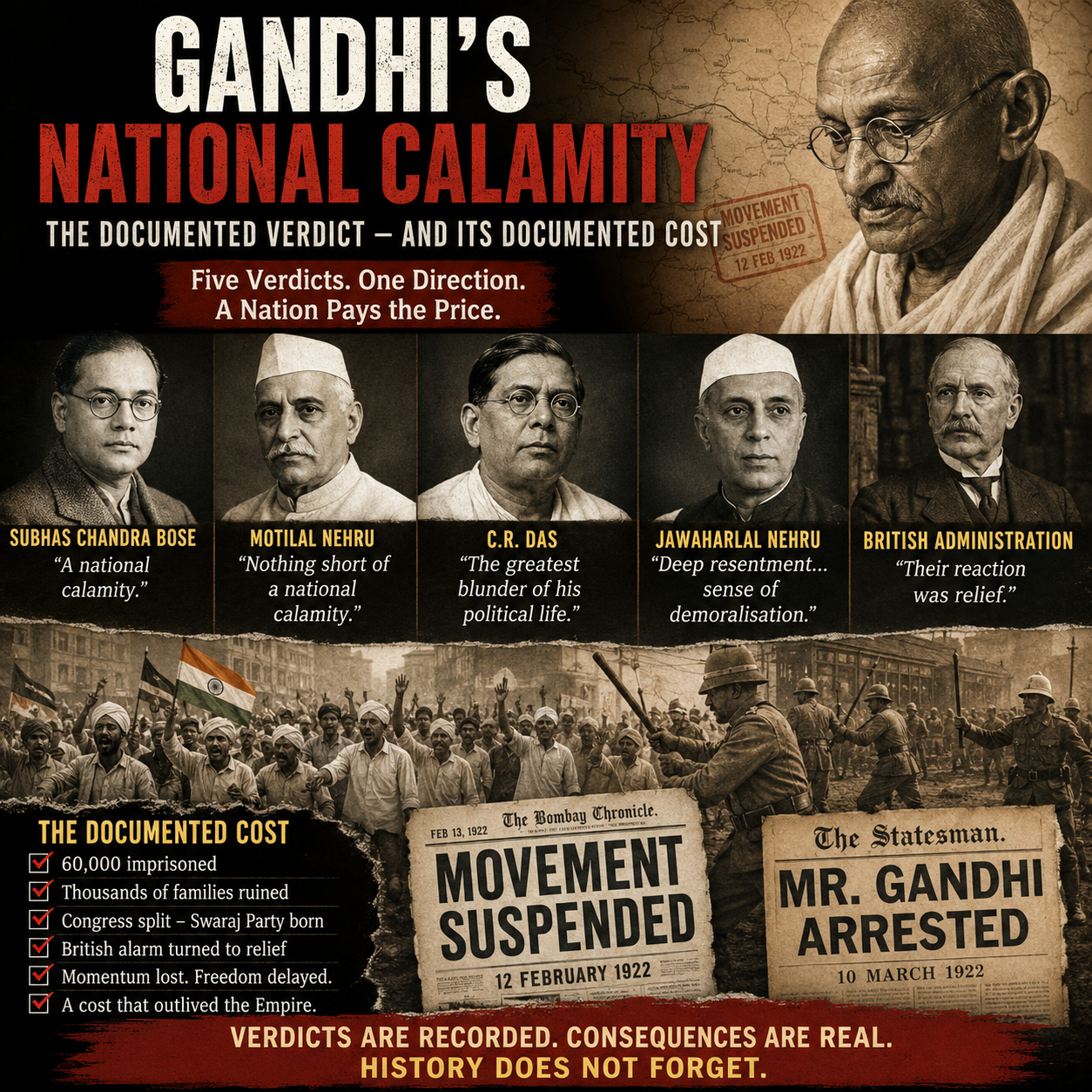
The prosecution places one observation before the reader: a leader who documents all three of these positions simultaneously has placed on the written record a self-assessment of unfitness for the unchallengeable unilateral authority he had been exercising over 300 million people. The precondition was wrong. The method was impossible. The judgement was Himalayan. These are not a critic’s characterisation. They are Gandhi’s own documented words.
What the Two Statements Establish — Read Together
Gandhi’s Himalayan Admission places the logical consequence of the two February 16 1922 statements before the reader precisely. The prosecution does not characterise — it derives.
Statement 1: “not possible in this age to conduct a mass movement on strictly non-violent lines.”
Statement 2: “I have made a Himalayan miscalculation.”
Read together, the two statements establish one documented logical consequence: if mass non-violent movements are not possible in this age, then the group Gandhi led on the path of Satyagraha did not meet the qualifications the method required. And if leading that group on that path was a Himalayan miscalculation, the miscalculation was documented by Gandhi himself as both the method’s unfitness for this age and his own misjudgement in attempting it.
This is not the prosecution’s characterisation. It is directly derived from the two recorded statements placed alongside each other — without inference beyond what the two sentences together establish.
What Continued for Twenty-Six Years
Gandhi’s Himalayan Admission places the documented continuation before the reader alongside the documented self-assessment.
Gandhi did not resign. Gandhi did not transfer authority to someone whose judgement he had not called Himalayan. Gandhi served two years of his six-year sentence on health grounds, was released in February 1924, and returned to public life — where the same method and the same unchallengeable personal authority over the independence movement continued.
1932 — Poona Pact fast: Gandhi fasted unto death to coerce Ambedkar into surrendering separate electorates the British had granted the Dalit community. The same method — personal fast as political coercion — deployed against a documented democratic mechanism. The same unilateral unchallengeable authority applied to a constitutional question affecting millions of Dalits who had not been consulted.
1942 — Quit India Movement: The same method of mass mobilisation launched. The same authority exercised without democratic mandate from those who would participate. The same pattern of arrests, same British relief at suppression, same question of whether the movement would have succeeded had it continued.
1946 — Royal Indian Navy Mutiny: Sailors who had come closest to delivering documented armed resistance were called an “unholy combination” by Gandhi. The same authority used to condemn the closest documented approach to armed indigenous liberation.
1948 — Pakistan payment fast: Gandhi fasted unto death to compel the Indian government to release Rs 55 crore to Pakistan during the documented Kashmir war. The same method of personal fast as political coercion applied to national military and financial policy. Patel’s documented decision was reversed.
Gandhi was not removed from leadership by any democratic mechanism of the movement he led. He was physically eliminated on January 30 1948 — twenty-six years after placing the three documented statements before the reader.
The Prosecution’s Observation
Gandhi’s Himalayan Admission places one precise observation before the reader. The series does not assert that Gandhi was unfit for leadership. It places Gandhi’s own documented self-assessment before the reader — and asks the reader to examine what it establishes about the authority he continued to exercise for twenty-six years after placing it on the written record.
A leader who documents that the precondition for his method does not exist, that the method is not achievable in this age, and that his own judgement was Himalayan in its error — and then continues to exercise unchallengeable unilateral authority over the same method for twenty-six more years — has placed on the written record a gap between documented self-knowledge and documented continued exercise of authority. The prosecution places that gap before the reader without characterisation.
The Prosecution’s Position
Gandhi’s Himalayan Admission places three questions before the reader.
- Did Gandhi’s own documented Young India writings of February 1922 establish a three-part self-assessment: the precondition for his method was not present (“far more purified atmosphere than I had imagined”), the method was not achievable in this age (“not possible in this age to conduct a mass movement on strictly non-violent lines”), and his own judgement was Himalayan in its error (“I have made a Himalayan miscalculation”)?
- Did Gandhi continue to exercise the same unchallengeable unilateral authority over the same method across four further documented instances — Poona Pact fast 1932, Quit India 1942, Navy Mutiny condemnation 1946, Pakistan payment fast 1948 — without any documented democratic mechanism removing him from the authority he had documented as having been exercised with Himalayan error?
- Does the gap between the documented self-assessment of February 1922 and the documented continuation of unchallengeable authority for twenty-six years — until Gandhi’s physical elimination on January 30 1948 — constitute an exhibit the reader places alongside Gandhi’s documented authority over the Indian independence movement?
The series does not answer. Gandhi’s Himalayan Admission places the three documented statements, their logical structure, and the twenty-six years that followed them before the reader. The reader will examine the gap between what Gandhi documented about his own judgement and what Gandhi’s continued authority produced — and complete the sentence.
Invitation To Defence
The floor belongs to the defense. We now invite them to present their exhibits and challenge the narrative established by the prosecution.
February 9 1922, Young India: “a far more purified atmosphere than I had imagined.” February 16 1922, Young India: “not possible in this age to conduct a mass movement on strictly non-violent lines.” February 16 1922, Young India: “I have made a Himalayan miscalculation.” Then: Poona Pact fast 1932. Quit India 1942. “Unholy combination” 1946. Pakistan payment fast 1948. January 30 1948. The prosecution places Gandhi’s own documented self-assessment of February 1922 alongside the twenty-six years that followed it. The reader will complete the sentence.
Feature Image: Click here to view the image.
Videos
Glossary of Terms
- Himalayan Miscalculation: Gandhi’s own expression describing what he considered an extremely serious error in judgment regarding the launch of mass civil disobedience before the public was prepared for disciplined non-violence.
- Rowlatt Satyagraha: Gandhi’s nationwide protest movement launched in 1919 against the Rowlatt Act, later suspended after widespread violence.
- Civil Disobedience: A method of peaceful resistance involving the deliberate violation of specific laws while accepting legal consequences.
- Nadiad Admission: Gandhi’s first recorded use of the phrase “Himalayan Miscalculation” at Nadiad in April 1919, later documented in his autobiography.
- Young India: Gandhi’s English-language weekly journal in which many of his political statements and reflections were published.
- Purified Atmosphere: Gandhi’s expression describing the moral and social conditions he believed were necessary before a disciplined Satyagraha could succeed.
- Mass Non-Violent Movement: A large-scale political movement based entirely on non-violence, which Gandhi stated in February 1922 was not achievable in that historical age.
- Bardoli Suspension: Gandhi’s decision in February 1922 to suspend the planned mass civil disobedience campaign following the Chauri Chaura incident.
- Unchallengeable Personal Authority: A key phrase in this series referring to Gandhi’s continued unilateral moral and political leadership over the independence movement without a documented democratic mechanism limiting that authority.
- Poona Pact Fast: Gandhi’s 1932 fast opposing separate electorates for the Depressed Classes, resulting in the Poona Pact with Dr. B.R. Ambedkar.
- Royal Indian Navy Mutiny: The 1946 naval uprising against British rule, described by Gandhi as an “unholy combination.”
- Pakistan Payment Fast: Gandhi’s January 1948 fast that contributed to the release of ₹55 crore to Pakistan during the Kashmir conflict.
- Documented Self-Assessment: A recurring term in this series referring to Gandhi’s own recorded evaluation of his decisions, rather than judgments made by critics.
- Gap Between Self-Knowledge and Authority: A key analytical phrase in this series describing the contrast between Gandhi’s documented acknowledgment of serious errors and his continued exercise of leadership afterward.
#Gandhi #History #India #Freedom #Satyagraha #YoungIndia #Khilafat #PoonaPact #QuitIndia #Politics #IndianHistory #HinduinfoPedia
Gandhi’s Peace Efforts: The Questions Before the Mahatma (0)
Refer to Various Arks Referred to in the Blog