
Gandhi’s Overlay: Acknowledges — Then Dilutes (124)
भारत / GB
Part 124: Mahatma Gandhi’s Peace Efforts | Series Index
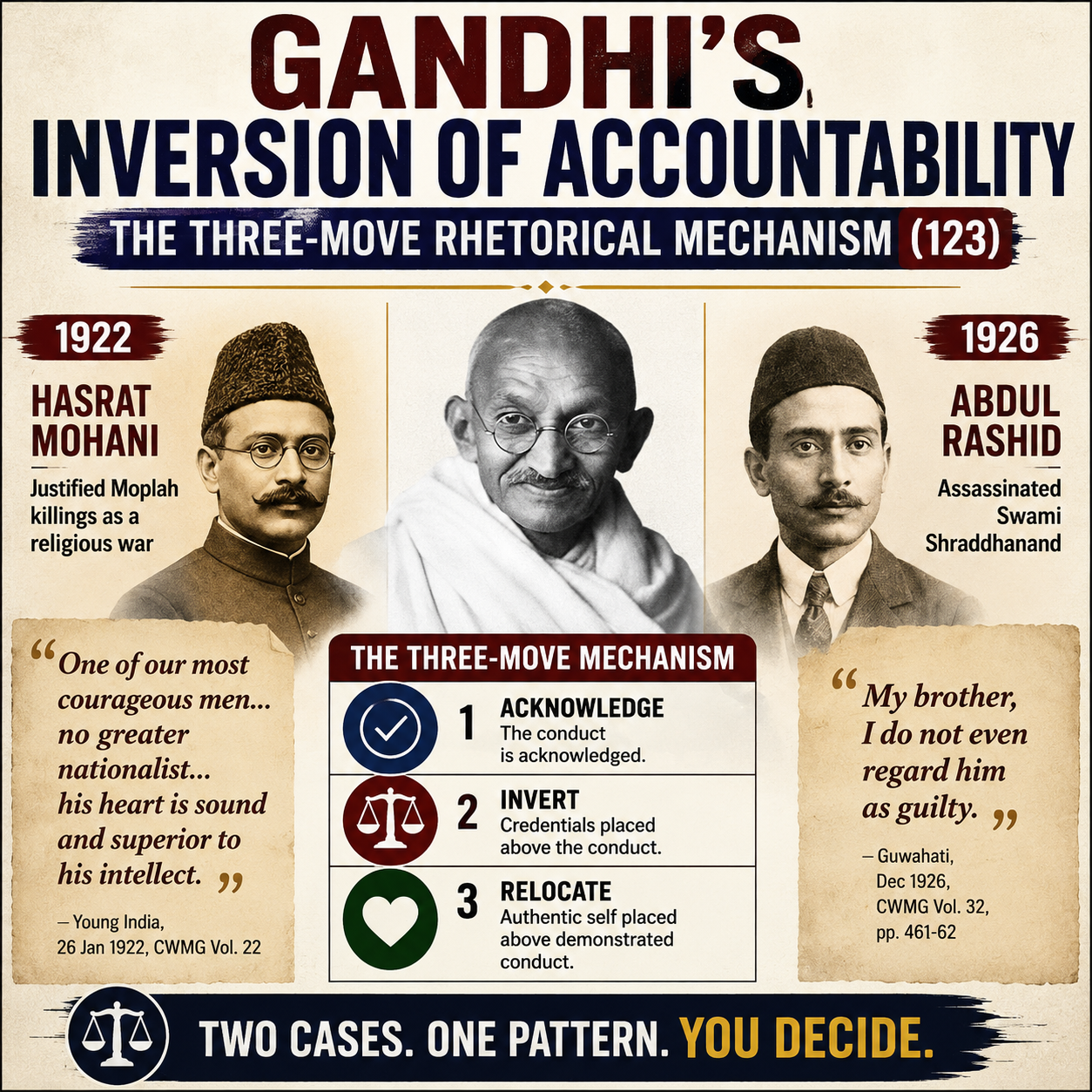
Blog 123 placed the three-move mechanism before the reader — acknowledge, invert, relocate — as applied to named individuals: Hasrat Mohani and Abdul Rashid. This post “Gandhi’s Overlay” places a companion linguistic exhibit before the reader: the same mechanism operating not on a named person but on a documented act — the Moplah rebellion of 1921 — within single sentences and paragraphs of Gandhi’s own writing.
Thank you for reading this post, don't forget to subscribe!The Action Taken: Following the desecration of ancient Hindu temples and attacks on civilian quarters in Gulbarga within the princely state of Hyderabad, Gandhi maintained complete public silence.
Who Paid the Price: The subjects of the Nizam’s territory, who were denied national advocacy because of Congress policy prohibiting interference in princely states.
The Alternative Bypassed: Condemning communal desecrations within princely states with the same ethical force applied to British territory.
Why This Matters: The selective application of public critique: communal atrocities within princely states were bypassed to preserve political relations with autocratic rulers like the Nizam
The Mechanism at the Level of the Act
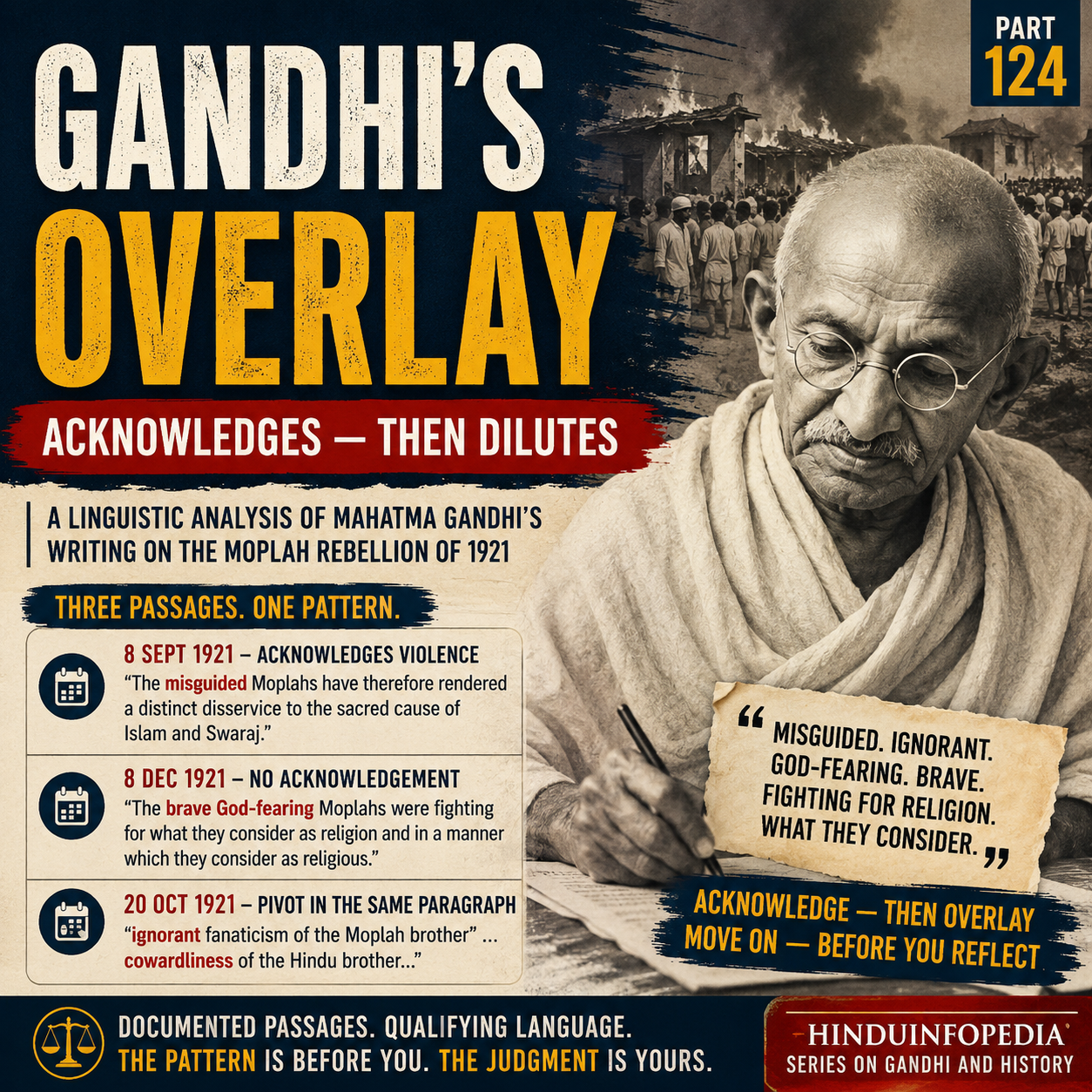
Gandhi’s Overlay places one precise observation before the reader at the outset. The three documented passages examined in this blog all follow the same linguistic structure: Gandhi names or acknowledges the Moplah violence, then immediately deploys qualifying language that repositions the act within a framework that seems to reduce its moral weight — before the reader has been given time to absorb the acknowledgement. The acknowledgement and the overlay arrive in the same sentence, or the sentence immediately following, so that the two cannot be separated.
The prosecution places the three documented passages before the reader and identifies the qualifying language in each.
First Passage — September 8 1921
Young India, September 8 1921, CWMG Vol. 24, p. 189:
“We must not betray any mental or secret approval of the Moplahs. We must see clearly, that it would be dishonourable for us to show any approval of the violence… The misguided Moplahs have therefore rendered a distinct disservice to the sacred cause of Islam and Swaraj.”
Gandhi’s Overlay places the linguistic structure before the reader:
The acknowledgement arrives first — violence, dishonourable to approve. This is real acknowledgement. Gandhi does not defend the violence here.
The overlay arrives immediately. The Moplahs are “misguided” — not wicked, not criminal, not brutal. Misguided locates the fault in their understanding, not in their character or their conduct. The disservice they have rendered is to Islam and Swaraj — the causes Gandhi cared about — not to the Hindu civilians who were killed, converted, and displaced. The Hindu victims of the rebellion are not named in this passage. The consequences of the violence that concern Gandhi are consequences to the movement’s causes, not to the movement’s victims.
The acknowledgement — violence, dishonourable — is absorbed and replaced by the overlay before the sentence ends.
Second Passage — December 8 1921
Young India, December 8 1921, CWMG Vol. 22, Gandhi’s article “Honesty in Arguments”:
The framing—“the brave God-fearing Moplahs were fighting for what they consider as religion and in a manner which they consider as religious”—originates with Hasrat Mohani, the same Mohani Gandhi called “most courageous” and “sound of heart” five weeks later (as established in Blog 123). Gandhi published this framing in Young India and defended Mohani’s right to hold it, adding his own rationalisation that the colonial government bore sole responsibility for the conditions that produced the violence.
Gandhi’s Overlay places the linguistic consequence before the reader: whether the framing uses Mohani’s words or Gandhi’s own formulation, the Young India platform carried it to the movement’s readership without challenge. The overlay—brave, God-fearing, fighting for religion, what they consider—reached the reader backed by the journal’s editorial authority.
“What they consider as religion” places the documented killings and forced conversions inside the actors’ belief system—the conduct itself is not named, not described, and not acknowledged. “Fighting for religion” is the alternative frame provided for conduct whose documented content is completely withheld from the reader in this passage.
The qualifying words: brave, God-fearing, fighting for religion, what they consider. Each qualifier operates to locate the actors inside a framework of religious sincerity. The documented acts—the killings, forced conversions, and temple desecrations established across Blogs 54–68 (Group 7, Moplah Unrest. Moplah Conclusions) —are absent. The overlay has no acknowledgement to replace because the acknowledgement was never permitted to appear.
Third Passage — October 20 1921
Young India, October 20 1921, CWMG Vol. 21, p. 317. The same paragraph exhibit placed before the reader in Blog 119 of this series — now placed before the reader for its linguistic structure:
“ignorant fanaticism of the Moplah brother” — immediately followed in the same paragraph by — “cowardliness of the Hindu brother who helplessly muttered the Islamic formula or allowed his tuft of hairs to be cut or his vest to be changed.”
Gandhi’s Overlay places the pivot of this paragraph before the reader. The perpetrators’ conduct is named — fanaticism — and immediately qualified — ignorant. Ignorant fanaticism locates the fault in knowledge, not in character or will. Then, without pause, the paragraph pivots to the victims. The reader moves from the perpetrators’ ignorant fanaticism to the victims’ cowardliness — without a sentence, without a pause, without a resting point for the documented acts that connect the two.
The paragraph’s structure does not allow the acknowledgement of fanaticism to stand on its own. It is qualified (ignorant) and then immediately followed by the victims’ characterisation (cowardly), so that the reader’s attention moves to the victims before the fanaticism has been fully processed.
What the Three Passages Establish Together
Gandhi’s Overlay places one observation across all three passages before the reader. The qualifying vocabulary Gandhi deployed across the Moplah period — misguided, ignorant, God-fearing, brave, fighting for what they consider as religion — constitutes a consistent set of overlays applied to the documented acts of the Moplah rebellion. Each qualifier places the documented conduct inside a framework (religious sincerity, ignorance, misguided belief) that reduces its moral weight before the acknowledgement can stand alone.
The prosecution places this alongside the October 20 1921 passage already examined in Blog 119: in the same paragraph, the perpetrators’ conduct is qualified (ignorant fanaticism) while the victims’ conduct is placed without qualification (cowardliness). The overlay is applied to the perpetrators; the unqualified characterisation falls on the victims.
The Prosecution’s Position
Gandhi’s Overlay places three questions before the reader.
- Did Gandhi’s September 8 1921 Young India passage (CWMG Vol. 24, p. 189) acknowledge the Moplah violence and then immediately overlay it with “misguided” and “disservice to Islam and Swaraj” — locating the act’s consequences in the movement’s causes rather than in the Hindu victims — before the acknowledgement had been allowed to stand on its own?
- Did Gandhi’s December 8 1921 Young India passage (CWMG Vol. 22) deploy the overlay without any prior acknowledgement — “brave God-fearing Moplahs fighting for what they consider as religion” — placing the documented killings and forced conversions inside a framework of religious sincerity without naming the documented acts at all?
- Did Gandhi’s October 20 1921 Young India passage (CWMG Vol. 21, p. 317) qualify the perpetrators’ fanaticism as ignorant and then pivot immediately to the victims’ cowardliness — so that the reader moves from a qualified acknowledgement of the perpetrators’ conduct to an unqualified characterisation of the victims’ conduct within the same paragraph?
The series does not answer. Gandhi’s Overlay places the three passages, their qualifying vocabulary, and their linguistic structure before the reader. The reader will examine whether the consistent deployment of overlay language across Gandhi’s Moplah writing constitutes a pattern — and complete the sentence.
Invitation To Defence
The floor belongs to the defense. We now invite them to present their exhibits and challenge the narrative established by the prosecution.
September 8 1921: acknowledge violence — then immediately: “misguided Moplahs… disservice to Islam and Swaraj.” December 8 1921: no acknowledgement — straight to: “brave God-fearing Moplahs fighting for what they consider as religion.” October 20 1921: “ignorant fanaticism of the Moplah brother” — same paragraph, immediate pivot: “cowardliness of the Hindu brother.” Misguided. Ignorant. God-fearing. Brave. Fighting for religion. What they consider. The prosecution places the qualifying vocabulary across three passages before the reader. The reader will complete the sentence.
Feature Image: Click here to view the image.
Videos
Glossary of Terms
- Gandhi’s Overlay: A term coined in this series describing a recurring linguistic pattern in Gandhi’s writings where an acknowledgement is immediately followed by qualifying language that appears to reduce the moral weight of the documented act.
- Overlay: Qualifying language placed immediately after an acknowledgement, shifting the reader’s attention toward mitigating context before the acknowledgement stands independently.
- Acknowledgement: An explicit recognition of a documented act before any explanation, qualification, or reinterpretation is introduced.
- Qualifying Vocabulary: Descriptive words or phrases such as misguided, ignorant, God-fearing, and brave that frame the actors or actions in a particular interpretive context.
- Moplah Rebellion: The 1921 uprising in the Malabar region of British India that involved documented violence, forced conversions, killings, displacement, and destruction of property.
- Linguistic Structure: The arrangement of words and sentences through which meaning, emphasis, and interpretation are conveyed in a document.
- Religious Sincerity Framework: A narrative frame that interprets actions primarily through the actors’ claimed religious beliefs rather than through the documented consequences of those actions.
- Young India: The weekly journal edited by Mahatma Gandhi in which many of his political and social writings were published.
- CWMG (Collected Works of Mahatma Gandhi): The official multi-volume compilation of Gandhi’s speeches, letters, articles, and public statements, widely cited for historical reference.
- Hasrat Mohani: An Indian nationalist, poet, and political leader whose published views on the Moplah rebellion are examined alongside Gandhi’s editorial treatment in this series.
- Editorial Authority: The influence exercised by a publication when it presents or reproduces particular viewpoints without criticism or qualification.
- Ignorant Fanaticism: Gandhi’s expression describing the conduct of the Moplah perpetrators while simultaneously qualifying fanaticism through ignorance.
- Three-Move Mechanism: A recurring analytical framework developed in this series consisting of Acknowledge – Invert – Relocate, used to examine patterns in Gandhi’s rhetoric.
- Inversion of Accountability: A term coined in this series describing a rhetorical pattern in which responsibility or moral emphasis shifts away from the documented perpetrators toward alternative subjects or contexts.
- Prosecution Exhibit: A documented quotation or historical record presented sequentially in this series as evidence supporting the analytical case under examination.
#Gandhi #Moplah #Khilafat #History #India #Congress #Freedom #Malabar #Politics #Analysis #HinduinfoPedia
Gandhi’s Peace Efforts: The Questions Before the Mahatma (0)
Refer to Various Arks Referred to in the Blog