
Gandhi’s Admission: “It Unified and Awakened the Mussalmans” — Gandhi’s Experiment Produced (113)
भारत / GB
Part 113: Mahatma Gandhi’s Peace Efforts | Series Index
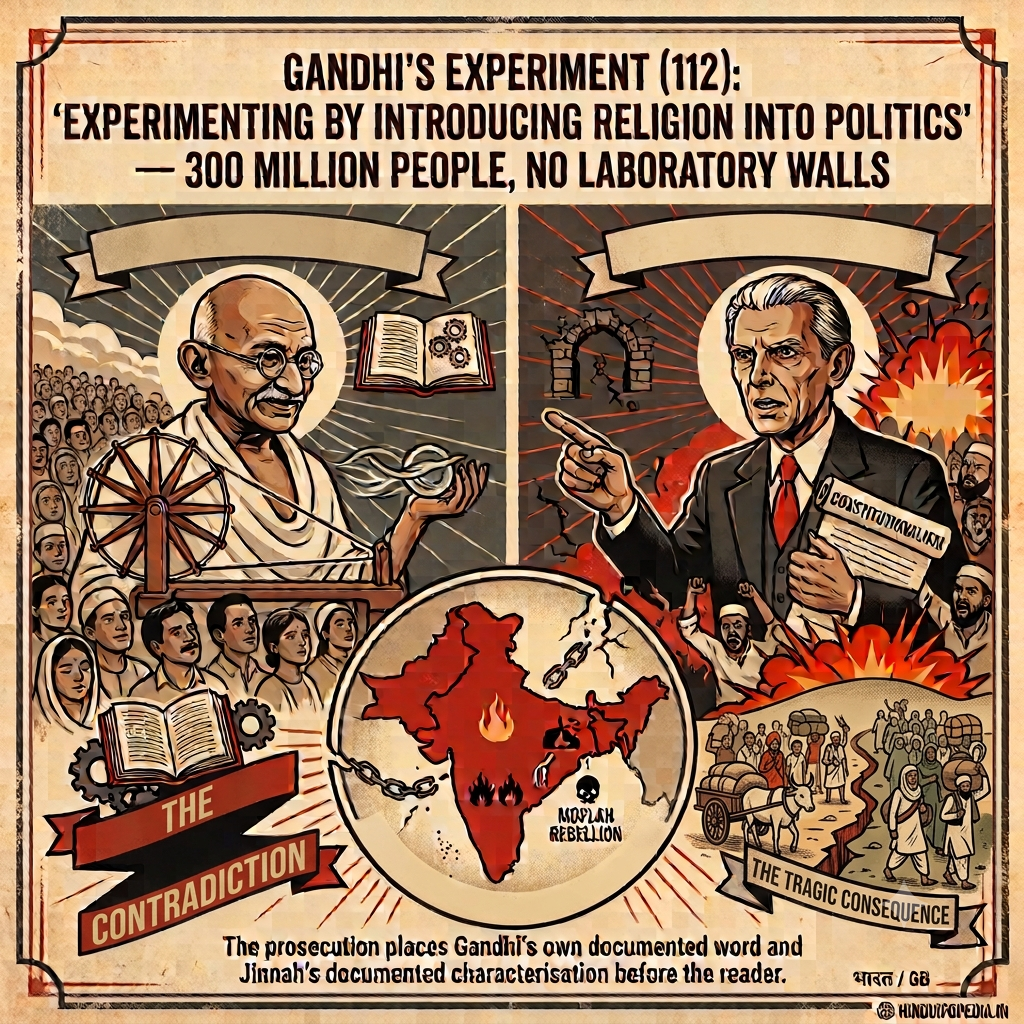
Blog 112 placed Gandhi’s own documented word for his method — “experimenting by introducing religion into politics” — and what Jinnah called the same action. This post on Gandhi’s Admission places Gandhi’s own documented assessment of what that experiment produced, from the same May 29, 1924 Young India article that has already given the series its most verified primary source material.
Thank you for reading this post, don't forget to subscribe!THE HISTORICAL RECORD — THE ALLIANCE RECORD (Pillar 1 of 7)
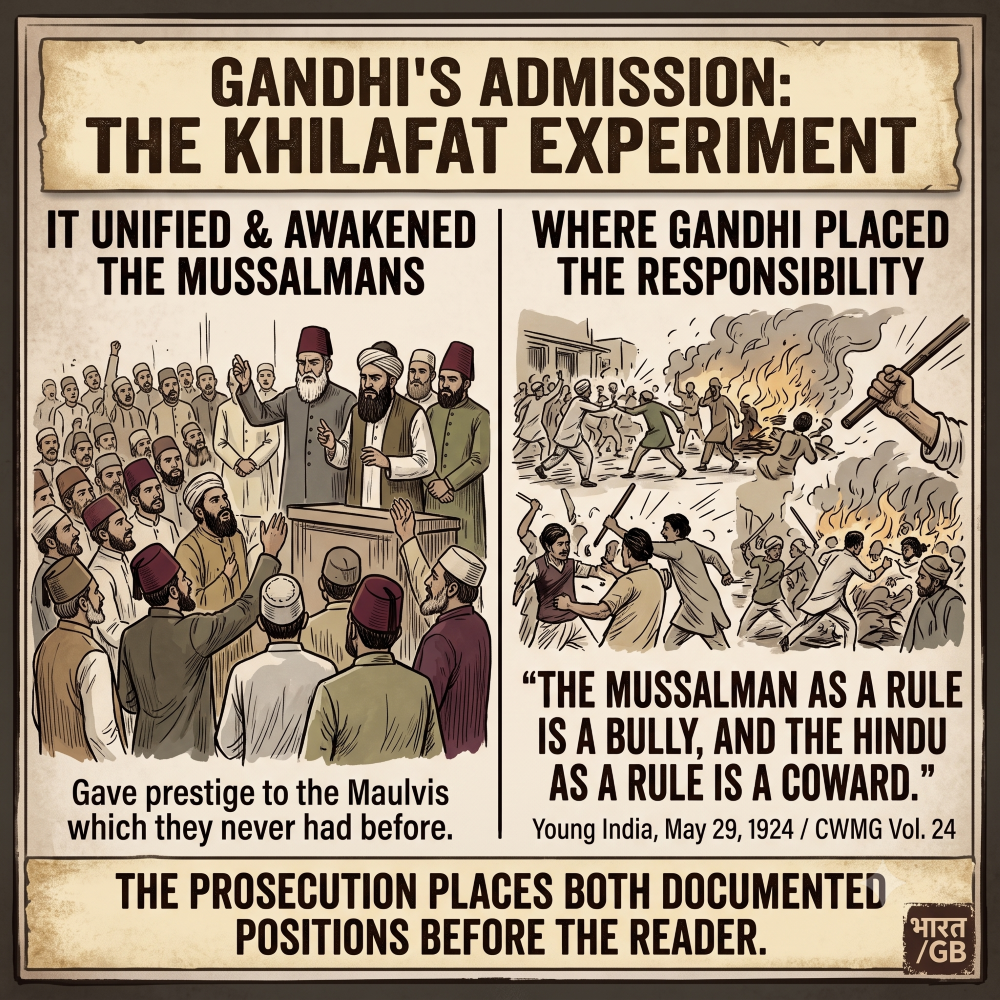
The Action Taken: In an analytical retrospective on the movement, Gandhi wrote: “The Khilafat movement awakened and unified the Mussalmans. It gave prestige to the Maulvis which they never had before.”
Who Paid the Price: Secular democratic development in India, which faced a reinvigorated, consolidated clerical class holding political veto power.
The Alternative Bypassed: Mobilizing the Indian Muslim community around secular economic, agrarian, and educational advancement.
Why This Matters: A formal primary confession of causation: the leadership admitted on record that its policy had institutionalized clerical supremacy in minority politics.
Gandhi’s Admission — His Own Documented Words
Young India, May 29, 1924, CWMG Vol. 24, p. 136. Gandhi’s own documented words, placed before the reader without paraphrase:
“It unified and awakened the Mussalmans. It gave prestige to the Maulvis which they never had before.”
Gandhi’s Admission places one observation alongside these documented words: this is not the series’ characterisation of what the Khilafat experiment produced. It is Gandhi’s own documented assessment, written in his own journal, four years after the experiment commenced, after the Moplah rebellion, after the communal riots, after the movement’s collapse.
The ‘it’ in Gandhi’s documented sentence refers to the Khilafat alliance — the cause Gandhi had documented in May 1920 as his experiment in introducing religion into politics, and the cause the series has established across Blogs 107–108 was adopted not for Swaraj but for Khilafat, with Swaraj added as a secondary object to induce Hindus to join. The documented outcome Gandhi himself identified in 1924: unification and awakening — achieved at the documented cost of the Swaraj he had said he would postpone for it — and the elevation of religious clerical authority among the Muslim population of India which they never had before.
What “Unified and Awakened” Produced — The Documented Record
Gandhi’s Admission places the documented record of what a unified and awakened Muslim political force produced before the reader across three documented arcs already established in this series.
The riot frequency data, documented by historian S. Gopal and carried in this series: 16 communal riots in the 22 years before the Khilafat alliance, 72 communal riots in the 3 years that followed. The awakening Gandhi documented in 1924 is placed alongside that arithmetic. The reader examines what the unification produced — in numbers already on the record.
The Jinnah arc, documented across Blogs 81-98 (The Jinnah Arc, Split Between Congress and Muslim League, Closing Arc): Jinnah’s documented constitutional offers (Fourteen Points, the four Calcutta amendments), the documented rejections, the documented 1937-1939 Congress ministry period, the Lahore Resolution of March 1940, Gandhi’s own documented March 20 1940 self-assessment — “it is my misfortune that no Muslim’s confidence remains with me today.” The unified and awakened Muslim political force Gandhi documented in 1924 is placed against the documented constitutional arc that force produced between 1924 and 1940.
The Maulvis whose prestige Gandhi documented as elevated: the documented Khilafat leadership — the Ali brothers, Hasrat Mohani, the Deobandi clergy — whose documented positions included justifying the Moplah violence as religious action. Gandhi himself defended Hasrat Mohani in January 1922 as “one of our most courageous men” despite Mohani’s documented public justification of the Moplah killings.
The prosecution places one further documented observation before the reader: the prestige Gandhi identified as elevated belonged to the clerical voice in Muslim political life — not the constitutionalist voice. Jinnah, documented across Blogs 81-98 (The Jinnah Arc, Split Between Congress and Muslim League, Closing Arc) as the constitutionalist Muslim political leadership, had walked out of the Khilafat alliance at Nagpur 1920. The Maulvis walked in. Gandhi’s documented admission that he gave prestige to the Maulvis which they never had before is placed alongside the documented Jinnah arc: as clerical authority rose, constitutional Muslim political leadership was systematically marginalised — until Jinnah himself was forced to adopt the clerical framework’s communal logic to remain relevant to his own constituency. The shift from Jinnah to the Maulvis is the shift Gandhi’s own documented words acknowledge he produced.
Where Gandhi Placed the Responsibility
Gandhi’s Admission exposes a second, deeper layer of the experiment’s logic. In the exact same Young India essay, Gandhi turned his lens toward the root cause of the escalating communal violence — assigning responsibility not to the political mobilisation itself, not to the leadership who drove it, but to the psychology of the victims.
CWMG Vol. 24, p. 137, verified: “There is no doubt in my mind that in the majority of riots Hindus come out second best. My own experience but confirms the opinion that the Mussalman as a rule is a bully, and the Hindu as a rule is a coward.”
According to this framework, the problem requiring a cure was not the structural elevation of religious clerical authority — which Gandhi had just documented in the same article — but the perceived weakness of Hindu character in the face of it.
The prosecution places these two documented positions side by side: an admission that the experiment systematically empowered a religious political bloc, alongside a simultaneous assignment of blame to those who bore the brunt of its friction. The political choice belongs to the experimenter. The accountability is shifted to the environment. Both positions are from the same documented article, the same documented date, the same documented hand.
The Prosecution’s Position
Gandhi’s Admission places three questions before the reader.
- Did Gandhi’s own documented words of May 29, 1924 — “it unified and awakened the Mussalmans, it gave prestige to the Maulvis which they never had before” — place on primary source record his own assessment of what the Khilafat experiment produced, in the same article and from the same CWMG volume already established as the series’ most verified primary source for this period?
- Does the documented record already placed before the reader across this series — riot frequency data, the Jinnah arc, the documented Maulvi positions on Moplah violence — constitute the documented consequences of what Gandhi identified as unification and awakening?
- Did Gandhi, in the same documented article, place responsibility for the consequences of that documented unification and awakening onto Hindu cowardice and Hindu character — rather than onto the decision that produced the unified and awakened force?
The series does not answer. Gandhi’s Admission places Gandhi’s own documented words — both the admission of what the experiment produced and the documented assignment of responsibility for its consequences — before the reader from a single primary source: Young India May 29, 1924, CWMG Vol. 24. The reader will examine what Gandhi admitted producing, what Gandhi documented as responsible for the consequences, and what the series has already placed before them as the documented record of both. The reader will examine both documented positions and complete the sentence.
Invitation To Defence
The floor belongs to the defense. We now invite them to present their exhibits and challenge the narrative established by the prosecution.
May 29, 1924, Young India, CWMG Vol. 24, p. 136. Gandhi’s own documented words: “It unified and awakened the Mussalmans. It gave prestige to the Maulvis which they never had before.” The same article: “The Mussalman as a rule is a bully, and the Hindu as a rule is a coward.” The experiment’s documented outcome named by the experimenter. The responsibility for that outcome placed by the experimenter on those who experienced it. The prosecution places both documented positions before the reader. The reader will complete the sentence.
Feature Image: Click here to view the image.
Videos
Glossary of Terms
- Young India: Weekly journal edited by Mahatma Gandhi in which many of his political views and public statements were published.
- CWMG (Collected Works of Mahatma Gandhi): The official multi-volume compilation of Gandhi’s writings, speeches, letters, and published articles used as a primary historical source.
- Khilafat Movement: A political-religious movement launched after the First World War to preserve the Ottoman Caliphate, later supported by Gandhi during the Non-Cooperation Movement.
- Khilafat Alliance: The political partnership between Gandhi, the Indian National Congress, and Khilafat leaders during the early nineteen twenties.
- Maulvis: Islamic religious scholars and clerics who exercised religious influence within Muslim society and politics.
- Moplah Rebellion: The violent uprising in Malabar during nineteen twenty-one involving sections of the Moplah Muslim community, widely debated in Indian history.
- Jinnah Arc: A documentary sequence in this series tracing Muhammad Ali Jinnah’s constitutional politics from nineteen twenty through the Lahore Resolution.
- Congress Ministry Period: The period from nineteen thirty-seven to nineteen thirty-nine when Congress ministries governed several British Indian provinces under the Government of India Act, nineteen thirty-five.
- Lahore Resolution: Resolution adopted by the Muslim League in March nineteen forty that proposed separate Muslim-majority states, later associated with the demand for Pakistan.
- Constitutionalist Leadership: Political leadership that pursued constitutional negotiations, legal reforms, and representative governance instead of religious mobilisation.
- Communal Politics: Political mobilisation based primarily on religious identity rather than common civic or constitutional principles.
- Primary Source: An original historical document created during the period under study and used as direct evidence.
- Gandhi’s Admission: The key phrase of this blog referring to Gandhi’s own documented assessment that the Khilafat movement unified Muslims and increased the influence of Maulvis.
- Experiment: The term Gandhi himself used to describe introducing religion into politics, forming the central theme of this series.
- Documented Record: The collection of verified historical writings, speeches, official publications, and archival evidence examined throughout this series.
#Gandhi #Khilafat #Jinnah #History #India #Congress #Politics #Partition #Moplah #YoungIndia #CWMG #HinduinfoPedia
Gandhi’s Peace Efforts: The Questions Before the Mahatma (0)